This year’s FE Week April Fool was just believable enough for some, especially as Mark Dawe, chief executive of the Association of Employment and Learning Providers, got in on the act. Check it out below if you missed it first time round….
In an effort to monitor the controversial minimum off-the-job training requirement, providers will be required to supply apprentices with welcome cards and a reader with a 20 per cent button.
Instead of clocking into work, apprentices will be expected to insert their card, sent with the ministerial welcome letter, and hit the red ‘training’ button when they clock-off work.
FE Week understands that all the off-the-job training time figures will be made available to view via a live dashboard, at both the Department for Education and Ofsted.
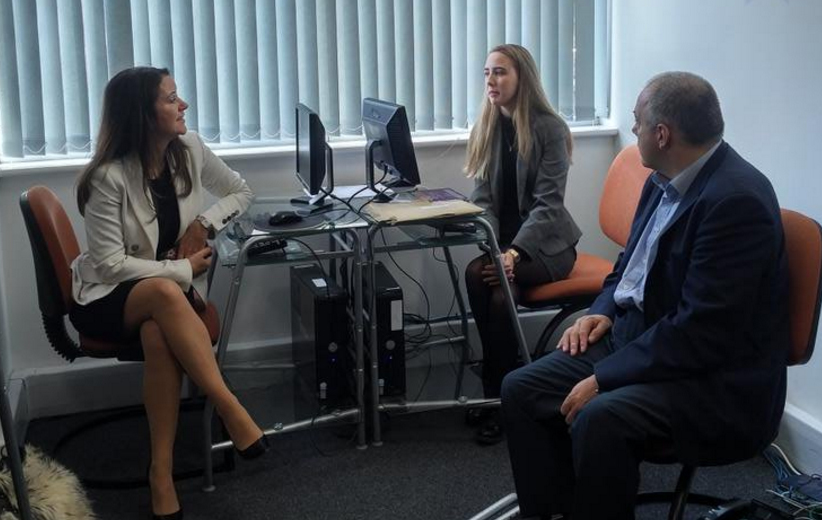
Mark Dawe, chief executive of the Association of Employment and Learning Providers, has tried the technology (pictured) and was impressed.
“Providers have been criticised in the past for a tick-box approach to training, so replacing a box with a button makes a lot of sense” he told FE Week.
The Skills Funding Agency funding rules state that every apprentice must “spend at least 20 per cent of their time on off-the-job training”, so the data will also be used to identify noncompliance.
FE Week understands the card and reader will cost around £8 per apprentice, which the SFA will charge the provider along with the cost of the certificates.
And the new Institute for Apprenticeships, which launches today, will run award ceremonies around the country to celebrate those apprentices and employers with the highest training time percentage.
A final design for the apprentice welcome card, which it is understood will feature a picture of a ladder, was due to be unveiled on 14 March. However, a Department for Education spokesperson would only confirm that the big reveal will be “in due course”.
Skills Minister Robert Halfon meets the two Ofsted inspectors that will work in shifts to monitor the live training time
Acting Ofsted spokesperson, Flora Pilo, told FE Week: “We welcome any attempt to measure the number of hours apprentices spend receiving vital off-the-job training.
“As an organisation, we firmly support calculators and are currently exploring methods of building calculators into our hybrid robo-inspectors.”
Around 70 of the country’s top skilled young people are this week taking part in a five-day competition that will decide if they make it into the team representing the UK at WorldSkills Abu Dhabi.
The squad of apprentices and learners travelled to Manchester for WorldSkills UK’s team selection event, where competitors in 32 different skills are vying for a final place at the global competition, dubbed the ‘Olympics of skills’.
Being held across five venues– Stockport College, The Manchester College, Trafford College, Coleg Cambria, and Training 2000 – experts in each of the disciplines will decide which one of their competitors will fly to Abu Dhabi and compete against competitors from over 50 nations.
The hopefuls are completing four days’ worth of tasks which simulate those they’ll face in Abu Dhabi. On day five they’ll learn whether they’ve made it in to Team UK.
Landscape gardeners, for example, are working to the same brief that was used at WorldSkills Sao Paulo – where former competitor Matthew Beesley won silver.
For the host providers, the team selection event gives them the chance to promote their apprenticeships delivery while giving their students an insight into the high skill levels they can reach.
Lesley Davies, Trafford College principal, a host college for the selection event, urged the government to “continue to invest” in the “unmeasurable advantages” that being part of WorldSkills UK brings, amid funding pressures for the organisation.
She said: “The students who are the competitors see their aspirations rise up and begin to believe that they can develop these high level skills by being part of these competitions.
Lesley Davies
“It is also great for our other students to see. They think ‘well if they can do it then I can do it to’, so the competitors become role models for our other learners.
“Our staff also benefit. We’ve got great chefs, for example, but when they see world class chefs participating and judging here, they like to shadow them and learn from them themselves.”
She added: “There’s no doubt that with Brexit I am sure WorldSkills UK is facing financial questions about where the funding is coming from and I would urge government to see this as part of apprenticeship development and continue to invest.”
And for any principals who have not yet signed up to the competition Ms Davies urged them to get involved.
“The advantages of these competitions are so good and I encourage every principal to get involved as soon as possible.
“For us it genuinely ups our students aspirations, self worth, resilience and confidence. The benefits far outweigh any disadvantages on the difficulty in logistic you might face.”
Mike Potter, the interim principal at Stockport College, also spoke to FE Week about hosting the team selection event. He said: “As part of our apprenticeship provision we believe the key to inspiring our apprentices is by getting them involved in the work they believe in, engaging them first-hand in the opportunities that an apprenticeship can lead to.”
This week’s event follows an assessment weekend in Loughborough last month where experts, team leaders and the bosses of WorldSkills UK headed to carefully consider who in each skill is worthy of a place in Team UK.
Competitors are feeling the pressure but are all determined and focused on making it to Abu Dhabi.
Ethan Davies, aged 21, who competes in CNC Milling, said: “It would be awesome to make it to the WorldSkills. I’ve spent the past three weeks before this week training solidly, I haven’t been home much and I have just been training, but it would be absolutely amazing and I would love it.”
Team UK for WorldSkills Abu Dhabi will be announced on April 21.
The 44th WorldSkills will be held in the Adnec (Abu Dhabi National Exhibition Centre) — a venue that has hosted both the Emirates skills competition and the Gulf Cooperation Council regional skills competition.
The event will take place from October 14 to 19.
FE Week are proud to be the official media partner for WorldSkills UK and Team UK. FE Week will bring you all the latest developments in the lead up to WorldSkills 2017 and will be onsite in Abu Dhabi to bring rolling coverage of Team UK’s progress.
Main pic: Hugo Johnson competing in jewellery making
The first inadequate-overall Ofsted rating has been handed out to a loans-only provider, which complained it had been unaware it was subject to inspection, causing its Skills Funding Agency contract to be pulled.
The Beauty Academy was handed the lowest possible rating overall and in three headline fields in a report published today (March 30), based on an inspection carried out at the end of February.
The verdict has led to the Skills Funding Agency pulling the Cambridge-based provider’s funding – which totalled almost £1.6 million for advanced learner loans in 2016/17.
But a spokesperson for the provider told FE Week it will “see through” all 262 learners affected until the end of their studies.
The report noted that The Beauty Academy’s directors had “only very recently become aware of some of the significant improvements that are needed to improve the quality of the provision”.
But it said: “They have insufficient understanding of the requirements of delivering government-funded learning provision.”
Terry Hadley, one of the provider’s two directors, accepted the findings of the report.
But he hit out at both the SFA and Ofsted, saying he had not been told of a key rule change which meant he would be subject to inspection.
He said this rule had been introduced in September “because there was a lot of abuse of the advanced learner loans facility” and meant that loans-only providers came under Ofsted’s remit “when for three years they hadn’t been”.
A summary of changes to the FE and skills handbook, published by Ofsted in August, included “clarification that the scope of Ofsted inspection includes loans-only funded providers”.
Mr Hadley said he was “very, very unhappy” that neither the SFA nor Ofsted had told him of the rule change, and that he only found out in January when he was invited to an Ofsted webinar for new providers.
“We know there’s a big difference between what Ofsted expects and what the awarding bodies expect,” he said.
“So we started to bridge that gap but within four weeks we get an inspection,” he said.
Inspectors for the education watchdog found that leaders at The Beauty Academy were “too slow to implement effective quality improvement arrangements”.
As a result outcomes for learners were “inadequate”.
“Too few learners” made “sufficient progress”, “achieve their qualifications” or “progress into further training or employment”, the report noted.
“Too many” learners on flexible ‘long’ courses – which made up the “large majority” of the provider’s learners – “drop out of learning”, inspectors found.
In 2015/16 just “a quarter of learners achieved their qualifications and only one tenth did so in the expected timescales”, the report said.
But it did note that “learners on recently introduced ‘short’ courses make good progress and most achieve their qualification”.
Safeguarding at the provider was “ineffective and weak”, and “leaders have not fulfilled their obligations under the ‘Prevent’ duty”.
Mr Hadley confirmed that the SFA had pulled The Beauty Academy’s contract, and the provider had been taken off the Register of Training Organisations.
Loan funding accounted for about 50 per cent of their learners, Mr Hadley said, and the provider would be able to continue without it.
“The existing learners will finish their studies in July, and we’ll see all of them through,” he said.
The SFA was unable to comment ahead of publication, but an Ofsted spokesperson told FE Week: “In September 2016 we published our Further Education and Skills handbook, which made clear that loans-only funded providers would be subject to Ofsted inspection.
“As part of our stakeholder engagement programme, in January this year we wrote to the Beauty Academy’s CEO, inviting him to an official webinar to clarify what to expect from an Ofsted inspection.”
The country’s biggest skills and careers event is back and is confirmed to take place from November 16 to 18 later this year.
WorldSkills UK made the announcement about the return of The Skills Show on its website today.
NEC Birmingham will again host the event which will see around 70,000 visitors get the chance to engage with employers such as BAE Systems.
They will also be able to take part in around 100 hands-on activities, including furniture design, electrical installation, car bodywork, nail art, and media make-up among others.
The finals of the national skills competitions will as ever be at the heart of the show.
They will run across the three days and are expected to involve over 500 apprentices and learners taking part in around 50 different skill areas ranging from stonemasonry to floristry.
Top-scoring competitors will be recognised at an awards ceremony, hoping their efforts get them talent-spotted as a potential competitor at WorldSkills 2019 in Kazan, Russia.
There will also be a range of inclusive skill competitions for students with physical and learning difficulties.
Last year saw a total of 33 competitors taking part in carpentry, catering, ICT, health and social care, and media competitions.
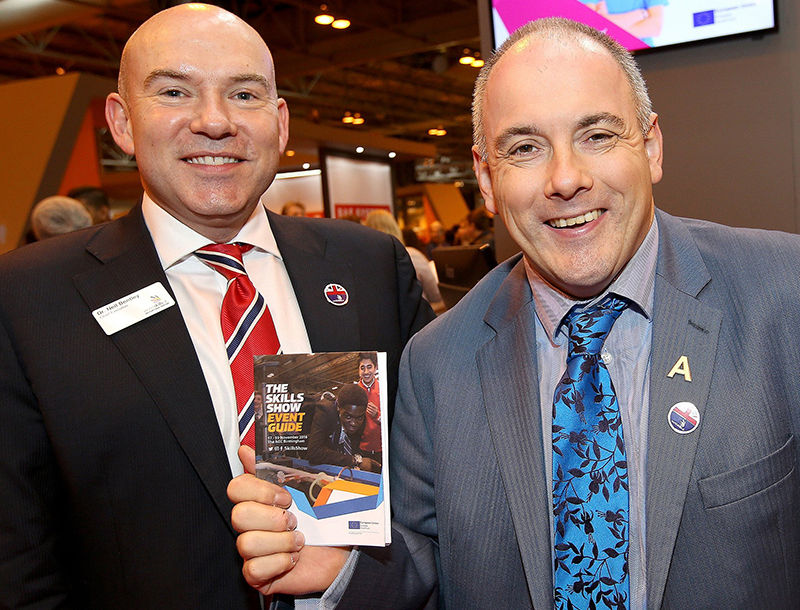
WorlSkills UK chief executive Neil Bentley (left) with apprenticeships and skills minister Robert Halfon at The Skills Show 2016
The Skills Show 2016 attracted over 70,000 visitors, including Robert Halfon, who became the first skills minister in three years to attend the show.
He said the show is the “future of our country” that will help bridge a growing skills gap with world-class apprenticeships.
Speaking at last year’s event, Mr Halfon said: “It is incredible. This is one of the most important days in the skills calendar.
“There is the best of Britain in this room.
“We’ve got hundreds of companies here, the public sector, skills competitors and people demonstrating skills. This is the best of the UK – this is the future of our country right here.”
A college facing “financial crisis”, which posted a 2015/16 group deficit of over £15 million, has come in for fierce ministerial criticism for poor oversight of doomed apprenticeship provider First4Skills.
The Liverpool-based company went bust earlier this month, affecting around 200 staff and around 6,500 learners, after the Skills Funding Agency pulled its contract.
That was prompted by a grade four rating from Ofsted, following an inspection carried out in February, on First4Skills which was 60 per cent owned by City of Liverpool College.
The college was recently revisited by the FE Commissioner’s team, and the findings’ warning of “financial crisis” and the £15,349 million deficit, have now been published – along with a letter reflecting on them from apprenticeships and skills minister Robert Halfon.
In this, he said: “Of particular concern is the college’s oversight of its majority owned independent training provider – First4Skills, where achievement rates have been below national minimum standards, and Ofsted have judged the provision ‘Inadequate’.
“This has led to the SFA taking the decision to withdraw funding from First4Skills and to seek alternative providers to support the apprentices.”
Reflecting more widely on the college’s finances, he said: “The college was re-referred for FE Commissioner intervention because of failures of financial management.
“Last year the college’s budget outturn was £8 million worse than planned, and it required £2 million exceptional funding from the SFA to continue operations.
“I understand that you accept that this represented a failure of financial controls, and that new systems have been put in place, as well as new senior financial staff. The £2 million loan has also been repaid. This is encouraging, but the college’s finances remain vulnerable.”
The college, which has five main campuses – all located in the Liverpool City Council Local Authority area – had an initial FE Commissioner intervention in December 2013 following an inadequate Ofsted inspection and an SFA assessment of 2012/13 financial health as ‘inadequate’.
It exited this in November 2014, following an improved Ofsted judgement (‘requires improvement’) in April 2014, and improved financial performance (‘satisfactory’) in 2013/14.
But it was referred back for another FE Commissioner intervention after the college informed the SFA last January that it needed £2 million exceptional financial support to cover working capital requirements, prompting a further notice of concern in February.
Stocktake assessments were carried out by the FE Commissioner and two advisers in November 2016 and February 2017.
The latest FE Commissioner report summary said of this: “During the November stocktake the team were concerned about some of the college board’s responses to the 2015/16 financial crisis.”
It pointed out: “The group’s annual audited accounts for 2015/16 show a total deficit for the year of £15,349 million. The college budgeted for a group breakeven position before taxation.”
Ofsted inspectors blasted leaders at First4Skills, in the recent damning Ofsted report, for failing to “tackle the significant weaknesses identified at the previous inspection”, with the result that “outcomes for learners and the quality of teaching, learning and assessment have declined further and are now inadequate”.
“Strategic priorities focus disproportionately on maximising the company’s income at the expense of providing high standards of education and training for learners,” it said.
Trainers’ targets “focus on recruiting more learners and increasing their caseload, and not on the aspects of training and assessment that they need to improve,” it continued.
City of Liverpool College decline to comment on the minister’s letter or FE Commissioner’s findings.
Government apprenticeship policies have come in for stern criticism in a new report by MPs, that insisted standards should have at least one approved assessment organisation in place before they’re delivered.
The sub-committee on education, skills and the economy, formed from the education and business select committees, gave a total of 36 conclusions and recommendations in the comprehensive report out today, which looked at all aspects of the apprenticeship reforms.
One of the key issues raised was that “apprentices should not have been allowed to begin their training without an assessment organisation in place and a clear idea of how their success will be measured”.
The committee, chaired jointly by MPs Neil Carmichael and Iain Wright, recommended that “standards should have at least one approved assessment organisation in place before they can be delivered”.
It comes as latest FE Week analysis, comparing the Statistical First Release (published March 23) with the Register of Apprenticeship Assessment Organisations (published March 28), found 1,720 (14 per cent) of 12,200 total starts on standards up to January this year still had no apprenticeship assessment organisations.
Former top skills civil servant Dr Susan Pember, now director of policy for adult learning provider membership body Holex, turned on government planners last October over this issue.
Dr Sue Pember
She described the situation as “diabolical”, after FE Week analysis at that time showed no approved awarding organisations for over 40 per cent of learner starts on new apprenticeship standards.
Now responding to the today’s report, Dr Pember said although the content was welcome, she did not “feel it goes far enough” on the recommendationof having at least one approved assessment organisation in place before a standard can be delivered, adding that that “should be the minimum”.
Mark Dawe, chief executive of the Association of Employment and Learning Providers, added: “An approved assessment process itself should also be in place first with an agreement on its price.”
Mark Dawe
Another aspect of the new apprenticeship system that was denounced in the sub-committee’s report was the government’s plan for the external quality assurance of standards.
Of the 162 apprenticeship standards currently approved for delivery, 26 had chosen the IfA as their EQA route, compared with just 15 that had gone with the government’s official qualifications regulator Ofqual.
Furthermore, while Ofqual would be overseen by the IfA in delivering quality assurance, the Institute itself will not have an organisation regulating its delivery of this role.
The MPs report said: “The integrity of the apprenticeships undertaken under new standards depends on the consistency and reliability of EPA. We are unconvinced that the government’s current model of EQA will achieve this.”
It recommended that to rectify this “Ofqual should be given responsibility for the EQA of all EPAs”.
But Phil Beach, Ofqual’s executive director of vocational and technical qualifications, told FE Week yesterday: “The important thing here though is not the action of any one body.
“We are committed to working with the IfA, and to partnering with industry on external quality assurance.”
The MPs’ report also raised concern about quality being sacrificed in the drive for three million apprenticeship starts, and found that while the government “is right to give employers greater influence within the apprenticeship system”, the voices of smaller businesses were being “drowned out”.
Stephen Evans, chief executive of the Learning and Work Institute, said: “The committee is right to be concerned that we risk hitting the target but missing the point.”
Petra Wilton, director of strategy for the Chartered Management Institute, agreed there was a need to “raise the quality and prestige of apprenticeships”, but defended employers’ involvement.
She said: “Employers are not investing their time and resources just to meet a government target of three million apprenticeships, they are genuinely employing new talent or upskilling their managers, to ensure they’re competitive and can access the skills needed to grow.”
Responding to the report, a Department for Education spokesperson said: “The government’s focus is on building a world-class education and skills system.
“It means we are not just concentrating on apprenticeship starts, but on employment opportunities, employer take-up and quality.
“In addition we are investing over £500 million a year of new funding for technical education and the apprenticeship levy will double the annual investment in apprenticeships to £2.5 billion by 2019-20.”
The FE Week Annual Apprenticeship Conference – now in its third year – shone a spotlight on the importance of quality being maintained and hopefully improved as the system is transformed.
Held just days before the launch of the apprenticeship levy – and shortly after the announcement of the controversial Register of Apprenticeship Training Providers – it was a welcome opportunity for attendees to get up to speed on all the latest developments.
This souvenir supplement features just some of the many highlights from the three days.
Quality was the common theme throughout AAC, which saw an array of prominent key note speakers from top politicians, civil servants and more, alongside over 65 indepth practical workshops.
Kirstie Donnelly, City and Guilds managing director, insisted quality had to be at the heart of reforms, which she fears are being pushed through too fast, in her speech on the opening day (page 3).
The Department for Education’s director of apprenticeships David Hill urged attendees not to “do a deal at a price you can’t deliver quality for” (page 4), while Keith Smith, director of funding and programmes at the Skills Funding Agency revealed the agency’s “uncompromising” stance towards delivering a “world-class” apprenticeship system (page 6).
Quality was also among the burning issues debated by a panel of sector leaders – you can read what they said on page 5.
An Ofsted double-header on page 7 looks at apprenticeships from the perspective of the education watchdog, while on page 14 Ofqual boss Sally Collier explains the work the exams regulator will be doing to support reforms.
Apprenticeships and skills minister Robert Halfon was unable to attend the conference, due to the terrible attack that took place in Westminster on the Wednesday. His sincere apologies were conveyed by his Labour counterpart Gordon Marsden, who used his appearance on the Thursday to set out his party’s five apprenticeship policy objectives (page 15).
Also on page 15, Shakira Martin, NUS vice-president for FE, spoke about the need for apprentices to be properly represented by the Institute for Apprenticeships. Peter Lauener, shadow chief executive of the IfA and chief executive of the Skills Funding Agency and Education Funding Agency revealed that the IfA board had “seized upon” quality “in all its aspects” in its first meeting (pages 16 and 17).
Page 18 is given over to WorldSkills UK – which represents quality in its highest form, with vox pops and tweets from throughout AAC opposite.
None of this could have happened without the support of our exhibitors and sponsors. Particular thanks to our headline partners AELP, the DfE and City and Guilds, and our conference sponsors Pearson, NOCN and Smart Assessor. And thanks to all the speakers who made time to provide useful key note speeches and workshops. Enjoy!
The search has begun for Peter Lauener’s replacement as head of the Education and Skills Funding Agency.
The job of chief executive of the funding agency, which will be formed through a merger of the existing Skills Funding Agency and Education Funding Agency on April 1, is advertised through the government’s civil service jobs recruitment site.
The job, which comes with a salary of up to £142,000, is described as “one of the department’s most senior leadership roles”.
It comes after FE Week reported on Tuesday that Mr Lauener would retire as chief executive of the newly-merged SFA and EFA once a permanent replacement had been found.
The chief executive of the merged agencies will be an “additional accounting officer” for “the vast majority of the Department for Education’s £66 billion programme and capital spend”.
Applications are invited from people with “successful experience as a proactive, strategic leader operating in a large and complex organisation” and “a track record of delivering demonstrably successful organisational change”.
Among the agencies’ key responsibilities are to “manage the system to operate the apprenticeship levy”, to “manage a programme of post-16 area reviews” on top of managing school funding for children up to the age of 16.
The deadline for applications is April 25, with final panel interviews scheduled for early June.
Mr Lauener, who is also shadow chief executive of the Institute for Apprenticeships, has led the EFA from its inception in 2012 and the SFA since 2014.
According to the job advert, he had “pursued an agenda of developing shared services and joint teams over the last two years, even while the agencies were in separate departments”.
Consequently, “ministers have now decided that the agencies should be merged to maximise scope for further savings and for improving the quality of customer services and the effectiveness of all its functions”.
But, as reported by FE Week, the merger has raised concerns that skills and adult education could now drop down the list of priorities at a merged agency also focused on schools.
Peers have passed an amendment to the Technical and Further Education Bill, which would extend child benefit and financial support available to higher education students to make it accessible to apprentices.
The amendment – passed this week at reporting stage – is designed to ensure that any person taking an apprenticeship can apply to qualify for child benefit or access a one-off bursary of £2,000 for care leavers.
It was moved this week by Lord Watson and Lord Hunt, opposition education spokesmen, during the House of Lords reporting stage on the bill, which still needs to go back to the House of Commons for third reading approval.
The peer insisted during the debate that if the government’s target of three million new apprenticeship starts by 2020 is to be reached “it cannot be in anyone’s interest for doors to be closed to young people keen to embark on an apprenticeship”.
He added: “In some circumstances, parents may prevent young people taking up apprenticeships because the economic consequences for the family of loss of benefit payments in various forms could be considerable.”
Under the existing system, families lose child benefit for children who take up apprenticeships, on the grounds that they are in paid employment.
In contrast, the families of A-level students continue to receive benefit payments if they qualify, even when the child is earning in their own time.
The new amendment would change these rules to enable families eligible for child benefit to receive it for children aged under 20 on an apprenticeship.
It would also benefit care leavers by opening access to a bursary traditionally only applicable to university students.
Currently, young people in local authority care who move into higher education can apply for a one-off bursary of £2,000 from their local authority. The amendment would ensure that care leavers who take up apprenticeships would be able to access this financial support as well.
Responding to Lord Watson’s proposal, parliamentary under secretary of state for schools Lord Nash said he welcomed the sentiment behind the amendment, but added that “sufficient safeguards and support” had already been established.
“From April this year, undertaking an apprenticeship at minimum wage will pay more than five times the maximum child benefit rate,” he said.
“Therefore, an apprentice’s parents are not eligible for child benefit for supporting that employed young person.”
Lord Nash added that “is not correct to equate being on an apprenticeship to being in higher education, where a student is making a substantial investment in their education and has appropriate access to student finance”.
He said: “Apprenticeships, by contrast, are real jobs and those undertaking them are employees who earn a wage.”
Speaking to FE Week about the amendment, Lord Watson said: “We are basically trying to make sure through this that young people don’t have to give up apprenticeships because of financial hardship.
“It will also hopefully help ensure that as the government pushes for its target of three million starts by 2020, a good number of people doing them will be from disadvantaged backgrounds with a fair level of financial support.”
Lord Hunt said many members of the Lords had remarked on how young people are treated differently when they go to university, compared to choosing FE and apprenticeships.
“This amendment is about achieving parity of esteem,” he said.
Shadow skills minister Gordon Marsden told FE Week the amendment covered an “issue which needs to be addressed”, adding that the currently system is “unfair”.
Shane Chowen
“It will be over to the minister Robert Halfon and others to do the right thing,” he said.
Shane Chowen, head of policy and public affairs at the Learning and Work Institute, said: “There are currently participation penalties for low income and disadvantaged young people who take an apprenticeship compared to an academic pathway.
“This amendment would help towards treating apprentices and students in further and higher education equally in the student support and benefits system.”
The amendment will now go back to the House of Commons for its consideration before it can be fully approved.