The country’s largest FE provider has lost a High Court bid to quash an as-yet unpublished ‘inadequate’ Ofsted rating, FE Week can reveal, leaving more than 1,600 of its staff at risk of losing their jobs.
Learndirect failed in its judicial review to overturn the damning report on August 4 – the release of which would by its own admission force it to call in the administrators, as it would oblige the government to pull more than £100 million in public funding contracts.
FE Week can only now report this and the other findings of a high-profile joint investigation with The Financial Times, after our lawyers successfully contested strict reporting restrictions on the case.
Ofsted will now publish the final report 48 hours after sharing it with Learndirect, and FE Week understands it is likely to see the light of day on Thursday.
During a two-day hearing in July, the Administrative Court in Manchester heard that Learndirect, a giant training provider with 1,645 employees and over 70,000 learners, had been rated ‘inadequate’ overall after a massive four-day Ofsted inspection.
The report, which was described in court but not presented to reporters, awarded grade fours to the provider’s apprenticeships and outcomes for learners.
Management of apprentices is ineffective
Amongst the criticisms Ofsted made was the fact that “management of apprentices is ineffective”, while around a third of learners on apprenticeships “do not receive their entitlement to off-the-job learning” and fail to develop “the skills they require to progress to the next step in their career”.
Learndirect challenged the report findings on two counts – that inspectors had a “predetermined” negative view of its apprenticeship provision, and that Ofsted’s sample size of apprentices was not large enough to reflect the size of the company.
However, Mr Justice King ruled that there was no evidence for the predetermination argument, and also pointed out that Learndirect didn’t cross examine the inspectors it had accused of bias.
The judge also dismissed the second point, again pointing out that Learndirect didn’t provide any expert witnesses to challenge Ofsted.
For months Learndirect could not be named due to a reporting restriction imposed by the court.
Now, however, FE Week can reveal the full story behind the provider’s attempt to quash Ofsted’s verdict – and its threat to file contempt of court proceedings against our publisher.
We reported in April that the pre-election purdah period had delayed publication of Ofsted’s report – which involved 17 inspectors reviewing Learndirect’s provision over four days from March 20.
It lodged a series of written complaints to Ofsted later the same month, suggesting that the inspection was inadequately detailed considering its size, but these were rejected by the inspectorate.
It then applied in June for a judicial review, seeking a quashing order and a permanent injunction to try and prevent the report from ever being published. The court banned publication of the report, the details within it, and even the name of the provider, until conclusion of the review.
Papers obtained by FE Week showed the court believed there would be a risk of “irreparable damage including financial consequences” to Learndirect if the report were published while the review was underway.
According to these papers, Learndirect argued that if the ‘inadequate’ grade were upheld, the consequences would be “catastrophic”, and would lead to government funding being withdrawn.
Ofsted’s press office did not realise there was a reporting restriction and at one point told FE Week it had “applied for a judicial review of its recent inspection report” and said “the report will not be published until the court process has concluded”.
We were also unaware of the restriction, and published an online article about the review, which was removed after Learndirect’s lawyers complained.
Michael Hayton QC, representing Learndirect in court, argued the report should have been quashed because the sampling by inspectors was “ineffectively unreasonable”.
He even accused one inspector of jumping to the wrong conclusion – that the provider had made a “sinister attempt” to hide evidence from the inspectorate, something the provider denied.
The inspector in question had been for a time unable to log in to Learndirect’s online training system, and wrote in his notes that he was “concerned I may have been prevented having access initially to inhibit my activity to scrutinise more of the evidence”.
The court also heard that the other inspectors had been concerned the provider was limiting their access to provision – for instance when attempting to interview learners.
But Mr Hayton described this as “another example” of inspectors coming to the view that there was some “deliberate malfeasance on behalf of the claimant to seek to limit or inhibit appropriate inspection”.
Sarah Hannett, representing Ofsted, insisted that there had been a “very serious decline in outcomes for learners”.
The court heard that Learndirect’s achievement rates had declined over the past three years and were “well below” the national average.
The Department for Education’s 2015/16 apprenticeship achievement-rate data for all providers, released in June, showed that Learndirect had fallen 7.3 percentage points to 57.8 per cent. This brought it below the minimum standards threshold of 62 per cent.
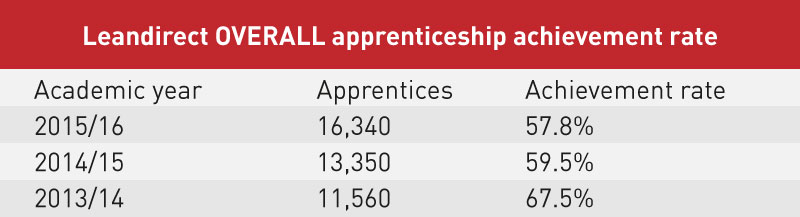
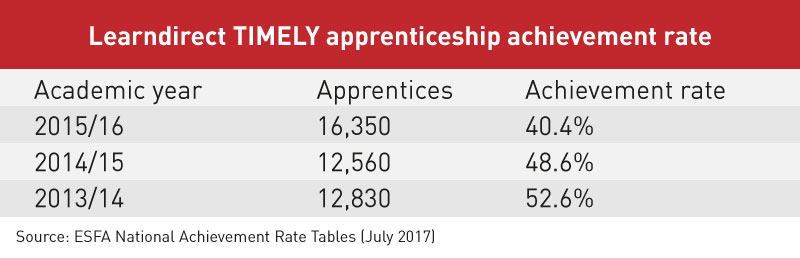
FE Week then confirmed in July that the provider had finally been hit with a serious performance breach notice, a month after its apprenticeship achievement rates plummeted below the minimum standards.
The news caused dismay across the sector as the issue date listed on the notice was March 14.
Learndirect response to FE Week in full
A spokesperson said: “Ofsted’s inspection was challenged because we believe the process did not give a true reflection of Learndirect Limited’s training quality and performance.
“The business presented compelling evidence as part of the appeal to support this view.
“In particular, we felt that the sample size of 0.6 per cent used by Ofsted to arrive at its conclusions is not sufficient to judge the quality of Learndirect’s training.
“We are therefore extremely disappointed with the verdict.
“Learndirect Limited will continue working with the ESFA to ensure our learners are fully supported as they proceed with their courses as usual.
“The outcome of the inspection does not affect the non-ESFA and e-assessment contracts held within our adult skills business, Learndirect Limited or Learndirect Apprenticeships Limited, which is independent and was not subject to an inspection from Ofsted.
“We continuously review our performance and strive to provide the highest standards of service for learners and apprentices.
“Learndirect Limited will continue to be well-supported by our stakeholders, and we will ensure our employees remain fully engaged around the ongoing evolution of the business.”
Who owns Learndirect?
This once publicly-owned company is the largest FE provider in the UK.
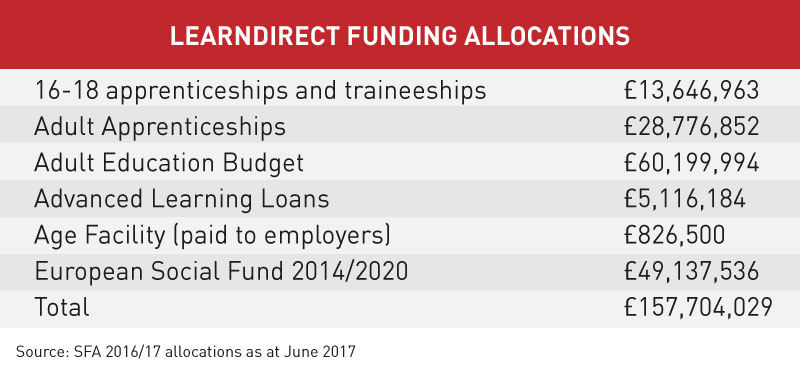
According to Education and Skills Funding Agency records for 2016/17 allocations, Learndirect has a total allocation of £157 million, of which 71 sub-contractors held £45.8 million of contracts in July.
It was previously owned by the UFI Charitable Trust, but in October 2011, the business was sold in a management buyout backed by Lloyds TSB Development Capital (LDC) for £36,309,000.
The vehicle used to acquire it was Pimco 2909, which had been incorporated the previous month by Sarah Jones, then the chief executive of Learndirect.
The acquisition was funded by a £40.2 million loan from LDC.
In the four full years since the acquisition, Learndirect went from a company with £36 million in the bank and a net asset position of £11.2 million, to one with just £5 million in the bank and a net asset position of £7.2 million.
Over the same period, £5.5 million was paid in net interest and £20.25 million was paid in dividends.
The FT, which is running its own report into Learndirect’s finances in tandem with FE Week, asked why 84 per cent of the cash generated by the business is being spent on interest payments, fees and dividends, particularly given the declining strength of the balance sheet?
Normal dividends were paid to our shareholders when the business was growing rapidly
A spokesman for Learndirect said: “Normal dividends were paid to our shareholders when the business was growing rapidly, generating significant profits (more than £25 million in 2013), and the sector outlook was positive.
“In addition to this there were significant intra-group dividends paid as part of a group reorganisation, none of these resulted in cash leaving the group. No further dividends have been paid since.
“Learndirect Ltd’s recent financial performance has been significantly impacted by external factors, in particular successive central government funding cuts which have reduced our revenues by £100 million over the last three years. Significant cuts have affected all providers in the sector.
“We have responded to these difficult market conditions by changing our operating model and diversifying our income, and we have remained competitive throughout this period.
“We have a supportive shareholder in LDC, which has reinvested over £37 million into Learndirect over the last three years to support the business during these funding cuts, and together we remain committed to providing the highest standards of service for learners.”
The inspection report as described during the case
The provider was given grade fours for overall effectiveness, apprenticeships, and outcomes for learners, with all other criteria receiving grade threes.
It said the great majority of its apprentices are employees of small and medium-sized enterprises, and mostly at level two and three, spread evenly. The majority are delivered directly by Learndirect with the rest by subcontractors.
The management of apprenticeships was described as “ineffective”, with oversight “weak”.
“Around one third of apprentices do not receive their entitlement to off-the-job learning,” the report was said to have added. “So apprentices do not develop the skills they require to progress to the next step in their career”.
The proportion of apprenticeships who do not complete their apprenticeship on time has increased steadily over the past three years and is very low
It warned that “leadership and management have allowed standards to slide since previous inspection”, and “the proportion of apprenticeships who do not complete their apprenticeship on time has increased steadily over the past three years and is very low”.
The report also stated: “The new senior management team has begun to tackle main weakness and early signs of improvement indicates their actions are beginning to have an impact.”
However, “until very recently company directors and senior leaders have presided over a sustained decline in performance”, and “leadership and management at all levels failed to oversee and challenge the particularly poor provision delivered by apprenticeship subcontractors”.
The one positive finding on apprenticeships came at the end: “Leadership and management develop very effective partnerships with a range of high-profile corporate clients. Managers work very closely with these to meet new standards. Apprentices make good progress, develop new skills and enjoy their learning.”
On day two of the hearing, the court heard that five apprentices had been selected at random, and looked at on Learndirect’s online ‘e-track’ system.
None of the learners, chosen at random, had an initial assessment or an individual learning plan in their e-portfolio – as they should have done, detailed in their procedure.
Learndirect’s apprenticeship manager was said to be shocked to see this. They apparently stopped the meeting and wanted to do scrutiny on their own, with the Ofsted nominee happy with this. There was said to be nothing covering starting point and progress monitoring, nor any evidence of targets being set in individual learning plans – which simply were not present.
Learndirect’s judicial review focused on two claims
There was limited apprenticeship evidence base for such a large provider – REJECTED:
Learndirect provided examples that it believed showed a “meagre sample size”.
It claimed just 0.6 per cent of apprentices were spoken to, which was an “insufficient sample leading to unreasonable conclusion”.
As an example, it claimed Ofsted spoke to just one apprentice out of 5,000 enrolled on level two apprenticeships in health and social care.
Ofsted claimed Learndirect actually deliberately tried to scupper its on-site inspections, such that there was “a strategy by the provider to limit our evidence base”.
It said it was initially only given the details of 97 out of 21,000 apprentices to visit, and when it was finally given the details of more, it was not supplied with addresses or postcodes.
In another example, Ofsted said it was told there was evidence of monitoring progress in audio files. So it asked for the audio files and found no evidence of monitoring progress. The inspector asked in his notes if Learndirect was “gaming evidence”.
Ofsted undertook a post-inspection review of the sample size by an inspector from a different region, who concluded there was “a comprehensive evidence base clearly supporting the judgements made”.
On the matter of whether the inspection was detailed enough for a large provider, Ofsted pointed out that it deployed the equivalent to 55 inspector days, when the typical highest Ofsted inspection tariff is 24 days.
So that was said to be more than double the intensity, plus there were two senior HMIs when there is normally just one.
The judge was critical of Learndirect’s claim in two regards. Firstly, it did not bring forward an expert witness to explain why the evidence base was too small.
Secondly, the Learndirect lawyer said the size of the sample simply “spoke for itself”. The judge replied that the sample size did not speak for itself.
The judge said: “It is an expert judgment taken by an expert regulator. I have no proper basis upon which I could interfere with the expert judgment made by this expert regulator.”
“The defendant [Ofsted] had to make a judgment about suitable sample size,” said the judge. “It is an expert judgment taken by an expert regulator. I have no proper basis upon which I could interfere with the expert judgment made by this expert regulator.”
The lead inspector for apprenticeships had a closed and predetermined mind – REJECTED:
Learndirect claimed the lead inspector for apprenticeships stuck to his view from day one and declined to accept evidence to change his mind.
Learndirect did not cross-examine the lead inspector for apprenticeships, nor claim he had undue influence on the other inspectors.
The judge said “matters relied on were short” and were only in the form of written witness statement from Learndirect employees.
The judge said there was “no evidence of predetermination whatsoever”, and that Learndirect didn’t even get beyond the first stage of mounting a claim.
He said the lead inspector for apprenticeships reached his conclusions based on a considered assessment that emerged during the inspection – not predetermination.
The judge said this “supports the defendant’s conclusions”, namely:
– Complete confusion on how data was recorded
– Inability to demonstrate how progress was monitored
– Learndirect’s forecast for outcomes was insecure
The judge repeated that “no material has been shown to me which effectively demonstrates a closed mind”.
Consequence of a grade four for Learndirect
Learndirect said that if it were given a grade four, the SFA had confirmed it would serve a three month-termination on all contracts, worth over £100 million.
This, Learndirect told the judge, would force it to call in the administrators, which would put 2,000 staff out of work and over 20,000 learners in need of help to find an alternative provider.
Learndirect also told the judge that going into administration would end its ability to fulfil contracts with the Department for Work and Pensions (pre-employment training), the Home Office (to deliver immigration tests) and the Standards and Testing Agency (to deliver the professional skills test for prospective teachers).
Timeline
March 6 – The Skills Funding Agency issues a ‘notice of serious breach’ for 70 per cent of apprenticeships in 2015-16 falling below minimum standard.
March 15 – Notices of concern become public but Learndirect is not named. It is not until some time after FE Week publishes an article asking why it was excluded that the list is updated to include Learndirect.
March 16 – Ofsted informs Learndirect it will begin a full inspection on March 20. Learndirect managing director Andy Palmer asks for its apprenticeship provision not to be included in the inspection as it is trying to move its provision to a new company set up in 2016 (Learndirect Apprenticeship Limited).
March 17 – Ofsted rejects Learndirect’s request and tells it apprenticeships will be included in the inspection.
March 20 – Seventeen Ofsted inspectors begin a four‐day inspection. Six are focused on apprenticeships, including a lead inspector for apprenticeships.
March 23 – The last day of four‐day inspection; in the grading meeting Ofsted indicates (subject to internal moderation) that the overall grade will be ‘inadequate’ (grade four), as well as the apprenticeships grade and the outcome for learners grade. All other grades will be ‘requires improvement’ (grade three).
April 11 – Learndirect writes to Ofsted making a series of complaints, including that the inspection was inadequately detailed for such a large business.
April 12 – Ofsted plans to publish the report, but without taking external advice decides to delay publication until June 9, owing to a concern around general election purdah rules.
April 28 – FE Week reports that the Learndirect inspection report has been delayed until after the election, quoting an Ofsted spokesperson.
May 4 – Ofsted writes to Learndirect to say the quality assurance process for the inspection has been completed, including a full review of the evidence base. The letter says Ofsted is satisfied the evidence base was complete and that no additional evidence is needed.
May 11 – Ofsted writes to Learndirect to say its letter of complaint had been rejected.
Unknown date – Learndirect’s MD claims in court that the Skills Funding Agency told him it would serve a three-month termination notice on all contracts if a grade four is confirmed.
June 5 – Learndirect applies for a judicial review seeking a quashing order and permanent injunction so the report is never published. Learndirect wins interim relief – such that there can be no publication of the report nor can the provider be named until conclusion of the review.
The judge (HHJ Moulder) uses Ofsted’s decision to delay publication owing to purdah, and says there appears to be “no particular urgency or prejudice should the defendant be restrained from publishing the report whilst the judicial review application is considered. By contrast on the evidence put before me, the claimant’s business may be severely damaged and irreparable financial and reputational harm could result even if the proposed grade is subsequently withdrawn.”
Had Ofsted chosen not to delay publication until after the election it may well have been published on the April 12.
June 8 – Ofsted’s press office does not realise there is a reporting restriction and tells FE Week that “Learndirect Ltd has applied for a judicial review of its recent inspection report. The report will not be published until the court process has concluded.”
FE Week publishes an online article about the judicial review, which it removes when Learndirect’s lawyers get in touch about the reporting restriction.
June 15 – The SFA publishes the 2015/16 apprenticeship achievement rates for all providers. Learndirect falls 7.3 percentage points to 57.8 per cent. Timely achievement rate fell 8.2 points to 40.3 per cent.
June 24 – FE Week publishes an article with the headline “Achievement rates at Learndirect fall under minimum standards”.
July 14 – The SFA updates its published list of notices of concern and Learndirect’s notice of serious breach for falling below minimum standards becomes public knowledge. The apprenticeship minimum standard is a 62 per cent achievement rate, and when 40 per cent or more apprentices are below 62 per cent, a notice of serious breach is sent out.
July 28 – Day one of the judicial review in open court. Attended by FE Week reporter John Dickens, it primarily features Learndirect outlining its case as the claimant. FE Week publishes an article about the first day of the judicial review, not identifying the provider. Nevertheless, its lawyers successful apply to the court for an injunction on the story, which is then removed from the FE Week website.
Learndirect’s lawyers also inform FE Week that they intend to make oral application to the judge against the owners for committal for contempt of court, a criminal offence which can lead to a fine or even imprisonment.
July 31 – Day two of the review, primarily Ofsted outlining its defence, attended by FE Week editor Nick Linford. Learndirect’s lawyers decide not to make an oral application to the judge against the owners of FE Week for contempt of court.
August 4 – Judicial review judgement. After a three-hour summary, the judge concludes Learndirect has no valid evidence and rules against it. Against the wishes of Ofsted and FE Week, he extends the publication and reporting restriction to 4.30pm on August 14 and gives Learndirect until August 10 to apply for an appeal.
The judge indicates for the first time he is not pursuing an matter relating to contempt of court.
August 10 – Lawyers acting on behalf of Learndirect file an application to the court to appeal the judgment.
August 11 – Lawyers acting on behalf of FE Week file an application to overturn the reporting restriction.