A-level results day is here!
Today’s the day when A-level learners up and down the country find out whether all their hard work has paid off, and what their next step in life will be.
*** The live blog is now closed. Sorry if your pictures didn’t make it in – we’ve been inundated with stories and there simply hasn’t been time to add them all. We really appreciate you sending them and don’t forget to send them in next year. Congratulations to all the learners who got their results today and best of luck for the future.***
As with previous years, we’ll be sharing some of the success stories from colleges, sixth form colleges and providers up and down the country. To get involved, send your pics and quotes, along with names and ages of the learners pictured and what subjects they’re studying to jude.burke@feweek.co.uk
____________________________________________________________

Manchester College student George McKenzie is living proof of the second chance that FE can offer.
The 19-year-old left school with no GCSEs, but has managed to turn that around to score BBD in chemistry, physics and maths – which will see him study his “dream subject” physics at the University of Central Lancashire.
“My journey at The Manchester College has been overwhelming, with the support of my fantastic teachers, who I thank from the bottom of my heart,” George said.
He re-sat his GCSEs at the college, before progressing on to A-levels.
“After putting in the work, with help from the wonderful teachers here, I can say this is probably the best college in the country,” he said.
“All I can say is thank you to all the teachers,” he added.
____________________________________________________________
Bill Watkin, chief executive of the Sixth Form Colleges’ Association, has added his congratulations to students receiving their results today.
“Sixth Form Colleges have done remarkably well to take on board all the recent changes to A level and Applied A level specifications and examinations, and to deliver once more the fantastic results that we have become used to from them,” he said.
“Because they can focus exclusively on teaching sixth formers, and because they have large numbers of students, they are able to lead the way in supporting young people to get the best results they can and reach the destinations they want.”
____________________________________________________________

It’s been double trouble for Loughborough College today, which has seen not one but four sets of twins receive their results!
But while identical twins Milly and Fifi Dunne (above, centre) may look alike, their future career paths are very different.
Milly is heading to Bristol University to study film after securing BBBB in her A-levels, while Fifi will train in weapons engineering in the Royal Navy after following Loughborough’s space engineering programme.
“The university interviewed me and offered me a place on the spot – which was brilliant enough but now this. I think we both need to have some ice cream to celebrate,” said Milly.
William Reilly (above left) scored an A*ABC to secure a place at the University of East Anglia to study natural sciences while twin brother Zak (above right) was given an unconditional offer to study art and design and heads to De Montfort University.
Colin Butler, acting principal, said: “Our continued and significant improvement in A-level results at the highest levels and 97% pass rate overall really is a cause for celebration.
“At a time of such wide-ranging reform in these exams, our A-level success is testament to the capabilities of our students and the quality of our teaching and support staff who enable them to fulfill their ambitions.”
____________________________________________________________
While many students receiving results today will be heading to university, sector leaders are reminding them – and their parents – that there are other options.
David Hughes, chief executive of the Association of Colleges, said there were “many routes to getting into a chosen career”.
These included FE colleges which “offer a wide range of higher level technical and professional education, including apprenticeships and part-time study options” – and benefits including lower tuition fees, and “living and travelling costs are also much lower because it’s possible to stay at home”.
Another option to consider was a higher level apprenticeship, which “can be just as valuable to an individual as an honours degree, yet with the added bonus of having a job and an income whilst studying”.
“Whatever the path, I want to offer my congratulations to every student on their results and wish them all the best for their next steps,” he added.
Meanwhile, Mark Dawe, chief executive of the Association of Employment and Learning Providers – and former exam board boss – has urged parents not to put their children off from doing an apprenticeship.
“It’s not so much that snobbery is an issue – it’s more a case of parents and teachers being unaware of the benefits and potential earnings available from apprenticeships in both the manufacturing and service sectors,” he said.
“More and more young people are seriously weighing up their options that may result in them choosing an apprenticeship or a technical education course rather than university.
“Parents should take pride in these choices rather than thinking of apprenticeships as being just for other people’s children.”
____________________________________________________________

Sheffield College student Melodie Maggs can’t wait to phone home with her results after scoring an impressive A*AA in maths, biology and chemistry.
The 19-year-old was home educated until the age of 14 when she started at the college, where she completed five GCSEs before moving onto A-levels.
“I think my success is due to being both home educated and studying at the College, which has been very refreshing. I’ve loved both experiences and together they have made me determined to achieve, and helped me to learn independently,” she said.
Melodie is taking a year off before applying to university to study medicine.
____________________________________________________________

Students at Christ the King Sixth Form College are celebrating their amazing A-level and BTEC results this year.
Rob McAuliffe, newly appointed principal, said he was “so proud” of the college’s staff and students.
“The combination and achievement of young people in this part of south east London is to be celebrated,” he said, adding that: “We are very happy with these results.”
____________________________________________________________

Emmah Younis can’t quite believe she’s made the grade today at Bury College!
The 18-year-old (pictured from second from left), who scored A*A*A in biology, geography and chemistry and is headed to the University of York to study biochemistry, said: “I am in disbelief after receiving my results! I feel I have benefitted from great teaching at Bury College and have made a great group of friends.”
Also receiving outstanding results today at Bury College were Gregory Peston, 20, and Melissa Belk, 18.
Gregory (back, second from left) is heading to Sheffield Hallam Univeristy to study child nursing after gaining triple distinction stars in health and social Care (health-sciences) multi-professional cadet scheme.
“Bury College has been really good with a nice learning environment,” he said.
And Melissa (back, second from right) said she was “so happy” to be going to the University of Leeds to study geography and Spanish, after getting A*AA in English language and literature, geography and Spanish.
Charlie Deane, Bury College principal, said the college was “extremely proud of the efforts, achievements and successes of our students and staff” and wished the students “every success at university or in their chosen career”.
____________________________________________________________

Among the students at Newcastle under Lyme College whose next stop is university are (L-R) Natalia Falacinska, Alex Broad, Daniel Scothern, Charlotte Birks, Millicent James and Daniel Heath, all aged 18.
Natalia (far left), who scored AAA in English language, English literature and French, said she was “really emotional but obviously very pleased”. She’s packing her bags for Durham University to study English literature.
Daniel Heath (far right) said he “struggled with further maths” but still managed to get an A – along with an A* in maths and A in computing. He said he’s “really pleased” with those results, which will see him head to the University of Manchester to study maths.
Millicent (second from right) said she was “pleased” with her BDC in film studies, German and music which mean she’s heading to the Birmingham Conservatoire.
Karen Dobson, principal, said she was “delighted” with today’s results and “so proud of what the students achieve here at NULC”.
“The last 12 months have seen significant changes to A-level qualifications, with very little exemplar material available to staff and students, so to see a healthy increase in our overall pass rates against a difficult backdrop and tougher qualification framework is an outstanding achievement and a true testament to the hard work of both staff and students alike.”
____________________________________________________________

You wait four years for a student to go to Cambridge – and then two come along at the same time!
Oliver Smith (left) and Jake Stuchbury-Wass (right) are the first two students from UTC Sheffield to go to the prestigious university since the technical school opened in 2013.
Both Oliver and Jake achieved A*A*A* in maths, further maths and physics, plus distinction* in their engineering technical qualifications, and both will be studying engineering.
“I felt shocked and very pleased when I opened the results envelope as my grades have exceeded what I needed to get into the University Cambridge. It feels a real accomplishment to have got in and it’s also great for the UTC,” Oliver said.
And Jake – who was part of a gold medal-winning team in industrial control at last year’s Skills Show – added that he’s “had a great time at the UTC”.
“I chose to move to the UTC at 16 because of the engineering specialism and A level subjects that support that, which makes it different to other schools.”
____________________________________________________________

More than 450 students were hoping for good news when they collected their A-level results today at Cronton Sixth Form College.
These included Laura Farrell (fifth from right, front row), who achieved an amazing AAAA* in English language, English literature, history and extended project, and will be off to the University of York to study English literature.
“I have received fantastic support from all of my tutors who have helped me achieve my great results,” she said.
18-year-old Will Ellis (far left) is “really pleased” with his results – as he should be with A*AA in maths, further maths and physics.
He’s now “looking forward” to going to the University of Liverpool, where he’ll study maths.
Another high achiever at the college was 18-year-old Crison Sunil (far right), who scored A*AA in accounting, ICT and business – which he said he was “delighted” about.
He’s now headed to Lancaster University to study accounting and finance.
____________________________________________________________

Future wildlife conservationist Amethyst Johnson, 18, was among hundreds of students collecting their A-level results today at West Nottinghamshire College.
Her AACA in biology, English language, geography and extended project mean she’s off to the University of Manchester to study environmental science.
Amethyst said she was “really pleased” with her results, particularly in biology which “came as a surprise”.
“A-levels are a big step-up from GCSEs and you don’t really realise that until your second year, but if you put the work in, you get the grades,” she said.
____________________________________________________________
https://youtu.be/EniSc2pmgsM
Most people covering A-level results day can remember how it felt the day when they collected their results – the hope, relief, happiness and sometimes the tears.
 Ethan Butterworth
But not FE Week‘s work experience student, Ethan Butterworth. Not only has he not done his A-levels yet, he’s only just done his GCSEs!
To give him a taster of what he can expect when he picks up his exam results next week, we sent him along to Tower Hamlets College to speak to some of the students.
These included Jahed Minar, 19, who achieved A*AB in sociology, history and politics, and is now off to Queen Mary University to study history.
He told Ethan that the secret to his success was that he “chose something I enjoy and the work and reading came naturally”.
Mohammed Aubhaiz, 17, who was collecting his BTEC level three results, offered some advice to Ethan and others who will be starting A-levels soon: “Study hard and stay focused – it will benefit you in the future.”
18-year-old Niam said she was “satisfied with my results”, which were ACD in business, economics and accounting.
She told Ethan she had started preparing early for her exams “as there is no time to waste”.
“These two years are crucial and very difficult,” she warned.
Farzana, 18, advised anyone going into exam season to “have faith in yourself”.
She achieved ADD in sociology, psychology and politics, and told Ethan that Tower Hamlets was a “very friendly” college to study at.
Not everyone was happy with their results, however.
Samad Abdul got BCD in sociology, accounting and maths, and told Ethan he “should have revised more”.
Scott, 20, got BCC in English language and literature, history and politics.
He was more philosophical about his results – reminding Ethan and everyone else that there are other options if things don’t work out.
“Take your results with a pinch of salt,” he said.
“Be prepared to work hard and study, but if you’re not in the right state of mind don’t continue – other things and opportunities are available,” he added.
Alison Arnaud, Tower Hamlets College principal, told Ethan she was “very proud” of the college’s students who had achieved “phenomenal grades”.
“Students put huge amounts of effort into the new A-levels, which have shown difficulty to learners, as the students now sit the A-levels after two years.
“So I am very pleased with the results as we have remained stable or improved,” she said.
____________________________________________________________

Chesterfield College student Beth Shouk, 18, said it was “amazing” to achieve A*A*A*A in chemistry, biology, sociology and psychology.
She will be heading to university – but not immediately. She’s applied for a job as a junior chemist to gain vital work experience before moving on to higher education.
“All the effort I put in has amounted to something,” Beth said.
“I was nervous because of all the changes in A-levels and grade boundaries but I am so happy with my results. I can choose from so many universities with these grades.”
Julie Richards, Chesterfield College principal, offered her congratulations to all the students receiving their results today.
“It is wonderful to see so many students with places at university or apprenticeship positions secured because of the hard work and commitment they have put into their studies so far,” she said.
“I wish everyone all the best for the future.”
____________________________________________________________

One A-level student not among the thousands collecting their results in person today was 18-year-old Olivier Niyibizi – because he’s already started university in the USA!
The Bilborough Sixth Form College student achieved AABA* in maths, business studies, computer science, and extended project, which was enough to secure his place at Emory University in Atlanta, Georgia where he’s hoping to study either computer science or quantitative science.
“I just thought this would be such an amazing opportunity to experience a different education system and I think it will help me immensely when I return to the UK and apply for jobs,” Olivier said of his unusual choice of university.
____________________________________________________________
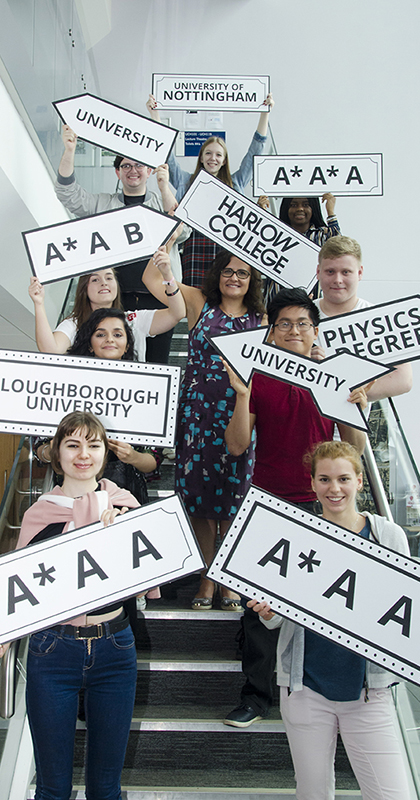
Former skills minister Robert Halfon and Harlow MP sent his “massive congratulations” to students at Harlow College getting their “outstanding” A-level results today.
“This is a tribute to the extraordinary commitment of the staff, students and the parents who are climbing the ladder of education and skills to ensure that our new generation in Harlow get the jobs, security and prosperity they need for their future,” he said.
Karen Spencer, Harlow College principal, said she was “incredibly proud” of the students whom she described as a “credit to Harlow”.
“Once again they’ve shown how hardworking and talented they are,” she said.
Pictured Francesca Wintie [left], 19, holding A*AA sign (sociology, history and English literature); Davinder Kaur, 18, holding Loughborough University sign (AAB, business, sociology, psychology); Holly Humphreys, 18, holding University of Nottingham sign (A*A*A, government and politics, sociology, English literature); Alinafe Ndalama, holding A*A*A sign (maths, psychology, business); Karen Spencer, Harlow College principal (holding Harlow College sign); William Renouf, 18, holding physics degree sign (AAAB, physics, maths, further maths, chemistry); Viola Tam [right], 20, holding A*AA sign (maths, physics, further maths), plus other Harlow College A-level students.
____________________________________________________________

Sunderland College student Morgan Ozuzu, 18, is jumping for joy at his A-level results – A*A*A* in maths, further maths and physics – and is now headed to Newcastle University to study physics.
Morgan was diagnosed with Asperger’s syndrome at an early age and struggled to try new experiences or to face change throughout school – issues that he learned to deal with with the help of therapy and his friends.
But he said: “When I started college it was reassuring to know that if I did have any problems, I would be able to talk to my tutor about it. I have now learned to embrace change when it comes which is why I’m particularly excited for university and why I am no longer worried about my autism being an issue.”
____________________________________________________________

Twenty-year-old Leeds City College student Grace Haley is a step closer to her dream of becoming a histopathologist (a doctor who diagnoses and studies disease using expert medical interpretation of cells and tissue samples) having gained AAAB in biology, chemistry, maths and physics.
Grace, who is off to the University of Manchester to study medicine, said getting her results was a “huge relief”.
“I have had many sleepless nights whilst counting down the days! Coming to college has been a fantastic experience and I’m looking forward to the future.”
____________________________________________________________

More than 180 students got their A-level results at Barnet and Southgate College today – including Vishwa Patel [right], Alex Robertson [centre] and Emily Caesar [left], all aged 19.
Vishwa said she was “so pleased” to get her results – AAC in biology, chemistry and maths, which mean she’ll be off to Queen Mary College in London to study biomedical science.
“Barnet and Southgate College has been the best atmosphere for me, and I’ve really enjoyed it,” she said.
Alex went to Barnet and Southgate after doing badly at the first year of A-levels at school, and he credits the college with helping him to “settle in” and “turn things around”.
He got ABB in business studies, history and sociology, and will be heading to Brighton University to study sports journalism.
An impressive A*AB in sociology, law and English literature mean that Emily is off to City University, London to study law.
She said she was “really pleased” with her results, and added that she enjoyed her time at the college as “the teaching has been so good and I liked being treated like an adult”.
David Byrne, Barnet and Southgate College principal, said the college’s “impressive results” – which included 100% A-level pass rates in 11 subjects – were “testament to the hard work and dedication of our students”.
“They should all be very proud of their achievements – some are going onto study at prestigious universities, some will be staying on at College for their Higher Education and a number of them will be taking up apprenticeships or going straight into the workplace”.
____________________________________________________________

18-year-old Wakefield College student Grace Exley has stars in her eyes after achieving an outstanding A*A*A*A in physics, chemistry, Spanish and maths.
She’s now hoping to study at physics at either Cambridge or St Andrews University.
“To leave Wakefield College with 3 A* and an A is unbelievable. I would never have managed it without my tutors’ hard work and all of the opportunities Wakefield College has offered me,” she said.
Wakefield principal Sam Wright said: “We are extremely proud of our students’ achievements. It is a testament to the hard work and dedication of our students that they continue to deliver great results for the College.”
____________________________________________________________

Stockton Riverside College Bede Sixth Form student Sharon Saji, 19, is set for a degree in medicine at Plymouth University after getting an A* in biology – adding to her existing haul of AA in chemistry and maths, achieved last year.
“This is more than I could have even hoped for. It just feels amazing,” she said.
____________________________________________________________

A group of Blackburn College students are set to achieve their dreams after getting the results they needed to go to university.
Aadam Ahmed, 18, [left] says he “can’t wait to go” to Bangor University to study marine biology and zoology after getting AAA in psychology, biology and chemistry.
“I feel really happy and relieved that I got my results,” he said, and added that his time at Blackburn had “provided me with a lot of theoretical knowledge as well as practical skills”.
After gaining AAB in English language, psychology and English literature, Faye Bretherton, 19 [second from left], will be headed to the University of Manchester for a degree in English literature and creative writing.
Studying at Blackburn has given Faye other benefits, too: “My confidence has also improved a lot. I feel I can talk more in class now and my presentation skills have really improved as a result of this.”
17-year-old Noor-Ul-Huda Ghouri [third from left] enjoyed her time at Blackburn College so much she’s staying on at its University Centre to study a degree in history and literary studies, after achieving ABB in English literature, history and religious studies.
She credited the college for its “really enjoyable” teaching style that “made learning fun”.
18-year-old Akisha Musa’s [third from right] family is “delighted” at her results – and so they should be! With A*AA in law, psychology and sociology, she said she “can’t wait” to start studying primary education with qualified teacher status at Manchester Metropolitan University.
Safiyyah Makda [second from right], 18, gained A*BB in psychology, further maths and chemistry and will be off to the University of Manchester to study maths.
“I’m so happy that my hard work has paid off,” she said.
And Mohammed Lunat [right], 18, said getting his results was a “big relief” as he “did better than I had hoped” and was “really happy”.
With AAC in psychology, law and business, and dreams of being a sports and exercise psychologist, he’s off to study psychology at Edge Hill University.
____________________________________________________________

Nelson and Colne College students Jamaal Iqbal [bottom row far left], 18, Anna Stephenson [bottom row second from left], 18, and Sophie Aisnworth, 18, are all over the moon to receive their A-level results today.
Jamaal got A*A*A in drama and theatre Studies, English language and English literature and is heading off to the University of Manchester to study English language – which he hopes will stand him in good stead for his dream career working in the media.
“I’m pleasantly surprised, especially as I achieved higher than the entry requirements and my predicted grades! I’m excited to start university now – Manchester is such a cosmopolitan city,” he said.
“I have had excellent teachers at NCC who know their subjects well and go out of their way to help. I have also made some incredible friends who I hope to stay in contact with after university.
Meanwhile, Anna secured A*AA in English literature, French and history and will be heading to the University of Cambridge to study modern and medieval languages.
“I’m really pleased with my grades,” Anna said, adding that: “NCC definitely prepares you well for university as you develop independence here and the teaching and support is of outstanding quality”.
And Sophie is heading to Durham University to study English literature after gaining A*AB in English literature, film studies and history – an achievement that’s all the more incredible given that she’s been in an out of hospital during her A-level studies.
Sophie has lupus, which has left her struggling with severe joint pain that left her struggling to walk, painful breathing, dramatic weight loss and her hair began to fall out which all resulting in several hospital stays.
“I’m absolutely delighted with my results,” Sophie said.
“I have an ambition to be a film director and my qualifications have given me a variety of skills in subjects which complement each other and my future career.”
____________________________________________________________

Bradford College student Abigail Woods, 21, has overcome the odds to achieve an an amazing B,B,C in A-level film, media and English literature today – and is now off to the University of Bradford to study film.
She’s a full-time carer for her mum, who uses a wheelchair as a result of serious hip problems. Not only that, Abigail was diagnosed with dyspraxia, which affects coordination, and dyscalculia, a maths-related learning difficulty, mid-way through her course.
“I want to be a screenwriter and am excited to move on to university but have really enjoyed my time at Bradford College and am thankful for the support they have given me,” Abigail said.
“It has been tough juggling my responsibilities at home and college but the tutors have been very supportive and understanding. I am essentially on call 24/7 for my mum. She is very proud of me and I am of myself.”
____________________________________________________________

19-year-old Thabiso Khoza is among hundreds of students from the College of Haringey, Enfield and North East London celebrating after receiving their results for vocational courses.
Thabiso is off to De Montfort University to study a BEng in mechanical engineering, having successfully completed an engineering diploma extended level three course.
“I really enjoyed the course at CONEL. It really related to the engineering world and was more practical than at school, which should give me an advantage at university,” Thabiso said.
____________________________________________________________

Of course, it’s not just A-level students getting their results today – some BTEC students will also be celebrating success, too.
These include best friends Cameron Parry (left) and Daniel Andrews (right), both aged 19, who both achieved amazing triple distinction star in hardware engineering BTEC at Middlesbrough College.
“This course has really gave me the foundations to go on and study cybersecurity and networks at Teesside University – I can’t wait,” Cameron said.
Meanwhile, Daniel – who is hoping to go to Coventry University to study cybersecurity or computer science – said he was “really pleased with my results”.
Rod Bristow, President of Pearson (which owns BTEC) in the UK, said: “Today is a day we rightly celebrate the success of our A Level students, and I wish them every success as they prepare for higher education.
“But today we are also celebrating the fact that a quarter of students who will go to university in the autumn will have studied a BTEC qualification – either a BTEC alone or through a combination of BTEC and A Levels, which is now the fastest growing route into university.”
____________________________________________________________

18-year-old Amy Dennis [right] and 19-year-old Bethany Andrews [left] are among 250 students at Derby College receiving their A-level results today.
Amy achieved A* grades in maths and sociology, and B in psychology, and is off to the University of East Anglia to study maths
“I wanted to come to college to be in a more adult environment and I am really pleased that I came here,” Amy said.
“It has been harder work not doing AS levels as you are sitting exams based on two years’ work but the hard work has paid off.”
Meanwhile, Bethany will start a higher apprenticeship at pharmaceutical giant AstraZeneca after gaining A levels in Chemistry, Biology and Maths.
She will work as a laboratory assistant and study for a chemistry degree distance learning, paid for by her employer.
“I am really looking forward to my apprenticeship – it is a fantastic opportunity,” Bethany said.
____________________________________________________________

Kicking off this year’s blog we have 18-year-old Dominick Skreta, a student from the Bedford Sixth Form. He got three A* in A-levels history, business studies and English literature and language – despite arriving in the UK from Poland just five years ago. He’s now off to do an apprenticeship with ET Accountancy.
Ian Pryce, group principal of the Bedford College Group, said: “Our students have never worked harder, and our staff under new head Paul Clarkson have never performed better.
“The exceptional increase in our results this year – higher grades and higher pass rates – at a time of so much A Level reform, shows the benefit of choosing a specialist A Level environment if you are serious about your studies.”