Skip to content
15 October 2026

Latest news from FE Week

The skills system is broken because we keep fixing it in pieces

Every corner of the skills system has its own crisis. Falling apprenticeship vacancies. Too few T Level placements. A shortage of entry-level jobs for young people. Almost a million 16–24 year old NEETs.

Each issue matters, but only tells part of the story. Employers sit at the heart of these challenges, yet policy treats them in isolation. What’s missing is a joined-up approach that recognises the cumulative effect on business and helps employers see how investing in skills can work for them.

Our members, representing employers of all sizes and sectors, tell us it’s not a lack of willingness to train or employ people but the sheer number of pressures hitting businesses at once.

Increased national insurance, record national minimum wage, escalating materials, energy and transport costs. A higher retirement age keeping the workforce older for longer while the cost of reskilling rises. Add to that the cost-of-living crisis, and many employers are operating with tighter margins and being asked to do more.

AI and automation is changing the nature of work, with a growing demand for digital, data and problem-solving skills. Employers are trying to adapt while keeping their businesses viable.

A record 252 employers took part in this year’s 5% Club audit, representing more than 800,000 employees across 20 industries. Together, they employ over 70,000 people in “earn and learn” roles such as apprenticeships and graduate schemes – 8.7 per cent of their workforce, the highest proportion we’ve ever recorded. Employers remain committed to developing talent, even when times are tough.

For the fifth-year running there’s been a rise in higher and degree-level apprenticeships, typically supporting mid-career reskilling and upskilling – exactly what employers tell us they need most.

But with young NEET numbers growing, government focus is weighted heavily towards this issue. The young population is growing and will continue to do so in the next five years, so we may see NEET levels grow even further.

Employers can ‘t solve this challenge alone. Entry-level roles are declining. Level 2 apprenticeships are at their lowest since the audit commenced, and the expectation is employers will do more. We need to align national need with commercial reality. We have to make it make sense for business to get involved.

Beyond apprentices, for the third consecutive year, employers have reduced the number of formal graduate schemes and placements. The median number of graduates has fallen from 31 in 2024 to just 23 this year, and SMEs expect to cut graduate recruitment by another 6 per cent next year. As competition for graduate roles intensifies, many will apply for lower-level roles that non-graduates might once have secured, pushing those furthest from the labour market even further from opportunity.

Each new initiative – the youth guarantee, foundation apprenticeships or sector-based technical colleges – is created in silo. Employers have to navigate multiple schemes, funding and reporting requirements, each with their own rules and language. This fragmentation is holding everyone back.

 For policymakers, it means every reform has to prove its worth just as the last one starts to settle. For employers, it means more time, money and effort spent navigating a maze of disconnected schemes. For SMEs, that’s near impossible. We will only create enough opportunities for young people if the system is easy for all employers to engage with. Right now, it isn’t.

The problem isn’t just fragmentation; it’s continued change. Apprenticeships are key to many employers’ long-term workforce strategies. We’ve come a long way in building the apprenticeships brand, and further reform cannot undo that work. Wide scale change risks undermining that progress and damaging confidence in both funding stability and programme quality.

It isn’t all doom and gloom. Where employers do engage, results are impressive. More than three-quarters of audited employers reported apprenticeship achievement rates above 90 per cent. Employers going beyond the minimum, investing beyond their levy funds, sharing good practice with other employers and making their apprentices feel they matter, see higher achievement and lasting loyalty.

We need to change the conversation. Instead of designing separate interventions for apprenticeships, T Levels, work experience, bootcamps, apprenticeship units, V Levels or adult learning, we need a single, connected narrative that meets skills needs.

Only then will we unlock the scale of employer participation needed for a truly sustainable, inclusive and future-ready workforce.

If learners don’t feel they belong, they won’t engage

Working in safeguarding means you get to see up close the barriers and setbacks that learners face, but you also see their potential – often long before they do.

That’s why I’m a real advocate of intervention programmes, which many colleges invest in to support learners beyond delivering qualifications. At LSEC, we are running one such initiative – Steps to Success – funded through our ten-year equality, diversity and inclusion (EDI) grant project.

It began as a pilot to address achievement gaps, specifically for Black Caribbean males. But we soon saw benefits for a wider cohort. This year, it’s open to all male students wanting to take part. The aim is to help them build confidence and take ownership of their learning journey. We want to help them link their college experience to their wider aspirations – for example, showing how consistent attendance directly improves career prospects.

Our pilot showed promising results. Learners said they felt empowered and supported. It also raised an important question: how do we reach the very hardest to reach learners?

Building connection from the ground up

For me, engagement starts with a natural connection, finding commonality and being relatable. I’ve always had a student-facing role and know this direct contact is crucial. As a safeguarding professional, I work with many learners right from enrolment and gain an in-depth understanding of the challenges they face.

When a young person trusts you enough to open up, you see not just surface issues such as attendance or punctuality but the underlying causes. That insight helps me identify who might benefit most from Steps to Success and how to encourage them to participate. Being present matters: sitting in disciplinary panels, attendance reviews or simply being visible on campus. When students see you are consistently there and genuinely listening, they are far more likely to engage.

A whole-college approach

This work can’t sit in isolation. At LSEC, I collaborate with my safeguarding team, additional learning support (ALS) and curriculum colleagues to provide wraparound support. Our goal is to join up the networks around each learner so they feel supported and, most importantly, that they belong and are cared about.

Encouraging participation also relies on all staff knowing what’s on offer. If tutors, mentors and support teams promote the same opportunities in different contexts, learners hear a consistent message: ‘this is for you’.

Meeting students where they are

We must also recognise this generation’s mindset. Many young people seek instant gratification and respond best when they can see clear, immediate benefits. That might mean offering something small to get them through the door, like a free lunch. Once there, we help them see the longer-term gains – for example, improved self-worth, a sense of direction and hearing a different voice encouraging them along their journey.

Peer encouragement is another powerful motivator. When learners hear success stories from others like them, it hits differently. Hearing “this helped me get back on track” from a peer can break through barriers that staff alone perhaps cannot.

Encouraging accountability and aspiration

Much of my safeguarding work involves helping young people step out of the “shame and blame” cycle – the feeling that things just happen to them. We help them recognise their own agency and take responsibility for their journey.

Reaching out to parents and carers also matters. Even though college isn’t school, families remain an important influence. We send letters home explaining the value of the programme and its goals.

Learning from what works

Finally, evaluation is key. We can’t just assume success because students attend or say they enjoyed it. We track impact carefully – from achievement rates to student feedback – to ensure interventions genuinely make a difference, then can evolve and improve them.

Engaging the hardest-to-reach students boils down to three things:

  • Build heartfelt relatable relationships with learners, including through peers.
  • Invest in enrichment and belonging opportunities. Our recent 3000 Voices research into young people’s wellbeing revealed that this is something they want and need.
  • Ensure every staff member understands the benefits of the programme, making them more inclined to refer those students who they feel will benefit.

We can’t force young people to engage – we want them to want to engage. To do this every opportunity has to feel relevant and rewarding, with students at the very centre of everything we do.

To rebuild lives prison teaching can’t be just English and maths

This October, the Ministry of Justice launched the new Prison Education Service (PES) contracts. On paper it’s a fresh start, promising consistency across regions. But in a number of prisons the curriculum has shrunk back to core subjects – English, maths and a few vocational options.

Across the North West where I primarily work, education staff numbers are down by around 15-20 per cent. The official line is that funding is unchanged. But the reality is there’s fewer opportunities and less time out of the cells for purposeful learning.

Enterprise learning changes lives

When people hear the words “enterprise education”, they often think of start-ups and business plans. But in prisons it’s much broader.

Our social enterprise works with prisons, probation and FE partners to help people with convictions build skills, confidence and enterprise for life after custody.

We find that enterprise learning teaches people to solve problems, take initiative and work well with others – the same qualities that employers look for and that help people rebuild their lives.

I’ve seen learners who, after planning a small project and managing setbacks, gain real confidence. They communicate better, take pride in their work and start thinking about building a future for themselves and their families.

Education already reduces re-offending; enterprise education goes further by helping people see their own value and potential. Research in 2018 conducted for the Ministry of Justice found that people who participated in education whilst in prison were less likely to re-offend within 12 months of release than those who had not.

Digital helps, but people matter

There’s growing interest in digital and in-cell learning. Used well, it allows flexible study and keeps learning going during lockdowns or staff shortages.

But it can’t replace human contact. Behind a cell door, learning becomes lonely and abstract. What truly changes people is the interaction, encouragement from tutors, feedback from peers and the example of mentors who’ve been there themselves.

Why VCSE partners are vital

This is where voluntary, community and social enterprise (VCSE) organisations can make a real difference.

We’re small, flexible and close to the people we support. We bring lived experience, credibility and local links that complement what FE providers deliver. Colleges have structure and accreditation; VCSE partners add innovation and continuity after release.

At Entrepreneurs Unlocked, we work with education providers, probation and employers to deliver enterprise and employability programmes that build resilience, problem-solving skills and confidence. Learners finish with practical plans for work or self-employment, and a belief that they can succeed.

John’s story

Enterprise training in prison helped John to complete qualifications provided by SFEDI (the awarding organising for entrepreneurial qualifications). He accessed our support whilst in custody and post release to help him launch a social enterprise, Elite Tennis and Sports Programme CIC. This gave him the skills and knowledge to match his entrepreneurial talent to launch with confidence.

Peer role-models inspire

One of our most successful initiatives is the Ambassador Programme, which trains former prisoners to mentor new enterprise participants. Ambassadors share their own journeys, helping others to stay engaged and hopeful. In the last year they have inspired over 300 people with their stories.

The results are powerful. Learners see proof that change is possible, and ambassadors develop leadership and communication skills of their own. It’s low-cost, scalable and the kind of innovation the new PES should be encouraging.

Enterprise doesn’t need to sit apart from vocational training; it should run through it. If someone’s learning bricklaying, we can also teach how to quote for jobs, manage costs and deal with customers. These lessons turn a trade into a livelihood.

The new education contracts could be an opportunity to rethink what learning in custody achieves. It shouldn’t just be about certificates but unlocking potential.

If we want rehabilitation to mean something, we need to prepare people not only to find work, but to create it. In 2022, an education select committee report found that “simply offering courses isn’t enough: what matters is relevance of the education [to employment/self-employment], continuity after release, support structures, and linking to opportunities”.

Enterprise education does exactly that and deserves to be at the heart of prison learning.

Training across borders works but we risk missing the boat

Transnational education (TNE), traditionally described as education delivered by an institution in one country to learners based in another, has emerged as a powerful model to support internationalisation, access and quality in education. And significant progress has been made in applying TNE in higher education.

But its role and potential in technical and vocational education and training (TVET) remains underexplored.

This is a missed opportunity; TVET has long been central to preparing people for work, entrepreneurship, and lifelong learning.

Across the world, effective skills systems underpin inclusive growth and resilience, especially as societies face rapid technological, environmental and demographic transitions.

Recognising this gap, the British Council commissioned the Edge Foundation, in partnership with the Association of Colleges, to conduct new research Global Skills Partnerships: Exploring Transnational Education in TVET to explore the relevance, impact and models of TNE in TVET, and its potential to contribute to national development and global skills agendas.

Why TNE in TVET matters

The report highlights that TNE in TVET can deliver transformative benefits at multiple levels.

For learners, it expands access to internationally recognised, high-quality training opportunities without the financial burden of studying overseas.

For host countries, it supports improvement of TVET systems, enhances institutional capacity, modernises pedagogy and aligns training provision with national priorities.

For UK providers, it creates opportunities for collaboration, diversification of income and strengthened global engagement, extending the reach and influence of the UK’s technical education expertise.

The research shows that TNE in TVET is delivered through a variety of adaptable models, which often differ from conventional approaches.

Examples include franchise partnerships in hospitality and engineering, as well as co-developed programmes responding to emerging skills needs in renewable energy, health, and social care.

The UK’s FE providers have built strong partnerships with countries across the world, from China and Saudi Arabia to Morocco.

Innovative delivery models, such as blended learning, “flying faculty” arrangements and train-the-trainer approaches, reflect the flexibility and creativity of UK FE and skills providers in adapting to different contexts and markets.

However, the research also acknowledges key challenges. Funding constraints, complex regulatory frameworks and staffing shortages can limit the scalability of TNE in TVET. Sustainable partnerships depend on shared understanding, context-sensitive design, and mutual benefit between home and host institutions.

A moment of opportunity

The demand for TVET has never been stronger. Employers worldwide face acute skills shortages, while young people seek practical, employment-focused education.

Advances in digital technology are making new models of international delivery possible, from micro-credentials to immersive online training.

Although the UK is widely recognised for its expertise in technical and vocational education, only a small number of colleges deliver transnational education.

The report highlights some excellent case studies from colleges across the four nations of the UK that are ahead of the curve in terms of TNE provision, including Cardiff and Vale College, City of Glasgow College and Lincoln College Group.

With the right policy support, the TVET sector could expand its TNE offerings, creating greater opportunities and benefits for learners both in the UK and internationally. By increasing international engagement, UK institutions could play a more active role in shaping global skills ecosystems while strengthening their own practice through cross-border collaboration and knowledge exchange.

The British Council’s role

The British Council, as the UK’s international organisation for cultural relations and educational opportunities, provides research, insights and platforms that can inform discussions around TNE in TVET.

Through initiatives such as Going Global Partnerships, it facilitates evidence gathering and dialogue that may help institutions and policymakers explore international collaboration and innovation in TVET.

The opportunity presented by TNE in TVET is significant and this research is just the opening chapter.

It calls on policymakers, institutions and partners to engage in a collective effort to build frameworks that enable sustainable TNE in TVET, to invest in international capacity-building, and to champion the role of vocational education in tackling shared global challenges.

White paper’s details pose a devilish problem for FE admin

In HG Wells’ War of the Worlds, the intellectually and technologically superior aliens did not achieve their strategic ambitions, because they forgot the small matter of their vaccinations for travel to Earth.  Good or bad, intentions are quite often scuppered by a failure to think through the details.  If the ambitions in the post-16 white paper are to be realised we must not overlook those small things that could trip up implementation.

Any white paper denotes implicit criticism of what has gone before.  The success measures in the paper make it clear that a quality model based on Ofsted grades and student achievement rates (two areas where colleges have performed strongly) has not been fit for purpose.  This is because it omitted a key focus on student volumes.  The sector has not enrolled enough of those not in education, employment or training (NEETs), enough learners at Levels 4 and 5, and enough learners in key occupational areas.

As a result, the white paper proposes some revolutionary ideas to address these failures such as auto-enrolment of 16-year-old NEETs and a complete overhaul of the vocational curriculum, including new V Levels.

The success of these proposals will be determined by how well we address their very considerable resource implications for college student data, exams and timetabling teams.

Colleges process millions of enrolments annually, and every extra field or keystroke added to the enrolment process therefore has a real and significant cost.

Enrolling all 16-year-old NEETs at a default college might mean entering data for 300-plus people who have not shown the slightest interest in that institution, let alone express a view on a preferred qualification.  Getting them on the system, only to then remove or amend those records is a real extra burden.  Funding follows the learner, so there is no compensation for that work.

Similarly, the overhaul of the curriculum means an entire re-coding exercise.  If Pearson’s dominance at Level 3 is replaced by a more diverse range of awarding bodies, then exams staff will need retraining to understand the systems and processes of the new bodies.  The scale of the changes also increases the risk of coding errors.

V Levels are much smaller than BTECs.  A programme of study made up of three V Levels means more choices, more combinations, more invigilation and more (probably smaller) classes too.  Some V Level combinations may stray across existing college department boundaries, which could have serious implications for timetabling. Three V Levels also requires three times the volume of curriculum coding input compared to a single BTEC.

Colleges are much bigger than schools and have a much greater variety of educational activities.  Timetabling is very different as a result.  Colleges do not generally want all students to have the same breaks because it places an impossible burden on canteens, toilets and social spaces. Changes to the maths and English curriculum also mean a cohort studying the same main qualification will need breaking into smaller cohorts for those taking different maths and English qualifications, adding to the complexity.  Resolving these difficulties will be critical to successful change.  It is unlikely that the extra workload can simply be absorbed.

You may remember in 2013 the elegant new London skyscraper known as the Walkie Talkie building was found to have a design fault, with its concave glass acting as a mirror directing a beam of light so hot that it melted the cars below. It was a detail that no-one had considered before.  If we want the white paper proposals to help students reach for the skies, let’s attend to the detail and make sure we properly resource our data and exams teams, so they avoid a very different sort of burnout.

Confidence, curiosity, and connection: How colleges are building learners for life

The tools to succeed

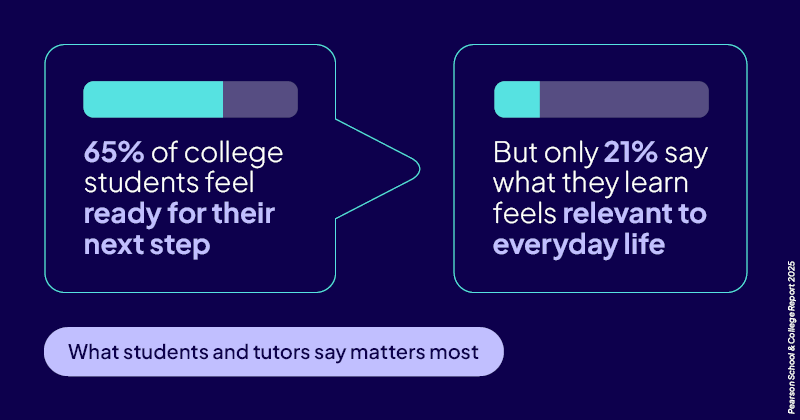
Data from Perspectives, Pearson’s first-ever college report, shows that two-thirds of students in England (65%) feel they will be ready to move on to their next steps by the end of their course, while more than half of tutors (54%) say their students are genuinely engaged in learning. The report also found a widely shared appetite for education that balances wellbeing and ambition, giving students the tools to succeed in work and life. However, just 29% of students told us they enjoy applying what they learn, while a third (33%) enjoy discovering new things.

For tutors, the priority is clear: help students develop problem-solving skills, communication, collaboration, self-confidence and a growth mindset that reframes ‘failure’ as valuable – all qualities Perspectives identified as most important for 16- to 18-year-olds.

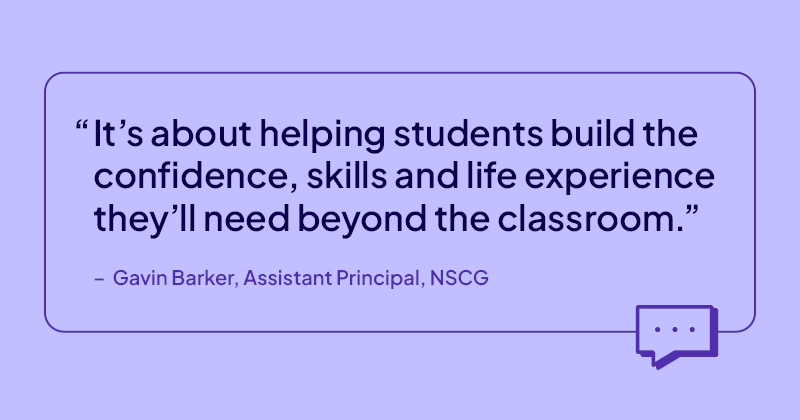
The Newcastle and Stafford Colleges Group (NSCG) exemplify the report’s findings in action. “We’ve got a number of initiatives to help students develop confidence and life skills,” says Gavin Barker, assistant principal for Teaching, Learning and Quality, “but honestly, a lot of it happens every day through skilful teaching, learning and assessment.

“We’re lucky to have a really skilled team of teachers and a pastoral tutor system that’s a bit different from other colleges,” he adds. “Our personal tutors only tutor. Their role is to support students’ development and act as a key point of contact. Because of this, they’re very well equipped to spot if a student is struggling with their wellbeing.”

Connecting learning to the real world

In Perspectives, students’ answers put “developing skills [to] use in everyday life” at the top of the most important reasons for learning, yet only 21% feel what they learn is relevant to their everyday experiences.  With life after the classroom understandably a major preoccupation for college students (almost four in 10 are worried about getting a job or progressing in their role), the findings suggest that grounding more subjects in wider world contexts could be the solution.

“Work experience and industry placements are a huge part of what we do,” Gavin from NSCG tells us, and are key to helping students see the everyday relevance of their learning. Every student, regardless of level or course, completes at least 24 hours of work experience. Ideally, it’s in the field they want to progress into, but sometimes it’s more about developing wider skills – for example, working in a charity shop to build confidence and customer service.”

Placements like this, as well as other initiatives like guest speakers, help students connect the classroom to life beyond it, reinforcing Perspectives’ finding that practical relevance is a powerful driver of engagement.
A drive towards digital skills

The report also looked at the transformational impact of technology, seeing responses that underscore both the importance of preparing students for rapidly changing careers and the recognition of digital literacy as a core life skill.

Through Perspectives, as many as 6 in 10 tutors are calling for curriculum reform to embed digital and AI skills, with 58% believing AI will have a positive impact on vocational job prospects in the future.

“One of the biggest misconceptions is that all young people are digitally skilled,” says Gavin Barker. “They’re confident on phones, but many struggle with Excel, PowerPoint or Word. Part of our job is ensuring they leave with those essential digital skills for higher education or employment.”

Yet there are clear gaps to be addressed among those teaching: while 6 in 10 (61%) feel confident in their own ability to help students develop digital skills for the workplace, many tutors feel they need additional support to confidently embed AI and technology into lessons.

At NSCG, leadership is tackling this issue by appointing a digital technologist across its colleges. Their role? “[To] help staff and students build digital confidence, with AI being a key focus.” Gavin adds: “It’s about helping students understand how to use AI ethically and effectively, and supporting staff to use it to enhance teaching, learning, and assessment.”

Life skills for lifelong success

Transferable skills – including creativity, critical thinking, teamwork and resilience – are seen as critical qualities too, Perspectives responses showed. A number of colleges have found proactive ways to teach them. NSCG’s Skill Up, Stand Out initiative is just one example.

“Three times a year, students assess themselves against ten key skills we’ve identified using local and national intelligence about what employers need,” says Gavin. “These include communication, confidence, critical thinking, digital skills, literacy, numeracy, resilience, technical skills, time management and teamwork. Tutors then use this information to adapt teaching – so if a group is struggling with teamwork, for instance, we’ll embed more group activities. It’s a way to make those transferable skills visible and intentional.”

By combining structured skills tracking with everyday learning, colleges can offer students vital tools to navigate interactions and experiences. Doing so aligns directly with one of  Perspectives’ key conclusions: that life skills and wellbeing are key to preparing students not only for their next academic steps or first job, but for lifelong success.
Preparing students for tomorrow

The discoveries of the report make it clear that colleges do so much more than meet basic course and qualification requirements. The value they place on life skills, digital literacy and opportunities for real-world connections shows tutors’ deep care for fostering confident, curious, capable learners.

What can this look like in practice? Colleges like NSGC are giving us their version of what’s possible. Alongside them, Pearson is here to translate research and insights into tangible change and experiences, helping prepare every student for a future of opportunities.

Explore the report

Let’s stop treating school apprenticeships as second-class training routes

As an academy trust with 19 schools across East Sussex and South London, we’re creating a workforce united by a mission to improve the life chances of all children.

Apprenticeships as a route into working for STEP Academy Trust have proved popular, with a growing number of apprentices across ICT, business administration, sports and premises, and now teaching via our new teaching degree apprenticeships.

Throughout this expansion we have learned lessons, including the importance of working with providers whose values align with ours.

However, apprenticeships in schools remain under-discussed within the wider skills landscape. And this is surprising given the number of support staff and teachers who enter the sector this way.

The best structure for apprenticeships continues to evolve, with the recent creation of Skills England, the introduction of the growth and skills levy and the importance of what prime minister Sir Keir Starmer describes as “gold-standard apprenticeships”.

Alternative training route

STEP introduced apprenticeships because we understood that everyone learns differently, and there are plenty of talented, passionate people who need a different environment to thrive.

We are proud that some of our senior leaders came through the apprenticeship route, so our values have been instilled from the outset.

We have also been well placed to learn from other qualification models, taking what’s working well from traditional routes into teaching, namely SCITT (School-Centred Initial Teacher Training) and ITT (Initial Teacher Training), and embedding them into our apprenticeships.

This is part of our commitment to ensuring our apprentices receive the same level of high-quality teaching, support and career development as those on traditional routes.

This inspired the creation of the STEP Apprenticeship Network and Mentorship Programme, designed to address some of the key barriers young people and career-changers face when beginning an apprenticeship. The network offers reflection and collaboration by connecting apprentices across departments, providing a platform to share learning and mutual support.

To deepen organisational understanding, senior leaders are invited to showcase career pathways, and each session concludes with hands-on activities that challenge participants and strengthen teamwork.

In addition, our mentorship model mirrors the PGCE. Each apprentice is paired with one of our eight mentors, who work within a different service and school. This broadens our apprentices’ exposure to various operational contexts, facilitates knowledge sharing and builds their confidence through guidance, feedback and peer learning.

The appetite for this support is shown by the near-100 per cent attendance at all of our apprenticeship network events. Apprentices report that they feel more confident and have clarity about their career progression.

In total, 90 per cent of those who have completed an apprenticeship with us went on to join us in a full-time position.

Possibility of progression

The success of this approach is also evidenced by the progression of our staff. For example, one of our cleaners embarked on the facilities apprenticeship. Not only has she qualified, but she has been promoted to assistant site manager and is now a mentor for other apprentices.

Ultimately, the programme is supporting our apprentices to reach their potential by facilitating opportunities to learn from their peers and maximising engagement by having consistent expert support around them.

This is accelerating professional growth by creating clear, supported pathways from entry-level roles to long-term careers in education. As a result, apprentices feel fully embedded and part of our mission.

While apprenticeships are a big part of our ethos at STEP, no pathway should function in isolation. There is much to gain from sharing insights from other career entry routes, which helps us to build a more inclusive, flexible and future-ready workforce.

New Ofsted inspection process is FE sector’s ‘chance to shine’, says Oliver

Ofsted’s refreshed approach to inspection and new focus on inclusion represents a “chance to shine” for the FE sector, chief inspector Sir Martyn Oliver has told college leaders.

New inspections under the reformed report cards system began last week.

Overall headline grades have been removed and the watchdog will now grade colleges in up to 16 individual areas – including inclusion for the first time – on a five-point scale from ‘exceptional’, ‘strong standard’ and ‘expected standard’ to ‘needs attention’ and ‘urgent improvement’.

Speaking to the Association of Colleges conference today, Oliver praised colleges as “among the most inclusive institutions in our entire education system”, highlighting their work with young carers, adults returning after long breaks from education, and learners with specialist needs.

Despite “no set definition of disadvantage at post-16”, he said, colleges “find ways to make education work for everyone who comes through your doors”.

“This, alongside recognising inclusion in our refreshed approach to inspection, is a chance for your sector to shine,” Oliver said. “It’s an opportunity to have your excellent work – work that’s been happening for some time, often without due recognition – properly acknowledged and celebrated.”

He added: “We want to support you to continue to be inclusive while driving achievement. These refreshed inspections should feel like recognition.”

From ‘best fit’ to ‘secure fit’

Oliver said the new inspection methodology responds directly to college sector feedback, particularly criticisms of inconsistent judgments under the previous “best fit” approach.

He acknowledged that “the definition of ‘best fit’ was creating confusion and, frankly, frustration” and that colleges felt “different inspectors were interpreting the framework differently”. 

“‘Secure fit’ brings a more robust, consistent approach to making judgments,” he said. “It means clearer criteria that everyone can understand and work towards. It’s more rigorous – and I make no apologies for that. But, crucially, it’s also clearer, fairer and more human.”

‘No read across’ from old grading system

Oliver also addressed misunderstandings about Ofsted’s new grades, stressing that the system is not comparable to the old one.

“There is no read across from the old judgments to the new grades. We are starting over,” he said. 

He described the new “expected standard” as “a high bar”, reflecting expectations set by government, and insisted that achieving it represents “a job well done”.

Ofsted is working to communicate the new grades to parents and learners, including green colour coding to indicate that “hitting ‘expected standard’ means you are good to go”.

Oliver said if providers achieve above expected standard, then “you really are flying”.

“Strong standard marks out excellent practice. Anything graded ‘exceptional’ is exactly that – truly among the very best nationally.”

He insisted the ‘needs attention’ is not the same as ‘requires improvement’ under the old system: “It is not a fail – that’s important – but it is an indication that there is work to be done.”

“This grade is about catching things before they become bigger problems,” he added, describing it as an “opportunity” and “a catalyst for improvement”. Oliver stressed that colleges should not be surprised by such findings: “We shouldn’t be shining a light on anything you haven’t already identified.”

Revised monitoring will allow quicker re-grading, he added: “If you address the areas that need attention, we can recognise that improvement promptly – and turn the amber to green.”

First report cards batch published

At an AoC breakout session this afternoon, Denise Olander, Ofsted’s acting deputy director of post-16 education and training, said the first report card reports will be published after Christmas and released in batches.

“We started inspections last week, and they went really well. We were pleased with them. But we will not be sharing our report cards until after Christmas,” Olander said.

“We will batch publish so those that go first don’t feel exposed. There’ll be a huge amount of reports that will be published from January onwards. So you won’t see anything in the public domain until then.”

Finalists revealed for 2025 Good for Me Good for FE awards

Staff and student volunteers, fundraisers and social action campaigners have been shortlisted for this year’s Good for Me Good for FE awards.

The finalists were unveiled on the main stage at the Association of Colleges annual conference in Birmingham this morning by Good for Me Good for FE co-founder and CEO Elevare Civic Education Group Sam Parrett and AoC chief executive David Hughes.

Now in their third year, the awards – sponsored by NCFE, The Skills Network and FE Associates – recognise colleges’ social impact and the millions of pounds of social value generated through community action. 

The 24 finalists announced today will be invited to a special House of Lords reception hosted by Baroness Nicky Morgan, taking place on December 5, where the winners will be announced. 

Parrett said: “The independent judging panel noted that the standard of entries was extremely high, reflecting the inspirational social action that is taking place at colleges across the country. 

“These amazing individuals and teams not only give their time to help others, they represent everything that the FE sector stands for: deeply embedded in their communities, with colleges acting as true anchor institutions.”

Good for Me Good for FE awards 2025 finalists:

  • Individual fundraiser of the year:
    James Shields (Loughborough College Group); Robert Smith (Dudley College of Technology); Loui Frost (Cheshire College South and West)
  • Team/college fundraiser of the year:
    Waltham Forest College; City College Plymouth; Queen Mary’s College
  • Student volunteer of the year:
    Autumn Barker (North Hertfordshire College); Olivia Cook (Lincoln College); Sultan Arel (East Coast College)
  • Staff volunteer of the year:
    Emma Shipstone (Nottingham College); Lewis O’Callaghan (MidKent College); Lisa Whait (Loughborough College Group)
  • Volunteering project of the year:
    Clair Firth (Leeds City College); Rebecca Myrie (Milton Keynes College); Autonomy Project (Sunderland College); Early Years Department (Blackburn College)
  • Volunteering accreditation excellence:
    Nottingham College; USP College; MidKent College
  • Inspirational role model of the year:
    Emma Shipstone (Nottingham College); Kerry Amos (USP College); Danny Lee (Loughborough College Group)
  • Outstanding long service award for volunteering:
    Frances Fahy (SGS College); Lisa Humphries (Chichester College); Ric Holmes (East Coast College)