The T Level pass rate has risen above 91 per cent while the proportion of students dropping out has continued to shrink.
A total of 11,724 learners from the fourth wave of T Levels received results this morning compared to the 16,081 who started the 2023 cohort.
It suggests 27 per cent left the course early. This is an improvement on the 29 per cent and 34 per cent dropout rate that was recorded in 2024 and 2023 respectively.
Dropout rates for those who took three A-levels last year were 10 per cent.
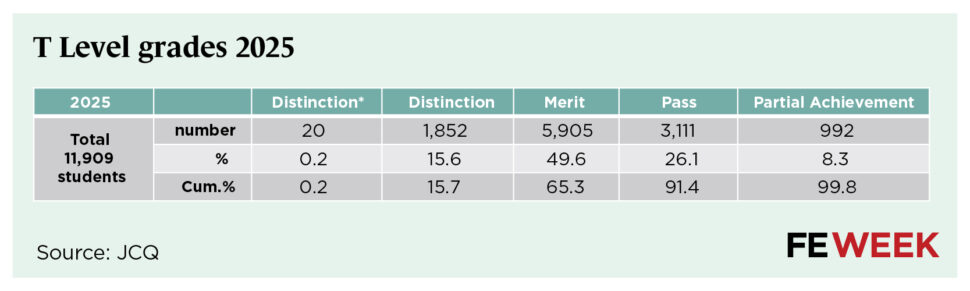
Meanwhile, the overall pass rate on T Levels has jumped to 91.4 per cent, up from 88.7 per cent in 2024. The total number of students in receipt of T Level results today was 11,909, which includes 185 from an earlier cohort.
Ofqual chief regulator Sir Ian Bauckham told FE Week a pass rate “in the 90s is an important threshold”.
“It will be great if we can move a bit further in that direction, so that when students spend two years studying for a T Level, they do come away with a grade,” he added.
T Levels were introduced in 2020 as the government’s new “gold standard” two-year qualifications that are meant to be the technical equivalent of A-levels.
A T Level has three parts – the core component involving an exam and employer set project, the occupational specialism where practical skills are tested and a minimum 315-hour, or 45-day, industry placement.
Today’s results cover 18 individual T Levels, two of which are awarded for the first time this year – legal and agriculture.
The number of students receiving results has risen 61.4 per cent from 7,380 in 2024 to 11,909 in 2025, while the number of schools and colleges offering T Levels has increased 57.4 per cent from 162 to 255.
The proportion of students that achieved the top two grades of distinction* or distinction fell marginally from 15.9 per cent to 15.7 per cent.
But merits were handed out to 49.6 per cent compared to 46.8 per cent the year before, and the proportion receiving a pass was 26.1 per cent compared to 25.9 per cent in 2024.
And 8.3 per cent of students received a “partial achievement” this year – which is where a learner attempts all elements of the T Levels but does not achieve all of them – down from 11.1 per cent in 2024.
The Joint Council for Qualifications only releases partial T Level data to journalists before 9.30am on results day, unlike A-levels which benefit from a full analysis.
The Department for Education will publish full T Level data later this morning, which includes breakdown by gender, region and other granular data including industry placement completions.
Results data for other vocational and technical qualifications like BTECs, which are sat by hundreds of thousands of students, is also sparse. Figures for these courses are due to be published later today.
Bauckham said: “Britain’s economic future depends on a skilled and knowledgeable workforce. All types of qualifications open doors of opportunity to students to contribute towards Britain’s economy.
“Whether students are using their results to continue in education or move into the workplace, they can be confident that they have qualifications that will stand them in good stead for their future.”
Arcadis has been working in collaboration with specialist post-16 provider Orchard Hill College (OHC) to explore how we can influence and challenge government guidance when it comes to SEND colleges and improve the quality of their teaching environments.
Architects reference the Department for Education’s (DfE) BB104 for designing inclusive and accessible educational spaces. It is a useful baseline, but falls short of addressing OHC’s cohort specific challenges – retrofitting existing buildings and dealing with commercial leases.
For students in the SEND system, preparing for life beyond education involves more than just academic achievement. It’s about developing independence, building life skills, staying healthy, and feeling connected. Crucially, it’s not only about supporting these students—it’s about creating inclusive communities where everyone is valued for their unique contributions.
There is an ongoing debate about whether more guidance helps or hinders innovation. From our experience, the lack of clear standards can lead to unsuitable buildings being proposed; spaces that are too small, lack outdoor areas, or aren’t accessible for students with complex needs. They may be spatially challenged, where the educator will be under pressure to increase their roll beyond capacity to support local growing need. Or perhaps existing buildings are technically challenged with corridors that are too narrow, no outdoor space, or ceilings too low for hoists.
Without a shared benchmark, it’s difficult to measure success or ensure quality. And when working with commercial landlords unfamiliar with specialist education, negotiations can become challenging. Their focus may be on preserving asset value, rather than creating inclusive, functional learning spaces.
That’s why we believe in expanding and refining design standards for the specialist independent college sector. Doing so would:
Give partners, such as local authorities, greater clarity and confidence when planning new schemes; and get a head start on engagement on schemes by ensuring they understand SEND expectations.
Help planning authorities assess proposals more effectively and reject poor-quality designs.
Ultimately, creating better developments will benefit the students in their learning environment and create a better workplace for staff.
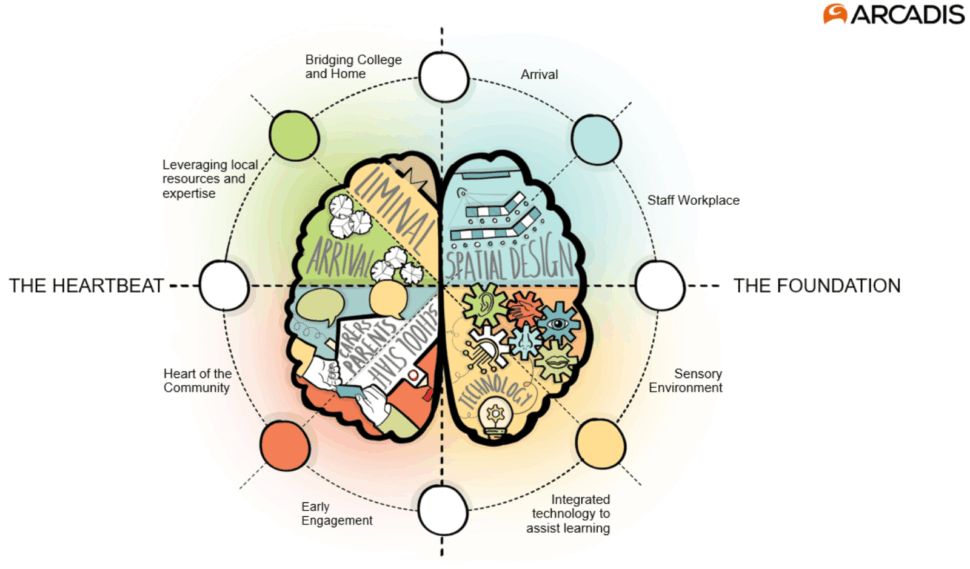
Our collaboration has identified gaps in the existing guidance around the areas most crucial for improving college learner outcomes. We believe the greatest impact can be achieved by providing direction across two key themes: The heartbeat, nurturing a sense of belonging and connection with the students and the community, and the foundation which incorporates the physical presence of college infrastructure.
The heartbeat
In recent times, workplaces have made significant progress in embracing neurodivergence, thereby breaking down stigma and fostering inclusivity. By embedding these values into the heart of colleges, we prepare students for the workplace and contribute to a more integrated community. The urban challenge lies in ensuring that the college is collocated with public facilities and positioned within a visible, accessible part of the community, reinforcing its role as a hub for learning and inclusivity.
Early community engagement shapes college development to reflect local needs.
Working with the community transforms SEND Colleges into vital resources. Adult learning programmes and partnerships with local employers destigmatise neurodivergence. Engaging the local workforce in college design and construction strengthens community ties. Collaboration with businesses, sports facilities, and health services creates work experience opportunities for students.
The foundation
Arrival: A controlled, safe, and accessible drop-off area is crucial for students to start their day calmly. In urban settings, a close-to-entrance drop-off point with a clear route reduces stress and helps students get on the right foot.
Sensory environment: Designing sensory-friendly spaces supports students’ physical, social, cognitive, and sensory skills. Calming design elements help mental health and long-term growth.
Layout: Effective spatial design caters to diverse student needs. Adaptable spaces, including transitional areas, provide opportunities for regulation and reflection.
Staff workplace: Supportive environments attract and retain staff. Proper acoustics, lighting, and ventilation reduce stress, while dedicated social spaces allow staff to recharge.
Integrating technology: Technology enhances learning and fosters independence. Adaptable spaces with sufficient infrastructure ensure technology serves its purpose.
source: Arcadis
We have applied our programme on to one of the new colleges for OHC, opening in September 2025 in a former Life Skills Centre which closed in 2023. The proposal has made significant interventions, all in agreement with OHC’s landlord, London Borough of Sutton, that deliver on the trust’s key requirements.
They include a new covered entrance that controls the ability to keep the students regulated and alongside a separate access road, access to outdoor space, and new rooflights bringing in natural daylight.
Project costs are modest yet will have so much impact on students’ life chances and for the community. With the right approach to development, a strong collective vision, early engagement with industry partners and the right advisors supporting the local authority and the trust, there is a pathway to greater inclusivity in our communities.
Of course, any new design standards must remain flexible. Every college and every cohort is different. But by setting a clearer foundation, we can build places that truly support every student’s journey to independence.
Skills England has today released its comprehensive report, Skills England: Sector evidence on the growth and skills offer, providing an in-depth analysis of the country’s current and future skills requirements across ten priority sectors. The quango’s third report marks a significant step in aligning the nation’s workforce capabilities with its economic ambitions, and keeps up its commitment to be data driven.
The report identifies critical skills shortages in sectors pivotal to the UK’s growth plans. The construction industry needs 100,000 additional construction workers a year to meet the government’s goal of building 1.5 million homes by 2029, a task made even harder by changes to the government’s immigration policy.
That policy is also likely to create challenges for the healthcare sector, which to no one’s surprise is also being impacted by an aging population and evolving healthcare needs. A radical rethink is needed that harnesses technological advances, differing skills needs and pay expectations.
And the transition to a green economy and advancements in manufacturing technologies have led to increased demand for technicians proficient in automation, AI and sustainable practices. This is a complex area where qualifications can struggle to remain relevant in a fast-moving world.
The digital sector requires a surge in professionals skilled in cybersecurity, data analysis, and software development to support the UK’s digital infrastructure and innovation. Investment is needed to support the challenges and opportunities provided by AI as well as the increase in cyberattacks.
To address these challenges, Skills England outlines several strategic initiatives already in play. The growth and skills levy aimed at encouraging employer investment in high-quality training programs, addressing the 19 per cent decline in training expenditure since 2011. We still await further details of potential changes to what employers can spend their levy on.
We’ve also just seen the announcement of new technical excellence colleges, aiming to train 40,000 individuals in high-demand construction skills by 2029. Whilst this is welcomed it doesn’t address existing shortages and 2029 is a long time away! Allowing for drop out rates and the current need, this would appear to be half of what is needed. Whilst apprenticeships will undoubtedly fill some of those gaps, they rarely fill higher skilled posts. And does Skills England hope the lifelong learning entitlement and micro-credentials will play a part? If so, it would be useful to have that reflected against these aims.
Finally, the apprenticeship reforms aim to streamline apprenticeship assessments to make them more employer-friendly, with a goal to revise all standards and assessment plans by August 2026. The sector is urgently waiting on further details on these changes.
Skills England emphasises the importance of collaboration with employers, training providers, and government bodies to refine and implement these strategies effectively. Upcoming roundtables and webinars are planned to engage stakeholders in shaping the nation’s skills agenda and it will be interesting to see how they develop.
This report serves as a call to action for all sectors to invest in skills development. However it urgently needs funding across the FE sector to support its aims. We have a current shortage of experienced tutors and lecturers who can both teach and bring current occupational experience. It would be useful to see incentives for recruitment and importantly retention.
We also face a shortage of qualified and experienced assessors in the sector and the new apprenticeship reforms will exacerbate that, with more posts needed within training providers and potentially employers. It would be good to see upskilling funding made available.
Capital investment into FE colleges and training providers is needed to support all the sectors highlighted by Skills England.
While the new technical excellence colleges will receive funding, this leaves other colleges and particularly training providers out in the cold. It will be interesting to see if additional capital expenditure is released on a wider basis. Let’s hope this message is heard in the roundtables.
Finally all this has to be set against the current economic restraints and the awaited Autumn Budget, now rumoured to be November. This report needs to act as a catalyst for skills funding that drives growth and creates employment investment but we know the priorities are defence and the NHS. We know employers are not replacing leavers and young people in particular are facing rising employment rates. But this is not addressed within the report. It’s great that we have skills shortages clearly set out, but without employer investment and potentially incentivisation it runs the risk of gathering dust on the shelf.
The government should reverse the “failure” of the apprenticeship levy by tripling the number of businesses that pay into it and releasing all funding raised by the tax to be spent on training, a Labour-linked think tank has said.
In its new report “Levying-Up: how to make the growth and skills levy work”, the Fabian Society argues that the levy system has crashed on its key goals of increasing the number of apprentices, meeting employers’ skills needs and driving social mobility.
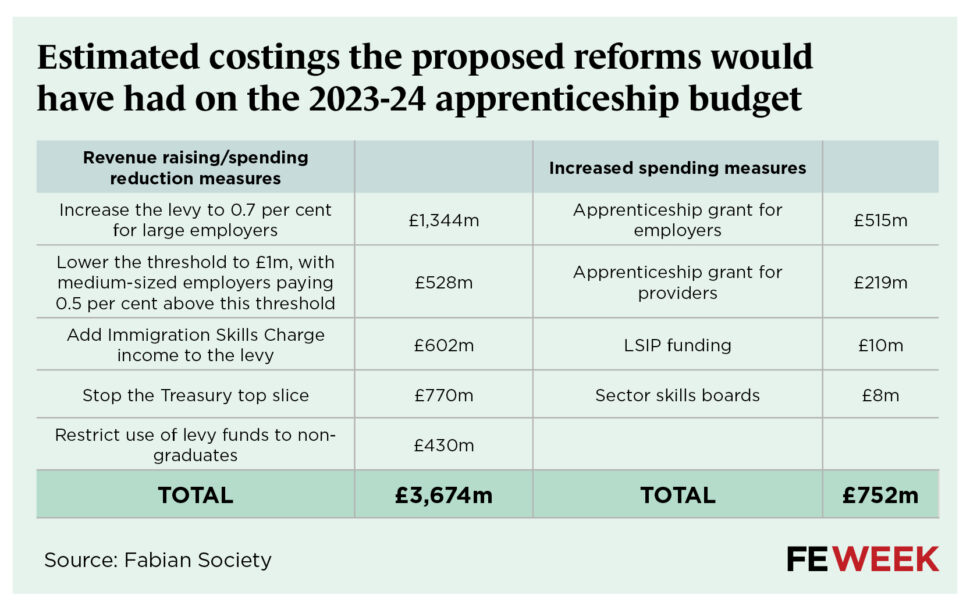
To “unleash growth and unlock opportunity”, the government should create a new “growth and skills fund” worth more about £5.5 billion – double its 2023-24 value – by lowering the levy threshold, increasing the cost for large businesses, and forcing the Treasury to ringfence income from skills charges for training.
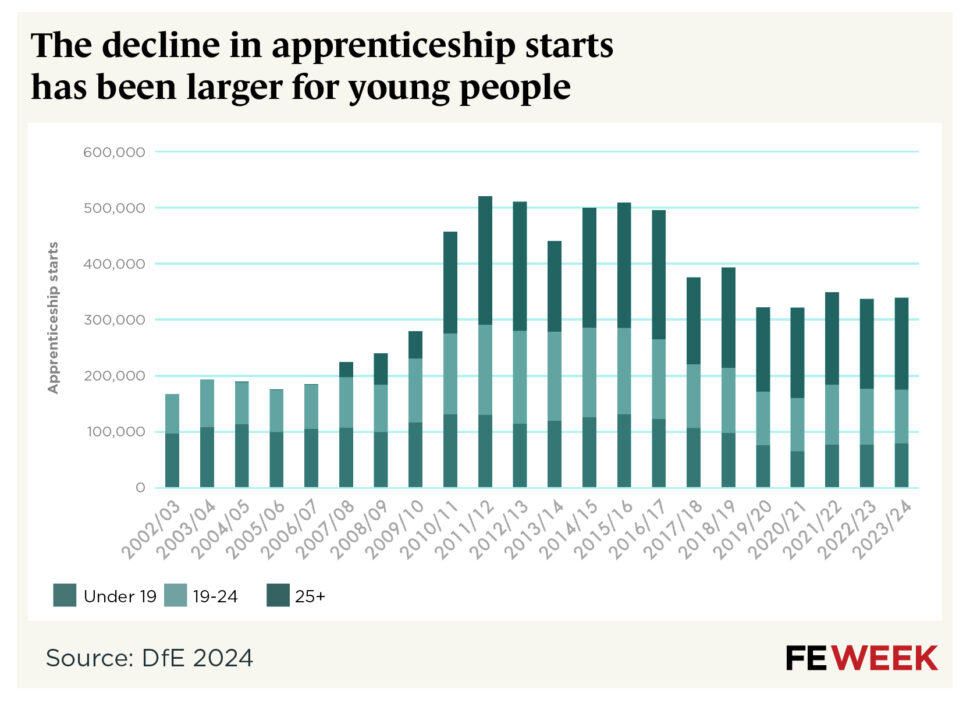
The report calls the levy system an “abject failure” at creating more apprenticeships, which have “plummeted” by 31 per cent since its launch in 2017 – especially “letting down” small and medium sized employers (SMEs) where the number of starts is down by half (48 per cent) – or at boosting employer investment in skills, which fell by £9.5 billion to about £44 billion between 2017 and 2024.
Report co-author Joe Dromey, Fabian Society general secretary, said the number of entry-level opportunities for young people has also “collapsed”, while employers have “increasingly invested in workers who are already well qualified”.
He added: “The government’s commitment to reform the levy is hugely welcome, but we need to see progress soon. The growth and skills levy must seek both to boost employer investment, and to redirect it towards those who could most benefit.”
‘Growth and skills fund’
Labour is currently reforming the apprenticeship levy into a “growth and skills levy”, where an unspecified portion can be spent on non-apprenticeship training in some priority sectors linked to the industrial strategy from April 2026.
The Fabian Society wants the government to go further. Its proposals include lowering the levy threshold from companies with a payroll of £3 million or more to £1 million, to ensure more SMEs have “skin in the game”.
Combined with increasing contributions from large employers from 0.5 to 0.7 per cent, levy revenue would grow by £2.55 billion, giving greater “headroom” to the budget (currently £3.075), which overspent for the first time in 2024-25.
However, results from a survey of 2,000 employers this year showed 60 per cent of non-levy payers opposed extending the levy, while 39 per cent supported a levy increase in return for increased flexibility.
The report said: “The decline in both apprenticeship starts and employer investment represents a drag on growth, contributing to growing skills gaps, and sluggish productivity growth.
“In reforming the levy, the government should seek to boost the size of the funding pot available to employers, enabling both more flexibility in how funds can be used, and greater total investment in skills, without a decline in apprenticeship numbers.
“It should do so through ensuring all funds raised by the levy are invested in skills, and through both increasing the levy and broadening the levy over time.”
End levy top-slice and lump in immigration skills charge
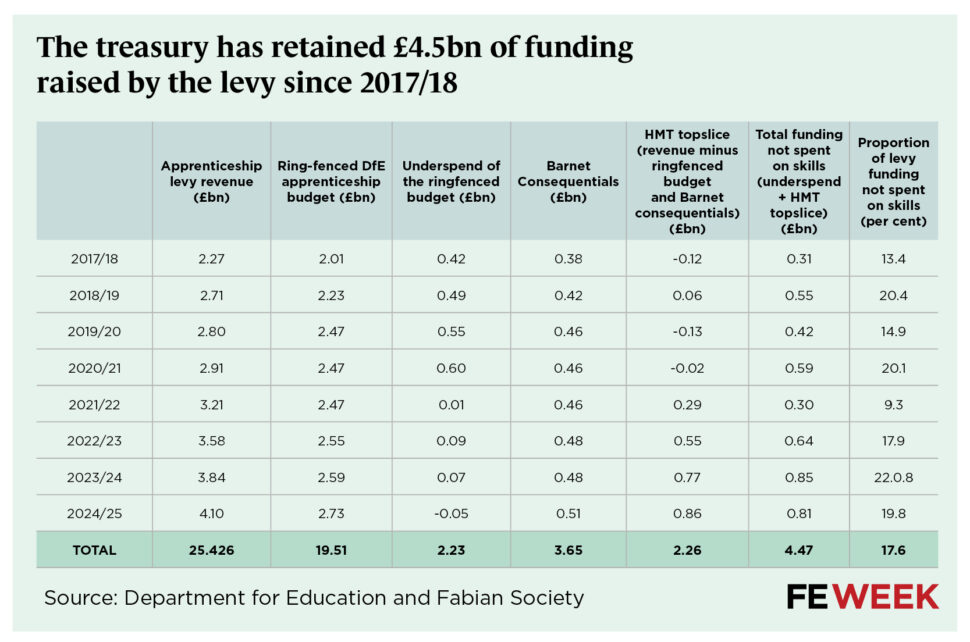
The report also argues that the Treasury should no longer retain its near-20 per cent top-slice of apprenticeship levy income. Updated analysis shows that between 2017-18 and 2024-25, £4.5 billion of funding raised by the apprenticeship levy was retained by the Treasury.
Government should also ringfence income from the immigration skills charge (ICS), which raised £668 million in 2023-24.
The ICS is a charge on employers who bring skilled foreign workers into the UK, introduced in 2017 with the promise of putting revenue “towards addressing skills gaps”, although how the funding is spent has never been confirmed.
Labour’s immigration white paper included plans to increase the charge by 32 per cent and pledged to use the ICS to support training in priority sectors.
The government faces “clear policy choices and difficult trade-offs” if it wants to avoid either another overspend or a “further decrease” in apprenticeship starts if flexibilities are added to the levy system, the report warns.
But it nonetheless argues that its revenue-raising proposals would create the financial headroom to give employers “greater flexibility” on what type of training they can spend the levy on.
This should be guided by Skills England and new sector skills boards to “lead” the system, as well as the industrial strategy, migration policy and devolved local government.
Rebalanced investment
The levy system has made the UK’s “stark inequalities” worse as funding is increasingly spent on higher level apprenticeships, for older and more educated learners, in more prosperous regions of England, and in large businesses, the report argues.
It added: “This shift is bad for growth, given apprenticeships for older workers have poorer labour market returns, and those at higher levels offer worse value for money.”
A key cause of this is the Conservative government’s “flawed ideology” that put employers in charge, which failed to either boost growth or widen opportunity because businesses chose to “rebadge” existing training as apprenticeships and maximised investment in their current staff and “alienated” SMEs.
The report also cites Department for Education statistics suggesting that apprenticeship starts in the most deprived neighbourhoods declined by 47 per cent between 2017 and 2024, while those in the least deprived declined by only 11 per cent.
To counter this “highly unbalanced” system, the Fabian Society has backed calls to ban graduates from levy-funded apprenticeships.
It said only apprenticeships for workers without a degree level qualification should be funded through the levy.
In addition to the restrictions to level 7 apprenticeships coming in from January 2026, this measure “would save £250 million, which should be redirected to investment for young people and lower-level qualifications”.
Bring back AGE grants
Government should also bring back grants for employers and providers to reverse the decline in starts at SMEs (48 per cent) and for young people (34 per cent), at an estimated cost of £515 million from the new, larger growth and skills levy.
The Fabian Society’s employer survey suggests a grant of £3,000 per start for SMEs employing an apprentice aged 16 to 25 would be “effective at incentivising employers”. The report argues that a previous scheme offering an employers’ grant between 2012 and 2017, known as the Apprenticeship Grant for Employers (AGE), was also “effective”.
A grant should also be created to incentivise providers to work with SMEs and young apprentices, with £1,000 and £1,500 available for each respectively, to “help them through the process”.
However, the survey suggested incentives were the least popular proposal to increase young apprentices, behind pre-apprenticeship training, advice and support, and restricting levy funding.
Overall, employers were “evenly split” on whether the levy should be more focused on young workers, with 39 per cent in favour and 39 per cent preferring an all-ages approach.
A DfE spokesperson said: “We are transforming the apprenticeship levy into a new growth and skills levy, which will offer greater flexibility to employers and learners and support the industrial strategy.
“In August we introduced new foundation apprenticeships for young people in targeted sectors, as well as shorter duration apprenticeships to break down barriers to opportunity and drive economic growth through our Plan for Change.
“To support business and boost opportunity the Government announced at the Spending Review that we will spend £1.2 billion more on skills by 2028/29, to ensure young people are developing the skills they need to succeed.”
With T Level and A-level results day fast approaching, young people across the country will be thinking about what comes next.
I wish them all the very best and want to particularly salute T Level learners for choosing what is still a relatively new but exciting education route.
These enterprising young people put their faith in a winning package. T Levels are quality, employer-designed pathways into rewarding careers, backed up by substantial industry placements.
Now, they deserve more than just congratulations. A healthy proportion of T Level students go straight into jobs after collecting their results, often following up on their work placements. But many progress to higher-level training and need the full support of a forward-looking skills system.
I’m extremely proud to be chair of Skills England, where we are lucky enough to work with expert employers, who understand their sectors and contribute outstanding insights and knowledge to help shape apprenticeships and other training. We are also committed to co-creating solutions with FE and HE providers, regional partners, and departments across government.
Skills England’s success will be built from outstanding partnerships and we will always be prepared to listen and learn.
But while the benefits of harnessing all that first-hand expertise are huge, it’s also vital that our work follows the evidence. We must and will be data-driven.
Learning the right skills
We have today published a new report: Assessment of Priority Skills to 2030. It analyses future employment needs across ten critical sectors, aligned with the government’s industrial strategy and plan for change.
Our findings show that demand for jobs in priority occupations is expected to grow significantly by 2030.
Jobs in areas such as digital, adult social care, construction, and engineering will experience some of the biggest increases in demand.
Added to this, the report highlights the scale of demand.
Over a quarter of a million people enter priority occupations from the skills system each year. Those are vast numbers, and we need to double down on making sure they learn the right skills.
It is also important to recognise the levels of training required. Our analysis found that one-third of the projected extra demand in priority occupations will need workers with a career entry-level qualification. The rest will require higher-level qualifications and training that many of the young people about to get their T Level and A-level results will soon be progressing to.
This is the third major publication from Skills England.
In September 2024, we published Driving growth and widening opportunities, which outlined how skills can drive UK growth, along with an initial assessment of skills needs in the economy. An important insight I drew from this was that far too many employers and learners found the skills landscape baffling. The system is too complex and fragmented. Skills England will help simplify it.
In June 2025, we published Skills England: Skills for growth and opportunity. This summarised findings of our analysis and engagement on the growth and skills offer, and skills needs assessments for the 10 priority sectors. Key takeaways from this included that apprenticeships needed to be more responsive and flexible.
No room for complacency
Together, the three publications amount to a major step forward in our understanding of the skills landscape.
However, there is no room for complacency.
With seismic shifts in technology — particularly the accelerating impact of AI — the shape of our economy is in flux. That’s why Skills England is doubling down on future planning, continuously monitoring emerging trends and refining our thinking as fresh data becomes available.
It’s about staying ahead of the curve and providing the nation’s future workforce, including the wonderful young people who will be receiving their results in the coming days, with the skills they will need to succeed.
An early years training provider in West Yorkshire has received top marks from Ofsted for its “culture of high standards” and high level of distinctions achieved by apprentices.
Leeds-based Cliffe House Training Academy impressed the watchdog with apprentices developing their professionalism quickly and a “substantial proportion” taking on more responsibility at work, according to its first full inspection report published today.
The provider began to offer early years apprenticeships to staff at the seven Cliffe House Day Nurseries and five other nurseries in West Yorkshire in January 2023.
It had 14 apprentices on level 2 early years practitioner apprenticeship and 15 on the level 3 early years educator apprenticeship at the time of its June 30 to July 2 Ofsted visit.
Inspectors found Cliffe House leaders “carefully” plan curriculums, which results in apprentices conquering the fundamental knowledge they need, particularly for level 2 apprentices, many of whom are new to the sector.
The report noted that apprentices swiftly develop as professional practitioners and make “exceptional progress” from their starting points.
The assessment of apprentices’ progress was found to be “very thorough”. For example, level 3 assessments include a project where apprentices demonstrate how they apply their child development knowledge to support children successfully.
Inspectors were also wowed that tutors worked with employers “exceptionally well” to coordinate work-based training and classroom-based training.
Tutors also assess the English and maths skills and “very effectively” plug the skills gaps that apprentices come to them with.
The report said: “Tutors support apprentices well to fill gaps in their mathematical skills through a range of activities such as learning how to budget. The few apprentices who need to gain functional skills qualifications in English and mathematics achieve these quickly.”
Ofsted inspectors also pointed out that leaders make sure that staff workloads are “manageable” and that they have effective arrangements for overseeing the quality of growing apprenticeship provision.
For example, managers frequently meet with tutors in standardisation meetings to share good practice and discuss any concerns.
The report said: “Apprentices have highly positive and mature attitudes to their learning. They thrive in a culture of high standards and expectations set by staff. They are highly committed to developing their knowledge and understanding of early years, recognising the considerable responsibilities that they have for children.”
All apprentices who have completed their apprenticeships so far have passed, with “many achieving grades at distinction level”.
Tori Doherty, training manager at Cliffe House Training Academy told FE Week: “We are proud that this high quality of education has been reflected in all areas of our recent Ofsted inspection, gaining outstanding across the board.”
“One stand out element of our delivery programmes are Skills Builder Days which are a great hit with our students and really help to build a wider skill set,” she added.
From September, the provider will be starting to deliver the Level 5 Early Years Lead Practitioner standard, which has had a “great amount of interest in so far”, Doherty added.
“I am very proud of our teams achievement and we are excited to see our delivery programmes continue to progress and develop, to ensure our students always gain a high quality apprenticeship that develops their wider skills too,” she said.
Results day is a key moment not just for students, but for the teachers, advisers and colleges who have supported them every step of the way.
Each year, most students go on to secure their first choice (known as their UCAS ‘firm’ choice). Last year, a record 279,550 18-year-olds in the UK were accepted into university.
But for those who don’t get the grades they had hoped for, may wish to revisit their decision, or are applying for the first time – being up to speed on the full range of options available can make all the difference. So here’s how teachers and advisers can help students feel prepared and informed.
Understand the options
If, come results day, students are still looking for an available place (rethinking their plans and considering a different course or institution, or even submitting an application for the first time) they’ll enter clearing — the final stage of the UCAS admissions process.
Clearing allows students who have received their results to find university or college higher education places that are still available. Clearing opened on July 5, and many students may already be researching clearing options.
UCAS’ message to applicants is to build a results day plan in advance and reflect on any research they did earlier in the cycle, so they are ready whatever happens.
When guiding students through the process, you may want to encourage them to revisit the original five choices they listed on their UCAS application. Many students ultimately decide to return to one of these institutions through clearing, so it’s worth considering them again as viable options.
You could also suggest they make a quick checklist to prepare for clearing, like jotting down their top choices, key phone numbers, and a few reasons why each course stands out.
Utilise tools and resources
UCAS has a dedicated space, with practical tips and useful resources to help you guide your students in making informed decisions about their future.
The UCAS clearing toolkit is another really useful resource. It includes lots of material, such as an editable checklist to help you prepare for results day, and posters to help students visualise their next steps.
Knowing what each application status means is essential for supporting students. UCAS’ guidance can help with this, giving you a summary of what each status means so you can confidently talk students through their next steps.
A crucial part of the clearing process for students is contacting universities and colleges to discuss available places.
You may want to signpost them to UCAS’ videos offering advice on how to approach these conversations. It’s also worth reminding students to have their UCAS personal ID and clearing number ready when making those calls.
For students who accept their place on results day, UCAS also provides guidance on what comes next – from budgeting and finding part-time work, to securing accommodation and looking after their mental health.
We also recognise the significant role parents, guardians and carers play in supporting the young person in their lives, especially on results day.
To ensure they feel fully informed and confident, we’ve created a clearing toolkit for parents which you can share with them, to help them in supporting a young person with their options and decision-making.
Of the nearly 90,000 people currently in custody across England and Wales, almost half arrive without any formal qualifications. At the same time, more than half of those assessed upon enrolling in education in prisons are found to have some form of learning difficulty or disability – ranging from dyslexia and dyscalculia to ADHD and developmental issues.
Despite these barriers, a significant number of prisoners actively seek out learning opportunities.
We know this, because we have an ongoing partnership with the Ministry of Justice who have adopted our AI-driven Assessment and Learning solution in over 100 prisons in England. The solution is focused on functional skills improvement in English, maths and digital.
Encouragingly, functional skills achievements in prisons are on the rise. In 2023-24, there were 17,126 full or partial achievements in English, maths, or ICT – an 18 per cent increase from the previous year when adjusted for population size. This upward trend reflects a growing commitment to education within the prison system, and a shift toward digital solutions that enhance engagement and accessibility.
For many, education is more than a way to pass the time. It’s a chance to build a future, gain meaningful employment after release and break the cycle of reoffending.
The desire to learn is real and widespread. In 2023-24, over 47,000 prisoners completed initial assessments in English and/or maths – more than half the prison population. These assessments are invaluable. They not only provide an accurate level of attainment but can help uncover undiagnosed learning difficulties. Armed with the right information, assessors can then use digital assessment and learning tools to create individualised learning plans – giving each learner the tools they need to succeed.
Digital learning platforms offer a scalable, secure and adaptive way to deliver education in environments where traditional classroom settings may be limited. The best of these platforms use AI to tailor content to each learner’s ability, adjusting questions based on previous responses to ensure the learner is stretched and challenged. Multimedia formats keep learners engaged, while accessibility features such as adjustable fonts, screen readers and simplified interfaces support those with learning difficulties.
The impact is measurable. Prisoners who participate in education are 7.5 per cent less likely to reoffend within a year of release and those who complete functional skills courses are significantly more likely to secure employment. These statistics are not just numbers. They represent lives changed, families stabilised, and communities strengthened.
For the individual, prison learning offers a renewed sense of purpose, improved self-esteem, better coping mechanisms and a way to reclaim identity. For many prisoners, education is the first step toward seeing themselves as capable, worthy and ready to contribute to society. This is a shift from being defined by past mistakes to being empowered by future possibilities.
However, delivering digital education in prisons comes with unique challenges. Security protocols mean internet access is tightly controlled. So any digital platform must operate within a secure, closed environment. The ideal solution balances safety with functionality, offering robust educational content without compromising security. It must also be intuitive and user-friendly, especially for learners who may have limited digital literacy.
The right solution must also keep pace with technological change. Long-term prisoners face a world transformed by technology. And without exposure to the latest digital tools, even basic tasks like online shopping or banking can feel insurmountable. Keeping prison education software up to date ensures that learners are not left behind. It prepares them not just for employment, but for everyday life in a digital society.
Ultimately, digital education offers more than skills. It offers hope. With the right tools, prisoners can rebuild their lives, reduce their chances of reoffending and rejoin society with greater purpose. For those on the inside, digital education offers a pathway to dignity, independence, and reintegration. These positive outcomes extend far beyond the prison walls.
With just one month to go to EuroSkills 2025, Anviksha Patel was invited to get a glimpse of the behind-the-scenes preparation that WorldSkills UK puts its competitors through ahead of the international competition.
A group of 19 young students and apprentices gathered from England, Wales, Scotland, and Northern Ireland at the University of Warwick last weekend for their final training bootcamp before travelling to Herning, Denmark, in September.
Together, they are Team UK and they will go head-to-head against around 600 other young professionals from September 9 to 13, competing for bronze, silver and gold medals in their vocational specialisms, which range from cabinetmaking to mechatronics to hairdressing.
WorldSkills UK’s training programme is an intense schedule for Team UK and the dedicated band of training managers that support them. There are multiple pressure tests against international counterparts and exercises on handling the mental pressure that comes with competing for your country on the international stage.
Parisa Shirazi, WorldSkills UK’s director of standards, said the support has to be wraparound and holistic.
“This weekend is primarily positioned around equipping those individuals with competition craft, in terms of the things that will help them improve their game, from lean working principles, so work organisation management all the way through to focus and distraction control,” she said.
At the bootcamp, competitors and training managers heard from the organisation’s health and wellbeing team to understand how nutrition and sleep will impact their performance.
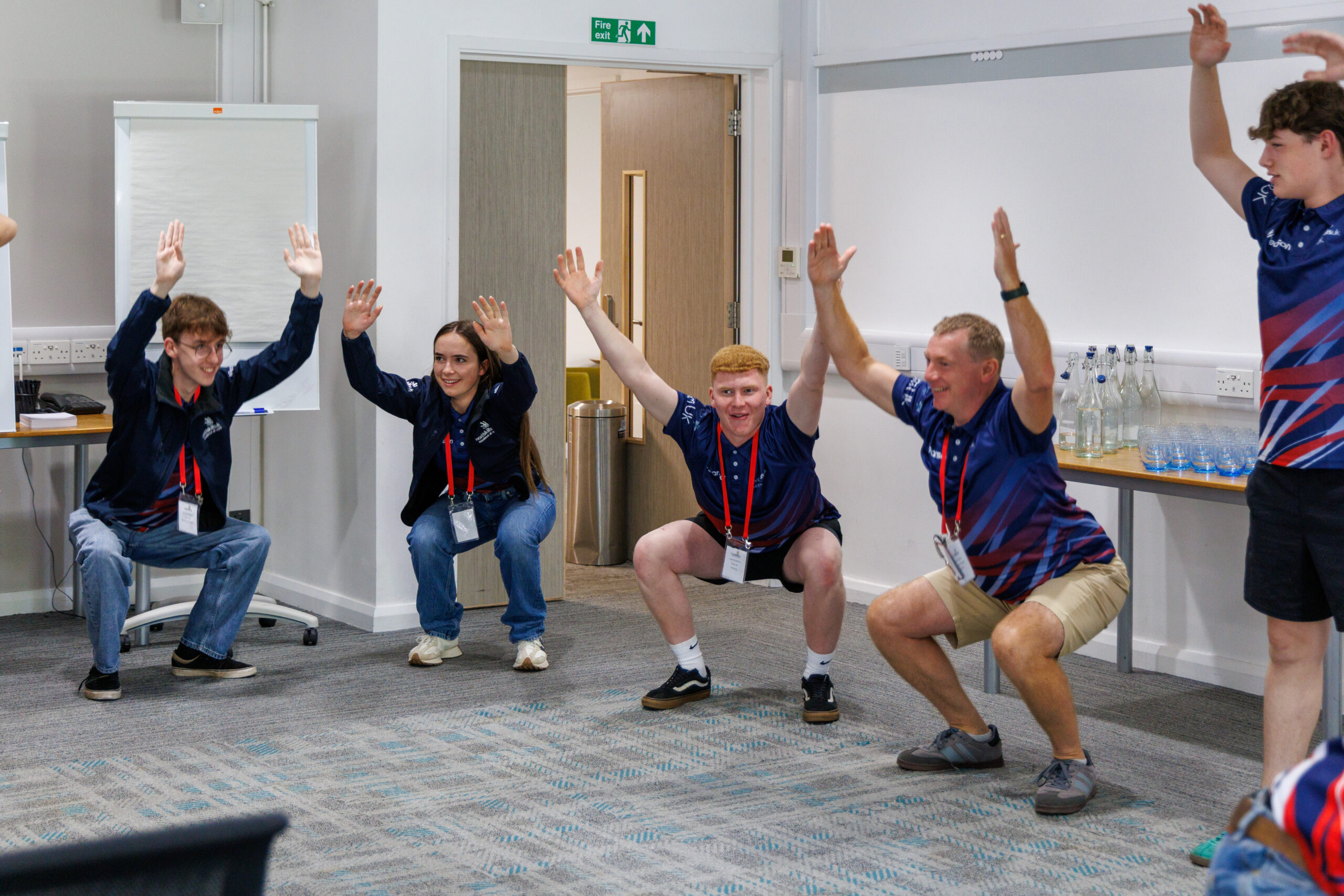
They also had a stretching session, which competitors are expected to practise before each competition day. There was mindset training too, teaching the team how to get out of their heads and focus on the task at hand.
Stretching session at WorldSkills UK bootcamp, University of Warwick
In a session delivered by one of the WorldSkills UK team, competitors focused on all the potential distractions they could encounter at EuroSkills; members of the public cheering and filming them for hours, potential sabotage by rival competitors and even how to coordinate toilet breaks.
“Just by being in a large public environment is going to be quite overwhelming,” Shirazi said.
She added: “We instil some of the steps, practices and methods that are going to help you perform at your very best, and this is about personal best.
“Yes, it’s the European championships, but all we can ask of these individuals is to have that mindset that’s going to enable them to kind of push beyond where they are at, making sure that they’re striving for excellence.”
Pressures of training
Melody Cheung, graphics design competitor
The 19 competitors will participate in 17 skills at the European event. The competition marks a milestone in the 18-month training schedule, which crescendos at WorldSkills 2026 in Shanghai, China.
EuroSkills Herning will see the first UK entry in the graphic design competition, represented by 19-year-old Melody Cheung, a student at Bridgend College.
She told FE Week that she was feeling the pressure a little.
“It’s a lot of pressure, but at the same time, there’s nobody to compare me to, which has its downfalls, but again, there’s nobody to compare me to. So we don’t have previous training to look back on.”
Cheung was homeschooled and had her first experience of mainstream education at college, studying a level 2 art and design before moving onto a level 3 animation course.
When asked how it has shaped her journey to Team UK, she said: “It’s important that I am where I am from being homeschooled because I think there’s a lot of disbelief about homeschool kids.”
Her biggest challenges for this competition are flying abroad for the first time and the potential distractions of the competition hall.
Web technologies competitor Finn Gallagher was feeling a bit nervous about travelling too.
“I haven’t been to another country before,” he admitted.
Finn Gallagher, web technologies competitor
The Cardiff University student’s confidence has grown a lot since joining the WorldSkills squad 18 months ago.
“Towards the start of the competition, I wouldn’t really say I’m somebody who actively strives to push myself out of my comfort zone,” he said.
Examples like the bootcamp weekend itself, meeting new people, and conversing were especially challenging initially.
But Gallagher said his coaches have provided tips to hone their craft that have bled into his everyday life.
“I think one thing that they focus a lot on is time management,” he explained, adding that he is currently juggling two jobs as well as university work.
“Definitely at the start of university, I found myself a procrastinator, disorganised, and a tiny bit messy, but they give us tips to like handle that, how to schedule ourselves, and I found that also very applicable to my personal life as well.”
Most of Team UK have other commitments, such as self-employment, like mechatronics competitor Jason McVerry or being part of another national team, like health and social care champion Grace Longden.
Longden is a UK triathlete in her age group and is eagerly awaiting her T-level results this week, with the hope of studying physiotherapy at Keele University.
“Confidence has been quite a big thing for me,” she said.
“Before WorldSkills, I wasn’t as confident, I was quite a quiet person. But now it’s just developed my communication with other people and built my confidence that I have that self-belief in me, that I am good enough.”