


A rule that blocks apprentices from accessing their legal entitlement to English and maths training will be changed, it has been confirmed.
Officials are also considering amendments to apprenticeship funding rules covering visas, workers employed across UK borders, subcontracting, co-investment collection for completion payments and additional learning support reimbursements.
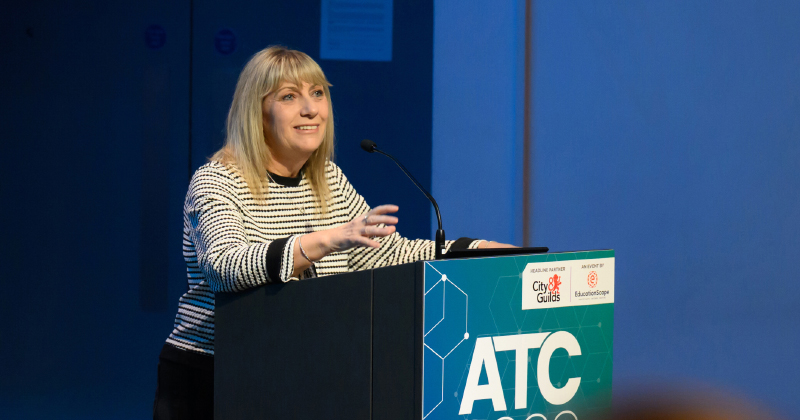
Department for Work and Pensions’ head of funding delivery Tracey Cox outlined multiple rule change proposals that could come in from 2026-27 during a workshop on day two of this week’s Apprenticeship and Training Conference.
Here’s what you need to know.
English and maths double funding
Ministers announced on February 11, 2025, that an exit rule forcing apprentices without a GCSE pass to achieve a functional skills qualification in English and maths to complete their training was scrapped with immediate effect for those aged 19 or older.
Employers must now agree for older apprentices to opt in to study English and maths. When employers do not agree, apprentices should still be able to exercise their statutory entitlement to level 2 English and maths.
However, current apprenticeship funding rules do not allow apprentices to study the subjects using alternative funding streams while on an apprenticeship.
Cox said the issue had generated a high volume of queries and complaints over the past year.
The government is now looking to change the rules on “double funding” in the English and maths section to “allow for apprentices to seek adult skills fund (ASF) funding outside of their apprenticeship in circumstances where their employer does not allow them to study English and maths as part of the apprenticeship”.
This will hinge on funds being available locally, and apprentices may have to use a different provider if their apprenticeship trainer does not hold an ASF contract.
Learning support cash should double
All education and training providers have a duty under the 2010 Equality Act to make reasonable adjustments for those with learning difficulties so they are not placed at a “substantial disadvantage”.
The main source of funding, the additional learning support (ALS) fund, is a fixed £150 per month intended to pay providers for adjustments such as additional assessor visits and specialist equipment.
Cox said the government receives “continuous feedback” that providers are not claiming this funding due to fears of clawback following several high-profile cases, and because the process can be “burdensome”.
Her department has recommended reviewing the policy, including the funding level, but Cox said this would be a longer-term project and any changes would come in from 2027-28 at the earliest.
She asked ATC delegates how much they spend on learning support per eligible learner each month, and discovered it was at least double the current £150 amount.
Break the co-investment and completion payment link
Under current rules, apprenticeship providers must collect and record each employer’s co-investment payment in the individualised learner record for their 20 per cent completion payment to be released, even if the amount is minimal. This must be done by the final return – known as R14 – in the academic year the apprentice completes.
Providers say the rule is burdensome and increases operational costs because staff must track and chase often small co-investment payments, while providers take a financial hit if the money is not collected on time.
The DWP has recommended “removing the link between collecting co-investment and releasing the completion payment”. However, as there is a financial impact to the government, this “needs further exploration” with the Treasury.
Cox said if approved, it “could make a big difference” for providers.
50% working time in England
To be eligible for English apprenticeship funding, an individual must spend at least 50 per cent of their working hours in England over the duration of the apprenticeship.
Cox said she believed the government “should allow greater flexibility in this area” after receiving “a lot” of queries about learners working for employers close to UK borders.
Her team is working with the four nations to “come up with some kind of agreement on what is acceptable across the board”.
Visa clarification
The rulebook states that a foreign learner must be able to fully complete an apprenticeship within the time available before their visa expires.
Cox told ATC the rule had frustrated providers who have apprentices due to complete after their visa expiry date but who plan to extend their visa when they are able to apply for renewal.
Visa extension can be a slow process and they are typically only extended in the six months before expiry.
Analysis suggests that in most cases applications for extensions are granted, Cox added.
The DWP plans to add the following clarification to the funding rules: “Providers must not fund learners who would not have enough time on their visa to complete their course, and who do not intend to or would not be eligible to renew their visa where the course continues past the learner’s visa expiry date. Providers may at their discretion fund that learner only where they have a high degree of confidence that the learner intends to renew their visa.”
A clear subcontracting definition
Apprenticeship subcontracting rules underwent a significant review in 2022. Officials are now looking to update their definitions after finding some providers are failing to declare subcontracting because they are unsure what counts.
Cox said there were around six cases where auditors proposed to claw back all funding handed to providers because rules were misinterpreted.
She said that “everything is subcontracting when you don’t deliver it yourself to a learner”.
But there are areas, such as first aid training or a talk from a tax expert, where Cox believes this should be declared but not classed as subcontracting.
Officials are working on a new, clearer definition.
The DWP is also aware of requests from providers to use subcontractors not on the official apprenticeship provider and assessment register (APAR). Providers can already do this if the total amount subcontracted is less than £100,000.
Cox said her department wanted to provide “further clarity and consider how we can improve the current de-minimis arrangements to allow expert input to training delivery by non-APAR providers”.













ALS is NOT limited to £150 a month and I’m frankly amazed that the ***Head of Funding Delivery*** does not know this…
Whilst the ILR only generates £150 per month, any excess can (MUST!) be claimed via the Earnings Adjustment Statement, a situation that has been in place for well over a decade. What is *wrong* with people???