

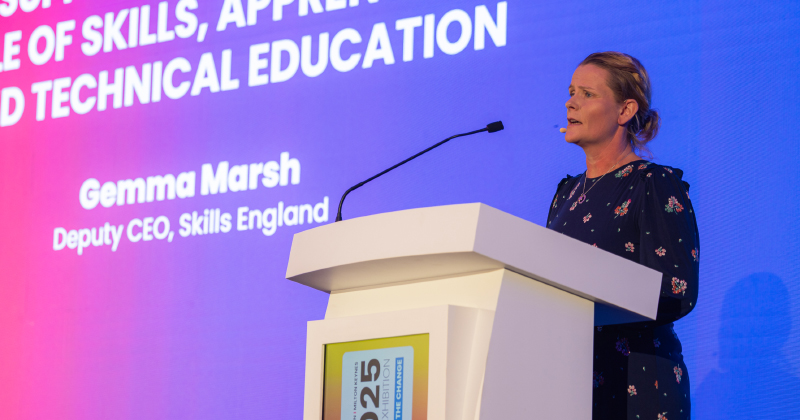
Incoming assessment reforms will not “dilute” or “dumb down” apprenticeships, a Skills England boss has claimed following a backlash from employers.
Gemma Marsh, Skills England’s deputy CEO, acknowledged widespread concern from businesses, especially in safety-critical industries, that plans to streamline the assessment of apprentices will lead to some learners qualifying without proving they are competent.
But she insisted at the Federation of Awarding Bodies (FAB) conference that Skills England, a government agency belonging to the Department for Work and Pensions, is “not rushing”, is “listening”, and is determined to take a “pragmatic approach”.
“I’ve really been trying to get under the skin of assessment reform,” said Marsh, who joined Skills England six months ago after 23 years working in Greater Manchester.
“Nowhere in these reforms is it about diluting. It’s not about reducing competency. It’s not about dumbing down – you have my word on that.”
She added that the government is “not throwing the baby out with the bath water” but pressed the need to “simplify” the current system.
Her comments follow an FE Week investigation into discontent from the first five pilots of reformed assessment plans, and alarm that Skills England is “bulldozing” through changes without properly consulting and listening to employers and sector experts.
Skills England’s plans include having mandatory and independent assessment for only around 40 per cent of an apprenticeship’s knowledge and skills statements, with the remaining 60 per cent being “sampled”.
Officials also want to make mandatory qualifications, that sit within over 100 apprenticeships, the sole method of assessment for some of those standards and also remove independent assessment of behaviours entirely, leaving employers to “verify” them internally.
‘Not on my watch’, say chief regulator
Skills England plans to publish the names of the first batch of apprenticeships that will officially go through the assessment plan reform process before Christmas. They will be linked to industrial strategy sectors.
The plan is to then plough through the 700-strong suite of apprenticeships in England during 2026, with a target end date of August 1 for getting all apprenticeships started on the process.
Delegates at today’s FAB conference hit back at this timescale, telling Skills England officials it was “impossible” and “unmanageable”.
Sir Ian Bauckham, Ofqual’s chief regulator, also spoke at the conference and acknowledged the concern raised by employers and experts and recognised the “demanding” timescale.
He claimed apprenticeship quality would not be compromised on his watch.
“Of course, I recognise there are mixed feelings about this [apprenticeship assessment reform], and in particular, concerns that some of the changes may lead to a dilution of quality,” Sir Ian said.
“I want to reassure anyone who might be concerned about this, that Ofqual intends to regulate to ensure apprenticeship assessment remains a valid and reliable signifier of occupational competence, and there will be no compromise on quality on my watch.”
‘Competency is key’
Marsh stressed that the pilots were a “test phase”, and added: “Every sector is different, and that’s absolutely what we’ve learned.”
She said the reforms would not be applied uniformly across all standards, emphasising that “not everything is a one-size-fits-all” and that Skills England must take a “practical approach”.
Marsh also insisted the reforms were not being pushed through quickly despite political pressure to streamline apprenticeship assessment and increase completion rates.
“Please take one thing away from today: we’re not rushing. We are listening,” she said. “We want to build this with you, and we want to take all of your advice on board.”
She also made a plea for the sector to “reset” the tone of the ongoing debate, arguing that anxiety around lower standards had “got lost in the language”.
“This is not about dumbing down competency. This is not about diluting assessment,” she said. “Quality is key, and that will remain. Competency is key, and that will remain.”
FAB CEO Rob Nitsch said: “The desire that we now have a reset that leads to us working more closely together was clearly expressed; it will be important that this is carried through – we will be very committed to ensuring that it is.”
Employer-led or pro-employer?
The government’s language recently shifted from the skills system being “employer-led” to taking a “pro-employer approach”.
Asked directly about confusion over whether the apprenticeship reforms remain “employer-led”, Marsh argued the labels do not matter.
“Language is a wonderful thing, isn’t it? Because I’m not very civil servant a lot of the time, my language is completely different,” she said.
“Employers are absolutely critical. We need to listen to employers, we need to make sure we are meeting their needs – but they also have to meet us halfway. They are part of that journey and are accountable for ensuring that we have good jobs, better jobs and the skills we need.”
Marsh added that Skills England was exploring new “expert pools” which involve wider engagement beyond trailblazer groups to ensure more voices feed into standards development and assessment design.












It is even more worrying that the senior leadership of Skills England are in denial!
It’s a terrible shame that they are even thinking of heading in the direction of frameworks or whatever you’d like to call them.
It will end up with the same old weak monitoring by dodgy TPs / colleges and unscrupulous employers taking advantage of uneducated youth.
Scandalous knee jerk bull***^