


Andy Burnham has staked his reputation on transforming Greater Manchester into the UK’s flagship region for technical education. His ‘MBacc’, billed as the country’s first employer-driven alternative to the EBacc, is a bold attempt to shift the hierarchy of school subjects and tilt a whole system towards skills.
It even now has its own accreditation – the ‘MBacc award’ – created with the Baker Dearing Trust.
But behind the high-profile launches and minister-baiting speeches, the rollout has been slower, messier, and more contested than the mayor lets on. Education leaders praise Burnham for elevating the status of vocational education. But privately some are questioning whether Burnham’s zeal for school-level reform is distracting from the adult learning policy he actually controls.
MBacc lowdown
Burnham launched the MBacc in 2023 as a set of post-14 subjects aligned to Greater Manchester’s growth sectors.
It was designed as a direct counterweight to the EBacc – a school accountability measure assessing how many pupils achieve a grade 5 or above in English, maths, science, a humanity and a language GCSE. Only 36 per cent of Greater Manchester’s 16-year-olds achieved the EBacc, far below the former Conservative government’s 90 per cent ambition.
The MBacc promises English, maths and science alongside specialist subjects aligned to the region’s key growth sectors: construction and the green economy, creative and cultural industries, digital, early years, engineering and manufacturing, financial services, and health and social care.
But the MBacc has since broadened into a more vague promotion of technical education, with almost any new FE-related policy in the region brought under its banner.

Teething problems
Fourteen months after launch, the numbers remain modest. Only 53 schools – 17 per cent of the region’s secondaries – are engaged in the curriculum changes. The original deadline for every school, college and specialist provision to have an MBacc route “embedded into the curriculum” has quietly shifted from 2030 to 2035.
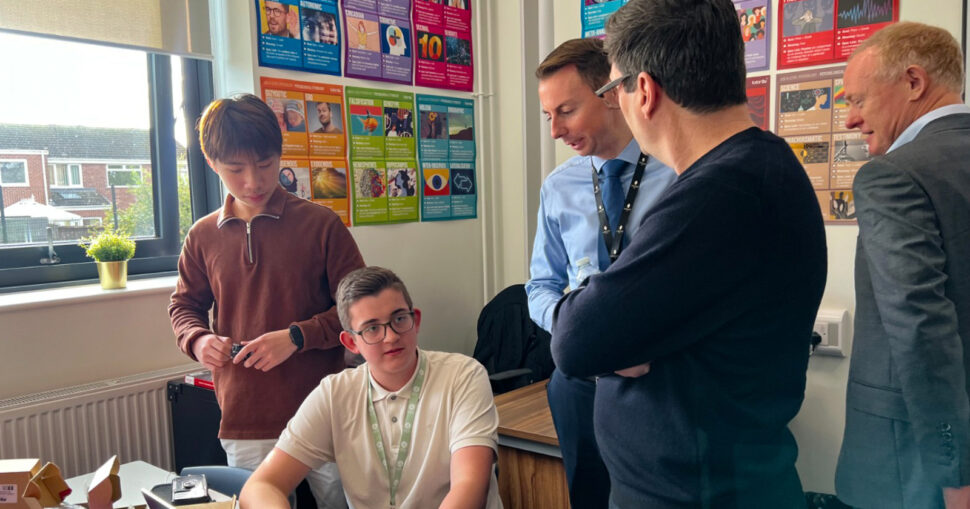
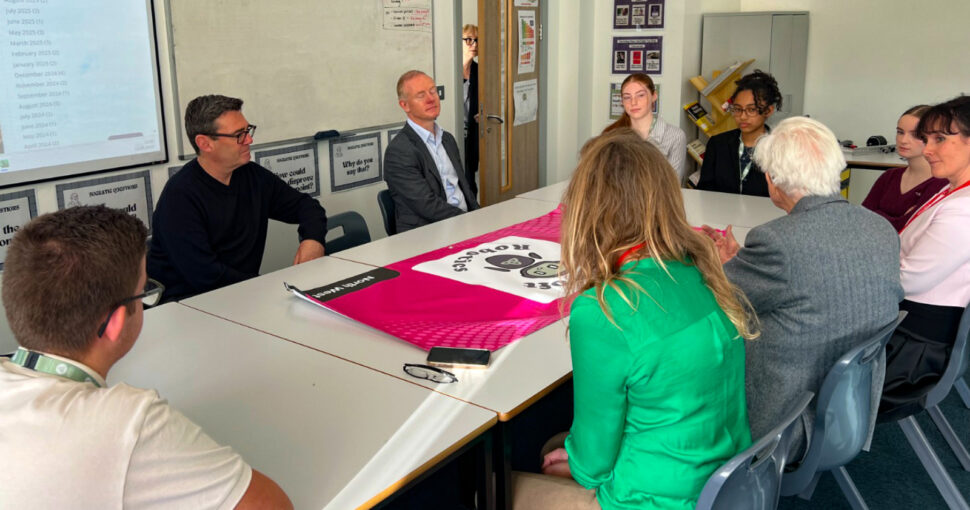
Sitting in a classroom at Laurus Ryecroft secondary school in Tameside on the day he announced the ‘MBacc award,’ Burnham admitted that the “backing from the centre” to his MBacc policy had been “slower than I’d hoped”.
His divergence from national policy, and a failed bid for control of 16-19 funding in the run-up to his 2023 trailblazer devolution deal, has occasionally put him at odds with the Department for Education. He said the “skewing effect of the EBacc” had lingered “too long”, which has been “a frustration”.
Reactions to the policy among local school leaders vary. One regional expert said they “generally ignore” the MBacc and questioned Burnham’s jurisdiction over them. But Glyn Potts, CEO of Greater Manchester Youth Federation and a former Oldham headteacher, said he had not met a school leader who was “dissatisfied” with the policy.
“Most of us are really relieved government are rethinking the EBacc. We want Greater Manchester to be a place where young people can go into skilled work without needing a university route.”
Potts attributes the slow MBacc uptake to schools waiting for multi-academy trust-level decisions and for the outcome of the curriculum and assessment review.
The government’s decision to scrap the EBacc and consult on an alternative accountability measure that “balances a strong academic core with breadth and student choice”, is, in some ways, vindication for Burnham’s mission.
Burnham believes “the pendulum is swinging back towards the technical side”, and that for previously reluctant schools, “the light is going green” for his MBacc.

The MBacc award
The launch of the MBacc award at Laurus Ryecroft showcased the political theatre that now accompanies Burnham’s technical-education mission. “What can I say, Andy? You’re just the King of the North,” quipped Linda Magrath, CEO of the Laurus Trust, after Burnham swept in with his entourage.
Burnham was joined by 91-year-old former education secretary Lord Kenneth Baker, president of the Baker Dearing Trust which oversees England’s 44 university technical colleges (UTCs). A peculiarly warm front has formed between the Tory peer, who in 1988 introduced the national curriculum, and Burnham, who has probably done more than anyone outside government to override it.
Burnham praised Lord Baker for being “the voice in the wilderness at times saying ‘technical education matters’”. “Not enough people were listening, but we were listening,” he added.
Greater Manchester Combined Authority (GMCA) hopes to sign up over 100 “MBacc centres” – both schools and colleges – by the start of the next academic year, and to fully roll out the MBacc award to all those on technical pathways by 2029.
These learners will undertake a series of employer projects embedded into their curriculums, aligned to the MBacc subjects and built around the skills employers want.
They will receive a certificate of completion at an awards ceremony, bringing what GMCA describes as a “currency” to the MBacc pathway, recognised by employers.
Last year, a survey of young people in the region found only 10 per cent had heard of the MBacc.
But Burnham told pupils how, in the future, “everyone” in Greater Manchester will “recognise” his award as being “really high quality”, and “as good, if not better, than the university route”.
UTC sleeves
Baker Dearing is also partnering with GMCA to bring its ‘UTC sleeves’ model into the region’s schools, including Laurus Ryecroft.
The model involves UTCs providing alternative technical educational pathways for mainstream secondary school pupils, who would spend two days a week in classrooms converted into workshops or on placements with local employers.
Greater Manchester’s history with UTCs is chequered – both Oldham and Bolton saw closures after poor results and safeguarding concerns – though the two that remain, Aldridge UTC and Bolton University Collegiate School, are now rated ‘good’. Nationally, the UTC brand has regained some esteem.
On the day of FE Week’s visit, Policy Exchange recommended the government pilot 10 UTC sleeves in priority growth areas at a cost of £25 million, pointing to higher apprenticeship progression and lower NEET rates. But the Budget failed to provide any Treasury backing for the proposal.
In Greater Manchester, the model has the financial backing of Laurus Trust sponsor Andrew Law, a Manchester-born hedge-fund billionaire, who hopes to open two sleeves by 2027. “Lots of things have been tried,” Law said. “But our belief is this is the one that’s going to work.”
A personal mission
Burnham’s passion for shaping an education system reflecting employer needs stems from his own experience. After graduating in English from Cambridge and looking for work back in his home region, he said: “I couldn’t find [a job] anywhere, because all the old industry had closed. To get on in life we had to go south.”
Now, “that’s not the case” with Greater Manchester’s economy growing faster than anywhere else in the UK. Hollywood superstar Robert De Niro has just visited Manchester as a key investor in the city’s soon-to-be tallest skyscraper, Nobu Manchester Building.
The MBacc is a “path that leads you to those skyscrapers”, Burnham told pupils.
45-day placements for all
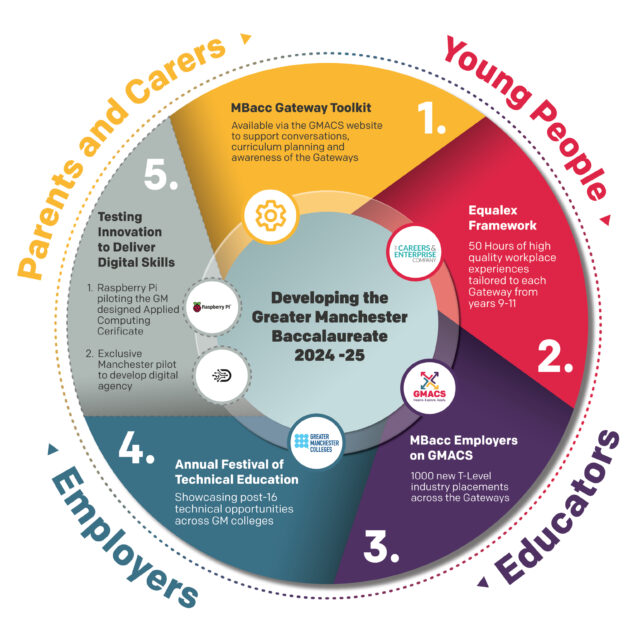
Another key aspect of the MBacc mission is creating work placements. By 2035, GMCA’s aim is for every young person by the age of 19 to have 45 days of “high-quality experiences of the workplace”.
For some stakeholders, Burnham’s target feels unrealistic. “If I’m a kid who needs to look at five different industries, the last thing I want is to be stuck somewhere for 45 days… it’s madness,” one source said.
GMCA’s own assessments show access to work experience is currently “unequal” across the region. The short-term goal is for half of schools to work towards 10 days.
Burnham denied his target is too ambitious.
“We’re building them up all the time,” he said. “There’ll be a 45-day work placement for everybody.” He argues the UK has never “got work experience right”, describing the government’s two-week placements pledge as “awkwardness in the corner, opening the post”. Longer placements, he says, “professionalise it”.
All hands on deck
As well as the “significant team” of around 20-30 people Burnham has working on his “core, flagship priority” of the MBacc, he also has GMCA’s business support team, the Greater Manchester Growth Hub, engaged in asking businesses to provide T Level placements. They are now close to meeting a target of 1,000.
“The whole system through the business growth side is leaning into the [MBacc] reform,” he said.
GMCA is highly praised by college representatives for these efforts. But one questioned how much the mayor is spending on staff working on the MBacc “vanity project”, for which he has “no legal duties or responsibilities”, compared to adult education, a topic on which he is “too quiet”.

Championing apprenticeships
Another representative said they were “desperately trying to get” the GMCA focused on lower-level apprenticeships, which are in relatively short supply, but Burnham’s interest lies more in degree apprenticeships.
The University of Manchester is about to expand its degree apprenticeships and Burnham is pushing for more of them across the region, telling Lord Baker: “We need to work together on this”.
The Baker Clause – named after Lord Baker himself, who proposed it in 2018 – is a duty on schools to provide year 8-13 pupils with access to a range of technical education and apprenticeship providers. Within Greater Manchester, some elements of the MBacc are helping to ensure compliance, but that is not the case everywhere.
Dale Walker, director of education at Apprentify, described compliance as “inconsistent and often tokenistic”. Meanwhile, Dan Thomas, CEO of The Learning Partnership MAT with 15 schools across Cheshire and Staffordshire, said the clause is “not being enforced”. It had taken his UTC in Crewe three years to get “any view into” local schools.
Adults sidelined
Although Burnham failed to secure control of 16-18 funding, his trailblazer deal established a joint board for post-16 technical oversight. FE leaders, however, are concerned that adult learning is falling down the agenda.
The Greater Manchester Colleges Group’s proposals to provide an adult education maintenance allowance did not reach Burnham’s election manifesto, and while GMCA papers reference an “all-age” MBacc, its practical focus remains on young people.
Burnham said the adults’ element “remains the ambition”, but is “harder to achieve” because of the need for “more control” over employment support from the Department for Work and Pensions.
“It’s just, we don’t yet have full control of those levers. A shrinking adult education budget hasn’t helped.”
This year GMCA’s adult skills fund streamlines core funds, free courses for jobs and skills bootcamps into a £108 million pot – a 3.58 per cent real-terms reduction, due to national cuts.
Burnham now has the power to move funding between policy areas based on local priorities, which poses an even greater threat to adult education and worries some college leaders.
Wigan & Leigh principal Anna Dawe earlier this year described it as a “great shame” that much of the dialogue is centred around young people’s education.
“The value in FE is all its component parts… we focus in on what seems to be flavour of the day, and that’s never changed,” she said. “I hope we don’t see further cuts to adult education, because it can’t take any more cuts”.

MBacc as all things
The MBacc brand has continued to absorb new initiatives. Beeline, a digital platform offering information on work placements, courses and jobs, launched last year. A Raspberry Pi Foundation applied computing certificate, a UNESCO-endorsed Skills 4 Living programme, and a mentoring scheme for young people in or at risk of the youth justice system have all appeared under the MBacc umbrella.
Plus, a long-running initiative providing school pupils with taster days in FE colleges has been tweaked and renamed the ‘festival of technical education’, under the MBacc banner.
Burnham is praised for using his convening power to draw impressive initiatives to the region. “People want a little bit of his stardust on their stuff”, said one source.
Others see the MBacc as a political catchphrase for anything related to technical education.
“It almost frustrates people that you’re doing something, then suddenly the MBacc badge appears on it,” another said.
Burnham’s big ideas
One of the most eye-catching MBacc proposals is “Our House” – university-style living accommodation for apprentices. Burnham argues that “the ability to live independently at 18 should be available to all young people”.
A Co-op Bank survey suggested the halls would boost apprenticeship uptake, but some local leaders remain sceptical. “Why can’t he accept an apprenticeship is just a different way? Not everything needs to mirror university,” said one.
Equally divisive is Burnham’s plan for a UCAS-style centralised technical admissions system by 2030. Under the proposal, every Year 11 pupil would apply online for technical courses, with an attached work placement. Colleges would specialise more, meaning some learners may travel further.
Critics say this undermines the principle of local provision. “A fundamental waste of time, money and energy,” said one college representative. Another warned that “a Level 1 bricklaying student isn’t travelling just because he has a free bus pass”.
With Greater Manchester’s 16-19 population set to rise sharply in the coming years, technical participation is likely to increase regardless of policy intervention. As one source put it: “The MBacc may be doomed to success – whatever its complexities.”
Whether that success is credited to Burnham’s leadership, demographic inevitability or institutions adapting around him may be a question for a future Labour leadership contest.













Your thoughts