

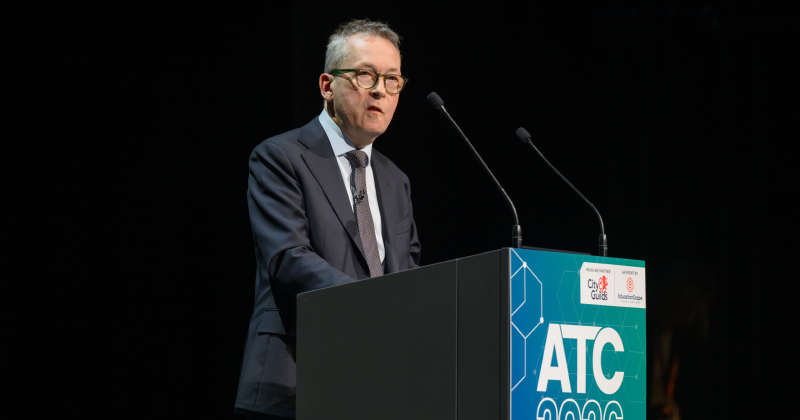
Sir Ian Bauckham was jolted into “stepping up” Ofqual’s work on AI misuse after students admitted to him they were using AI but were too afraid to tell their teachers.
Speaking at a keynote and Q&A session at this week’s Apprenticeships and Training Conference (ATC), the chief regulator also said V Levels could be regulated as a “marketplace” without becoming an “easy” option, and insisted Skills England’s apprenticeship assessment overhaul will not mean standards slipping “on my watch”.
AI ‘confessions’
Bauckham told delegates his job regularly takes him into schools and colleges, where he probes what’s really happening on the ground with qualifications.
Over the past year, he said, teachers had told him AI misuse was becoming increasingly difficult to spot, particularly in coursework and non-examined assessments.
At the start of the “AI era”, he said, plagiarism and detection tools could more easily identify where a student’s work had been copied “directly” from elsewhere. But that advantage is fading as AI tools improve and students become more fluent in prompting them.
“When I talk to students and ask them to tell me the truth, not necessarily what they would tell their teacher, they say, well actually, yeah, please don’t tell my teacher, yes I do,” Bauckham said.
This has sharpened worries about “the long-term viability” of non-examined assessments and made it clear to the chief regulator that Ofqual needed to “step up our efforts in this area”.
The remarks came as Bauckham referenced a letter to awarding organisation chief executives, published on Tuesday, in which he warned that while detected AI cases reported to Ofqual remained “relatively low”, there was “significant concern” among teachers and leaders about the true extent of misuse.
In the letter, Bauckham asked awarding organisations to reply to him spelling out the specific steps they were taking to root out AI misuse in their qualifications by the end of March.
In the ATC Q&A, he rejected the suggestion Ofqual had been slow to respond to AI misuse in qualifications, arguing awarding organisations sit closest to centres and were responsible for setting expectations and enforcing them.
Pressed on what happens after the March deadline, Bauckham said Ofqual would review the boards’ proposals and assess “the quality of their responses” before deciding whether further regulatory action was needed.
He acknowledged the “ultimate sanction” would be removing non-examined assessments from qualifications entirely, but stressed many teachers had urged him not to “default to the easy option” because coursework “can be a powerful learning experience”.
Instead, the regulator has its own ideas on “cheat-proofing” but wants to see what boards propose first.
Asked whether he would use AI to help him determine if the AO’s responses were enough, he said: “Of course not, we’ll use our old-fashioned human brains.”
V Levels: ‘No easy options’
Bauckham also set out how Ofqual would regulate V Levels if ministers stick with the government’s proposal to have a market of multiple awarding organisations offering them, as is the case with A Levels, rather than the single-AO licence approach with T Levels.
“Ofqual was set up to regulate a market of awarding organisations, so we’re very comfortable” with multiple AOs, he said.
He added there would be “nationally set content” for V Levels, but with “legitimate variation” in how AOs design, sequence and assess. Ofqual’s job, he added, would be to ensure that a V Level in the same subject holds a comparable standard across AOs “so there won’t be an easy V Level available”.
This followed the latest round of wave 2 T Level licences, showing Pearson will hold 16 of the available 20 T Levels in September 2027.
Asked directly whether it was “high risk” to have a dominant force in a single-provider T Level system, Bauckham said he would “slightly dodge the question”, but said an advantage of a regulated market was that it creates “a layer of resilience” because “there is always a plan B if something goes wrong with an awarding organisation”.
Concentrating all qualifications of a certain type into one AO “potentially reduces that system resilience”, he suggested.
‘Not on my watch’
On apprenticeships, Bauckham said the purpose of Skills England’s assessment reforms was to respond to concerns about “complexity, duplication and unnecessary delays”, while recognising fears the changes could “dilute quality” or weaken how reliably assessment signals occupational competence.
“My priority is, and will remain, the protection of that quality and the purpose of apprenticeship assessment,” he said. “Simplification and streamlining does not mean dumbing down. Not on my watch anyway.”
Bauckham said Skills England’s assessment plans would continue to set baseline requirements per apprenticeship standard, and Ofqual would “regulate to make sure the intention of those plans is delivered”, including by challenging awarding organisations on assessment design choices and requiring them to demonstrate they reflect occupational competence needs.










Your thoughts