


V Levels will launch in three subjects and begin teaching in colleges from September 2027, the Department for Education has confirmed in its consultation response today.
Ministers have also decided to design V Levels to the same qualification size as one A Level – 360 guided learning hours – so that students can choose to take a “mix and match” selection of vocational and academic qualifications.
In its full response to a public consultation on reforming the post-16 qualification landscape, the DfE has revealed that V Levels will be taught in digital, education and early years, and finance and accounting from September 2027.
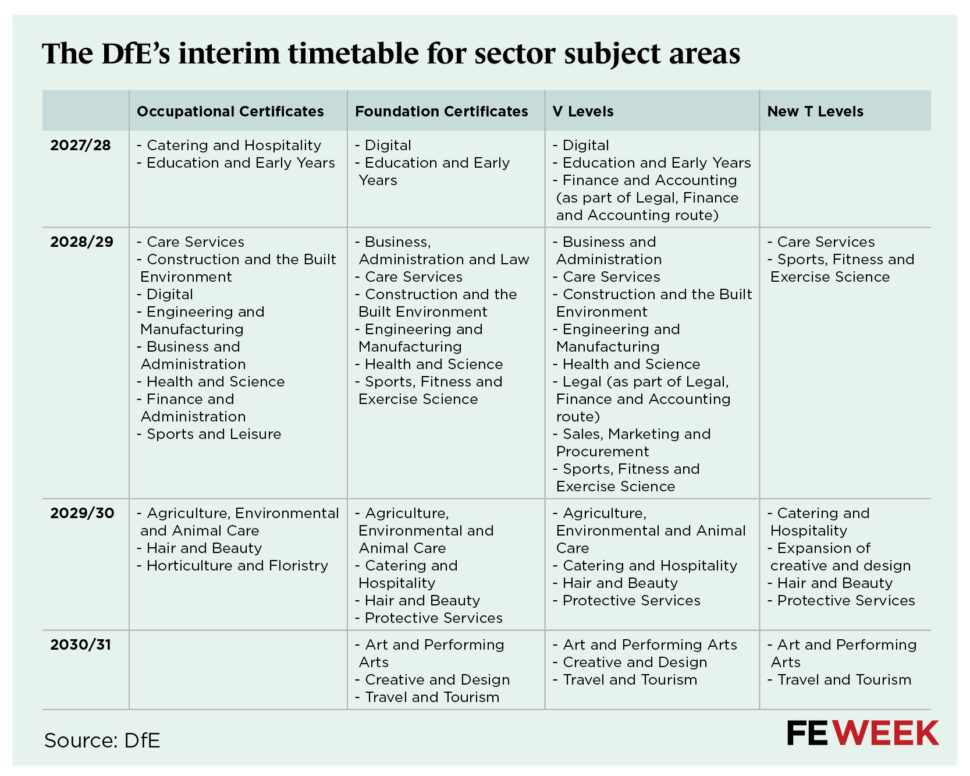
Further V Levels will follow in 2028 in eight subjects including business, health, care, and construction, with four more subjects coming in 2029 in areas like catering and hospitality and hair and beauty, before completing the rollout in 2030 with courses in three subject areas including creative and travel.
In most cases, the DfE expects there to be just one V Level per subject, instead of multiple options under each route.
A four-year roadmap includes a total of 18 V Level subjects, 28 new level 2 certificates, and eight new T Levels (see table below).
The government has also launched a consultation on a new qualification for students with lower attainment in English and maths as a stepping stone to resitting their GCSEs.
It comes as ministers have again delayed the controversial defunding of popular alternative level 3 vocational qualifications, such as BTECs, that were due to be axed this year (click here for full story).
Labour’s introduction of V Levels is based on Becky Francis’ independent curriculum and assessment review, which called for a “third, vocational pathway” to sit alongside A Levels and T Levels at level 3.
However, many consultation respondents warned the government that “rushed and poorly planned implementation” could impact the quality of qualifications and employer confidence.
Education secretary Bridget Phillipson said: “Our bold reforms will end the snobbery in post-16 education, supporting young people with real choice and real opportunity to build secure, future‑proof careers.
“Not only that, but it will give parents much-needed confidence in a system that values every route to success – academic, technical or vocational – as we continuing driving forward our mission to ensure two‑thirds of young people are in education, training or apprenticeships by 25.”
Piles of new quals
The government said it will publish a full implementation plan by June 2026, which will set out further detail on the delivery of reforms for the more than 50 new qualifications that span V Levels, T Levels and level 2.
A key concern about the transition to V Levels and new level 2 qualifications was that the 2027 teaching timeline could “impact negatively” on their quality and employer confidence, with some respondents suggesting piloting small numbers of routes and regionally tailored pathways.
The government said it recognises the timeframe is “ambitious”, so it will launch the qualifications route-by-route over the next four years to make implementation “more manageable”.
It added: “We are working rapidly, making use of cutting-edge approaches in qualification design (including artificial intelligence) and learning from what already works well in the existing qualification landscape to streamline our processes so that the sector has the information and resources as early as possible.”
This will include clarity on whether the new qualifications will be designed in an A Level-style open market or a T Level-style contract with a single awarding organisation.
Mandatory provider transition plans
Every college, school and training provider offering vocational qualifications will be required to submit “strategic transition plans”, which the department will monitor, each summer for the next four years.
Officials will request a “planning statement” from each provider in June, and then check providers are on track for 2027 in October, according to plans set out today.
Then from next July, an annual transition plan, signed by accounting officers, will need to be submitted which will outline delivery arrangements for new qualifications in the immediate and following year.
These should include “robust” transition plans, a clear timeline and strategies for supporting staff, students and employers through the development and delivery of new qualifications.
On a national level a group of “qualification pioneers” will be appointed to help model effective practice and advise what support the rest of the sector will need. This group will also shape the government’s “clear accountability expectations”.
Meanwhile, the government will offer “targeted, practical support” to providers, including through workforce development, strengthened careers advice, and guidance on accessing capital funding.
Optional content
The government will only allow more than one V Level per subject in “a limited number of exceptional cases” to ensure that students can mix and match, and that T Levels remain the main option for large technical qualifications.
Exceptional cases where a V Level could be “partnered” would be when studying more than one subject within the same employment route would be beneficial to students, in the same way A Level students can study maths and further maths, the DfE said.
Details of the “rigorous criteria” for such cases will be set out in the implementation plan in June.
While V Level content will be set by DfE and informed by occupational standards, “some” subjects may allow for “optional” content which providers can tailor to the needs of local employers, regional economies or the “interests and aspirations of their cohorts.”
Brand management
Ministers have backtracked on plans to eliminate awarding organisation branding from the new qualifications after hearing concerns about “losing well-established” product names.
After initially proposing to remove awarding organisation names from V Level titles, the government now says it will “allow differentiation” by including awarding organisation, level and subject, with the product name limited to the name of the pathway qualification itself.
This will also apply to the new level 2 foundation and occupational certificates.
Qualifications regulator Ofqual will consult on assessment and grading arrangements, which the government wants to be simple and consistent across awarding organisations, “in due course”.
Level 2 developments
Alongside V Levels, DfE will launch occupational certificates designed to be a two-year level 2 programme for students who want to study for a particular job or apprenticeship and “need to develop their skills in a classroom-based setting”.
Meanwhile, new foundation certificates will be a one-year “further study pathway” for students aiming to move on to level 3 studies such as A Levels, T Levels or V Levels – usually because they did not meet entry requirements due to their GCSE grades.
Catering and hospitality, and education and early years occupational certificates will be introduced alongside digital and education and early years from next September.
The first consultations on content of the new qualifications will launch in “late spring”, the government said.
‘Outcomes will improve’
The reforms will be positive for students with SEND thanks to their greater flexibility, quality and consistency, and “coherent” choice of subjects, the government believes.
The government argues that the smaller size of V Levels will mean they can more easily be combined or adapted, and that students can learn at their own pace or with additional support if needed.
Reforms to T levels should also make them “even more accessible” to students with SEND.
Overall, the plans “will improve outcomes for students”, the impact assessment said.
Survey says
The DfE said their reforms were justified after a survey carried out by DeltaPoll last month reportedly found that parents of 14 to 18-year-olds prefer a mix of academic and work-based or technical training.
The survey of 1,124 parents in England showed that 45 per cent prefer the mix and match qualification approach, compared to 23 per cent favouring exclusively academic choices and 22 per cent vocational.
One quarter of parents reportedly feel unsure that their child understands what options are available beyond A Levels.
David Hughes, CEO of the Association of Colleges, said: “The simplicity of an agile, adaptable system with only V, A and T Levels at level 3 and with a new set of level 2 qualifications is a good one.
“Now we need to work through the inevitable list of implementation and detailed issues that will require evidenced and grounded knowledge and understanding.”









Would you all feel comfortable with your mechanic, who is responsible for the safety of yourself and possible family members travelling in your car to have only had 360 hours of training split between the classroom and the workshop?
that isn’t the purpose of t level . if you want that then it’s apprentices.
t levels are misconceived as most people wanting to go into a job would be better off with an apprenticeship. only problem is no one seemingly want young apprentices has numbers have nose dived. t levels solving a problem that never existed and costing billions. v levels are the final nail in the coffin of a civil service designed failure.
I see the V Level combines Health with Science. This doesn’t work as it suits neither type of student. This was proved with T Levels