

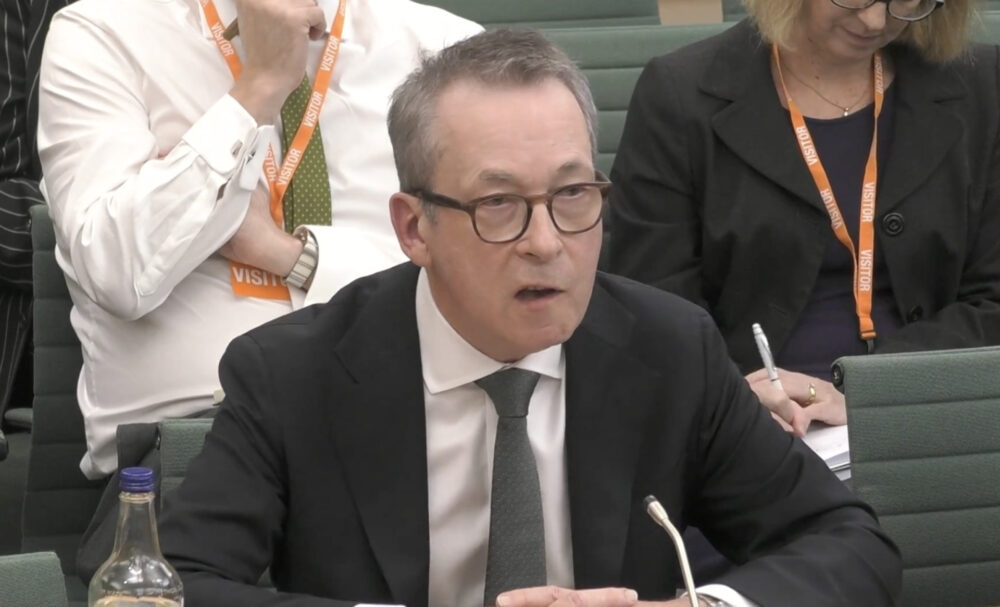
Poor progress in English and maths tracks “right back to primary school” and requires intervention at the earliest stage to break the “treadmill” of GCSE resits in post-16 education, Ofqual’s chief regulator has said.
Sir Ian Bauckham was quizzed by MPs on Parliament’s education committee today for the first time since his pre-appointment hearing in December 2024.
Here’s what we learned…
Tackle the ‘root cause’ of poor English and maths
The chief regulator said he “agreed” with the committee’s September 2025 report into further education that expressed “strong views about the treadmill of resits” in colleges.
Government mandates students who have not achieved a grade 4 pass in English and/or maths GCSE by age 16 study towards these qualifications as a condition of their post-16 places being funded. Most resit the exams.
Bauckham outlined his concern that a big contributing factor was “too many” students in primary education not reaching the expected standards in English and maths.
He told MPs that there is “no point” in a student who has spent 11 years studying English and maths and “only achieved a grade one or grade two repeatedly sitting an examination in the hope that by luck, one day they might scrape enough marks to pass”.
Bauckham urged the government to “look at the root causes of students making so little progress” and try to “address that much earlier on”.
“It tracks right back through primary, through secondary, to try to ensure that we don’t have students who have got these gaps in their learning,” he said.
He added that Ofqual is working “intensively” with the Department for Education on promised new level 1 “stepping stone” qualifications for students struggling with English and maths but could not give a date for when they could arrive in schools and colleges.
V Levels should not be dictated by T Levels
Bauckham was also questioned on his response to last year’s curriculum and assessment review, of which he was an observer on the review panel.
“What I witnessed was a very rigorous, very thorough overview of the whole curriculum, assessment and qualifications landscape in England,” he said.
He told the committee that he found independent reviewer Becky Francis’ recommendations to be “broadly sensible” and did not think anything was left out of her final report.
Regarding the proposal to introduce V Levels as small vocational qualifications to sit between T Levels and A Levels, Bauckham warned that the development should prioritise “distinctiveness”.
“The policy intention is not to force V Levels into a mould dictated either by T Levels or A Levels, but to create and then maintain a distinctiveness for V Levels,” he said.
The government’s consultation on V Levels closed yesterday.
AI ‘not ready’ to solely mark work
Bauckham said he wasn’t convinced that AI was ready to be the only marker of student work and exams.
That was because it still makes mistakes and is hard to challenge.
He added that it can be used to quality assure and detect “unexpected” patterns in examiner marking but hallucinations meant it is not yet ready to undertake sole marking.
Bauckham also cast doubt on how contested exam grades would be reviewed if they were marked by a “complex series of algorithms inside an impenetrable black box”.
And he said he had “signalled my anxiety” to the DfE about the use of AI cheating in qualifications with extended writing coursework.
He said there is “relatively little” of this coursework, but highlighted history and English A Level, where 20 per cent of the qualification is extended writing.
The chief regulator has commissioned a “significant piece of work internally at Ofqual to ascertain the extent to which this risk is being realised at the moment and what the options might be in any reform of those qualifications for closing down that risk and assuring ourselves of the integrity of these qualifications”.
He added: “I would not be being transparent if I didn’t say I am concerned about that, I visited a number of providers up and down the country, spoken to teachers and a number have raised this with me.”
‘Justice delayed is justice denied’
MPs also asked the chief regulator to comment on the “significant” number of fines handed out last year to awarding bodies for regulation breaches.
Bauckham said Ofqual had used its legal enforcement powers on more than two dozen occasions last year, including handing out fines and imposing special conditions.
After “inheriting” a large backlog of cases when he became chief regulator, partly due to covid, Bauckham admitted that Ofqual did not always prioritise closing cases quickly and his ethos was to send strong messages to exam boards when there are breaches.
“Justice delayed is justice denied applies in this circumstance,” he said.
“It feels to me as if those powers were given to us by Parliament, not only to send clear, strong messages to exam boards and to the sector that where there are breaches that are potentially damaging for the integrity of the qualification or for students, they are sanctioned and clear, strong messages are sent,” he added.
“I’m particularly keen that that’s done in a timely way.”
Boards didn’t like Bauckham’s new ‘rebuke’
Ofqual recently gave itself new powers to publicly “rebuke” rule-breaking awarding bodies where the case is not serious enough to warrant a financial penalty.
Bauckham told the committee that following a consultation with exam body chief executives, he concluded that public shaming was the right approach.
“We got very sharp feedback from awarding organisations who said they would find it a very difficult thing to receive indeed,” he said.
He added that it would lead CEOs to have difficult talks with their boards and even impact share prices of publicly listed awarding bodies.
“They didn’t like it very much, which gave me assurance that it might be effective.”












Your thoughts