Skip to content
30 September 2026

Latest news from FE Week

Commissioner suggests college help to Marine Society

The FE Commissioner has called for a distance learning provider to work with an FE college and raised doubts about the quality of its subcontractor of 35 years.

Commissioner Dr David Collins visited the Marine Society College of the Sea after the 260-learner college had been slapped with an Ofsted inadequate grading the previous month.

Inspectors found the designated specialist college, which is based in Lambeth and offers courses including GCSEs and A-levels to professional seafarers, was failing to monitor learners’ progress effectively, or achieve high success rates — findings echoed by Dr Collins (pictured right).David-Collins-new-cutout

In his report, he said: “The leadership team should develop closer links with the FE sector by working with a college that understands their situation and can advise them on how to manage learners and their progress better.”

And both Ofsted and the commissioner criticised the relationship the college — which has a current Skills Funding Agency (SFA) allocation of nearly £160,000, but is otherwise learner-funded — with its distance learning subcontractor of 35 years, the National Extension College (NEC).

Mr Collins said the College of the Sea, previously rated as good in 2009, had an “over-reliance” on NEC and had “not monitored subcontracted provision effectively”, while NEC had “not met the standards required in its provision”. He added: “Targets should be set, and if not met, the college should consider a change in provider.”

Mark-Windsor-cutout

The college’s post-Ofsted action plan included targets to raise success rates from 23 per cent to 70 per cent in the next three years and to monitor learners’ progress on a monthly basis.

The Marine Society’s director of lifelong learning Mark Windsor (pictured left) told FE Week: “Our performance at Ofsted in regard to our GCSE and A-level learning provision is disappointing.

“However, we are very clear on what we must do, confident we can do it and that our services remain well suited to the needs of seafarers.”

Ros Morpeth, chief executive of Cambridge-based NEC, said she “rejected” the commissioner’s claim NEC provision was substandard. However, she said NEC had a “commitment” to “make improvements on a clear time scale” and, with the Marine Society, was “actively addressing” issues the commissioner raised. Ms Morpeth also claimed the low success rates were due to the flexible nature of the course, where learners can enrol at any point and choose how long they take to complete their course.

“Inspection criteria are based on the assumption that you’ve got a fixed cohort of students coming in at a fixed time and having a fixed period of time to complete their course and therefore you can see very quickly what the success criteria are,” she said.

“Whereas when you’ve got a rolling enrolment and the students have more control over how long they want to take then it’s harder to pull out these hard facts and figures that Ofsted quite rightly wants.”

The commissioner is expected to conduct a proresss review in July.


New college procedures ‘not fit for purpose’

Official procedures to become an incorporated college have been described as “not fit for purpose” by the first person to have used them in more than two decades.

Neil Bates, who last year oversaw the process of his Essex-based Prospects Learning Foundation (PLF) becoming Prospects College of Advanced Technology (Procat), also said the two-decade gap since a new college “indicated a lack of dynamism in the sector”.

He told FE Week, which exclusively revealed his plans just over a year before they came to fruition: “The 1992 Further and Higher Education Act [which still sets the rules for incorporation] is not really fit for purpose and the fact that there has not been a new FE college in 22 years suggests a lack of dynamism in the sector.

“We were particularly struck by the fact that neither of the funding agencies or BIS were really geared up to support new entrants or new types of provision.”

His comments echoed the findings of the Department for Business, Innovation and Skills (BIS), which published a ‘lessons learned’ report on Monday (February 23).

It set out the requirements independent learning provider PLF met to become a college, including a good or outstanding Ofsted judgement, a business plan and a satisfactory provider financial assurance audit review.

It said: “This project was a first in the sector for over 20 years and so as the project developed we were clarifying legislation, regulations, policy and processes internally with PLF and in relation to obtaining ministerial approval.

“The project was also completed within a very short timescale (from the first project board meeting to incorporation was 10 months).

“The process has highlighted lessons learnt in two key areas — the process undertaken and the policy and legislation in place.

“The process currently in place for new incorporations and entrant funding may no longer be appropriate. This is being reviewed as part of a wider project assessing the longer term implications of government policy reform for the FE/skills provider market.”

However, Mr Bates nevertheless praised the “excellent work of the BIS officials who worked with us to ensure a relatively smooth and fast incorporation”.

The 2,000-learner provider was the first new incorporated FE college since 492 local authority-maintained institutions underwent the process in 1993 under the previous year’s Further and Higher Education Act.

Julian Gravatt, assistant chief executive for the Association of Colleges, said: “It is important that new colleges build on the high-quality provision already available in the FE sector.

“The government’s case study report on [the former] Prospects College could provide a useful road map for those interested in this option.”

Association of Employment and Learning Providers (AELP) chief executive Stewart Segal said: “Unfortunately, Procat had to change from its Independent learning provider (ILP) status to get an extension to its direct contract, gain access to £1.6m capital and get the support of two research fellowships.

“Investment in providers should not be dependent on the organisational structure. We hope that BIS will learn this lesson when looking at National Colleges as well as the issues around the process.”

A BIS spokesperson said no other ILP was currently undergoing incorporation.


Ofsted ‘sea change’ over college finances

Ofsted has undergone a “sea change” in the way it looks at college finances, according to a principal who got two good ratings among his headline fields and yet emerged with an inadequate result overall.

Weymouth College, visited by FE Commissioner Dr David Collins over its finances just under a year ago, got grade two findings for outcomes for learners and also quality of teaching, learning and assessment.

But it got a grade four rating overall, and also for effectiveness of leadership and management, with inspectors reporting that “poor strategic management and the failure by governors to hold the previous principal and other senior managers to account in monitoring the financial performance of the college have resulted in a significant budget deficit”.

The report was published on February 18 — three months after Dr Collins called for change at Ofsted if it was to “be more useful” after it rated Bournville College’s leadership outstanding despite a “critical cash position”.

The college had been rated good overall by the education watchdog in May, before Dr Collins visited three months later with an SFA notice of concern having been issued three months before Ofsted went in.

And the Weymouth College report mentioned “finances” or “financial” 18 times, but neither appeared in Bournville’s report.

The difference has led 3,843-learner Weymouth College acting principal Nigel Evans to believe the change Dr Collins called for was now in place.

“It is extremely unusual to have two out of three headline fields rated as good and be inadequate overall,” Mr Evans told FE Week.

“This probably marks a sea change in how Ofsted makes its judgements. It previously used to concentrate on academic performance.

“I think we are probably unlucky to have been assessed at this time, but have to accept the judgement as one of our briefs is to manage our finances.”

Nevertheless, an Ofsted spokesperson denied it had changed the way it considers financial issues when grading.

“Ofsted inspectors use their professional judgement when coming to conclusions about a provider,” he said, but declined to comment on whether this made inspections too subjective.

The situation has resulted in a call for more clarity on how Ofsted looks at finances.

Gill Clipson, deputy chief executive at the Association of Colleges, said: “Ofsted currently judges the effectiveness of an institution in terms of the performance of students.

“If judgements are now being made on financial performance then we need clarity about the criteria that are being used and assurance about the expertise of the inspectors.”

Ofsted declined to comment on whether it would update its guidance.

It come after Weymouth’s previous principal, Liz Myles, was suspended in November — around six months after Dr Collins identified “significant weaknesses” in leadership.

He visited after the Skills Funding Agency assessed college finances as inadequate and he recommended, among other things, that “the principal should engage a ‘peer mentor’ with a good financial track record to assist her in dealing with the college’s present financial situation”.

A college spokesperson told FE Week Ms Myles would be “leaving Weymouth College following her resignation due to retirement being accepted by the board of governors”.

No date has been confirmed for when her permanent replacement will be announced.

Only one other provider has been rated as inadequate overall while receiving good judgements in the same two headline fields as Weymouth.

The report, on Gloucestershire’s Ruskin Mill College, part of the Ruskin Mill Educational Trust Ltd charity which had 110 learners when it was inspected in March last year, did not mention finances either.


Predictability plea as just 15 pc affected after clawback warning

The Association of Colleges (AoC) has supported Skills Funding Agency plans to make its funding system more “predictable” after it emerged that just 14 per cent of providers issued with a shock clawback warning were actually be asked to repay.

Una Bennett, deputy director for funding systems for the Skills Funding Agency (SFA), wrote to 699 providers before Christmas warning they might have to repay against “provision that has been incorrectly claimed”.

Providers were later emailed by funding and programmes director Keith Smith, who apologised for the “premature” warning and asked them to go over submitted ILR data and tell the SFA before the end of last month if they needed to make any repayments.

And the SFA revealed on Wednesday (February 25) that it estimated a total of £500,000 needed to be repaid by 98 providers and it had “resolved the identified issues” with the remaining 601 who wouldn’t have to return any 2013/14 cash.

An SFA spokesperson said: “This work has also highlighted the need for simplifying the system further and we will be working with the sector to do this.”

Julian Gravatt, assistant chief executive of the AoC, told FE Week: “It is important that data errors are corrected.

“Helpfully, the SFA acknowledge that there is more work to do to make their funding system more predictable.

“Given that the adult skills budget is currently in freefall, this task has become more urgent.”

Association of Employment and Learning Providers (AELP) chief executive Stewart Segal said he was “pleased that the vast majority of providers will not be subject to a clawback”.

“We hope that in the cases where one is required, providers will have an opportunity to discuss the final calculations,” he said.

“We also hope that cashflow issues will be taken into account to protect the learners.”

Ms Bennett’s letter provoked an outraged response on the SFA’s Feconnect online forum, where users complained her correspondence was sent after the SFA’s own auditors signed-off provider accounts last autumn and did not specify how much needed to be repaid.

The subsequent apology by Mr Smith also came under fire on the forum, with one user complaining that she had suffered “sleepless nights” over the issue.

The SFA spokesperson said: “We would like to thank the sector for working with us to ensure that   data submitted is accurate. This is important to ensure that any funds incorrectly claimed in error can be recycled back into the system, under our performance management processes, to ensure all public funds are maximised.”

‘Careers advisers who don’t promote apprenticeships should be fired’

Failure to promote apprenticeships and traineeships should result in the sack for careers advisers, House of Commons Education Select Committee chair Graham Stuart has said.

During a debate secured by the Association of Colleges and All-Party Parliamentary Group for FE and lifelong learning chair Stephen Lloyd MP, Mr Stuart said schools needed a bigger incentive to offer comprehensive careers advice, including non-academic routes.

He said: “The heart of the problem is a simple one, in my opinion — it doesn’t come out in the myriad of reports that have been produced on this subject or indeed in enough speeches given by colleagues in this chamber. The problem is there are insufficient incentives for schools to take it seriously.”

He added: “We have got to change the accountability regime to a high-stakes environment in which you very easily get publicly humiliated or sacked.”

His comments on February 25 came after the 2011 Education Act made it an explicit requirement of schools to promote apprenticeships and traineeships in careers advice, and Mr Stuart said the majority of schools were failing to get it right.

“The central issue is that schools aren’t incentivised to take it seriously and they have some perverse incentives like filling their sixth form places which means they won’t even let colleges in,” he said.

Shadow Junior Education Minister Yvonne Fovargue agreed and paid tribute to the work of South Gloucestershire and Stroud College.

She said: “The fact is that we need more than an unenforced duty on schools, which simply leads to buck-passing. One-in-three teachers says they do not have the right expertise and resources to adequately provide effective information, advice and guidance.”

She added: “I visited the Bristol campus of South Gloucestershire and Stroud College the other month. The college has an excellent careers hub, working with schools across the area — independent schools, academies, state-controlled schools and primary schools — and providing one-to-one advice from professional careers advisers, which it employs.

“The college is the point of contact for all employers, it works with the local enterprise partnership, and it is considering expanding its service. It is an excellent model for the careers advice of the future.”

Main pic: Graham Stuart & Yvonne Fovargue


Teen confronts politicians over sixth form college VAT

A 17-year-old learner put School Reform Minister Nick Gibb and Shadow Education Secretary Tristram Hunt on the spot as he called for VAT “justice” at a Sixth Form Colleges’ Association (SFCA) parliamentary reception.

Callum Fairhurst, who is studying business, history and politics A-levels at Long Road Sixth Form College, in Cambridge, delivered a powerful speech at the event, aiming his final remarks directly at Mr Gibb and Mr Hunt, who were both in the audience.

 delivered a powerful speech
Callum delivers a powerful speech

Around 160 guests, including principals, governors and other MPs, heard Callum raise the key SFCA issue, with the government continuing to charge sixth form colleges (SFCs) VAT while schools and academies get a 20 per cent refund.

“Academies don’t have to pay VAT and I think that’s right. SFCs that attach to schools don’t have to pay VAT and I agree with that,” he said.

“It’s not fair [that SFCs have to pay]. Nick, Tristram — if there is one thing you take from what I say, it should be that you need to drop the learning tax. What I’m asking isn’t for a favour — it’s for justice to be served.”

Mr Gibb later told him: “We want to do something about it. The issue is how to fund it. It’s an anomaly we would like to address, but it would be costly.”

1502SFCA074
Labour MP Kelvin Hopkins

Mr Hunt also declined to provide a guarantee that his party would drop VAT for SFCs if it won the general election on May 7 when questioned after the student’s speech by FE Week.

However, he had earlier told guests during his own address: “When we enter government we will immediately get to work to see if we can find the funds which I know bedevil your sector in terms of VAT. There’s no logic to it, there’s no defence of it.”

James Kewin, SFCA deputy chief executive, said: “Callum was absolutely right to urge Mr Gibb and Mr Hunt to drop the learning tax — redirecting funding away from the front line education of students to pay VAT is nonsensical.”

He added: “We now need all political parties to make a firm commitment to drop the learning tax.”

The aim of the event, held in the House of Commons Terrace Pavilion overlooking the River Thames, was to celebrate the achievements of SFCs and provide a chance for networking between principals and governors.

It was hosted by Labour MP Kelvin Hopkins, chair of the all-party parliamentary group for SFCs and vice-chair of governors at Luton Sixth Form College. He called for more SFCs in his speech, which opened the event.

Shadow Education Secretary Tristram Hunt

He said: “There are many wonderful SFCs, many of them represented here today. They do a brilliant job but are still not fully appreciated by government. That’s why I hope the government and opposition members here today will take note.

“They should be nurtured and treasured by all who care about education and the success of our young people. I have argued that the government should, rather than just seeking to look after them, establish more SFCs and expand the sector.”

David Igoe, SFCA chief executive, praised the achievements of sector staff.

He said: “You represent your staff who do such wonderful work for the 160,000 16 to 18-year-old young people being educated in SFCs at this moment.

“We outperform all other state funded and non-selected sectors on nearly every important indicator. We do it at a price and in a style that represents the very best value to the tax payer and the treasury.”

But he warned: “This event is both an opportunity for celebration of our success and to issue a plea to policy makers for fairer treatment [over VAT payments] because you know and I know that we are in real danger now of being squeezed to breaking point.”

The SFCA’s Drop the Learning Tax campaign petition launched before Christmas and has been signed by more than 14,500 people including Oscar-winning actor Colin Firth, X Factor presenter Dermot O’Leary and Education Select Committee chair Graham Stuart.

 SFCA chief executive David Igoe
SFCA chief executive David Igoe

And the event, on February 24, came the day after a House of Lords debate on the issue in which Baroness King said: “My Lords, is it not strange, not to mention unjust, that a 16-year-old studying at a secondary school receives more funding than a 16 year-old studying exactly the same subjects at a SFC [because SFCs pay VAT]?

“Is this not doubly strange when research shows that sixth form colleges provide better education outcomes and better value for money and do more to improve social mobility?”

And Skills Minister Nick Boles said he was prepared to discuss the matter with the “fierce” Treasury as he answered Mr Hopkins during an education questions session at the House of Commons in January.


BIS issues new list of named and shamed underpaying bosses

Apprenticeship employers were among the latest round of offenders named and shamed for failing to pay the national minimum wage.

Business Minister Jo Swinson (pictured) named 70 employers who had failed to pay the minimum wage. They owed workers a total of more than £157,000 and have been hit with more than £70,000 in financial penalties.

A BIS spokesperson told FE Week that “some of the employee underpayment cases did involve apprentices” but she declined to identify individuals or each of the firms.

It brings the total number of companies identified as minimum wage offenders to 162 since the naming and shaming regime came into force in October two years ago.

Ms Swinson said: “Naming and shaming gives a clear warning to employers who ignore the rules, that they will face reputational consequences as well as financial penalties.”

She added “We are helping workers recover the hundreds of thousands of pounds in pay owed to them as well as raising awareness to make sure workers are paid fairly in the first place.”

The government has also announced a £3m increase in HM Revenue & Customs’ £9.2m minimum wage enforcement budget to help fund more than 70 extra compliance officers.

Apprentices’ ‘measly’ 2.6pc min wage rise

A proposed 2.6 per cent rise in the National Minimum Wage for apprentices has been branded “measly” by National Union of Students (NUS) vice president for FE Joe Vinson (pictured below)

The Low Pay Commission (LPC) has put a £2.80 an-hour minimum to the government while rejecting Business Secretary Vince Cable’s proposal to shift apprentices up onto a par with the 16 and 17-year-olds’ rate — currently at £3.79 an-hour.

The LPC argued that such a move could affect 200,000 apprentices with the cost to employers hitting at least £160m each year, possibly “much more”.

Mr Vinson said: “A measly 2.6 per cent increase from £2.73 to £2.80 an-hour for apprentices in their first year and those aged 16 to 18 will do nothing to help the cost of living crisis that apprentices are currently facing.

“It’s appalling to see a rejection of raising the apprentice minimum wage to the 16 to 17-year-old rate. The fact the LPC admits that a rise would benefit nearly 200,000 apprentices is an overwhelming reason to do it.”

Just days before the LPC recommendations were released the NUS had already issued a damning report on the issue of apprentice pay, labelling the current minimum wage of £2.73 an-hour “exploitative”.

The 21-page Forget Me Not report (pictured below right) painted a bleak picture of apprentice finances and called for the scrapping of the apprentice minimum wage, arguing that learners “should be entitled to at least the national minimum wage for their age”.

It also recommended, among other things, free transport for all 16 to 19-year-oldsand extending the bursaries available to students in FE to apprentices. Mr Vinson said: “Paying apprentices such an exploitative wage has led to the situation we are in at the moment, where apprentices are forced to work in the evening to make enough to live and run up huge credit card debts because they’re excluded from student bank accounts.”

With the Apprentice Pay Survey 2014 having showed how younger apprentices were being hit hardest by minimum wage non-compliance as nearly a quarter were underpaid, the LPC said it had been asked by Dr Cable to consider whether the structure of the apprentice rate could be simplified in “order to improve compliance”.

It agreed with the Business Secretary that higher-level apprentices should earn the ‘normal’ worker national minimum wage, for which a 20p rise to £6.70 was recommended, but said there were “significant risks” in merging the apprentice rate with that 16 and 17-year-olds.

“It would mean an unprecedentedly large increase in the value of the rate, of between 39 and 88 per cent,” said the report.

It added: “The cost to employers would be at least £160m each year and could be much more. That would be around half the total cost of the recommended increase in the adult rate, and at a time when there are other funding pressures on employers in England from possible mandatory cash contributions to training.”

The Department for Business, Innovation and Skills said it had “gone all out to support apprentices”.

A spokesperson said: “The government will now consider the LPC’s recommendations and respond in March. Once the government has responded, the regulations to change the rates will be debated in Parliament before the new rates are introduced on October 1.”


Byrne gives 16 to 19 ringfence assurance

Shadow Skills Minister Liam Byrne has pledged a Labour Government would not raid the 16 to 19 budget to pay for early years’ or schools provision.

Labour had promised to include 16 to 19 provision within an education budget ringfence, which currently ends at 16, but had not previously committed to protecting it from being raided for other provision.

However, at the City & Guilds’ Skills Debate For Prosperity and Growth at London’s Mansion House on Wednesday (February 26), Mr Byrne went one step further, saying the 16 to 19 budget would be protected within the ringfence.
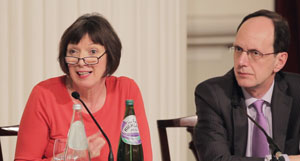
Frances O’Grady and John Cridland.

He told FE Week Labour “would not” take from the 16 to 19 budget to fund other learning within the same ringfence, adding the party’s policy was “about an £8bn spend on FE 16 to 19 provision”.

“If you protect it in real terms, that means you grow the 16 to 19 budget by £400m over the course of the next parliament,” he said.

The Liberal Democrats were the first to announce a plan to include 16 to 19 provision in the education budget ringfence but stopped short of pledging specific protection within the ringfence, although in June a spokesperson said that to move large amounts of money from one end of the wider age group to the other was not “consistent with the policy”.

Education Secretary Nicky Morgan has said the Conservatives would maintain the ringfence for five to 16-year-olds earlier, but did not commit to protection for early years or FE budgets.

Mr Byrne’s comments followed a Question Time-style panel debate, which also included Skills Minister Nick Boles, Liberal Democrat Sal Brinton, Confederation of British Industry director general John Cridland, Trades’ Union Congress general secretary Frances O’Grady, and was chaired by journalist Andrew Neil.

The debate, in front of an audience of around 150, focussed on how to solve the skills gap — an issue which Mr Neil said was “vital to our future and our economy”.

On the eve of the release of the skills funding letter [see front], many audience members raised questions about how the FE sector would continue to deliver the training needed to boost UK skills in the face of predicted cuts.

Although the contents of the letter had not yet been revealed, Mr Boles said: “I don’t suppose it’ll surprise anyone to learn that there are some biggish cuts to everything except apprenticeships.”
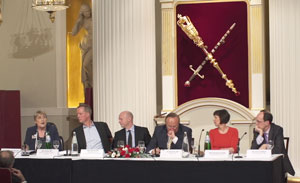
 From left: Sal Brinton, Nick Boles, Liam Byrne, Andrew Neil, Frances O’Grady, John Cridland.
From left: Sal Brinton, Nick Boles, Liam Byrne, Andrew Neil, Frances O’Grady, John Cridland.

However, he pointed to government protection and growth of apprenticeships.

He said: “If you are in the business of providing FE, and you moved into apprenticeships in a big way, then you have moved into a fuller stream of government funding, but if you have stayed traditional full time FE and not diversified then you will have had to make some very difficult cuts in budgets.”

Mr Cridland also called for changes to full time vocational qualifications and to GCSEs.

He said: “If the participation age is being raised to 18, what is the point of having terminal exams at 16?

“We should abolish GCSEs and rebrand high quality vocational qualifications as vocational A-levels — they are a recognised gold standard.”

Ms O’Grady said there had been too much change in the system under successive governments saying skills problems were “deep-rooted and long-running but the last thing many of us want is another rearranging of the deck chairs”.

However, Mr Boles argued there had been “a certain amount of consensus and continuity” between recent governments.
polies
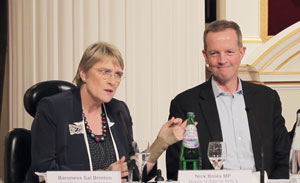
Sal Brinton and Nick Boles

“The most important element of that is on the increasing importance of English and maths, without which nothing else works,” he said.

“David Blunkett years ago started his review focussing on English and maths and we’ve carried out reviews and we’re insisting everyone continuing English and maths until they reach a certain standard.”

Lady Brinton told FE Week a focus on literacy should include English for Speakers of Other Languages (Esol) provision, but said the funding should be directed through Local Enterprise Partnerships.

“Then the funding can respond to local needs — there’s no point in providing the same level of Esol in Cornwall and Devon as there is in inner-city Birmingham,” she said.

Ms O’Grady also called for employers to be made to offer more workplace training.

“A third of employers don’t train at all,” she said.

“We need to recognise that the voluntary approach to investment in skills has failed.

“The picture on employer investment has not shifted substantially and in fact is getting worse so we need to tackle the idea that if left to the market there will be a rescue because frankly there isn’t.”