Skip to content
30 September 2026

Latest news from FE Week

Professor Wolf says more to be done on employer involvement

Professor Alison Wolf has called for more to be done to involve employers in college assessment and delivery after the government reported for the last time on progress in implementing reforms in her 2011 review of vocational education.

She also stood by her study programmes recommendation, which has prompted a rise in the number of learners taking up English and maths in an effort to gain at least a C grade GCSE or equivalent.

One of Professor Wolf’s recommendations for colleges was that the “assessment and awarding processes used for vocational awards should involve local employers on a regular basis”.

But, she told FE Week: “I’m not sure what else government could have done because our bizarre system it is to a large extent up to the awarding bodies and after that to Ofsted, but I don’t feel we have made as much progress as I would have liked in getting employers really involved in the assessment and delivery in 16 to 18 vocational education in colleges.

“I want us to get to a place, as in say Denmark or indeed France, that when you are doing your final exams on a level two or three vocational, occupational qualification, it is routine that employers are involved, not at the national level, but the local level.”

Professor Wolf defended study programmes, which were implemented last August and have seen the number of learners aged 16 to 19 requiring additional English and maths tuition rocket, adding: “I certainly didn’t expect learners to be put in for four GCSE resits in the course of two years, but I think that’s right.”

Of the 27 recommendations made by Professor Wolf in 2011, the government claims 20 are in place, another is partly enacted, while six are in the process of implementation.

Professor Wolf said: “I would not have expected, from my knowledge of government, that so many of my recommendations would have been put through with thought, and care and speed, and they were.”

Deborah Ribchester, senior 14 to 19 curriculum policy manager at the Association of Colleges (AoC), said study programmes had presented colleges with a “major challenge” in finding extra teachers and exam facilities, but that she recognised “the benefit it will bring to students”. She said: “Continuous professional development for maths teachers, also recommended by Professor Wolf, means staff will be better able to support these students.”


Sector chief tells of jobs fear as providers face 24pc funding cut

Association of Colleges chief executive Martin Doel (pictured) has told of his fears that more job losses could be about to sweep away FE and skills staff after it was announced provider budgets would be slashed by up to 24 per cent.

He said that with the average college having made 105 redundancies since 2009/10, he feared for the workforce as providers sought to balance their budgets in light of the latest government cut to FE and skills funding.

The Adult Skills Budget (ASB) is to fall 11 per cent next financial year, it was revealed on Thursday (February 26), and Skills Funding Agency (SFA) chief executive Peter Lauener has predicted this will translate to a 17 per cent cut next academic year.

But with £770m of apprenticeship money protected, and traineeship and English and maths funding prioritised, those who offer little or none of this provision could see their allocation, due out in just over a fortnight, fall by up to a quarter — even bigger than last year’s 15 per cent cut.

Mr Doel said the cuts were a “further blow to colleges and their current and future students”.

He said: “An additional major concern is how colleges, after suffering such considerable cuts, can continue to attract and retain the best staff. It is worth noting that the average college has made 105 redundancies since 2009/10 and we fear this figure will grow.”

The comments were echoed by Malcolm Trobe, deputy general secretary of the Association of School and College Leaders, who said: “The effect on colleges is potentially devastating. This sector has already suffered massive real terms cuts in funding and this announcement will put it under even greater financial pressure. It threatens the very financial stability of some colleges.”

Stewart Segal, chief executive of the Association of Employment and Learning Providers, said that with the apprenticeship protected “we need to see growth during the year if we are to meet employer demand”.

Some providers, he said, are at an early stage of developing their traineeship programmes and therefore their “carry-over will mean that they will require a higher budget for next year”. He further warned there would be “huge pressure on the rest of the budgets” with English and maths also prioritised, “inevitably resulting in some groups of learners not being able to access funding and this could include high priority groups such as the unemployed”.

Shadow Skills Minister Liam Byrne meanwhile accused the Conservatives of “hollowing out” the ASB, while University and College Union (UCU) general secretary Sally Hunt described the cuts as an “act of wilful vandalism that will decimate FE as we know it today.”

David Hughes, chief executive of the National Institute of Adult Continuing Education (Niace), said: “It is staggering that there is not more outcry about this drastic and sustained reduction in funding particularly given the clear consensus about the genuine threat that crippling skills gaps and shortages pose for UK economic growth.”

And Dr Mary Bousted, general secretary of the Association of Teachers and Lecturers (ATL), said the cut “looked like nothing less than a deliberate attempt to destroy the sector”. “It has already been battered by excessive cuts,” she said.

Joe Vinson, National Union of Students’ vice president for FE, said: “It’s appalling the government wants to reduce investment in skills when we need to stimulate the economy and give people the opportunity to gain work.”

Dr Lynne Sedgmore CBE, executive director of the 157 Group, said the predicted cuts meant she was looking at “new forms of social investment to sustain the future of high quality and accessible skills training for all”.

“We are working with the government to ascertain where legislative change may be needed in order to achieve this vision and to support the simplification of processes that may currently prevent innovation,” she said.

A spokesperson for the Department for Business, Innovation and Skills conceded the cuts would be “challenging for the sector”.

But, she said: “The sector was made aware at the time of the last spending review that government funding was reducing and of the need to look to generate other income streams, creating sustainable business models for the future. Private investment in skills training is high so government funding — although important — is not the only
funding available.”

—————————————————————————————————————————————-

Editor’s comment

There was no real surprise in the 5 per cent overall budget cut and little shock at the 11 per cent fall in the next financial year’s adult skills budget.

The SFA said this would look like translating into a 17 per cent cut to academic year allocations — but apprenticeships, traineeships and English and maths are the government order of the day so if you provide little or none of these expect your funding to fall by up to a quarter.

And while some question why these are prioritised, others question why higher education appears relatively unscathed and others still ask why older learners under BIS’s care aren’t afforded the same funding protection as that enjoyed by (some) DfE learners.

It’s not as if current funding levels are having no effect — just ask retiring157 Group executive director Dr Lynne Sedgmore to tell you about the rumour of 50 colleges in financial turmoil.

Jobs and provision might offer uncomfortable savings, but just how much more can be cut?

FE and skills has long been trying to shake off the Cinderella sector cliché, but what the government is instead discarding without the sector’s consent is its proud position as the ‘second chance’ saloon for adults to get on in life.

Chris Henwood

chris.henwood@feweek.co.uk

AoC chief calls on Labour to use tuition fee cut funding to benefit FE

Labour should use extra funding pledged to reduce university tuition fees to help support the FE sector, Association of Colleges (AoC) chief executive Martin Doel has said.

Responding to Labour leader Ed Miliband’s announcement today that his party would reduce the cap on tuition fees charged by higher education institutions from £9,000 to £6,000 a-year, Mr Doel welcomed assurances from Labour that FE funding would not be diverted to fund the cut, a possibility the AoC has warned of before.

But Mr Doel said Labour should go further by using extra cash to support the FE sector. His comments come after FE Week exclusively revealed providers faced a budget cut of up to 24 per cent in 2015/16.

Mr Doel said: “All young people should be supported on whatever pathway they choose post-16 and this is why we would like to see the extra money that the party is finding to support a traditional university education equally used to benefit the higher professional and technical education that equips people with the skills for the workplace.

“We previously had concerns about where the new money would be found to fund a cut in university fees and we’re pleased that they will not be taking it away from FE which has already seen massive cuts in the past few years.”

Announcing the tuition fee policy, Mr Miliband said: “These are fair choices, fair choices that allow a better future for our young people, a better future for Britain. Britain must not penalise the young, if we’re going to prosper in the future. Our economy and our country can’t afford to waste the talent of any young person.

“Let me say to Britain’s young people: I made you a promise on tuition fees. I will keep my promise. I don’t simply want to build your faith in Labour, I want to restore your faith that change can be believed. I owe it to you. We owe it to our country.”

Labour has said the £2.7bn cost of the cap change will be funded by reducing tax relief for people on very high incomes paying into pension schemes so it is set at the same rate as for basic rate taxpayers, capping the total eligible for tax relief in a lifetime at £1m and limiting the annual sum eligible for tax relief at £30,000.

FE Week launches 2015 survey — prizes on offer for your opinions

https://www.surveymonkey.com/s/FESURVEY2015

It’s that time again!

The second annual FE Week survey launches today with the aim of taking the sector’s pulse and delivering the results just in time for the general election on May 7.

And just like last year you could win an iPad Air and an FE Week subscription just for taking part.

The state-of-the-nation survey, again just like last year, is a joint project with the Policy Consortium and is open for a fortnight, closing on March 17.

“With the General Election less than ten weeks away, how has the Coalition Government fared in its stewardship of the FE and skills sector?” said Ian Nash, Policy Consortium member, freelance writer and journalist.

“The second annual survey by the Policy Consortium and media partner FE Week, launched today, will provide some measure of what staff and managers at all levels and all types of institution think.”

The wide-ranging survey embraces issues of governance, funding, Ofsted, learners, curriculum, local enterprise partnerships and plenty more besides.

It is aimed at, but by no means limited to, support staff, lecturers, directors, principals, chief executives and beyond, including those who work in unions, professional bodies and agencies.

Chris Henwood, FE Week editor, said: “The astounding success of last year’s survey meant there was no option but to do it again this year, especially with the promise of being able to deliver the sector’s message to political parties ahead of the election.

“What better reason to determine the views, priorities and moods of those in our sector about what is happening to it, what really matters and, indeed, what keeps those who work within it up at night.”

——————————————————————————————————————————————

Survey offers opportunity for ‘considered critique of current policies and strategies’

The first survey, Taking the pulse of education — the Great FE and Skills Survey of 2014, drew attention to serious shortcomings and misgivings, writes Ian Nash.

People responding used it to give a considered critique of current policies and strategies, not as an opportunity for a whinge-fest.

It is, therefore, worth reminding FE Week readers of some key findings (reported in edition 100 of FE Week, dated April 28, 2014 — see right) in advance of the 2015 survey.

Three concerns stood out, in well over a thousand responses, as meriting serious attention.

First, there were extremely high levels of concern over institutional funding, notably among the most senior staff best placed to measure the impact of spending cuts.

With pre-16 budgets protected, universities funded through fees and apprenticeships a priority, the already least-well resourced FE and adult provision was taking the greatest hit.

Second, there was considerable concern over the pace of change, whether in funding mechanisms, curriculum content or institutional arrangements.FE-week-E100-front
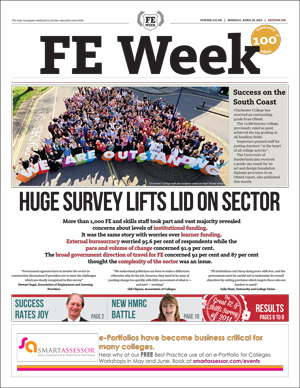
The survey revealed a picture of sheer frustration as staff said they had little or no opportunity to get on and do a good job before the rules were changed yet again.

Third, there were serious criticisms of the way funds were being switched away from colleges and other providers, partly as an effort to cut costs, apparently without due regard for the consequences. Notable among such concerns was the greater use of large contractors and a proposal to transfer apprenticeship funding to employers.

Providers echoed concerns expressed by national organisations over the impact on engagement of small and medium-sized enterprises.

Also, the shift of funding for learners with costly, high-level special needs from the colleges to local authorities was attacked for dismantling a system that was understood and worked reasonably well, in favour of one that threatened to destabilise provision and restrict opportunities for vulnerable learners.

Ofsted came in for criticism too, with many respondents sceptical that it was independent of government and damagingly inconsistent in its judgments at local level, despite the inspection framework.

Overall, FE staff did not see government changes to the sector as educationally legitimate, but rather as politically inspired.

Survey respondents talked frequently of political “interference” or “meddling”. They said that too often there wasn’t a partnership with other stakeholders but a sense that the sector was being “used” by politicians for their own, often short term ends.

Did ministers respond sufficiently to your criticisms 12 months ago? Government rowed back on some issues, such as direct funding of apprenticeships by employers.

But what of other issues such as the status of Local Enterprise Partnerships (Leps), the impact of academies and free schools on the sector, the state of careers guidance and the future role of digital technology following the recent House of Lords report? Let us know.

The survey will be conducted over the next two weeks — the closing date for responses is noon on Tuesday, March 17, and the findings will be reported in FE Week on Monday, April 27.

Visit here to take part in the 2015 survey.

——————————————————————————————————————————————

The FE and Skills Survey of 2015 has today (March 2) been launched and you’ve got a fortnight to have your say.

That’s also two weeks in which to make sure you’re in with a chance of winning a shiny new iPad Air and a year’s subscription to FE Week.

The 10-minute survey closes at noon on Monday, March 17, and the findings will be reported in FE Week on Monday, April 27.

Respondents can provide contact details within the survey in order to be in with a chance of winning.

Winners will be chosen at random and will be notified within a month of the survey results being reported in FE Week.

A detailed report by the Policy Consortium with full analysis will also subsequently be available online.

Those who opt to provide their contact details — so that either the Policy Consortium can email a copy of the analysis of the survey or to enter the FE Week prize draw — will have them treated in strict confidence. No-one will subsequently be contacted without their express permission.

Dr Lynne Sedgmore to step down from 157 Group executive director role

Dr Lynne Sedgmore today announced plans to retire from her executive director’s role at the 157 Group later this year.

She has served in the role for seven years and her retirement will bring to an end 35 years working in the FE sector.

She told FE Week: “I have loved my 35 years in the sector and have never wanted to be anywhere else.

“The work that FE colleges do for a huge cross spectrum of students is totally amazing, we truly transform lives for the better.

“I will miss colleagues and professional friends but in my 60th year, it feels time for a new and different life. I have plenty of things I want to do, places to go and adventures still to be had.”

Before leading the 157 Group, Dr Sedgmore was chief executive of the Centre for Excellence in Leadership between 2004 and 2008 and has also served as principal of Guildford College, vice principal of Croydon College and head of Croydon Business School.

She was award a CBE in 2004 and this year was  featured on the Debrett’s list of the UK’s 500 most influential people.

She is also a fellow of the Royal Society of Arts, the Institute of Directors and is a Chartered Marketer and the University of Surrey.

Sarah Robinson, 157 Group chair and principal of Stoke on Trent College, said: “Under Lynne’s leadership, the 157 Group has become established as a major organisation in the sector, an influential body fulfilling Sir Andrew Foster’s vision that principals of large, successful colleges should play a greater role in policymaking.

“Lynne has been instrumental in helping to raise the profile of further education, highlighting the social and economic mission of FE colleges and the important role they play in collaborating with employers and others to develop local economies.

“She has stimulated debate, supported research and facilitated the sharing of effective practice across the sector, especially in teaching and learning.”

Dr Sedgmore is expected to step down once a chief executive has been appointed to replace her.

“Her contribution to the 157 Group, and to the wider further education and skills system, has been enormous,” said Ms Robinson.

“Part of her legacy will surely be the increasingly positive light in which further education is viewed as an alternative gateway to sustained employment and a successful life.”

You can read FE Week’s profile of Dr Sedgmore here.

FE Week launches 2015 survey — prizes on offer for your opinions

Visit here to take part in the 2015 survey.

It’s that time again!

The second annual FE Week survey launches today with the aim of taking the sector’s pulse and delivering the results just in time for the general election on May 7.

And just like last year you could win an iPad Air and an FE Week subscription just for taking part.

The state-of-the-nation survey, again just like last year, is a joint project with the Policy Consortium and is open for a fortnight, closing on March 17.

“With the General Election less than ten weeks away, how has the Coalition Government fared in its stewardship of the FE and skills sector?” said Ian Nash, Policy Consortium member, freelance writer and journalist.

“The second annual survey by the Policy Consortium and media partner FE Week, launched today, will provide some measure of what staff and managers at all levels and all types of institution think.”

The wide-ranging survey embraces issues of governance, funding, Ofsted, learners, curriculum, local enterprise partnerships and plenty more besides.

It is aimed at, but by no means limited to, support staff, lecturers, directors, principals, chief executives and beyond, including those who work in unions, professional bodies and agencies.

Chris Henwood, FE Week editor, said: “The astounding success of last year’s survey meant there was no option but to do it again this year, especially with the promise of being able to deliver the sector’s message to political parties ahead of the election.

“What better reason to determine the views, priorities and moods of those in our sector about what is happening to it, what really matters and, indeed, what keeps those who work within it up at night.”

——————————————————————————————————————————————

Survey offers opportunity for ‘considered critique of current policies and strategies’

The first survey, Taking the pulse of education — the Great FE and Skills Survey of 2014, drew attention to serious shortcomings and misgivings, writes Ian Nash.

People responding used it to give a considered critique of current policies and strategies, not as an opportunity for a whinge-fest.

It is, therefore, worth reminding FE Week readers of some key findings (reported in edition 100 of FE Week, dated April 28, 2014 — see right) in advance of the 2015 survey.

Three concerns stood out, in well over a thousand responses, as meriting serious attention.

First, there were extremely high levels of concern over institutional funding, notably among the most senior staff best placed to measure the impact of spending cuts.

With pre-16 budgets protected, universities funded through fees and apprenticeships a priority, the already least-well resourced FE and adult provision was taking the greatest hit.

Second, there was considerable concern over the pace of change, whether in funding mechanisms, curriculum content or institutional arrangements.FE-week-E100-front

The survey revealed a picture of sheer frustration as staff said they had little or no opportunity to get on and do a good job before the rules were changed yet again.

Third, there were serious criticisms of the way funds were being switched away from colleges and other providers, partly as an effort to cut costs, apparently without due regard for the consequences. Notable among such concerns was the greater use of large contractors and a proposal to transfer apprenticeship funding to employers.

Providers echoed concerns expressed by national organisations over the impact on engagement of small and medium-sized enterprises.

Also, the shift of funding for learners with costly, high-level special needs from the colleges to local authorities was attacked for dismantling a system that was understood and worked reasonably well, in favour of one that threatened to destabilise provision and restrict opportunities for vulnerable learners.

Ofsted came in for criticism too, with many respondents sceptical that it was independent of government and damagingly inconsistent in its judgments at local level, despite the inspection framework.

Overall, FE staff did not see government changes to the sector as educationally legitimate, but rather as politically inspired.

Survey respondents talked frequently of political “interference” or “meddling”. They said that too often there wasn’t a partnership with other stakeholders but a sense that the sector was being “used” by politicians for their own, often short term ends.

Did ministers respond sufficiently to your criticisms 12 months ago? Government rowed back on some issues, such as direct funding of apprenticeships by employers.

But what of other issues such as the status of Local Enterprise Partnerships (Leps), the impact of academies and free schools on the sector, the state of careers guidance and the future role of digital technology following the recent House of Lords report? Let us know.

The survey will be conducted over the next two weeks — the closing date for responses is noon on Tuesday, March 17, and the findings will be reported in FE Week on Monday, April 27.

Visit here to take part in the 2015 survey.

——————————————————————————————————————————————

The FE and Skills Survey of 2015 has today (March 2) been launched and you’ve got a fortnight to have your say.

That’s also two weeks in which to make sure you’re in with a chance of winning a shiny new iPad Air and a year’s subscription to FE Week.

The 10-minute survey closes at noon on Monday, March 17, and the findings will be reported in FE Week on Monday, April 27.

Respondents can provide contact details within the survey in order to be in with a chance of winning.

Winners will be chosen at random and will be notified within a month of the survey results being reported in FE Week.

A detailed report by the Policy Consortium with full analysis will also subsequently be available online.

Those who opt to provide their contact details — so that either the Policy Consortium can email a copy of the analysis of the survey or to enter the FE Week prize draw — will have them treated in strict confidence. No-one will subsequently be contacted without their express permission.

Number of young people not in education, employment or training falls by almost 10 per cent on last year

The number of young people not in education, employment or training (Neet) fell by almost 10 per cent in the last three months of last year compared to same period in 2013.

Figures for the period from October to December were released today by the Office for National Statistics (ONS) showing that 963,000 16 to 24-year-olds in the UK were considered to be Neet.

The figure was 8 per cent down on the 1,041,000 Neets recorded for October to December 2013. However, the 2014 figure represented a 1 per cent increase on the 954,000 Neets recorded the previous three months.

There were 59,000 16 to 17-year-old Neets recorded between October and December last year, down 8,000 (7 per cent) from the same period in 2013 but up 3,000 (5 per cent) from July to September last year.

There were 905,000 Neets aged 18 to 24 during the final quarter of 2014, down 70,000 (7 per cent) from a year earlier but up 6,000 (1 per cent) from the third quarter of 2014.

The next ONS Neet statistics are due to be released on May 21.

Exclusive: SFA chief Peter Lauener warns providers of adult funding cut of up to 24 per cent

Colleges and independent learning providers are set for a national funding cut of up to 24 per cent next academic year, FE Week can exclusively reveal.

The Department for Business, Innovation and Skills (BIS) this morning released details of its 2015-16 (financial year) adult FE and skills funding budget, which will fall 5 per cent overall to £3.91bn — in line with indicative plans published in February last year.

However, alongside the letter from BIS, FE Week has seen a letter from Skills Funding Agency (SFA) chief executive Peter Lauener (pictured right) to providers, who are expecting their allocations in just over a fortnight, outlining how this will apply to the 2015/16 academic year.Peter-Lauener-(£)

He warned that the adult skills budget line in the SFA grant was being cut by 11 per cent, translating to a 17 per cent cut to the 2015/16 academic year. This, he said, would mean after protecting apprenticeship funding there would be cuts to provider allocations of up to a quarter — even bigger than last year’s 15 per cent cut.

He said: “At headline level, our initial modelling suggests that the total skills budget that we have available for allocation for the 2015 to 2016 funding year will be around 17 per cent less than in 2014 to 2015.

“Within this, the allocation budget for apprenticeships will initially be set at £770m and we will continue to work to ensure that every high quality apprenticeship opportunity can be funded.

“As a result of this continuing commitment to apprenticeships, the primary impact of the reduction is on the funds available for allocation as non-apprenticeship (other) adult skills which we estimate could reduce by around 24 per cent.

“The overall impact of our funding allocations will vary significantly between individual colleges and training organisations, depending on the mix of training provision delivered.

“Reductions will be higher where colleges and training organisations deliver low numbers of apprenticeships, traineeships, English and maths.”

The cut was attacked by the Association of Colleges (AoC) and the Association of Employment and Learning Providers (AELP).

Martin Doel, AoC chief executive, said: “The Government cannot continue to reduce this provision and at the same time expect adults to have sufficient opportunity to retrain for new or future job opportunities.

“By 2020, if the next Government continue to cut at this rate, adult FE will be effectively a thing of the past.”

He added: “This situation is now urgent. This could be the end of this essential education in every city, town and community in England and the consequences will be felt by individuals and the economy for years to come.”

Stewart Segal, AELP chief executive, said: “This is another major cut in budgets for the employment and skills sector while the funding for higher education continues to increase. This is the wrong focus while we are trying to give vocational learning the status it deserves.”

Skills-funding-webinar-2015-v2-1


Almost 100 providers to repay funding while hundreds more escape shock clawback

Nearly 100 providers issued with a shock clawback warning that caused “sleepless nights” for their staff over Christmas will be asked to repay 2013/14 funding.

The remaining 601 providers contacted by Una Bennett (pictured inset above), deputy director for funding systems for the SFA, late last year telling them they might have to repay against “provision that has been incorrectly claimed” will not face a reclaim.

Providers were later emailed by funding and programmes director Keith Smith (pictured right), who apologised for the “premature” warning and asked them to go over submitted ILR data and tell the SFA before the end of last month if they needed to make any repayments.

Kieth-Smith-web-

The apology saw the SFA come under fire once more on Feconnect, an online forum administered by the SFA, where one user complained that she had suffered “sleepless nights” over the issue.

However, the SFA has now revealed that a total of £500,00 from 98 providers could be reclaimed over mistakes over the minimum length of 16 to 18 and 19+ apprenticeships and eligibility for 24+ advanced learning loans.

It also said the work to find out how much should be reclaimed “highlighted the need for simplifying the system”.

A total of 699 colleges and independent learning providers (ILPs) had been warned about potential issues in their ILR data.

“Over the last couple of months, we have received responses from those who received a letter and have resolved the identified issues with the majority (601) of college and training organisations,” said an SFA spokesperson.

“We have written to these to notify them that no further action is needed and to thank them for their cooperation.

“We are working with the smaller number of college and training organisations (98) where data errors have been identified and have not been resolved to advise of the next steps.

“This includes college and training organisations having the opportunity to provide further information. Where errors cannot be rectified we will seek to reclaim funds.

“We will agree a suitable repayment schedule with individual college and training organisations. We estimate the total amount of funds to be reclaimed is £500,000, subject to final contractual discussions with these college and training organisations.”

She added: “We would like to thank the sector for working with us to ensure that ILR data submitted is accurate. This is important to ensure that any funds incorrectly claimed in error can be recycled back into the system, under our performance management processes, to ensure all public funds are maximised.

“We continue to work with the sector to seek feedback on our funding rules, to ensure they are as clear as possible so that colleges and training organisations have a full understanding of our rules which are a contractual requirement.

“This work has also highlighted the need for simplifying the system further and we will be working with the sector to do this.”