Mark Dawe reflects below on apprenticeship and skills minister Robert Halfon’s comments at the Conservative Party Conference on his priorities for apprenticeship reforms.
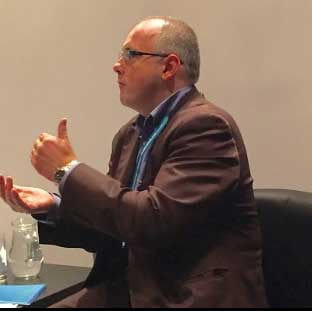
I have just sat in a fringe meeting at the Conservative Party conference that gave the apprenticeship and skills minster, Robert Halfon, the opportunity to speak and answer questions for an hour. In summary, if he delivers the priorities he listed through the revised apprenticeship guidance, then we will all be in a much better place.
Maybe I am just in a good mood having had a great night out at the weekend at a Chas and Dave concert – yes they are still alive and touring in their 70s. Interestingly I had to pay the same price for all my tickets – for all four children and adults, even though their knowledge of the song back catalogue varied – and amazingly I wasn’t allowed to negotiate the price. Maybe Chas and Dave can teach the DfE civil servants a thing or two about pricing.
Maybe Chas and Dave can teach the DfE civil servants a thing or two about pricing.
Anyway I wonder if Robert Halfon is thinking, ‘Mark Dawe, there “Ain’t no pleasing you”’? I would reply that everything AELP has proposed will help the minister achieve his priorities.
The priorities, which he has been clear about from the start, I would summarise as:
- Transforming the prestige of apprenticeships
- Social justice and mobility, in particular helping those at the very bottom and those just getting by
- The Levy and getting businesses to invest – with a particular focus on funding 16 – 18 year olds, the disadvantaged and non levy paying SME businesses
- Reaching the 3m manifesto (and legislative) commitment
- Ensuring all apprenticeships will be high quality
He also raised the concern during the hour about good maths and English and transition programmes.
So let’s take a look at each of these in turn. I won’t repeat some of the detail of our proposals, which I hope are very clear now.
- Transforming the prestige of apprenticeships – AELP absolutely support this aim and already we are seeing apprenticeship programmes from employers that will be a far superior training and learning experience compared to a classroom based or university-based programme. I think our main concern is treating apprenticeships like some bargain basement product where everyone can haggle over price. The main loser will be the learner and the quality of their apprenticeship – our proposal is for set rates for each framework and standard.
As an aside, the skills and employability conference I chaired in London this week included a presentation from the 2015 higher apprentice of the year, Jade Aspinall from MBDA. She was an amazing champion, and interestingly it was her father (I hope she doesn’t mind me saying) that was the most resistant. She told us how he is now a “flag waver” for apprenticeships.
Parents are one of the biggest influencers of their children’s choices and can be the biggest obstacle
Parents are one of the biggest influencers of their children’s choices and can be the biggest obstacle – we need a programme of “converted parents” champions as well as apprentice champions to really change the attitude of generations in this country. AELP are still not convinced the Careers and Enterprise Company money and activity is targeted correctly and having the impact needed – again a wider discussion.
And while we are at it, why can’t an HE apprentice get a maintenance loan so they can access the apprenticeship they want, wherever it is in the country with whatever company – isn’t that what maintenance loans are for in higher education?
It was wonderful to hear the minister’s support for WorldSkills with the regional, national and international competitions along with the annual Skills Show – I couldn’t agree more and what a perfect opportunity to demonstrate how our apprentices are world leaders. I hope that is reflected in his department’s commitment to proper sustainable funding for WorldSkills UK over the life of this parliament as a minimum.
- We need to improve social justice and mobility – it is a joy to hear these words in the list of priorities. It really does feel like the new ministerial team and the move to the DfE has led to the right balance between employer need and learner need – both so vital for the long term success of apprenticeships.
So AELP’s simple solutions for achieving this and the changes needed in the current draft guidance are as follows.
The first is easy – the same budget is needed for area and disadvantage uplift. We can have a debate about how best to efficiently allocate this money. Every system has its problems, and anything looking at individual income is generally laden with complexity and bureaucracy so a plea from us to keep it simple, but this funding is vital.
16 – 18 year olds and level two learners should not have any employer contribution imposed
16 – 18 year olds and level two learners should not have any employer contribution imposed. These are learners in the minister’s target group and require much more support – charging employers for the privilege of providing this support seems wrong!!
Finally a sensible transition from frameworks to standards – maintain existing framework funding until there is a fully functioning standard and costed end point assessment to move to – not really an unreasonable request and would resolve so many of the current concerns.
English and maths is also an issue for these learners. I have already written extensively about this matter. In summary, learners without level two English and maths from their eleven years of schooling are challenging. They require extra support and if they don’t achieve English and maths they fail their whole apprenticeship.
Faced with a choice between an individual who has English and maths and one who doesn’t, the danger is that the one without will be ignored by employers and providers.
Therefore we need proper funding and proper incentives to take on those without English and maths. The programme needs to be functional skills – we understand the brand concerns compared to GCSE – but actually most employers agree that functional skills give the individual the skills employers are looking for, GCSEs don’t. Forcing learners to fail a GCSE once again does nothing for motivation, learning and social justice – nor the employers. The focus on improving GCSE success should remain in schools, not post 16 technical and professional education.
- The Levy – getting businesses to invest. While covering 16 -18 and disadvantage uplift above, non-levy payers are a big concern. The non levy payers deliver the majority of apprentices currently – they are local and work within their communities to provide opportunities for some of the hardest to reach learners. We mustn’t disadvantage them. Any charge for the lower level apprenticeships is going to deter employers from getting involved. But more worrying, there is no commitment to a minimum budget for those employers. As things stand, if the levy is “used up” by the levy payers, which would be wonderful, there is nothing left for the non-levy payers and those that exceed their levy. This is currently estimated at some 70 per cent of the apprenticeship budget – or roughly £1.2bn. I am told time and time again not to worry as this money will be available, because there will be spare levy money. If I don’t need to worry, then the government doesn’t need to worry either about committing to this being a minimum budget for these employers.
- Achieving the target of 3m apprenticeships – AELP has been clear that some of the current draft proposals will reduce starts, not increase them. There has been a big drive for more higher and degree apprenticeships which we fully support. All we would ask is that it is not done at any cost and doesn’t damage the apprenticeship brand. We need to be clear what an apprenticeship is – starting in employment, the work based experience along with the technical training. We worry that in some cases we are just seeing employer funded degrees being flipped into apprenticeships standards without properly meeting these apprenticeship criteria – let’s be careful. In other cases we are seeing fantastic new programmes being developed and they should be applauded.
We worry that in some cases we are just seeing employer funded degrees being flipped into apprenticeships standards without properly meeting these apprenticeship criteria
There are bound to be more programmes for existing staff in the early days, as companies determine their medium term apprenticeship strategy. I agree with the minister, that providing we see a direction of travel with apprenticeship routes being established as a prime way of entering employment with training and education, along with an individual’s development once in the workplace, at this stage we shouldn’t be too concerned.
- They must be quality – AELP totally agree. I have already mentioned the concerns about negotiated prices and driving down funding of existing frameworks. AELP has concerns about the Standards and EPA process and look forward to discussing this further with the new IfA CEO and the minister. We are already hearing from employers who, for example, want to change from 13 standards to 2 with mandatory units and option – sound familiar! Other employers can’t understand why the standards and funding for heavy vehicle and light vehicle apprenticeships are so different when the main difference is just the size of the spanner (I might have over simplified that!). If employers are voicing these concerns, surely it is time to pause and review the process, what is a good standard and approach to assessment and make sure these are embedded in all future developments and retro fitted where necessary in current ones.
Clearly quality also relates to the quality of the provider and no one can tell me that allowing starts in a grade four provider screams quality – enough said on that. Ofsted should have a central role in ensuring the quality of delivery and if QAA is responsible for higher level apprenticeships, we need to ensure their regime of inspection is as robust and challenging as that of Ofsted.
And finally let’s just remember level isn’t quality – level two apprenticeships are vital and the majority are of outstanding quality. These get criticised as being poor quality because of their level by those who think apprenticeships should only be level three or even level four and above – they are wrong and such a change would cause enormous damage.
These get criticised as being poor quality because of their level by those who think apprenticeships should only be level three or even level four and above – they are wrong and such a change would cause enormous damage
The minister talked eloquently about the need for proper local programmes of engagement and transition for learners not yet ready to move on to a full apprenticeship. He gave examples of excellent programmes he had seen run by organisations like the Princes Trust. Traineeships have been one option but they are not getting the numbers first hoped for. This is probably yet another separate discussion and again I have written plenty on it, but simply put, these learners are hard to engage, hard to support and often take multiple attempts to get to achieve.
The current SFA minimum performance regime and Ofsted inspection regime terrifies many good providers – if there is a threat of criticism of quality and success without taking account of these challenges and the progress made, providers won’t take the risk of SFA contracts being withdrawn or a poor Ofsted grade which can also lead to their contracts being terminated.
There have been reassuring noises from both agencies, but they are not enough.
Quality is vital; however we need to properly define what success looks like in these programmes, recognise progress, not just set assessment points and don’t apply standard formula to something that is so learner focused.
There is no point introducing any new programme until these issues are resolved
There is no point introducing any new programme until these issues are resolved, otherwise they will receive the same tepid response from the very providers who are desperate to have such programmes funded and available for the individuals they meet every day.
And shouldn’t we make sure there is a better flow of individuals from Jobcentre Plus – at the moment the system is fractured and the people who suffer are those most disadvantaged that we are all trying to help.
Perhaps the only bit the minister got wrong was when he talked about the “great Nick Linford” but we can’t all get everything right. I am sure if the minister is reading this now he might be thinking “rabbit, rabbit, rabbit” but we can reassure him in the great words of the truly great Chas – “everything we ever done, was only done for you” and the success of the apprenticeship reform.
I look forward to the revised apprenticeship levy guidance reflecting Robert Halfon’s priorities.