

Ministers have been accused of breaking a promise for a real-terms funding increase for 16 to 19 year olds made in last year’s white paper to ease demographic pressures.
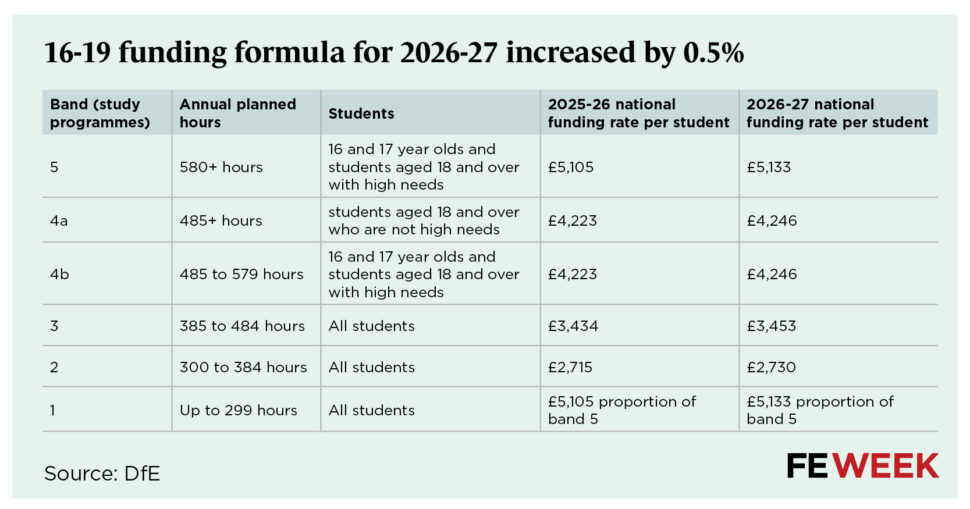
The Department for Education today confirmed the national funding rate for 16 and 17 year old learners will only rise by 0.5 per cent in academic year 2026-27, from £5,105 to £5,133.
This marks the lowest increase since funding rates were frozen in 2021-22.
The move has “disappointed” college leaders, who pointed out it breaks a pledge made in October’s post-16 education white paper which said there was “significant investment” available to “ensure there is increased funding to provide real terms per-pupil funding in the next academic year to respond to the demographic increase in 16 to 19-year-olds.”
Today’s batch of 16-19 funding guidance documents also failed to reveal details of any additional funding to support significant increases in learner enrolments this year due to a demographic boom in the number of school leavers.
Leaders said the government’s recent £800 million cash injection will be swallowed up by the extra estimated 20,000 16-18-year-olds entering college last autumn.
But the Association of Colleges (AoC) estimated that there are already around 32,000 current learners in colleges who will now be unfunded, and the “disappointing” funding rise will leave “very little” for staff pay rises.
The white paper promised £1.2 billion of additional investment per year in skills by 2028-2029, which will allow recruitment and retention of expert teachers and will “respond” to the demographic increase in 16-19-year-olds.
Julian Gravatt, deputy chief executive of the Association of Colleges, said: “Colleges will be disappointed by the funding announcement today by the Department for Education.
“The DfE calculation that there will be a 1.6 per cent [average per-student] increase shows that this promise hasn’t been kept, and right now, there is a lack of information on the overall budget,” he added.
Gravatt added that the demographic bulge will bring in extra income in the 2026-27 academic year, which will be lagged for one year, but will also incur extra costs associated with more teachers, staff and teaching space.
“This may leave very little money for pay rises in 2026-27 given that colleges are operating with funding that assumes no or minimal inflation,” he said.
Officials have also removed the 5 per cent uplift to the national T Level funding rate for several subjects.
Meanwhile, a £400 increase has been made to high-value courses in construction in a bid to boost the number of students who are “immediately” employable.
However elsewhere in the 16 to 19 funding formula, there will be no changes in 2026-27 to the advanced maths premium, core maths premium, disadvantage funding, English and maths funding, English and maths condition of funding or programme cost weightings.
T Level rate lowered
T Levels with technical qualifications introduced before 2022 will have their 5 per cent uplift removed in 2026-27, even if their occupational specialisms were introduced after.
The uplift was introduced to support extra costs associated with the early rollout of T Levels.
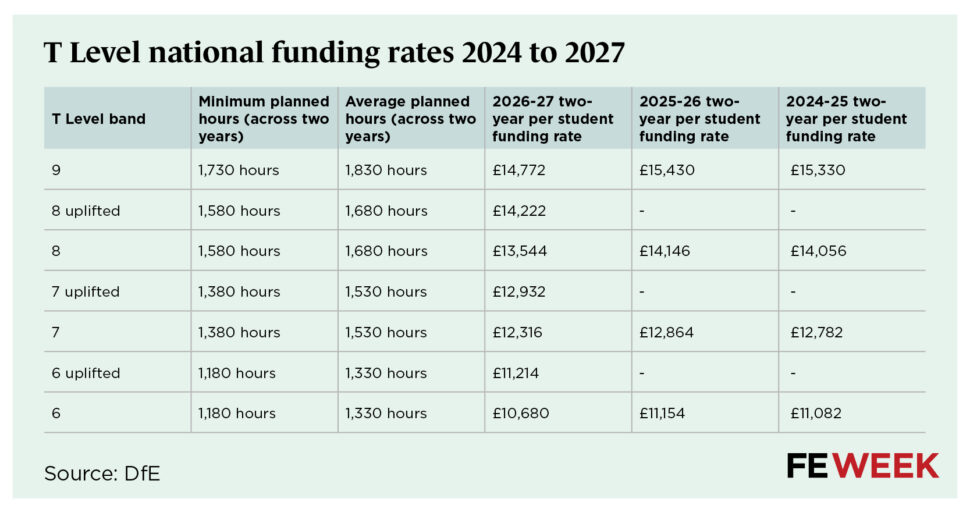
This means the funding rate has dropped by 4.3 per cent from last year for T Levels in digital, construction, education and early years and health and science.
The funding rate for band 9 “very large” T Levels of 1,830 total planned hours for the programme’s two years will be reduced to £14,772 in 2026-27 from this year’s rate of £15,430.
Band 8 (comprising an average 1,680 planned hours) will reduce from £14,146 to £13,544.
Band 7 will shrink from £12,864 to £12,316 and band 6 will fall from £11,154 to £10,680.
Sitting alongside the above funding bands are three additional “uplifted” funding rates across bands 6 to 8.
The 5 per cent uplift has applied to T Levels in business and administration, legal, finance and accounting, engineering and manufacturing, agriculture and animal care, creative and design and marketing.
The uplifted band 6 will fund the marketing, finance, accounting and legal services T Levels at £11,214 per student across the two-year qualification.
Uplifted band 7 has been boosted to £12,932, affecting T Levels such as management and administration, craft and design and media, broadcast and production.
Meanwhile, all three engineering and manufacturing T Levels and most routes under agriculture, environmental and animal care courses will be boosted to £14,222 per student under the uplifted band 8.
Ministers today confirmed plans to limit new T Levels to 1,080 guided learning hours, lower than the current minimum of 1,180 hours after long-standing calls from colleges that T Levels are too large and difficult to deliver at scale.
The move followed new starts data this morning showing ministers failed to meet their T Level recruitment target for 2025-26 by nearly a fifth.










0.5% rise is a real-terms cut and everyone knows it. The white paper promised proper funding to meet the demographic surge — this breaks that promise. The funding is shocking and letting the country’s future down. You can’t champion T Levels while cutting their funding rates at the same time.
totally agree