

It is almost 30 years since Tony Blair as opposition leader declared his top three priorities were “education, education, education”, back when the political landscape felt very different.
The Conservatives are now tasked with holding Labour’s feet to the fire from the opposition benches through their shadow skills minister Saqib Bhatti, while Ian Sollom holds the skills baton for the Lib Dems.
Reform UK and the Greens are surging in popularity, especially among young voters, but have been relatively quiet on skills and further education issues, and neither party has a spokesperson with those briefs.
Their political priorities reflect the public mood. In a recent PLMR poll, only 8 per cent of voters said they would like the government to prioritise education, compared to 59 per cent for the cost of living and economy.
But at a time when skills shortages are holding back economic growth, skills and education policies have arguably never been more important.
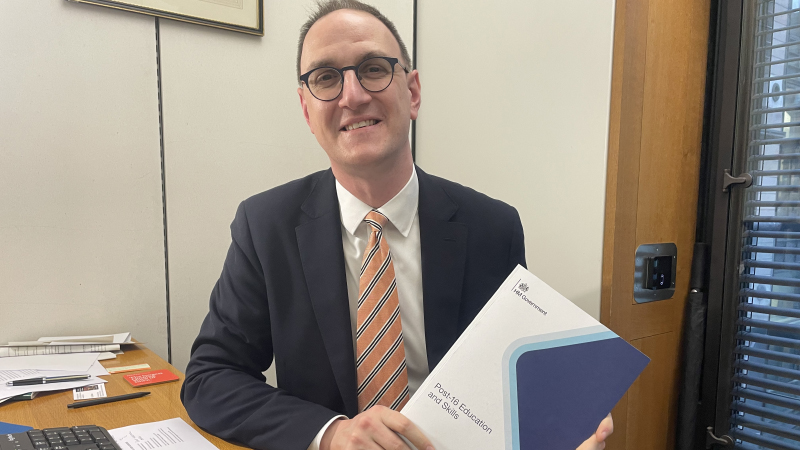
Sollom, skills and universities spokesperson, Liberal Democrats
The Lib Dems are the only opposition party that have put education at the centre of their agenda. And Sollom is well-versed in the FE sector’s challenges. The skills white paper sits open on his Westminster office desk as I enter the room. He proudly claims to have read every page, as well as “putting it into AI” to “probe little bits”.
He answers some tricky policy questions I put to him with relative ease.
But even he admits education is “low down on public priorities” – and “skills is even further down”.
“I’m pulling my hair out thinking, ‘but the economy comes really far up’ – there is a disconnect in people’s heads,” he says.
The movement of skills to the Department for Work and Pensions makes life complicated for opposition skills spokespeople as they must now liaise with both DfE and DWP departmental teams. “The speaker doesn’t necessarily recognise me as a DWP spokesperson”, says Sollom.
He believes that “skills is not getting the attention or the priority” it deserves because skills minister Jacqui Smith sits in the Lords, so cannot be held to account directly by opposition MPs in the Commons.
Many of the Lib Dems’ 2024 manifesto policies, such as replacing the apprenticeship levy with a “broader and more flexible skills and training levy”, developing some colleges as “national centres of expertise for key sectors”, rejoining the EU’s Erasmus+ scheme, and scrapping single-word Ofsted judgments, have since been rolled out by the current government, which Sollom admits has “certainly” been “frustrating” for him to watch from the sidelines.
His party favours boosting lifelong learning, but wants to achieve this through a £10,000 grant rather than student loans, which people could choose how to spend at different points throughout their lives.
Sollom sees the skills system as being akin to a three-legged stool, with the learner, the education provider and the employer each being the legs and all requiring the right balance of support.
He believes that “governments tend to rush to fix one leg, but if another of the legs is too short, it still falls over”.
Currently, he believes the employer leg is the weakest one; “The long-term decline in investment by employers into training and skills needs to be reversed”.
Sollom is concerned about the decline in SMEs taking on apprentices, and says his party would reverse it by enabling them to create “skills cooperatives” – groups of companies that would “pool the resources and risk” of taking on apprentices. This would mean apprentices moving between companies during their apprenticeships.
“SMEs are a vast pool that you could tap into if you can get the skills system working for them,” he says.
The party’s “ambition”, Sollom explains, is that FE teachers are paid the same as those in schools. He sees FE workforce shortages as “increasingly problematic, as you’ve got an ageing workforce in the FE sector because of the pay issues. And it’s no good putting skills front and centre if you’ve actually got no one to teach them.”
But – ever mindful of previous promises his party broke 16 years ago while part of the coalition government not to raise university tuition fees – he adds: “I don’t want us to make promises we can’t keep, and I’m aware of the constraints that the Treasury would likely place on us”.
The Lib Dems also support the Association of Colleges’ recent campaign to extend the pupil premium to disadvantaged 16-18 year olds.
Sollom is critical that Skills England is being “run by the civil service” (it’s joint CEOs are both ex-DfE directors) despite the government’s first King’s Speech “heavily implying” it would be put on a “statutory independent footing”.
Current polling indicates that the closest chance the Lib Dems could have to gaining power would be to form a coalition with other left-of-centre parties against Reform – in which case, their general alignment with many of Labour’s own education policies may be an asset.
“The Lib Dems have shown in the past that they’re prepared to be grown up in those circumstances,” Sollom says. “But ultimately, we’ve got to look at what we think is the best way of delivering the best outcomes for people.”
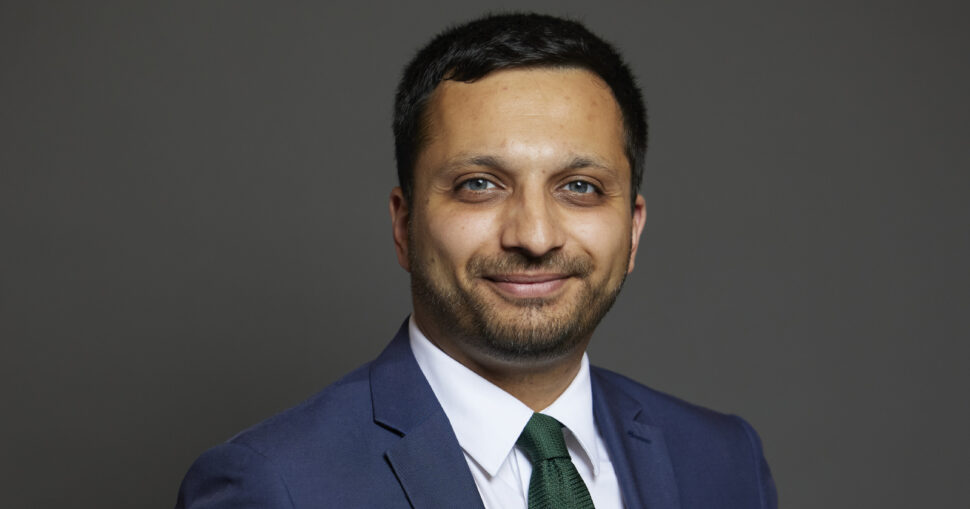
Saqib Bhatti, shadow education minister, Conservative Party
Unlike Sollom, who is not a keen Ticktocker, Bhatti is trying hard to build up a following on the platform, although he has not been using it to discuss FE issues. His top-pinned video uses a filter to show Kemi Badenoch mocking Rachel Reeves while wearing scribbled-on sunglasses, to the tune of a Snoop Dogg song.
His most successful post to date was one claiming the post-Covid shortage of lorry drivers was not down to Brexit, as the US and Poland faced a similar recruitment challenge. To his surprise, it got a quarter of a million views.
“You just never know what interests people,” he muses.
Bhatti sits to the right of the party. He supported Liz Truss’s party leadership bid in 2022 and saw her as a “very effective” international trade secretary while he served as her parliamentary secretary.
But he also sees himself as a “collegiate politician”, which he says he learned from Sajid Javid, whom he served as a private parliamentary secretary when Javid was health secretary, and who dealt with trade unions in a constructive way.
Bhatti is now offering education unions an “open door” to come to him with their ideas, because “it doesn’t matter where our politics are, ultimately we all have the same aim”.
Bhatti is an accountant by trade who “never planned to be in politics”; the prospect of the UK leaving the EU galvanised him into it.
I meet Bhatti and his two advisers outside Westminster tube station. To reach his favourite café from there, we must navigate our way past some rather rowdy protestors campaigning to rejoin the EU.
Little do they know that Bhatti is their political nemesis. He sat on the ‘Vote Leave’ board and founded Muslims for Britain campaign, helping persuade 800,000 Muslims to vote for Brexit by arguing that doing so would create a “fairer landscape” for those coming over from the Indian subcontinent.
“I was reticent to put my head above the parapet on political issues, but I just thought this was so important around Brexit. Being a British Muslim, I wanted ethnic minorities to have a voice in the campaign,” he says.
Like Labour, the Tories have put apprenticeship growth at the heart of their skills mission and, as ever with politicians, they are keen to show they have walked the talk.
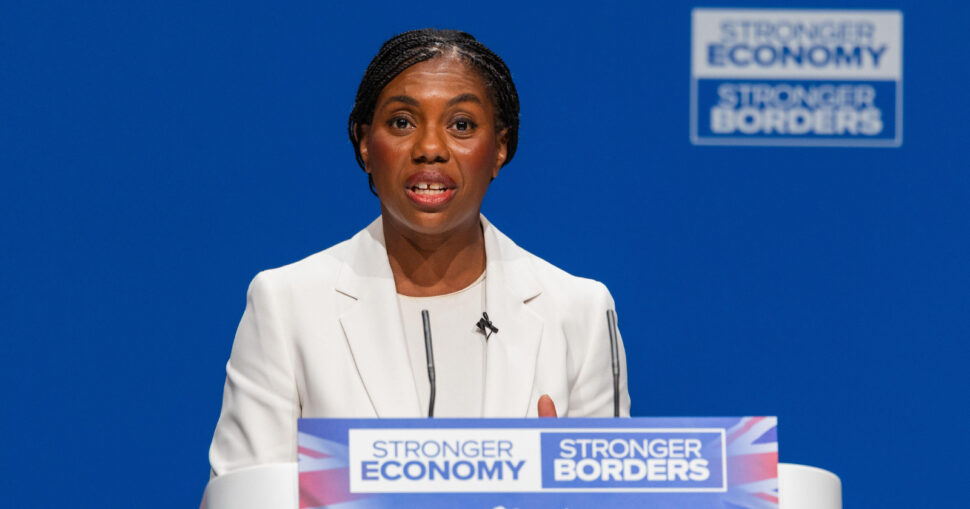
Conservative leader Kemi Badenoch claims to have taken an apprenticeship in software engineering, although her office has not responded to multiple queries from FE Week as to whether she completed it. Bhatti studied law at the London School of Economics but says “it’s very possible” that he would take an apprenticeship if given the chance again, in “something techie”.
At this year’s party conference, Badenoch unveiled proposals to double the apprenticeships budget to £6 billion a year by slashing enrolments onto “poor value” university courses, and directing “savings” towards apprenticeships and “worthwhile” courses.
The Tories are continuing to throw their support behind the T Level qualifications they introduced, despite their lacklustre take-up. Bhatti derides new V Level qualifications proposed in the skills white paper as “insulting, lower-level qualifications that reinforce a soft bigotry of low expectations for working-class students”.
He believes that cutting funding to level 7 apprenticeships will do “huge amounts of harm”, as those who “benefit” from them are “proportionally more the poorest in society”.
When it comes to skills, Bhatti discovered in his former role as president of Greater Birmingham Chambers of Commerce how “very convoluted” the sector is. He helped campaign for fellow Conservative Andy Street to be the first mayor of the West Midlands.
However, these days he is more reticent about the benefits of devolution, fearing that combined authorities are becoming “super bureaucracies”.
Like Sollom, Bhatti believes that not establishing Skills England as an independent body was a “missed opportunity”, thereby “taking away the business voice”.
Bhatti also criticises the government for cutting adult education funding, an issue “we have to fight hard for” which “matters incredibly,” given rising unemployment.
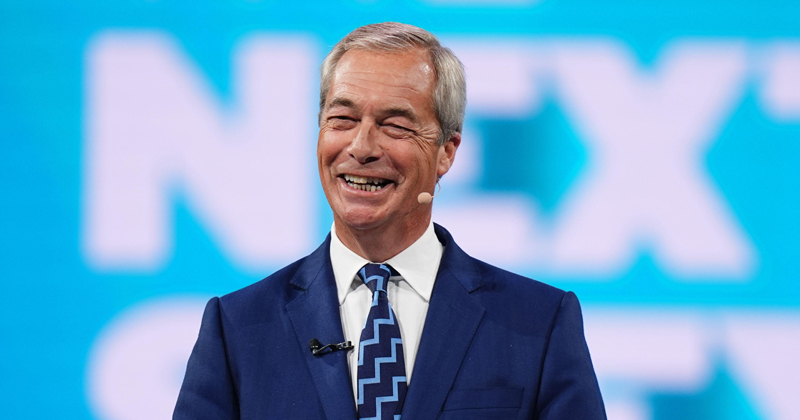
Reform UK: No spokesperson for education in post
Reform UK is storming the polls, with one recently predicting it would win 293 seats if a general election were held tomorrow, with Labour trailing on 191. But its leader, Nigel Farage, knows his rhetoric has made him unpopular among teachers. He predicts the entire UK teaching profession, who are “poisoning our kids”, would go on strike “very quickly” if Reform wins the next general election.
He believes that the “Marxist left” is “now in control of our education system” which requires an “absolutely herculean” job to turn it around.
Farage made these remarks during a recent visit to Hillsdale College, a small private Christian college in America which offers free online educational courses including The Genesis Story: Reading Biblical Narratives, Ancient Christianity and The American Left: from Liberalism to Despotism, and is affiliated with Regent’s University London.
Farage made a “commitment” to “help Hillsdale in the United Kingdom garner hundreds of thousands, if not millions, of young people to your online courses”.
Reform has so far revealed few details about its wider education and skills policies. But its politicians have indicated their support for the apprenticeships system.
The party’s policy papers say it would impose a higher national insurance rate (of 20 per cent) on foreign workers, which “could raise more than £20 billion over five years to pay for apprenticeships and training for young Brits”.
Reform also indicates that it would provide tax relief for businesses that take on apprentices.
But some other Reform policies could have undesirable knock-on effects for young people in FE. Its proposal to “front-load” the child benefit system in support of those with the youngest children would mean less money for college-aged offspring. And many ESOL learners would struggle to cope with its proposed requirement for five years in residency and employment before claiming benefits.
The party is already moving to cut ESOL provision in some areas where it holds power, including Greater Lincolnshire, Kent and Derbyshire.
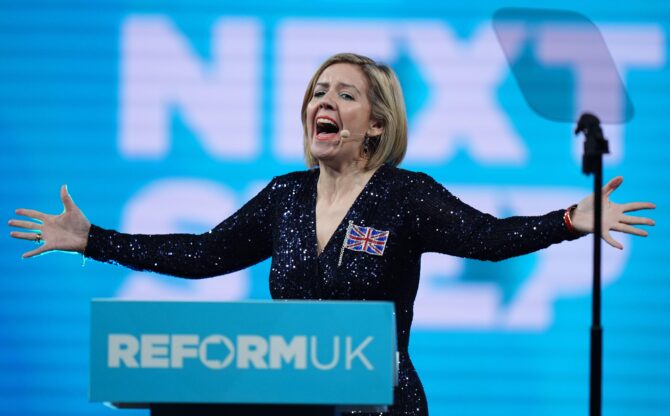
UK universities have good reason to fear the prospect of a Reform government; the party says it would withhold funding to universities that undermine free speech, and shorten degree duration to two years.
Reform has set up a working group to come up with a SEND policy paper, chaired by Greater Lincolnshire mayor and former Conservative skills ministerDame Andrea Jenkyns.
Whereas others in the party have taken a more hardline approach to SEND spending (deputy leader Richard Tice has said it was “being hijacked” by too many parents “abusing the system”), Jenkyns has a more nuanced perspective as she is neurodiverse herself and has a son with attention deficit hyperactivity disorder.
Tice has suggested that redundant church buildings could be used to teach children with SEND closer to home, and has criticised the excessive profits of independent special schools run by private equity companies. But his party shares the Tory aversion to VAT on independent school fees.
As part of its ‘war on woke’, for schools, Reform has pledged a “patriotic curriculum”, a ban on “transgender ideology” and the permanent exclusion of violent and disruptive pupils.
Reform would also “reopen high-intensity training camps for young offenders to teach basic education, teamwork and values”, to “tackle youth crime”.
The party’s only reference to adult education is to say it would provide free education to military personnel both during and after service.
The Green Party
The Greens are also riding high, having overtaken the Lib Dems in polls. They have the support of over 40 per cent of 18-24 year olds, with the largest youth and student wing of any political party. But the party has no discernible policies around further education or skills, and did not respond to repeated requests for comment and information from FE Week.
Their school policies include abolishing Ofsted, ending “high-stakes testing”, increasing school funding and teacher pay and extending free school meals to all school children. They have also pledged to restore university grants and end tuition fees.
The party’s education spokesperson since 2016 is Vix Lowthion, an Isle of Wight history, geology and classicsschoolteacher who has built relationships with the teaching unions but has said very little publicly on education issues in recent months.
Green party leader Zack Polanski says he wants to create a country “where education is free and entirely about the joy of learning”. In his role as a London Assembly member, he recently called on Sadiq Khan to “review” adult skills funding cutbacks and provide support to struggling Morley College London.








Your thoughts