


Pass rates in GCSE maths and English resits have remained stable despite a spike in the number of post-16 students sitting the exams this summer.
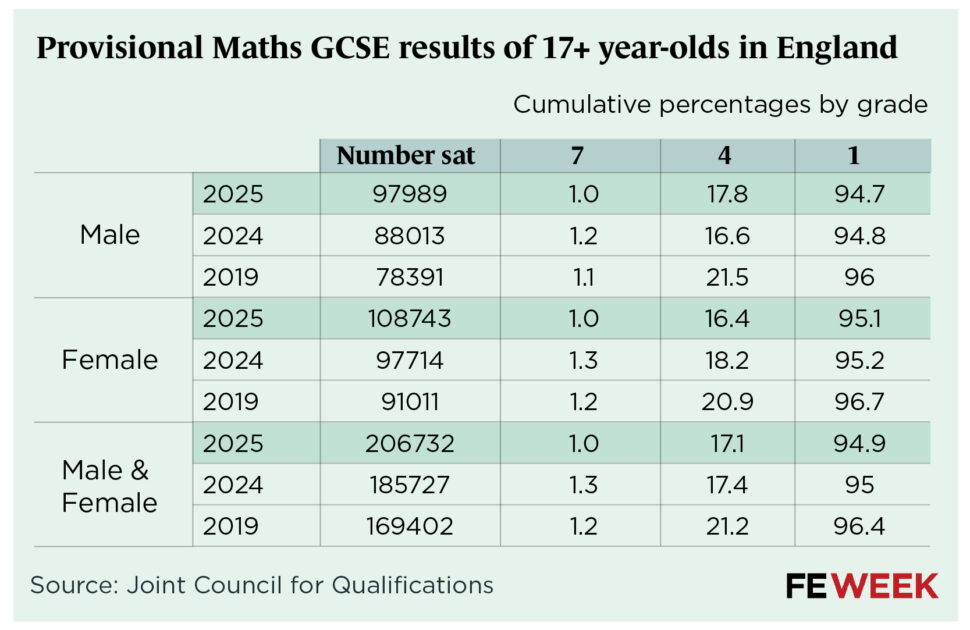
Figures published this morning show that 17.1 per cent of the 206,732 learners aged 17 or older taking GCSE maths in England achieved at least a grade 4 – a marginal fall from 17.4 per cent last year which had a cohort 11 per cent smaller of 185,727.
It means the maths resit pass rate is still around 4 percentage points lower than the pre-pandemic level of 21.2 per cent.
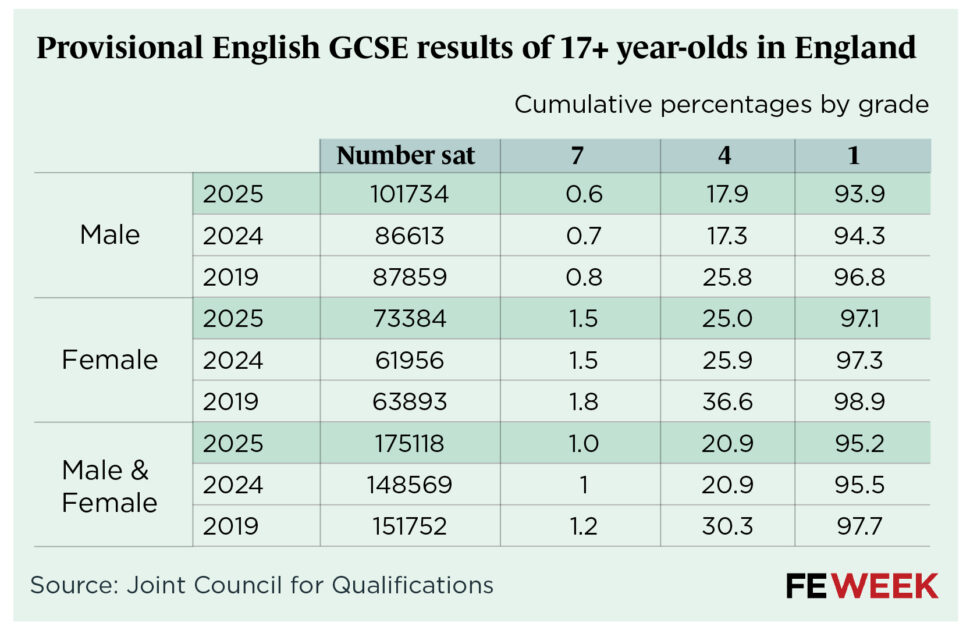
For GCSE English, 20.9 per cent of the 175,118 post-16 students who sat the exam this summer achieved a grade 4 pass. This is the exact same proportion as 2024 which had a cohort almost a fifth smaller at 148,569. This pass rate is almost 10 percentage points lower than 2019.
The results, published by the Joint Council for Qualifications, mean there are over 35,000 more people who have gained their GCSE maths grade 4 or above after failing to do so at school, and over 36,500 in English.
Ofqual chief regulator Sir Ian Bauckham said the data shows a “picture of great stability”, adding that the “increased number of entries doesn’t seem to have affected the performance” of resit students.
Boys overtake girls in maths
The gender gap in pass rates has flipped in post-16 GCSE maths. This year, 16.4 per cent of females achieved a grade 4 or above – falling from 18.2 per cent in 2024. Meanwhile, 17.8 per cent of males passed the subject this year, up from 16.6 per cent in 2024.
In English, 25 per cent of females reached at least a grade 4, which was a slight fall from 25.9 per cent in 2024. For males, 17.9 per cent obtained a pass, up marginally from 17.3 per cent the year before.
Older post-16 students, who are not subject to the government’s condition of funding rule, also continue to perform better than their younger peers.
Today’s data shows that 19.7 per cent (31,411) of students aged 17 to 19 passed GCSE English compared to 33.2 per cent (5,178) of learners aged 20 or older.
And for GCSE maths, 15.3 per cent (28,590) of young people aged 17 to 19 passed compared to 34 per cent (6,746) of 20-year-olds and above.
English resit entries will rise again
Colleges can expect a slight increase in their English resit cohorts next year, based on today’s results for 16-year-olds.
Pass rates for school leavers achieving a grade 4 in GCSE English and maths have fallen. This year, 29.4 per cent did not achieve a grade 4 in English, up from 28.8 per cent in 2024. In maths, 28.1 per cent did not achieve a grade 4, up very slightly from 28 per cent.
The very slight fall in the grade 4+ pass rate for 16-year-olds in maths is offset by a fall in the size of the cohort, so the number of students required to continue maths is roughly the same as last year, around 175,000.
There was also a decline in the size of the English cohort in schools, but the larger fall in the grade 4+ pass rate indicates a slight rise in the numbers required to continue post-16, up from around 181,000 to 186,000.
Will resit rules soon change?
Introduced in 2014, the government’s resits policy forces students who have not achieved a grade 4 pass in English and/or maths GCSE by age 16 to continue to work towards achieving these qualifications as a condition of their places being funded.
Students who achieve a grade 3 have to retake their GCSE, while students with a grade 2 or below can either take a functional skills level 2 or resit their GCSE.
The policy has split the sector since its inception, with some arguing it is a vital lifeline for young people who struggled at school, while others say that forcing students to repeatedly retake the exams is demoralising.
In 2018, then-shadow education secretary Angela Rayner vowed that a Labour government would scrap the resits policy.
The issue is currently being explored by Professor Becky Francis’ independent curriculum and assessment review.
Her interim report, published in March, said students who fail to pass GCSE English and maths at school should still be required to study the subjects in post-16 education – but with “greater nuance in measures”. Francis’ full report is due to be published this autumn.
Pepe Di’Iasio, general secretary of the Association of School and College Leaders, said today’s results show that “once again the majority of students who retake GCSE English and maths in post-16 education under a government policy of mandatory resits continue to fall short of a grade 4 standard pass”.
“It is utterly demoralising for these young people and there has to be a better way of supporting literacy and numeracy. We urge the curriculum and assessment review to grasp this nettle,” he added.












Stacked bar charts would help readers.
Post 16 GCSE E&Ms need reform. There needs to be at least 3 sittings throughout the year, with Maths being 2 papers. A student should be able to sit English or Maths paper 1 in November and then sit the other paper in Feb or June, at the end of the year cash in both papers to create a full GCSE. Honestly the 5 days each year that FE colleges needs to accommodate over a thousand students and use every single class room , space , office and all staff to facilitate these important exams, could be done better by utilising exam series windows that are specifically for post 16 FE college students.
Or perhaps let students just resit the paper(s) they have failed. Having to resit all 3 papers is demoralising for them.
Do you have any stats for Adult Learners (19+) that are funded through the Skills agenda?