


Just over 27,000 students began T Levels this year, leaving ministers short of their revised recruitment target by nearly a fifth.
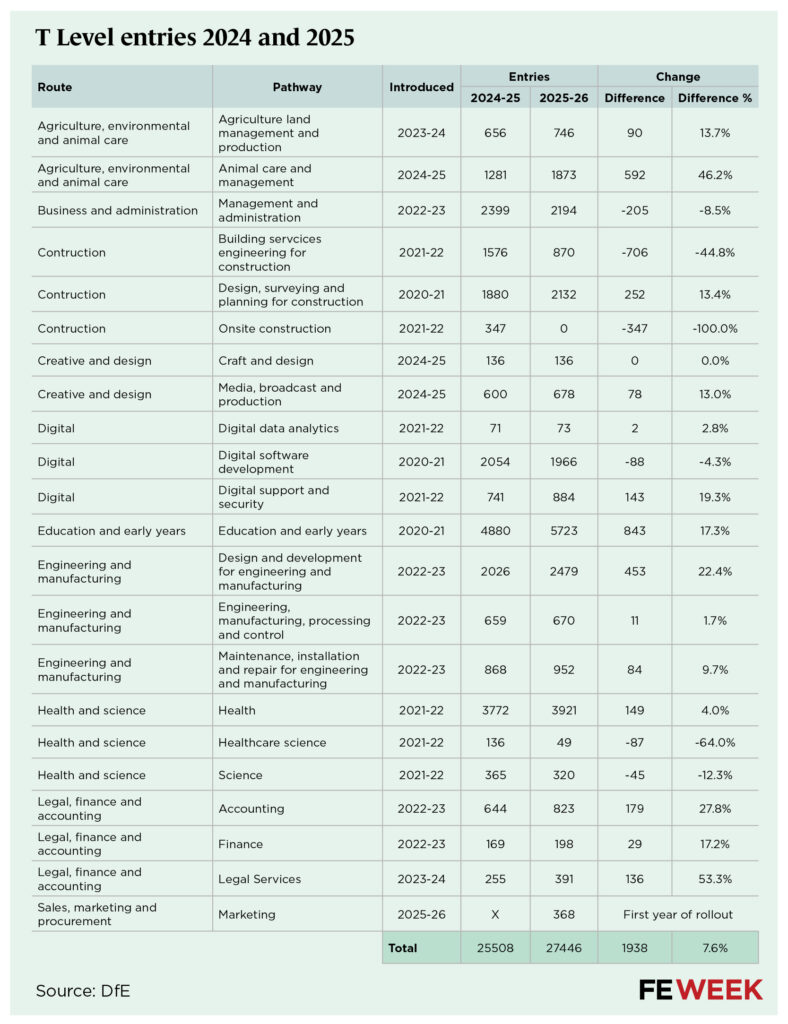
Statistics published this morning showed starts on the two-year technical qualifications rose 7.6 per cent from last year to 27,446 in 2025-26.
But the entry figures still failed to meet the Department for Education’s expected 33,400 starts, according to its latest estimates.
It means that recruitment targets for the government’s flagship technical qualifications have been missed for the sixth consecutive year since their rollout in 2020.
DfE revealed to the National Audit Office last year that it initially expected 106,500 starts for the 2025-26 academic year, according to an original estimate in May 2021.
Officials made subsequent revisions, reducing its target four times between January 2022 and October 2023.
The NAO warned the DfE about the scalability of T Levels after finding original student number forecasts were missed significantly, resulting in a near-£700 million spending shortfall.
Early years, health and business remain popular
Starts on the education and early years T Level, which was introduced in 2020, jumped 4 per cent in 2025-26, making it the most popular of the 21 T Levels available with 5,723 entries.
Meanwhile, the health T Level, introduced in 2021, cemented its position as the second most popular T Level, logging a 17 per cent increase in starts from 3,772 in 2024 to 3,921 in 2025.
In its second year of delivery, the animal care and management T Level recorded 1,873 entries in 2025, up from 1,281the year before, making it already the seventh most popular course.
Though it remained another popular T Level, the number of starts on the business and administration course dropped from 2,399 starts to 2,194 this year.
Starts on the building services engineering for construction T Level nearly halved to 870, a 45 per cent drop from 1,576 in 2024-25.
Take-up of the digital software development T Level (formerly known as digital production design and development) edged down 4 per cent to 1,966 starts this year.
Meanwhile, the new marketing T Level attracted 368 starts this year.
Accessibility on the rise
More students with lower GCSE prior attainment are starting a T Level, according to new analysis from DfE.
The proportion of T Level entrants who do not hold a grade 4 or above in both English and maths sat at 8.1 per cent in 2022-23, this increased to 11 per cent in 2023-24 and then rose slightly to 11.3 per cent in 2024-25.
The DfE said a breakdown of this characteristic was not yet ready for 2025-26.
By comparison, 32.5 per cent of students who enrolled on a large vocational technical qualification did not pass their GCSE English or maths at school.
More non-white and SEND learners
The data also found increasingly more non-white students and SEND learners taking up T Levels.
DfE used the young person’s matched administrative database to analyse GCSE prior attainment in English and maths, ethnicity, special educational needs (SEN) provision and free school meal (FSM) eligibility up to the 2024-25 academic year.
The proportion of non-white students starting a T Level was 19.1 per cent in 2022-23. This rose to 20.8 per cent the following year and to 22.1 per cent in 2024-25.
By comparison, 43.5 per cent of students taking a VTQ last year were non-white, while the population census showed 26.9 per cent of 16-year-olds were from an ethnic minority background.
Meanwhile, the proportion of T Level entrants receiving SEN support increased from 8.8 per cent in 2022-23 to 10 per cent last year.
According to individual learner record (ILR) and school census data, total T Level entrants were “almost evenly split” between male and female learners last year.
However, courses such as early years, craft and design and health had over 90 per cent of female learners.
In contrast, building services engineering for construction, onsite construction, and digital support and security (formerly digital support services) had mostly male students (over 90 per cent).
Foundation year starts down a fifth
Starts on the troubled T Level foundation year reduced to 7,344 in 2025-26, a 20 per cent fall from 9,228 in the previous year.
DfE explained the decline was due to a small number of large, high-volume providers reducing the number of routes they deliver. A total of 96 providers were recorded as providing the TLFY this year, down from 99 last year.
Health and science remained the most popular route with 2,075 taking the foundation course this year.
The construction route showed the largest decrease in entrants, a 70 per cent drop. Just 324 started a foundation course in 2025-26 from 1,104 the previous year.
DfE said the decline coincided with the scrapping of the onsite construction T Level and no new enrolments to this pathway this year.
Next year, the TLFY will be renamed ‘foundation year’ and will be gradually replaced by a new level 2 ‘further study’ pathway.












Has the ILR had a name change?
Yikes! Good spot. Thanks!
Missing the target for the sixth year running should tell ministers something — and it’s the placements.
T Levels depend on 315-hour industry placements. That’s what makes them credible, but it’s also the biggest barrier to growth. The Employer Support Fund closes this month with no replacement for direct financial support. The new contract starting in August offers advice and awareness — not a penny towards the real costs employers face in equipment, supervision, and staff time.
Look at construction — building services engineering starts nearly halved. High placement costs, significant health and safety demands, and disappearing financial support. The result is predictable.
You cannot scale a qualification built on employer goodwill while withdrawing the funding that makes participation viable. If the government wants T Levels to succeed, it needs to stop treating employer engagement as an afterthought and a free ride paid for by the Employer’s.