

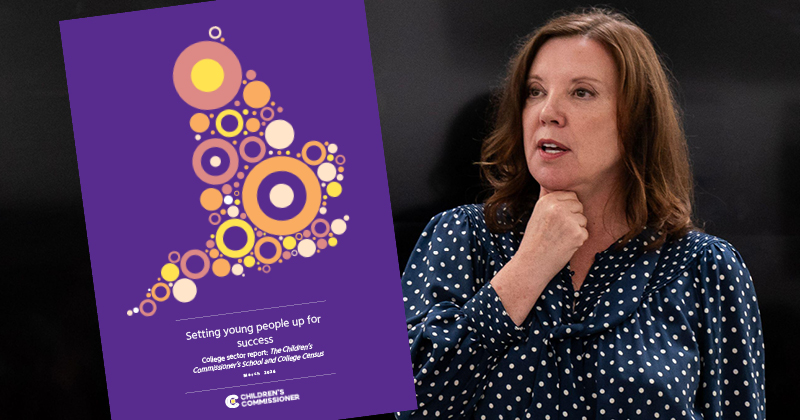
Colleges are “mopping up systemic failures” that include poor information sharing from schools and regional disparities in transport costs, the children’s commissioner has warned.
In a report based on survey data from 238 colleges, children’s commissioner Rachel de Souza said young people in post-16 education were often “neglected” due to a narrow focus on schools in education policy.
College leaders told the commissioner that information sharing from school to college was “not good enough”, with many students arriving with outdated education health and care plans (EHCPs).
Almost a third of colleges reported affordability and availability of transport for college students was a top concern, with regional variation in transport subsidies creating an “uneven playing field”.
Other top concerns included access to mental health support, student attendance, funding constraints, and diverse problems faced by college students such as complex home-life pressures, disadvantage and work responsibilities.
De Souza said the data, collected between September 2024 and February 2025, gives a unique national picture of how colleges typically go “beyond their core role” to help students.
She added: “The ambition to reduce NEET rates across the country will require us to tackle the structural and wellbeing barriers our young people face – and colleges are rightly recognised as part of the solution.
“Yet too often, rather than the wider system learning from them, colleges are asked to mop up after systemic failures elsewhere.
“When thinking about supporting young people’s needs, there is now rightful pushback to the simplistic idea of ‘put it on the school curriculum’ as a policy lever, but too little attention is paid to the burdens placed upon the FE sector and skills policy.”
College leaders reported that “delayed or incomplete” information sharing was a barrier to effective planning.
The report says: “Colleges have a shorter amount of time than schools to understand and meet their young people’s needs due to the length of time young people study at the college, and therefore timely information sharing is crucial.”
Key recommendations from the commissioner include providing free travel for as many children as possible, “timely and high quality” data sharing by local authorities and schools, and an extension of the pupil premium to young people in post-16 education.
De Souza said colleges and sixth forms play a “vital role” in young people’s educational journeys, and taught about a third of 16 to 18-year-olds in England in 2024-25.
However, 70 per cent of college leaders listed funding as one of their top concerns, compared to about half of secondary school leaders – revealing one of the biggest disparities between the two sectors.
And 35 per cent said funding constraints prevented them from fully meeting the requirements of EHCPs.
Most colleges step in to provide mental health support due to difficulties accessing local services, the report found.
Access to Child and Adolescent Mental Health Services (CAMHS) was a top concern for 79 per cent of leaders, with a similar number reporting that they fund their own mental health counsellor.
Chief executive of the Association of Colleges David Hughes said: “The barriers facing the college sector are well known to all across further education, but often fail to register in wider policy circles, so it’s heartening to see this report set them out so explicitly.
“Colleges are consistently asked to do more with less, and despite immense funding and resource pressures, they offer strong support to young people from all backgrounds, no matter what their circumstances.”
A Department for Education spokesperson said: “We are determined to break down barriers to opportunity to reach the prime minister’s target for two-thirds of young people to take a gold-standard apprenticeship, higher training or heading to university by age 25.
“Our post-16 education and skills white paper set out ambitious reforms, coupled with investment, to identify young people who need support and help them to move smoothly from school into further education, including piloting automatic enrolment and investing in better data sharing and attendance monitoring.
“We are also tackling the issues before young people reach college by expanding access to a mental health professional in every school and college, rolling out free breakfast clubs and free school meals, and lifting the two-child benefit cap.”













Your thoughts