

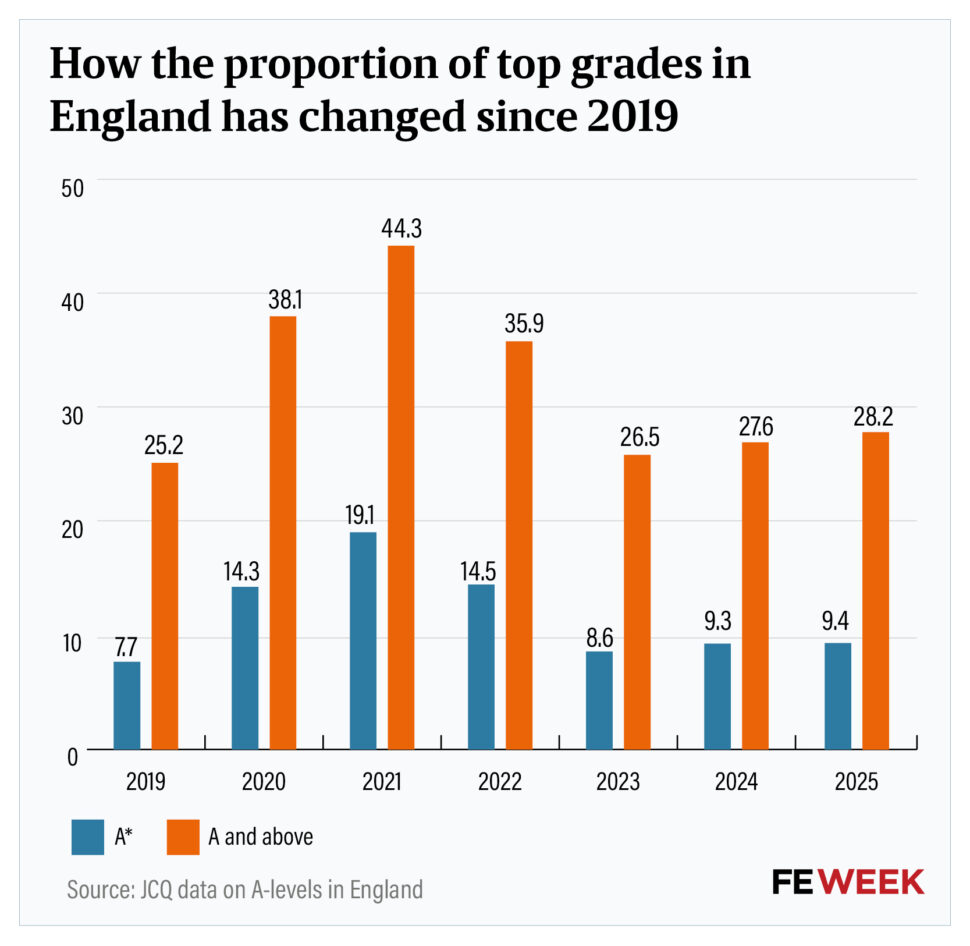
The proportion of top A-level grades achieved by students in England has risen slightly again this year – with boys outscoring girls for the first time since the pandemic hit.This year, 28.2 per cent of grades were A or above, up from 27.6 per cent last year (a 2 per cent rise). That also marks a 12 per cent rise than the 25.2 per cent in pre-pandemic 2019. The proportion of A* grades is largely the same (9.4 per cent this year compared to 9.3 per cent in 2023). However, this is still 22 per cent up on 2019.
Meanwhile, the gap between the top and lowest attaining regions has also risen.‘Stronger cohort’ behind results rise
In a blog published this morning, the regulator said they “can’t say for sure” why there has been an increase in pass rates.
The proportion of C and above grades also rose from 76 per cent in 2024, to 77.7per cent this year – a two per cent rise.
But Amanda Swann, executive director for General Qualifications at Ofqual, added prior attainment suggested this year’s A-level cohort “seems to be stronger than last year’s”.
This year’s students also made their A-level choices in 2023 – which was the first year GCSE grading returned to normal.
“That could mean those students had a more accurate picture of their strengths to guide their choices,” Swann added.
‘Students made better choices’
“We can’t be certain, but it may be that some students who might have taken A-levels in previous years instead opted for some of the level 3 vocational options, such as applied general qualifications (for example BTECs) or T-levels.”
Despite a rise in the number of 18-year-olds this year, the number of pupils taking A-levels has remained similar.
The number of A-levels taken has fallen slightly from 816,948 in 2024, to 814,224 (2,724 fewer, 0.3 per cent) – bucking a trend of entries rising steadily over previous years.
However the number of students completing T-levels this summer increased by 60 per cent up to 11,909.
But Swann added “any change in numbers achieving a grade is entirely due to a change in student performance, not a change in the standard expected”.
Ofqual said last year that results achieved in 2023 will now be the “baseline” for future grading standards.
However, despite attempts to unwind grade inflation from Covid years, results in 2023 were still higher than in 2019 – suggesting the post-pandemic grading standard is now more generous.
But Ofqual chief regulator Sir Ian Bauckham said: “Standards have been maintained for another year, with grades determined by students’ performance in exams using exam boards’ strict marking and grading processes.”
Regional gap widens
However, two regions in England saw results top results fall. The proportion of A and above grades in the north east fell to 22.9 per cent, down from 23.9 per cent in 2024. The west Midlands also saw top grades fall to 24.2 per cent, down from 24.8 per cent in 2024.
The east Midlands and the north west saw the biggest rise in top grades.
It means the gap between the north east, the lowest-attaining region, and London, the highest attaining, is now 9.2 percentage points.
This is wider than the gap between the best- and lowest-attaining regions last year, which was 8.8 percentage points.
Pepe Di’Iasio, general secretary of the Association of School and College Leaders, said the “big differences” reflect “socioeconomic factors which represent a massive challenge, not only for the education sector but our society as a whole”.
“We have to stop merely talking about these issues and actually address them with investment in communities suffering from generational disadvantage.”
University rates up for poorer pupils
The proportion of youngsters securing a university place has risen from 32.1 per cent in 2024 to 32.5 per cent this year. And the proportion of students from the poorest backgrounds getting a place is also up from 19.4 per cent last year to 20 per cent.
However, the university entry rate for students from the richest backgrounds has flatlined (falling slightly from 45.9 per cent to 45.8 per cent).
Education secretary Bridget Phillipson said “today is a time for celebration as young people up and down the country collect their exam results”.
But she added:“Every young person should have the opportunity to achieve and thrive. This government won’t stand by and accept the entrenched inequalities that continue to blight the life chances of too many young people, especially those from white working class backgrounds who have long been overlooked.”













Your thoughts