


Software testing and quality engineering have evolved drastically over two decades. But nothing compares to the pace of change driven by generative AI across business workflows, and the skills needed to deliver quality software.
The government digital service’s recent blog post illustrates how AI is rapidly speeding up development and engineering lifecycles.
Meanwhile, 49 per cent of engineering and technology businesses report difficulties with recruitment due to skills shortages, which is estimated to cost the UK £1.5 billion annually.
This tension between increasingly efficient pipelines and a shrinking talent pool raises the question: are training and education systems aligning with what modern engineering actually demands?
In a rush to encourage young people to use AI tools, further and higher education providers and businesses should not overlook giving young people the foundational understanding so they know when and why those tools are wrong.
Experienced engineers have the knowledge and contextual understanding to spot flawed AI outputs almost immediately. However, employers are finding that though their graduate candidates can swiftly prompt AI models, they struggle with debugging and differentiating good test coverage from poorly written output.
This is because the foundational exposure to coding and test design that once came naturally through education and early projects is being skipped in favour of vibe coding and an increasing dependence on large language models (LLMs).
Without learning how to validate outputs and understand the principles behind the code, graduates struggle to rely on judgment when automation falls short.
Strong foundations in coding, data literacy, testing principles and system design remain essential to understanding how data quality and manual oversight influence every step of a project.
For higher-level apprenticeships and technical programmes, this means rethinking curriculum design.
It’s not enough to add an AI module to existing content or teaching case studies without practical exposure. Rather, programmes need to ensure apprentices still get meaningful hands-on experience with coding, debugging and test design principles, even as they learn generative AI tools. They need to learn not just how to write tests, but to evaluate them so they can spot when something is over-engineered or likely to raise issues down the pipeline.
Employers, too, need to create environments where early-career engineers are mentored properly, exposed to complex problems gradually, and encouraged to question outputs rather than accept them at face value.
Take the importance of embedding quality at every stage of the engineering pipeline, for instance. Businesses increasingly demand a holistic approach, so graduates don’t have the luxury of applying judgment in some areas while relying solely on AI for the rest.
Training young talent to build quality into every stage of delivery is essential, and this is where higher education providers need to play a vital role.
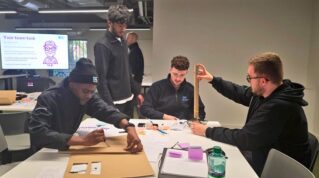
Through carefully designed apprenticeship schemes and on-the-job placements that incorporate low-risk projects, learners can experiment in fail-safe environments.
These structured experiences allow them to make mistakes, understand consequences, and refine their critical skills and practice without high-stakes pressure.
It’s true that the challenge cuts both ways. Apprentices and graduates struggle to find roles that match their skills because employers are looking for capabilities that traditional education is yet to effectively prioritise.
Similarly, employers struggle to fill positions because the talent pipeline hasn’t adapted to how rapidly the work itself has changed.
Caught in the middle, education providers must rapidly adapt their curricula for a job market that is more brutal than ever for young workers.
The industry is evidently in an experimental phase, figuring out where AI adds genuine value and where it introduces risk. But education and training cannot afford the same luxury of trial and error.
Intentional curriculum design and business partnerships that give the next generation the foundations of balancing cutting-edge tools with timeless principles are essential.
That means ensuring speed never comes at the expense of understanding, and that apprentices leave programmes equipped not just to use AI, but to work alongside it.








Your thoughts