


With the arrival of gen AI, our relationship with the written word requires an urgent re-evaluation.
We are understandably worried about academic integrity, but the solution isn’t found in stricter policing. Maybe the answer lies in the 1500s, with the man who defined the form that many are struggling to protect: Michel de Montaigne.
He didn’t view the essay as a polished, static product. He called his writings essais – from the French verb essayer, “to try.”
For him, writing was a process of radical self-examination and learning through trial and error. His famous question, Que sais-je? (“What do I know?”), embodied an intellectual humility that is missing from the high-stakes, “one-shot” assessments that many learners now dread.
In FE over the last decade, the essay has lost this utility. It has become a generic proxy for learning, a stand-in that transmutes a student’s unique thinking into a computable sameness that a chatbot mimics in seconds.
When we set tasks that machines can finish instantly, we aren’t testing skill; we are testing the ability to follow a template.
I say this as a sceptic. Despite my job title, I am as addicted to these technologies as anyone else. At 43, I remember life before algorithms were designed to fragment our focus. These platforms are built for engagement and data extraction, not necessarily for learning.
Without intentional scaffolding from educational experts, technology becomes a crutch. We must choose depth over a superficiality designed to keep us scrolling rather than growing.
I am inspired by artists like Rosalía and Kendrick Lamar, who embody Montaigne’s essai – the long, reflective attempt.
For her album Lux, Rosalía described using tools such as Google Translate to explore phrasing across languages, before spending a year testing meaning, rhythm, and tone with human collaborators.
The technology was the sparring partner, not the substitute. The skill and knowledge were applied through rehearsal and then in the studio.
In 2024, the music world was transfixed by a renewed “rap battle” between Kendrick Lamar and Drake. Beyond the feud, it surfaced a deeper cultural tension about effort and authenticity.
Lamar – the first hip-hop artist to win a Pulitzer Prize – represents the “long game”; extended periods away from the spotlight to prioritise craft, community investment and local legacy.
By contrast, critics argue that Drake’s recent output reflects a high-volume, streaming-era strategy – a form of “cultural strip-mining” that personifies a dopamine-driven, instant-gratification model. It is a montage of fashion trends and phoney quick-fix shortcuts designed for algorithmic visibility.
In our classrooms, the same tension exists: the “Drake” method of fast, AI-generated shortcuts versus the “Kendrick” method of slow, transformative and authentic craft.
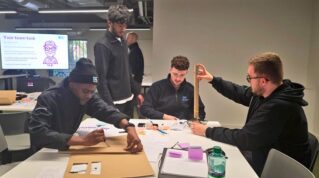
At BCoT, we are choosing the latter. In our travel and tourism department, students are moving away from extractive, generic tasks toward creating digital legacies.
They leverage vlogs to practise customer service and use podcasts to develop the skills of cooperation, problem-solving and vocal cadence required in the industry.
By building multimedia portfolios on Google Sites, they align their evidence with professional expectations.
Evidence of their skills and knowledge is captured through witness statements and recorded simulations, creating tapestries of proof that include annotated whiteboards, sketches and iterative blogs.
If an assessment is simple enough for a machine to do in seconds, it isn’t the learner who needs to change – it’s the assessment.
Wrestling with this article has reminded me why the written word still matters. I spent hours agonising over these paragraphs to clarify my thinking for an upcoming training session – voice-typing into Google Docs, editing and using AI to align my thoughts with formal conventions and my notes.
It was a challenging, deeply human process of clarification that no prompt could replace.
The essay as ‘default’ assessment in FE may be dead, but writing remains vital when it is used to shape the thoughts we are willing to be accountable for. By reclaiming the essai – the brave, high-effort attempt – we aren’t just making our assessments AI-proof; we are making them more human.











Your thoughts