The government is creating a group of “expert” apprenticeship providers in a new pilot programme unveiled today.
Those selected for this “mark of excellence” will be given “more access” to Department for Education systems in a bid to reduce the time and resource providers commit to coaching non-levy paying employers through the apprenticeship system.
But entry criteria is strict and eliminates many of the largest apprenticeship providers from participating.
The DfE is searching for a maximum of 15 providers to join the 12-month pilot, comprising seven independent training providers, five FE colleges and three higher education providers to “be reflective of current market share”.
To be considered providers must be rated ‘good’ or ‘outstanding’ by Ofsted, have an apprenticeship achievement rate of at least 51 per cent in 2021/22 as well as a 4-star employer feedback rating.
Early FE Week analysis suggests that of the 1,058 providers on the achievement rate table, just over half (53 per cent) meet the achievement rate and Ofsted criteria.
Big hitters such as the likes of Lifetime Training and HIT Training will already be excluded due to the achievement rates threshold, while other providers like BPP Professional won’t be able to apply due to holding a 3-star employer feedback rating.
Budding apprenticeship ambassadors must also be in “good” financial health and have been delivering apprenticeships for at least five years for FE colleges and ITPs.
Providers will need to already deliver at least 30 per cent, and a minimum of 50 annual starts, of its overall apprenticeships provision to non-levy paying employers.
Applicants must be prime contract holders and must not been sanctioned by the DfE following an audit or investigation in the past five years.
‘Priority engagement’ with officials and special access to DfE systems
The pilot programme is planned to start from October 31 this year. DfE needs responses by September 27 and applicants will be told if they are successful or not from October 16.
The guidance document stressed that the pilot will not include any further funding, but successful providers could see a growth in starts and cost efficiencies from being involved.
The aim of the programme is to make it easier for providers to work with small and medium-sized employers by reducing the time and resource providers need to commit to coaching SMEs through the digital apprenticeship system.
Chosen providers will be able to “use your expert status as a mark of excellence and a marketing tool,” DfE said.
This status will give providers special “flexibilities and permissions” in the apprenticeship service, which includes accessing the system on behalf of SMEs.
Providers will also get “priority engagement opportunities” with DfE officials through workshops and roundtables.
The DfE said the scheme will give “expert” providers the opportunity to “identify and realise operational cost and resource savings”.
The guidance outlines that providers’ expert status will be revoked if they receive any downgrades in Ofsted ratings, the emergence of a safeguarding issue, the termination of an apprenticeship contract, or if they become the subject of a DfE investigation.
Darlington-based training provider Baltic Apprenticeships has landed its first ever ‘outstanding’ report from Ofsted.
Inspectors praised the provider for its “well structured and carefully prepared” curriculum in an inspection in August, which was published today. Baltic Apprenticeships also received plaudits for making “substantial improvements” to both its functional skills provision, and for tackling the number of apprentices dropping out of its courses.
Tony Hobbs, managing director at Baltic Apprenticeships, welcomed the report, and said the rating will “allow us to further bridge the gap between education and employment, and accelerate our ability to make a real difference to our learner’s lives and our employer’s skillsets”.
“Our focus on tech and digital apprenticeships isn’t just about generating job opportunities, it’s about creating solid career foundations and building the skills modern businesses need,” he added.
Baltic Apprenticeships was established in 2008 and has scored Ofsted ‘good’ ratings on three inspections before this latest one. The provider mainly delivers courses in ICT, software and digital marketing and has 1,370 apprentices on its books. It also has 272 adult learners on programmes in lean manufacturing, logistics and warehousing.
‘Extensive knowledge’
Ofsted said the “proportion of apprentices who complete their programme is improving rapidly” after the provider took steps to keep them on their courses, such as encouraging employers on the level three digital marketer course to increase their apprenticeship salaries.
The provider also now provides “intensive support” on English and maths, and offers “high-quality sessions” which are “highly valued” by apprentices.
Inspectors put the provider’s high-quality curriculum down to its “leaders’ extensive knowledge of the labour market and their close working relationships with external stakeholders”.
It also received praise for its close work with employers to match apprenticeships with their needs. For instance, the provider included content on additional operating systems to the curriculums on the level three and level four ICT standards after feedback from an employer.
Baltic Apprenticeships’ “accurate oversight” of its courses also came in for praise, with inspectors highlighting its constant dialogue with apprentices and teaching observations to improve the standard of training. Inspectors focused, too, on the provider’s early assessments of apprentices at the start of their courses, and their efforts to adjust training plans to the individual apprentices.
The quality of the courses also means apprentices and adult learners develop “significant new knowledge and skills”, while “most apprentices and learners” also achieve their qualifications.
Inspectors also noted “consistently positive attitudes” among the apprentices and learners, who are “highly committed to successfully completing their programmes”.
Apprentices become ‘active citizens’
Inspectors also highlighted the provider’s “comprehensive careers advice and guidance”, which leaves apprentices “confident” about the options available to them after their courses.
Ofsted further pointed to the provider’s “high priority” focus on “developing apprentices to become active citizens” via volunteering with local charities. For instance, ICT apprentices teach basic computing skills to older members of the community, while a group of apprentices at the provider also renovated a flat to welcome a Ukrainian family to the UK.
“As a result, apprentices have a strong sense of community and the importance of being a good citizen in modern Britain,” inspectors said.
A House of Lords committee has blasted the Office for Students for a lack of independence from government and for losing trust with “many of its providers”.
In a damning report, the House of Lords’ industry and regulators committee said the actions of the higher education regulator “often appear driven by the ebb and flow of short-term political priorities and media headlines”.
The OfS was set up in 2018 to be an independent body that reports to the Department of Education and parliament, with a brief to work with higher education providers to make sure that students succeed. It regulates more than 400 providers, including 153 colleges.
But the committee’s report, published today following a six-month inquiry, said the regulator “is failing to deliver and does not command the trust or respect of either providers, or students, the very people whose interests it is supposed to defend”.
The OfS’ own actions are often driven by “political priorities”, according to the Lords committee, which stated that while the regulator “does occasionally push back against the government, too often it translates ministerial and media attitudes into regulatory burdens”.
Witnesses cited occasions where media and MPs raised concerns “without clear evidence” about written English competence. The OfS then started putting out edicts requiring spelling and grammar assessment, without any investigation into whether that was necessary, the witnesses said.
The committee heard there was “widespread concern that it simply does the government of the day’s bidding”.
This perception is not aided by the fact that the OfS’ chair, Lord Wharton, continues to take the whip of the governing party in the House of Lords, while simultaneously claiming that the organisation, as a regulator, is independent of the government.
The committee said that although Lord Wharton was under no obligation to do so, it would have “helped to ease concerns if the chair had resigned the whip and become non-affiliated for his time in post”, as other Lords in similar positions have done in the past.
University and College Union general secretary Jo Grady has now called on Lord Wharton to stand down.
DfE letters ‘too prescriptive and unusually frequent’
Today’s report also pointed out that government’s relationship with the OfS is different to other regulators, such as the water services regulation authority, Ofwat.
For instance, the government sends an annual guidance letter to the OfS setting out its priorities for the year with multiple follow up letters, which are “often specific about what the government wants the OfS to do”. In comparison, government sends the water services regulation authority, Ofwat, high-level aims without advice on how to meet those aims.
The OfS has received 26 guidance letters from the DfE since it was established in 2016, according to the report, which added the letters are “too prescriptive and unusually frequent”.
The committee also identified a “worrying” perception that the OfS would punish higher education institutions for any financial difficulties, rather than help them. That had led to some institutions not engaging with the OfS when they face financial pressures “for fear of a punitive regulatory response”.
On top of that, the committee said the OfS’ regulatory framework has become “increasingly prescriptive” over time. It is “too willing to direct higher education providers’ operations and activities, showing little regard to the need to protect institutional autonomy”.
Distrust and friction between the regulator and sector
The OfS has also allegedly given insufficient thought to the impact of its actions, requests and decisions in adding regulatory burdens to providers. The OfS also makes “frequent and often ad hoc requests” for data that are “both burdensome and, at times, duplicative of similar requests from other regulators—including asking providers for the same data submitted to other regulators, but in different formats”, according to the report.
In “many areas”, it “appears unclear to institutions what compliance with the regulatory framework looks like or why the OfS requests data from them”, the Lords said.
This “lack of clarity for providers extends to the OfS’ approach to investigations, where it is not clear what has triggered investigations, the process involved or the likely timescales and outcomes”.
The committee said uncertainty over why the OfS acts “in the way that it does” has created “distrust and friction between the regulator and the sector”.
OfS chair Lord Wharton said the report provided a “helpful opportunity to hear from representatives of higher education institutions, students, and policy-makers, and understand these stakeholders’ thoughts on our regulatory approach”.
He added that the report will provide “further impetus for our work to refresh the way we engage with the sector we regulate, and those for whom we regulate”.
Welcome to this special souvenir supplement celebrating Team UK’s performance at EuroSkills 2023, brought to you by FE Week in association with NOCN.
You’ll find everything you need to know about the competition, including the gruelling preparations, the all-important medal tables and exclusive behind-the-scenes reports from our on-the-ground senior reporter, Anviksha Patel.
Behind every competitor is a team of exceptionally committed training managers, WorldSkills UK officials, employers, families and training providers supporting them. We’re proud to support them too as their official media partner.
Nearly two decades of reforms to the skills system have failed to improve UK productivity, claims a new report.
The research, commissioned by the Federation of Awarding Bodies and co-authored by its former chief executive, Tom Bewick, said it “found no evidence to show government skills reforms have had a direct or positive impact on UK productivity” in its analysis tracking back to the Leitch Review of Skills in 2006.
Too much emphasis has been placed on boosting the number of jobs in the economy, the report states, without “improving the quality (and therefore the productivity) of existing jobs,” the report, called Running to Stand Still, said.
Alongside analysis showing how UK worker productivity compares to competitor nations in the OECD, the federation has tracked the extent to which recommendations made in six major skills reviews have been implemented by the government.
For example, it found that ten recommendations from the 2011 Wolf review of vocational education, four recommendations from the 2016 Sainsbury review of post-16 skills and 13 recommendations from 2019 Augar review of post-18 education have not been implemented.
Interviews with 25 sector experts, including the author of one of those reviews, Baroness Alison Wolf, lay the blame on distrust between the government and sector providers, a lack of consensus on the purpose of education and a “toxic relationship” between the Department for Education and the Treasury.
‘Skills laggards’
Using qualification attainment levels as a comparator, the report points out that the UK remains third from the bottom of OECD measures of intermediate-level skills in the workforce, despite a commitment made in the Leitch review to “become a world leader in skills by 2020”. Conversely, the UK beats countries like Australia, Germany and France in higher-level skills.
“Data highlighted in this report and elsewhere shows that access to adult skills and apprenticeships, as a total participation measure, have declined in recent years. It is particularly noticeable that the UK, when compared to other advanced economies in the OECD, has turned into a skills laggard by comparison,” the report said.
Declines in the number of below level 3 qualifications being awarded to adults should be a “major concern” to incoming ministers, according to the report, “because it is a major reason why the UK’s productivity record is so poor”.
Source: Running to Stand Still, Federation of Awarding Bodies (2023)
Bewick, who co-authored the report with social researcher Matilda Gosling, said he called the report Running to Stand Still because, “in the end, the main purpose of skills policy should be to support rising real wages and economic growth.
“Despite the best efforts of successive governments, our detailed analysis of these policies, including feedback from leading sector experts, found no evidence that various skills initiatives have really helped shift the dial on sluggish UK productivity rates”.
‘Regulation has tripled’
Budgetary constraints and the slow workings of Whitehall are also responsible for the government’s failure to act quickly enough to rescue the UK’s poor productivity.
Experts said that distrust between policymakers and sector providers had contributed to complexity in the skills system, which is also holding back productivity. “The challenge for people working in the Department for Education ‘is that they have to test [changes] out against gaming and unforeseen circumstances.’”
Despite the Sainsbury review talking about simplifying the skills system’s regulator landscape, “it now has more regulators and more qualification categories within it … It feels like regulation has tripled,” according to one interviewee.
Excessive government regulation in the skills system could itself be harming productivity, the report alleges.
The report doesn’t make firm recommendations on specific policy areas, but does make a plea for a UK-wide “integrated skills plan” and floats a new Department of Employment, Productivity and Workforce Skills to oversee the plan.
It also criticises departments, like DfE and the Department for Work and Pensions, for involving civil servants too much in the delivery of programmes, like T Levels, rather than “what they do best – policy”.
Ofsted will “avoid” inspecting education settings that are disrupted by RAAC this term, but only if the provider is on the government’s list of settings with confirmed cases of the crumbly concrete.
The inspectorate last week said it would consider requests from affected schools and colleges under its deferral policy “as an exceptional circumstance”.
But Ofsted has now changed its approach in a statement issued today.
“This term we will avoid inspecting any education setting that is on the Department for Education’s published list of education settings affected by RAAC,” the watchdog said.
“These settings will be removed from our scheduling and will not be selected for inspection during the term.”
Ofsted acknowledged “some settings are not on the list, but are still impacted by RAAC in some way – for example, hosting pupils from schools that have RAAC”.
The inspectorate said it had “updated our deferrals guidance to make clear that we will consider disruption as a result of measures taken to deal with RAAC, when looking at inspection deferral”.
These measures “will be kept under review”.
However, if Ofsted has “concerns” about an education setting then it “may continue to carry out an inspection, in line with our current policy, regardless of their situation with RAAC”.
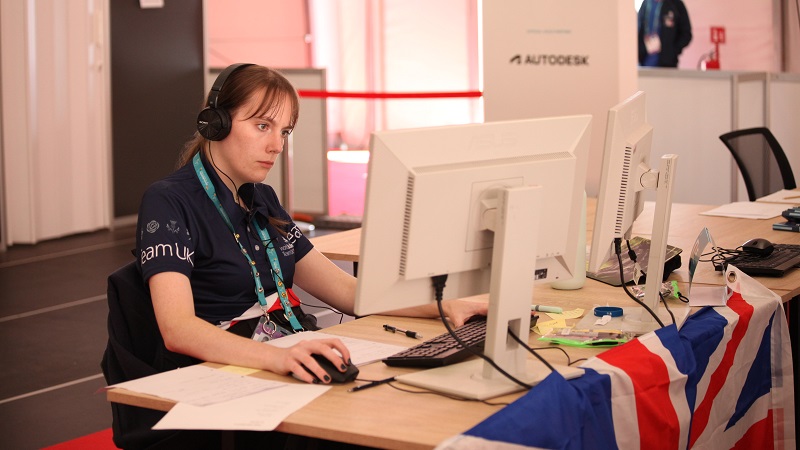
Team UK has scooped nine medals at this year’s EuroSkills competition in Gdańsk, Poland, including one gold and two bronze.
The elite team of young people representing the UK at the European skills Olympics swooped into 13th place out of a total of 32 competing countries across the continent.
Isabelle Barron, aged 22, from Clitheroe in Lancashire, won gold for her specialism in digital construction, an achievement that she said was “beyond her wildest dreams”.
“Being recognised as the best in Europe is life-changing,” she said. “I hope that I can use my experience as part of Team UK, to dispel some of the myths about working in construction and show young people the range of different opportunities that exist.”
She was also awarded the coveted “best in nation” title for the UK.
Barron works for global architects Chapman Taylor has a BSc Honours from Sheffield Hallam University.
Gold medal winner Isabelle Barron, Team UK, EuroSkills 2023
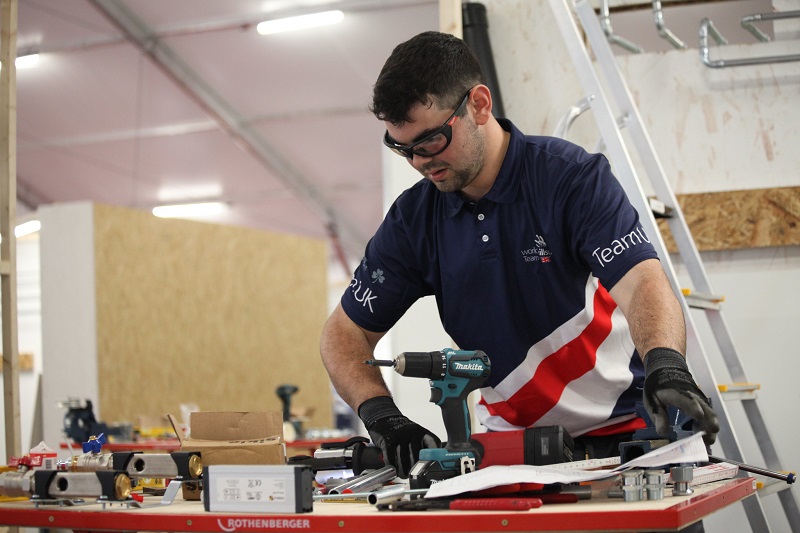
Taking home bronze medals were 21-year-old Ruben Duggan for plumbing and heating and 20-year-old Charlotte Lloyd in the hairdressing skill.
Bronze medal winner Ruben Duggan, Team UK, EuroSkills 2023
Six medallions for excellence were also awarded for achieving the international standard in their skills.
The medallion winners are Rhydian Brown in web development, Harry Scolding for joinery, Lucy Yelland and Ben Love for mechatronics, Daniel Knox for electrical installations, Daniel Davies for restaurant service, and robot systems integration duo Charlie Carson and Jason Scott.
Nineteen individuals made up this year’s Team UK.
At the last competition that the UK participated in – EuroSkills Budapest in 2018 – the UK brought home one gold medal, three bronze medals and seven medallions for excellence at the competition in Budapest, Hungary, placing them ninth in Europe.
Bronze medal winner, Charlotte Lloyd, Team UK, EuroSkills 2023
The awards were handed out at a sparkling closing ceremony at the Polsat Plus Arena in Gdansk on Saturday evening, attracting thousands of spectators.
Ben Blackledge, chief executive of WorldSkills UK, said: “This is a tremendous result for Team UK – and the nation. Each one of them should be proud of their achievement.
“These competitions provide a unique opportunity for us to learn from the best in the world and bring that international best practice back to the UK through the programmes we run at WorldSkills UK.”
Skills minister Robert Halfon said: “Congratulations to the exceptional UK competitors who showcased their skills at EuroSkills in Gdańsk. The EuroSkills competitions provide an unparalleled opportunity for gifted young people to hone their skills and climb the ladder of opportunity towards a better and brighter future.”
Colleges have until the end of this month to nominate staff, students and projects that pioneer social action in their communities for the inaugural Good for Me Good for FE awards.
Since its launch in 2021, the Good for Me Good for FE campaign has recruited 140 colleges to its ranks, all committing to support staff and student volunteering and community fundraising efforts.
Using the TOMS framework to calculate the financial return on social action activities, the campaign reckons over £4 million in social value has been generated by college staff and students to date.
A new set of awards, sponsored by NCFE, was launched this week to celebrate the colleges and individuals who have gone above and beyond to support their communities.
The eight award categories will be judged by an expert panel, whose members will shortly be announced, with the winners and runners-up announced on October 31.
Winners will get to attend a celebratory reception at the House of Lords in December.
Any college can submit nominations, whether or not they’re a member of the Good for Me Good for FE campaign.
Sam Parrett, group principal and chief executive of London South East Colleges, one of the campaign’s founders, said the awards will “reflect the importance of collective impact”.
“We have heard about so many exceptional people doing amazing work within their communities – and now we have the chance to reward this dedication,” she added.
“These awards reflect the importance of collective impact. Volunteering supports wellbeing and is a vital aspect of personal and career development. We want to hear the inspirational stories that will encourage even more people to get involved.”
Colleges can now make their case for awards in these categories: volunteer of the year (staff), volunteer of the year (student), volunteering team of the year, volunteering college of the year, fundraiser of the year, social impact award, outstanding service/lifelong commitment to volunteering and charity partner of the year.
Parrett added: “Colleges are such special places, at the heart of their communities and we are looking forward to celebrating this. So please do nominate some of the fantastic individuals and teams who do so much to support other people.”
Further information on the awards criteria, as well as how to submit nominations, can be found on the Good for Me Good for FE website. Nominations close September 29.
The last ten years has seen a gold rush of global private equity (PE) companies seeking to make the most of the opportunities presented by the apprenticeship levy by pouring their money into England’s independent training providers.
But PE owners are being hit by a double whammy of lower profit margins in the apprenticeships training sector and higher interest rates on their debts, casting doubts over whether some can keep propping up this part of the skills sector.
Several high-profile training providers – either partly or wholly owned by foreign investors – are now downsizing, or have gone under completely. The Association of Employment and Learning Providers (AELP) recently warned that urgent action is required to prevent “total collapse” of the publicly funded training system.
Skills consultant Aidan Relf believes that with “margins squeezed” in the absence of apprenticeship funding rate increases, “the probability of investment failures and unplanned exits increases”.
How we got here
The private equity market – made up of investment firms that buy companies to make an operating profit, or through re-sale later – grew rapidly in the decade up to last year due to low interest rates on debt compared to high prices and moderate returns on the stock market.
Global PE firms were lured to England’s training sector by the government’s announcement of the apprenticeship levy in 2015. They have been on a spending spree since, as the public sector is seen as a stable market with the potential for high returns.
Private equity can unlock funding for firms that would not be able to easily access public markets, and their investments have provided a much-needed lifeline in some cases for training providers to survive, scale up or fund management buyouts.
According to our analysis, the nine biggest investments in what some see as the first wave of private equity (2015-18), were all made by UK-based firms. Investments by MML Capital in Learning Curve Group, RJD Partners in Babington and Silverfleet Capital in Lifetime Training Group, gave those firms the resources to grow rapidly.
But since 2019, five of the seven most significant PE investments in training providers were made by companies registered overseas, some with opaque ownership structures.
Low financing costs and buoyant financial markets have so far made it easy for PE companies to sell investments for a gain, leading to regular transfers in ownership – the average PE investment lasts for only five years. There has also been increased investment from PE firms registered overseas.
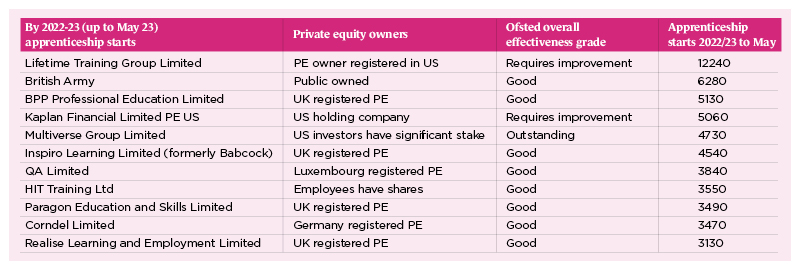
By May of 2023, of the ten largest training providers by apprenticeship starts, eight were majority-owned by private equity firms or other global investors – and of those, only four were headquartered in the UK.
Two have parent companies based in the US, and two in continental Europe. Of the other three, Multiverse is majority-owned by mostly American venture capitalist investors, HIT Training has a John Lewis-style ownership structure in which the majority share of the company is owned by its employees, and the British Army is publicly owned.
The largest training providers by apprenticeship starts
Are the good times over for PE?
The American PE firm Apollo Global Management (which has $617bn in assets) was until 2021 the ultimate owner of the UK’s third biggest training provider, BPP Professional Education Limited. Its chief executive, Marc Rowan, was recently quoted in the Financial Times warning that a decade of “money printing”, fiscal stimulus and low-interest rates that had pulled forward economic demand is now “in retreat”.
“In the [private] equity business, this year has really marked the end of an era,” he said.
PE-owned companies such as Learning Curve Group, Lifetime Training Group and Realise Training have, with PE investment, grown by snapping up competitors.
But Relf believes that the proof of whether PE “adds value” is the “level of investment made in the quality of programme delivery” – evidenced through Ofsted inspections – as well as “any required capital funding” they provide, which in the case of ITPs (unlike for colleges) does not come from the government.
Our analysis (see table above) shows that seven of largest PE-backed training in England are currently rated ‘good’ or better by Ofsted.
Yet some training industry insiders point to recent Ofsted verdicts on companies such as the American-owned Kaplan and Lifetime which were both deemed ‘requires improvement’ as evidence of deteriorating quality. Others point to quality of management.
The chief executive of NOCN, Graham Hasting Evans, told FE Week he is concerned that a “rush” of PE companies seeking to buy up struggling training providers right now will “just drive quality down because they’ve got to get their percentage out of it”.
He said there is “not a week that goes by” that his company does not get a “sales agency trying to sell us a training provider”, despite being anawarding body.“There’s quite a lot, because they’re going bust or struggling. Their owners are trying to get out while they still can.”
The capital for PE acquisitions is supplemented by debt, and research shows that companies bought by private equity firms are more likely to go bankrupt than companies that aren’t. Healthy companies acquired by private equity firms through leveraged buyouts see their probability of defaulting on loans increase ten-fold, according to 2019 research by California Polytechnic State University.
Brendan Ballou, who served as special counsel for private equity at the US Department of Justice, claims that PE firms are “generally insulated from the consequences of their actions”.
“Private equity firms benefit from a legal double standard: they have effective control over the companies their funds buy, but are rarely held responsible for those companies’ actions. This mismatch helps to explain why private equity firms often make such risky or shortsighted moves that imperil their own businesses.”
However, directors of UK companies owned by private equity firms are subject to the same duties and obligations as other directors. Under the Companies Act, they must comply with the duty to promote the success of their company, exercise reasonable care, skill, diligence and independent judgment, and comply with insolvency law.
Michael Moore, Chief Executive of the British Private Equity and Venture Capital Association, points out that private capital invested £27.5bn last year in UK businesses.
“The purpose of these investments is to provide funding, expertise, and networks to help a business grow. This is a long-term commitment, the average investment period is over five years compared to five months for publicly listed shares.”
Michael Moore of the BVCA
Training market ‘fraught with risk’
But there have been several high-profile examples of PE failures in other sectors in recent years. Four Seasons Health Care is now operated by administrators after a previous owner, the private equity firm Terra Firma, racked up huge debts.
And a large proportion of Thames Waters’ £14bn in debt was added when Macquarie, the Australian bank and infrastructure asset manager, owned the beleaguered firm, with its debt climbing to over £10bn when it sold the company in 2017.
Legal changes are set to come into play in 2025 which will tighten oversight of the biggest firms (with £750m-plus turnover and over 750 employees), including those owned by PE. Under proposed changes to the Companies Act 2006, firms will need to set out how they are managing their principal risks and building or maintaining resilience. However, most training providers are too small to be affected by this.
Relf believes the skills market is changing since the first wave of PE investors came in, and not just because of the levy-funded market maturing and changes in the regulation of subcontracting “making things tougher”.
“Within a few years, adult education could be fully devolved which poses challenges as well as opportunity for the larger independent providers,” he added.
He believes potential investors should “ask if a provider can grow the commercial training side of the business, to balance against risks now presented by government-funded skills provision”.
The market is now “fraught with risk” for PE investors as inflation and the introduction of apprenticeship standards have “significantly pushed up the cost of delivering a high-quality programme”.
“The danger is more young people across the country being deprived of new apprenticeship opportunities or the chance of completing existing courses,” he added.
Skills consultant Aidan Relf
In-depth: Private equity-owned training companies
Skills Training UK
In 2021, Skills Training UK’s future seemed rosy when Bridges Fund Management, which has offices in London and New York, acquired a majority stake through a holding company, Bridges Evergreen – pledging “ongoing support over the long term, with no exit requirement”.
As well as financial capital, it promised “strategic, operational and impact management support plus access to the specialist networks of the Bridges team”. Several members of the management team left shortly after, including CEO Martin Dunford who was replaced by turnaround specialist Guy Ballantine.
However, having PE backing did not improve the company’s prospects: pre-tax profit for the year to September 2021 went from £1.77m to £1.18m. Then in the period to July 2022, losses amounted to £3.35m, despite Bridges lending the company £2.1m that year and embarking on a restructuring.
Last month, the PE owners were unable to prevent the 24-year-old firm from going into liquidation, just six months after opening its new education centre in Dudley.
The company invested heavily in traineeships before they were scrapped by ministers earlier this year, then it missed out on an adult education budget (AEB) contract in the Education and Skills Funding Agency’s most recent procurement, along with several other big providers.
Lifetime Training Group
Lifetime Training, founded in 1995, is England’s largest apprenticeship training provider.
The company has undergone three rounds of PE investment. The first, in 2011, by Sovereign Capital enabled a management buyout and was a success for the firm.
Five years later when it was sold to Silverfleet Capital, Lifetime had boosted learner numbers from 10,000 to 22,000, and diversified its sector offering from predominantly fitness to hospitality, health and social care, retail, early years, business and administration and beauty.
But then its fortunes started to flag. Lifetime recorded 23,020 starts pre-pandemic in 2018/19, before falling by more than a third to 14,980 in 2019/20. In 2020/21 starts further slipped to 12,910 but increased slightly in 2021/22 to 16,720.
Last year Lifetime was sold to private debt specialist Alcentra, one of the provider’s lenders which is in turn owned by California-based asset manager Franklin Templeton. As of April, it held assets of $1.4trl.
After a ‘requires improvement’ Ofsted inspection and a government audit dispute which could result in a £13m clawback, Lifetime is now shedding an additional 50 jobs on top of the 60 redundancies announced earlier this year following a “strategic review of its cost base.”
Accounts for the 18-month period ending January 31, 2022, show a loss of £9.2m, compared to a profit of £6.8m in 2020.
Realise Training
The management buyout purchase supported by the UK-based Enact fund (Endless LLP) of Sheffield-based Realise Training (then Interserve Learning & Employment) in 2020 has so far proven a success.
Investment from Leeds-based Endless LLP, which in the year to March 2022 held funds with commitments of over £1bn, has enabled Realise, which specialises in the early years sector, to grow its business at just the right time. The government this year announced a huge expansion in the provision of free childcare hours.
Last year, Realise bought up fellow providers FW Solutions and Training Plus Merseyside, with managing director Greg Scott (who has led the company since 2019) saying Enact’s investment had been “key to us developing the business” and pointing to “ambitious plans to continue our growth as a business through both organic and inorganic growth”.
Babington Business College
Under new PE majority ownership from an affiliate of Switzerland-based giant Unigestion SA, which has over $19.4bn in assets, Babington has brought in a new management team and announced it is quitting the AEB market – putting 123 jobs at risk.
This came after former CEO David Marsh suddenly left the company in May this year. Its new chief executive officer Mark Basham said: “This change is essential to continuing to deliver on our purpose to develop better futures for organisations, individuals, and the communities in which we operate.”
The sale of Babington and its subsidiaries from previous PE owners, the UK-based RJD Partners, in December 2022, led to a write-off of £2.2m of “group intercompany debt reassessed as irrecoverable”, the latest accounts for the year to July 2022 for Babington Business College Limited stated.
BPP Professional Education Group
The ultimate owner of BPP, which claims to be Europe’s largest professional education and training company, is a group of international investment funds managed by British PE firm TDR Capital LLP.
Prior to 2021 it was part of Vanta Education, owned by funds managed by the American Apollo Global Management and the Vistria Group.
After buying up Estio Training from fellow PE firm Palatine in October 2021, and Firebrand Training in June 2022, BPP in February purchased Dublin-based Digital Marketing Institute (DMI).
BPP University, while part of the same group, is a distinct legal entity registered with the Office for Students.
Learndirect
Learndirect was set up with noble ambitions: its former owner, Ufi Charitable Trust, was created in 1998 to take forwards the government’s vision of a ‘university for industry’ and launched Learndirect in 2000.
It has since been through a complex web of PE ownership structures and turmoil. The first PE owner, from 2011-2018, wasLDC, the private equity division of Lloyds Banking Group.
An FT investigation found that between 2012 and 2015, Learndirect’s profits declined 85%, while student failure rates doubled in its educational programmes.
During this period, 84% of Learndirect’s profits were redirected to its parent firm to pay for dividends, debt-servicing, and legal fees, as well as half a million pounds to sponsor the Marussia F1 racing team.
Its apprenticeships division (Learndirect Apprenticeships) was taken on by PeoplePlus Group Ltd, part of recruitment firm Staffline Group PLC, then sold in 2020 to Babington. Last year, DTS went bust – along with LD Training Limited, the latest renaming of the original Learndirect company.
But the Learndirect brand lives on as another Learndirect offshoot company, under PE owners. Learndirect Limited, formerly Stonebridge Colleges (publishing) limited) was bought in August 2020 by Guernsey-based Queens Park Equity Partners, which has since made five other acquisitions in the training sector.
Other PE investors in the training market:
Davies Group, which is funded by American PE firm HGGC and Canadian AIMCo, and rebranded to Davies Learning Solutions in 2020, bought up insurance training provider FWD Training and consultancy in 2019. It was rated requires improvement by Ofsted the following year.
BGF, which was founded by Barclays in 2011, has minority stakes in more than 400 small and mid-sized companies. Its portfolio includes Alpha, which provides finance training, and Apprentify, which offers digital marketing, social media and tech courses.
In July, Leeds-based PE firm Key Capital Partners, struck a £6 million deal with management training provider Fuel Learning for a ‘significant’ minority stake in the business.