Skip to content
5 October 2026

Latest news from FE Week

Young shepherd starts his own flock

Counting sheep will never send one Somerset learner to sleep. Sam Harvey, 16, of Norton Radstock College, has started his own flock by breeding six lambs, including one set of triplets.

Sam, who is studying an environment and landbased studies level two diploma alongside his GCSEs, said he bought three pregnant ewes “as it’s a cheaper way of starting your own flock”. He plans to boost numbers by 10 ewes this year.

“Each has its own personality. It’s been brilliant having them.”

Sam funds the care of his flock, which he feeds two to four times each day, through money that he made last year raising pigs for meat.

His dream is to run a farm shop stocked with meat and vegetables reared and grown himself.

Kevin Connell, head of landbased studies at Norton Radstock, said: “Sam is a model student and mature beyond his years. He will have a good career in agriculture.”

Student nabs modelling contract

A hairdressing student could have a career on the catwalk after winning Sheffield College’s Next Top Model contest and nabbing a contract with Sheffield-based agency DK Model Management.

Eleanor Renshaw, 19, who wants to break into the modelling industry, said: “I’m shocked, but it’s been a fantastic event.”

The competition attracted about 80 entries, both male and female, after its launch on Facebook. Ticket sales for the semi-finals and finals raised more than £800 for the Help A Capital Child charity.

Julie Byrne, principal of Sheffield City College campus, said that it was a pleasure to be involved in such “a fun event”.

The runners-up were Sheffield City College aviation student Elize Miezane, 16, Norton College English language, psychology and sociology A level student Alicia Irvine, 17, Norton performing arts student Charlotte Hewitt, 18, and Hillsborough College fashion design and manufacture student Georgia Ali, 19.

London student eyes 2016 Olympics

A London automotive engineering student swapped four wheels for two legs to cruise into the 200m final at a British Universities & Colleges sports event.

Barking & Dagenham College HND student Omololu Abiodun, 20, won his semi-final in 21.9sec, after coming first in his heat in 22.12sec. However, he sadly missed finishing in the top three in the final.

Omololu follows another Barking & Dagenham student, 2012 Olympic sprinter Adam Gemili, who last year gained distinction in a level three extended diploma in sports.

Omololu, from Chingford, Essex, said: “It would be amazing to get to the next Olympics.  I’d love to compete against Adam and for us to run side-by-side in Rio.

“I will continue to train and challenge myself, and hope to come back with a medal from the BUCS outdoor athletics championships in May.”

Mature student heads to Barcelona

A mature learner from west London is flying high after winning a scholarship for a three-month exchange to Spain.

Shadia Ferguson, 46, from Chiswick, is studying at Kingston College for a foundation degree in early years. She will now spend three months at the Ramon Llull University in Barcelona as part of the ERASMUS programme.

The mother of two said: “Having this chance to go to Barcelona is amazing. I’m looking forward to experiencing another culture and learning the language, and hopefully can incorporate it with my studies.

“I’m fortunate that my family are very supportive of me doing this. It’s hard learning at my age – but the tutors have been excellent and go that extra mile to support.”

Shadia is also planning to volunteer for a charity working within a school.

Leipzig looms for top WorldSkills competitors

Hopefuls for a UK team place in WorldSkills 2013  have been put through their paces at two Midlands colleges 

Young people from across the UK flocked to the Midlands last weaek to show off their skills and compete for a slot in the UK team for WorldSkills 2013.

The top apprentices, learners and recently qualified skilled workers under 23 demonstrated their abilities in hairdressing, bricklaying, carpentry and more than 15 other areas at Stephenson College, in Coalville, and North Warwickshire & Hinckley College, in Nuneaton.

One competitor in each skill area will go forward to represent the UK at the international finals in Leipzig in July.

For David Thomas, training manager for the electrical installation squad, it wasn’t not just the opportunity to represent the country, but skills the competitors gained that made the selection process important.

He said: “From when squad members start competing, you see them raise their game to get to national level. But international level is even higher. They end up way above their peers.”

In the four-day selection event, which followed regional events last year and EuroSkills 2012, competitors were given complex and strictly timed 22-hour projects that were later judged by training managers.
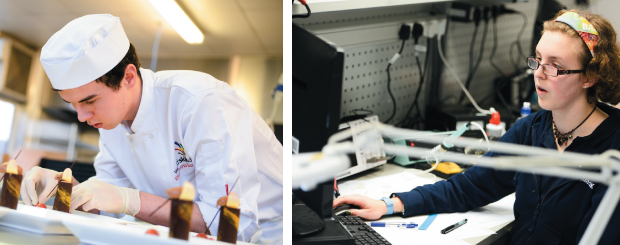
From left: Confectionery and pastry: Stephen Smith, 18, and from Harpenden, Herts, is a student at Westminster Kingsway College and  Electronics: Heather Peach, 18 and from Wigan, is an apprentice training at Wigan and Leigh College and employed by MBDA UK

Training managers also acted as trainers and mentors. joinery training manager Andrew Pengelly said: “Competitors also develop in themselves through the contest, in terms of their ability to work under pressure, their problem-solving, confidence, and interpersonal skills.”

Some skill areas had only one squad member, but still had to demonstrate that they could meet the standard required to get through to Leipzig.

In many cases they worked alongside hopefuls from other nations who travelled to the UK selection to give themselves and the local candidates more competition experience.

Jaine Bolton, chief operating officer for the National Apprenticeship Service (NAS), said she had seen how WorldSkills had an impact on learners at Stephenson College.

She said: “They see what’s going on and they want to know more. I’ve seen them stand and applaud as the squad came into the college. The squad were amazed, it was a real boost for them.”

“You can see how important World Skills is from the judges and training managers — these are busy professionals willing to take time out because they’ve seen what it does for these young people and their skill level.”
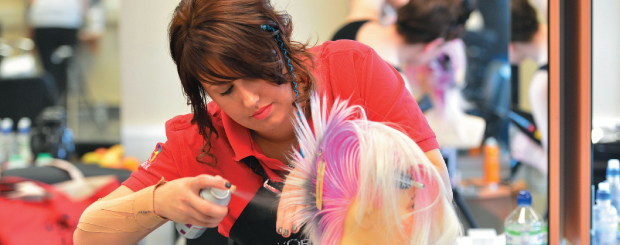
Hairdressing: Hannah Clague, 21 and from Quedgeley, Gloucestershire, attends Red Edge Training Company and is employed by Reds Hair Company.

North Warwickshire & Hinckley College curriculum manager Martin Shelton said employers were enthusiastic about the benefits of WorldSkills.

He said: “Local companies have been massively supportive, whether through sponsorship or allowing their apprentices the time to come and take part. They can see the value it’s adding.”

Pastry chef and confectioner squad member Stephen Smith, 18, said he was certain that being on the squad would impress employers.

“Learning how to use techniques professionally has been great and it will definitely help me with getting a job,” he said.

“It’s too soon to say whether I’ll get on to the team or not but it’s all gone well so far.”

The final team for Leipzig will be announced Friday, March 15.

Wall and floor tiling: John Morgan, 20 and from Newry in Northern Ireland, attends Southern Regional College and is employed by Gobal Tiles and Bathrooms

Caption for featured image: Aircraft maintenance: Luke Greenaway, 22 and from Andover, in Hampshire, works at QinetiQ 

A break with tradition

What are the value of MOOCs? Are they an opportunity or a threat, asks Carolyn Lewis

Massive open online courses (MOOCs) have been around for a while, educating many people for a lot less money than more traditional methods. They provide great opportunities for life-long learning, particularly for those who face barriers to education.

They generally do not lead to a formal qualification, although some institutions do offer credit by exam. But with many courses offering only automated or peer grading, the real objective is to get people to learn, something that must be applauded.

Enrolment is completely open so it’s quick and easy to get started. Most content is provided by the institution, using links to resources already freely available on the web. Content can be varied, but it has been said that some courses rely too heavily on video lectures — not the most engaging way of learning.

Support comes mainly from a student’s peers, with tutors and or mentors online to answer questions. But there is a significantly lower ratio of educators to students, with some quoting 100,000 students to one teacher. MOOCs use a connectivist approach — each student responding with detailed answers to course questions.

Are MOOCs successful? It depends on your perspective. Many students drop out — but as enrolment numbers are often in the hundreds of thousands, it could be argued that even a small success rate is worth celebrating.

How can FE and HE institutions afford to design and develop MOOCs and then share them free?”

For example, about 46 per cent dropped out at the first stage in one Massachusetts Institute of Technology MOOC that had more than 150,000 sign-ups. Around 5 per cent passed the final exam.

Clearly, participants need to be highly motivated and able to learn on their own with little support, which is probably why there appear to be few young adult learners. According to the Cousera website, more than 60 per cent of those taking MOOCs hold postgraduate degrees.

What is their future in the UK? The increasing cost of university tuition and the introduction of student loans for mature learners in FE could make them extremely popular.

But how can our FE and HE institutions, many of them facing funding cuts, afford to design and develop MOOCs and then share them free? It is true that offering something free can lead to further participation in other costed provision, but an initial investment has to be made. Can our universities, colleges and training providers afford to do this?

Caution is needed: we should recognise the challenges and potential impact of MOOCs on our educational organisations. They do offer opportunities, but I’d like to see them supplementing existing face-to-face and online courses, rather than replacing them.

We must not lose sight of the benefits and value of what we already do well. Once it’s gone, it’s difficult to get it back.

Carolyn Lewis, managing director of Vocational Innovation Ltd and eLearning Marketplace Ltd

Advertorial: We believe in small change, big difference

Workpays engages in projects that make big differences a reality – and always starts by asking the people that matter questions about what matters to them

The most important question we ask is whether students are better equipped for work by their time at college. It’s also the reason why we have developed a suite of teaching and learning materials that are aimed at improving the performance of staff within a quality framework.

This is not in isolation; our delivery maps to units within the IAG, employment related services (ERS), customer service, and sales and marketing.  Independent training providers, welfare to work providers and FE colleges can see an improvement in their outcomes as a consequence of accessing this training for their staff.

Evidence of how a  small change made a big difference to one of Workpays clients is demonstrated by Scott Parkin FIEP, director of employment at Advance Housing and Support Ltd who said: “We are delighted with the initial impact of the employment–related services programme being delivered by Workpays.  In the first month we have seen our job outcomes increase seven-fold, which is a real positive for the team and, of course, our customers.  The programme has raised our performance levels and has exceeded our expectations and has certainly justified our investment.”

Workpays provide a competency-based programme tailored to organisation and personal job roles to improve performance and build new skills following national standards in ERS. The programmes are delivered to reduce off-the-job time and support staff in real-time situations to provide a programme that is both cost and time effective.

Working with Workpays increased job entries seven fold”

Workpays are also a licensed delivery partner of the Digital Youth Academy (DYA), an organisation that has built up a network of FE colleges and training providers to deliver its cutting edge and innovative social and digital media products.

The programmes currently on offer are a level one social digital routeway (SDR) and a full level two social digital apprenticeship.  Both these programmes were developed in partnership with the awarding organisation, Edexcel.

The SDR centres on a level one diploma and is designed as a classroom-based programme that can be delivered either part-time or full-time through the current foundation learning funding stream or moving forward under the new study programme banner.

Workpays began delivery of the level one programme to a cohort of NEET learners in February from within the Custard Factory in Birmingham.

As a progression pathway from the SDR, the social digital apprenticeship is a full level two apprenticeship that is predominantly delivered in the workplace through innovative e-learning.

During the programme, learners are taught about topics such as social media applications for business, search engine optimisation, Google Analytics and blogging. If better performance of employability and skills destinations matters to you or you’re interested in adding DYA Work Study Programme to your learner offer get in touch, we’re all ears. Go online at www.workpays.co.uk, call us on 07572 262013 or email us at info@workpays.co.uk

Apprentices in the spotlight

Six years after it was first conceived, National Apprenticeship Week has become about so much more than just raising awareness of alternative pathways. This year’s will be the biggest and best yet, says David Way

It seems incredible that we are celebrating the sixth National Apprenticeship Week.

As in previous years, it will provide a great opportunity to showcase the best apprenticeships, apprentices and employers, and will put work-based training in the limelight.

It promises to be the biggest and best yet, with more than 500 events (and counting) taking place around England.

Thanks are due to those who have got behind this. It is only through this collective effort that we get the attention of millions and gain the opportunity to highlight the value of apprenticeships and how they change lives.

When the event was first conceived, its purpose was simply to raise awareness of apprenticeships.

We are well beyond that now, with the breadth of events demonstrating just how far we have come: for example, apprenticeships are now breaking down barriers to professions once seen as the preserve of graduates and creating fresh opportunities to go right to the top whether it is in a local business or a global company.

The preparatory work that we have carried out ahead of the week makes clear that apprenticeships are still very newsworthy. They tell stories about real people whose achievements often go well beyond anything they first expected.

I hope the week will also bring more people up to date with the occupations now available in new and emerging sectors, such as professional services, banking and the creative industries, and at higher levels in vital sectors such as engineering.

We must not forget the growing number of small employers taking on apprentices”

The theme of this year’s week is ‘Apprenticeships deliver’. We want to showcase the achievements of apprentices and their employers, and to demonstrate how apprenticeships really are transforming lives and improving business.

Our evidence about boosting productivity, employment prospects and income needs to be got across – as do our many examples of successful businessmen and women who started as apprentices.

There is no shortage of events, including business breakfasts hosted by premier league football clubs, apprenticeship buses touring cities and regions, and major conferences, including our own fourth international conference.

Previous National Apprenticeship Weeks have shown that the most powerful advocates of the benefits of apprenticeships  are the apprentices themselves.

They are our principal ambassadors, which is why this year we are putting them in the spotlight.

There will be apprentice ‘job swaps’ between some of our apprenticeship award-winners and their chief executives for the day, while in  #247 Apprentice, a selection of apprentices will use various forms of social media to report on their working day.

But my personal favourite will be a national ‘Made by Apprentices’ campaign to showcase the talent of the nation’s apprentices and the contribution that they make to the economy.

Many large employers will be showcasing their programmes during the week, but we must not forget the growing number of small employers taking on apprentices.

I have been delighted with the increasing number of small employers taking up the Apprenticeship Grant for Employers of £1,500.

Such has been its popularity, the government has decided to extend the grant until Christmas 2013.

‘Bring back apprentices’ used to be the cry.  National Apprenticeship Week is the opportunity to show not only that they are back, but that they are working for business and for the talented young people wanting a great start to their working lives.

David Way, chief operating officer of the National Apprenticeship Service

The rules of changing partners

With great power comes great responsibility: what should governors think about when deciding to merge? asks Smita Jamdar

The number of stories in FE Week recently about how decisions to merge colleges are made may be a reflection of the paucity of guidance and advice to governors.

Before the Education Act 2011, the ultimate decision on any merger lay with the Secretary of State. The decision to propose a merger was that of the relevant funding agency, after public consultation, and the suitability of merger proposals and prospective partners was judged against criteria promulgated by the funding agencies.

The 2011 Act introduced a new power of governing bodies to dissolve their corporations and transfer their assets and liabilities to “prescribed bodies”. Incidentally, the prescribed bodies include private for profit companies, provided they are established for educational purposes, although in such cases the dissolving college’s property transfers subject to a charitable trust to be used exclusively for charitable purposes.  The power is therefore one that has the potential to change forever the landscape of FE and the nature of FE providers.

This new power was not accompanied by much guidance as to how governing bodies should go about making this highly significant decision. Instead, we had the publication of New Challenges, New Chances, the  government’s  strategic vision for FE. Though not particularly detailed, this set out the government’s expectations that in making decisions about the future shape and delivery model of their colleges, governors would be expected to be accountable to their local communities, learners and employers, and to work with LEPs and local authorities.

The power has the potential to change forever the landscape of FE”

Any changes to delivery models could be undertaken only after completing a college structure and prospects appraisal, and wide, transparent and meaningful consultation of the communities they serve. Partner selection was expected to be transparent through open and competitive procurement practices.

Are there other obligations that should guide governing bodies in making merger decisions? In my view, there are other areas of law that impose duties on colleges and their governors which could be relevant to deciding whether and if so with whom to merge.

These include:

Firstly, charity law and the duty it imposes on trustees to act in the best interests of their charities. Without the open, transparent and competitive process to which the minister referred, how can governors be sure that the partner they choose provides the best possible future and opportunities for their learners?

Secondly, the public law constraints on exercising discretionary powers such as this, which imply obligations to exercise those powers following careful, rational and reasoned deliberation. These obligations, again, may not be satisfied without openness and receptiveness to the range of options available to the college to deliver the best outcome for learners.

Thirdly, the obligations under the Financial Memorandum in terms of accountability for public funds and value for money, which presuppose a measured and balanced consideration of all the available options.

And finally, the single equality duty that requires decisions to minimise adverse impact and improve opportunities for disadvantaged learners from protected groups.

So despite the absence of specific guidance, there seem to be a range of legal obligations and duties that point in the direction of a transparent and a reasoned decision-making process. Even if there weren’t such obligations, one has to wonder why governing bodies would do anything else, given that these are not commercial mergers where private interests make confidentiality and exclusivity required characteristics, but, rather, are decisions that determine the future of educational charities with substantial public assets on which the cleansing spotlight of public accountability and scrutiny should surely fall.

Smita Jamdar, partner and head of education, SGH Martineau LLP