A special dish created by a college restaurant has made it into a cookbook showcasing the best recipes and stories from Liverpool’s culinary community.
The meal, of duck breast, croquettes, dauphinoise potatoes and star anise jus served with a creamy broccoli purée, is a signature dish at Hugh Baird College’s L20 Restaurant, based on Merseyside.
Developed by students under head chef Anthony Wright and sous chef Barry Langston, the dish will appear in ‘The Liverpool Cook Book’ as an example of fine cuisine taken from across Merseyside and the Wirral.
Also featured in the book are fine dining establishments such as Panoramic 34, as well as restaurants, cafes, delis and pubs.
The college runs the L20 Restaurant as part of its hotel school, which is serviced by students under the supervision of staff.
Hospitality student Grace Clarke, who worked on the dish, said: “We’re all made up to see it in the book.
“We came up with dish after working with Anthony and the team. They taught us what different flavours and textures complemented each other, and they allowed us to try our different ideas.”
Featured picture: (L-R) Sous chef Barry Langston, student Grace Clarke, and head chef Anthony Wright with the Liverpool Cookbook.
The latest report from the Institute of Public Policy Research (IPPR) recommends abolishing level two apprenticeships for all 16- to 18-year-olds. It proposes forcing all those in this age group who are not taking an academic route to university, to undertake a two-year pre-apprenticeship programme at their local FE college or not-for-profit training provider.
Even before the government’s reforms have been implemented, let alone evaluated, the authors are suggesting, somewhat prematurely, a total change in the way young people enter the world of work. But the report is based on highly selective statistical data without any context.
The failure is not in post-16 vocational education or apprenticeships but in the 11 years of education leading up to this point. Our current school curriculum and examination system are designed to prepare pupils for university. It needs to be changed also to prepare pupils for the world of work with a vocational skills route as opposed to an academic route.
To subject pupils to an additional two-year pre-apprenticeship programme at an FE college would be a disservice to the pupils concerned – not to mention an admission that state education has not properly equipped them for employment.
As judged by Ofsted, FE colleges’ track record for delivering apprenticeships is disappointing, with a few notable exceptions. Indeed, FE colleges are minor players in apprenticeship delivery and were strenuously encouraged to increase it by the previous skills minister Nick Boles. When modern apprenticeships were introduced some 30 years ago, FE colleges, third-sector and private providers all had an equal opportunity to deliver them.
Yet today 76 per cent of all apprenticeships are delivered by private training providers, with the remaining 24 per cent equally split between employers with their own direct contract and FE colleges.
The massive growth in apprenticeship numbers and the astounding increase in success rates from a low 50 per cent to 75 per cent plus today has been achieved mainly by private sector providers. This report choses to ignore this and proposes a monopoly of FE colleges and charities to deliver their ill-conceived pre-apprenticeship programmes. This is more reminiscent of a Stalinist approach than a 21st century solution to producing a skilled workforce.
The statistics this report uses to justify its two-year pre-apprenticeship programme are based on those leaving full-time education with poor results, not those entering apprenticeships. Vocational learning in schools and colleges, through a variety of initiatives, such as TVEI and vocational GNVQs, has produced poor results.
This concept of a two-year pre-apprenticeship programme would be ideal for 14-year-old pupils, for whom a vocational career is the best route and a programme including early work experience – especially for those disillusioned with full-time education – would be a benefit. At 14 it’s a brilliant concept; at 16 an irrelevance.
The authors are suggesting, somewhat prematurely, a total change in the way young people enter the world of work
There will always be a sizeable group of young people at 16 for whom entering employment is the most suitable route, and an apprenticeship the best thing for both the young person and the state. This report’s plan to prevent this is undemocratic and demonstrably not in the public interest.
This government has already introduced the traineeship programme for unemployed young people and the take-up has not been brilliant, partly because the Youth Training Scheme it aimed to replicate paid both trainees and employers, which the current programme fails to do. There are other reasons why traineeships are not successful, such as the fact that in many sectors there are entry-level job vacancies available – in retail, hospitality and catering, for example – so young people would prefer paid work to working for free.
The statistics in this report appear to have been selected and the contents written to support a preconceived outcome for the FE sector – to deliver a two-year pre-apprenticeship programme – without any alternative being considered, or the bigger role of the economy and of employers in the programme being discussed.
A system of any extreme is unlikely to deliver the right outcomes for individuals, employers or the economy, says Gemma Gathercole
There can be little doubt that apprenticeships are the hot topic in the skills world, but recent events and reports have shown us there is still little consensus on what our apprenticeship system should ultimately look like.
Over the weekend I found myself thinking about apprenticeship policy through the lens of two letters: QP. These letters represent three essential questions for the sector right now: Question of Priority, Question of Purpose and Question of Position.
We’re risking distorting our skills system so apprenticeships are the only answer
On the question of priority, apprenticeships have never been higher, but we’re risking distorting our skills system so that apprenticeships are the only answer.
Part of the issue emerges from the general decline in employers’ investment in training, as Sajid Javid noted in the 2015 apprenticeship levy consultation by the Department for Business, Innovation and Skills.
But a secondary issue contributing to the decline is the limited availability and/or general removal of government investment in this type of learning. The conversion of grant funding to loans has caused a decline in the offer of higher level courses. In fact as recently as July this year, individuals wanting to access this type of training would have had to self-fund. It was only at the start of this funding year that courses at levels five snd six could be funded by an advanced learner loan.
On the question of purpose, there has been some discussion about what sort of apprenticeship system these reforms will deliver. But perhaps part of the confusion is the term apprenticeship itself. Do we as a nation share a common understanding of what an apprenticeship is? For some it’s still a traditional indemnity to an employer, to others it’s the worst example of the misuse of the system, and for others still, it’s indelibly linked to qualifications.
If we take it back to core principles, it’s a job with training
If we take it back to core principles, it’s a job with training. We must remember that jobs with training allow progression from beginner to competence in a particular role. But the journey shouldn’t stop there.
The system should be individual-led rather than employer-led. Potential learners and/or apprentices are the consumer for this form of training and should have the ability to select for themselves the type of training they want to undertake.
After all, if they are both invested in the system and have to pay back some of the cost they should have the same decision offered to university students: follow a course that leads to a job/career, or follow a course they are interested in, but which may not necessarily lead directly to a job.
While the person specification for my current job required a degree, it did not specify the subject. If this is a suitable outcome for the ‘academic’ track, then the ‘technical’ track should not limit a learner’s outcome either. For those keeping track – that’s the third and final QP, the question of position: how and where does it lead?
And of position, a system of any extreme – employer only, government only, awarding organisation only – is highly unlikely to deliver the right outcomes for individuals, employers and the economy. The government is right to want to put employers at the heart of the system, but to suggest that this is the first time is naïve.
Taking the theme of David Hughes’ opening speech to the AoC Conference this week, I want to focus on a positive: in order to deliver effective apprenticeships, reform and the broader technical agenda, we need a position where the expertise of all aspects of our system is respected, and we need to work together to get the best possible outcomes.
The Skills Plan will fail if it isn’t sufficiently embedded in curriculum choices before 16 and, critically, in parents’ and employers’ minds, so young people are supported to make those choices. In the end, that will make the government priority of three million starts incredibly easy to achieve as apprenticeships will be a destination of choice, rather than the thing that other people’s children do.
Gemma Gathercole is head of policy for FE and funding at OCR
Sector leaders should expect sage advice on how to excel in all areas from the new FE Commissioner, now that his former college has come out on top in FE Week’s first ever rankings table.
Exeter College, which was led by Richard Atkins CBE until he retired in March, scored a perfect 16 in our new survey, making it officially the most successful college in England based on a number of key criteria published by the Department for Education.
Three other colleges narrowly missed out on the top spot, with Kendal College, Selby College and Eastleigh College scoring 15 points each.
All four of the top-scoring colleges have been rated ‘outstanding’ at their most recent Ofsted inspections.
Exeter’s current principal John Laramy told FE Week that he was “delighted” that the college’s “unremitting focus on outstanding teaching, learning, employer engagement and the student experience has been recognised by this accolade”.
Our success is down to our focus on individuals
“We have great students and a great team of staff,” he said. “I would like to thank everyone – partners, employers, students, staff, leaders, governors and stakeholders – all of whom have contributed to our ongoing success.”
Mr Atkins took up the reins as FE commissioner from Sir David Collins earlier this month, leaving a college he headed between 2002 and 2016 – which means he was in charge for the period that our data covered.
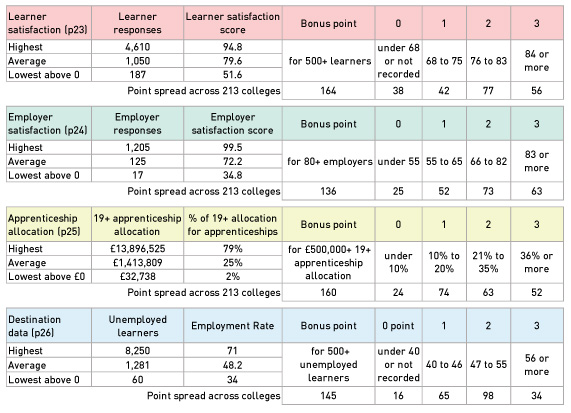
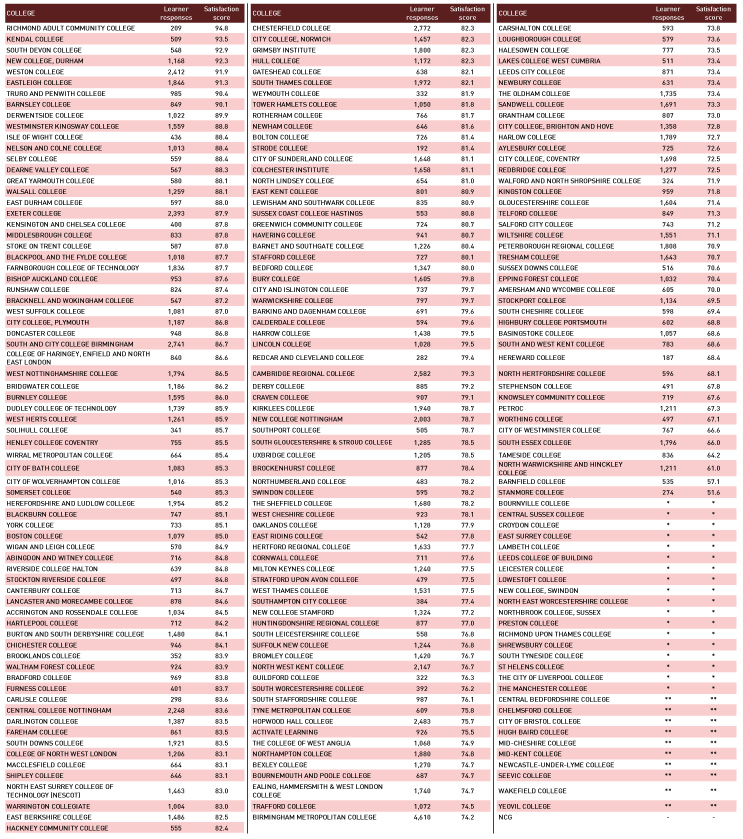
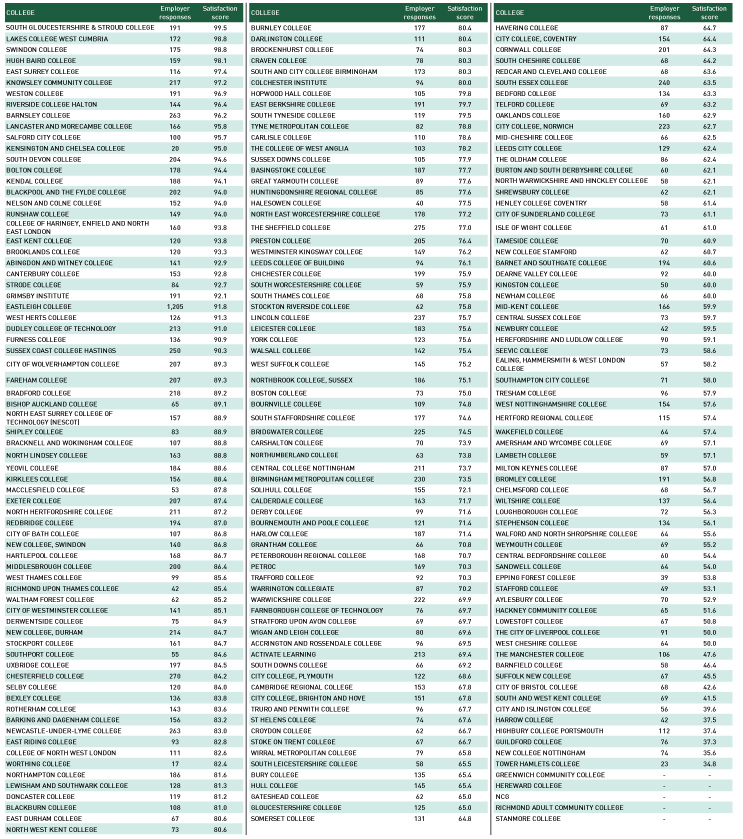
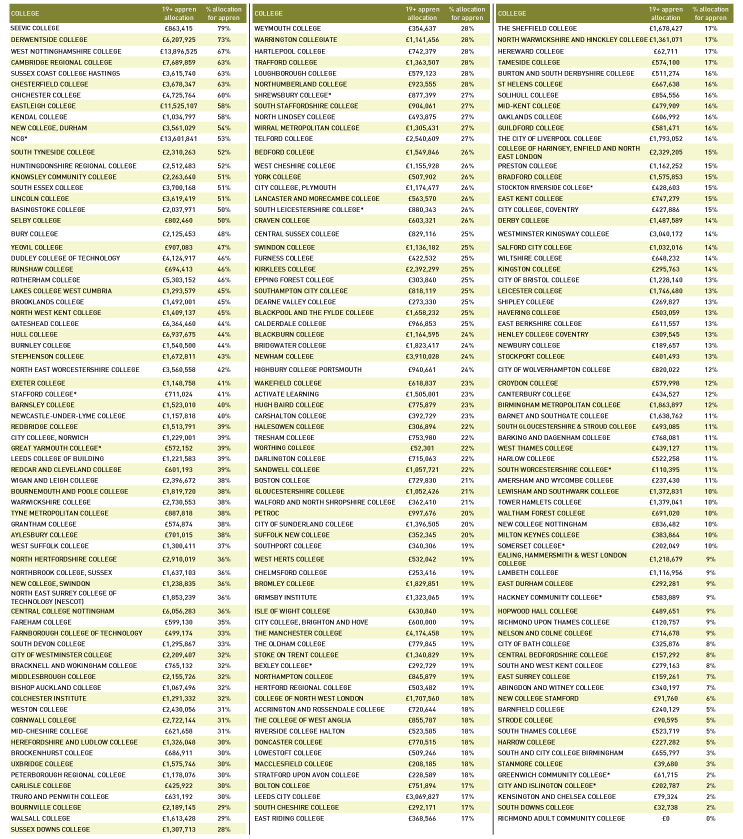
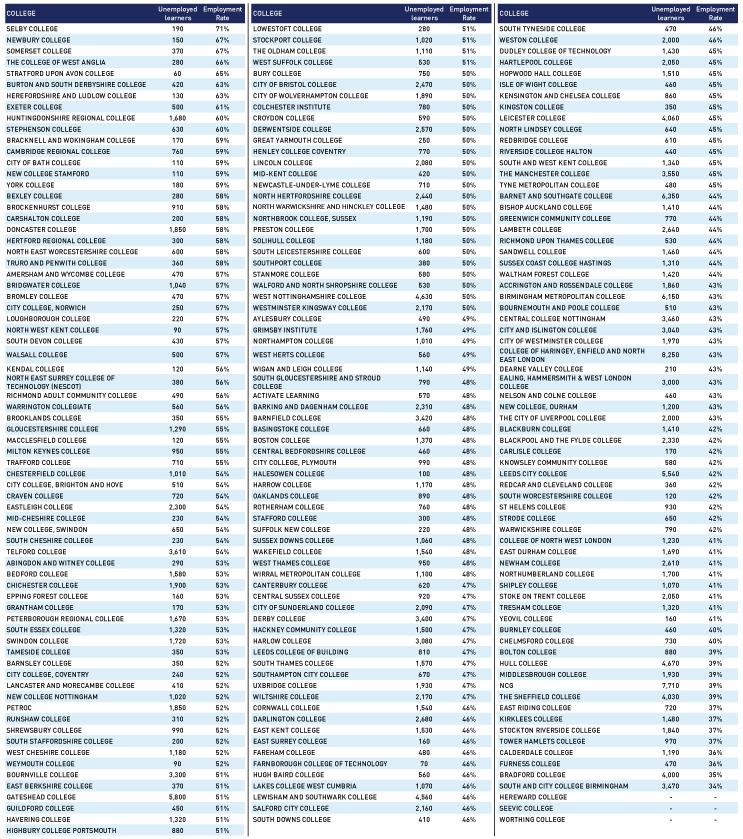
FE Week’s ratings are based on four measures: 2016/17 adult apprenticeships allocations as a percentage of all adult funding, employer and learner satisfaction scores, and destination data (specifically a college’s success at getting unemployed learners into work).
All 213 colleges in the country were awarded a score of between zero and three points based on their performance in each category, with an additional volume-based bonus point available per measure.
The points system was devised by Nick Linford, FE Week’s editor and a former director of performance at Lewisham College.
He said: “The government previously considered scoring colleges via what they called ‘a balanced scorecard approach’ within the Framework for Excellence.
Read editor Nick’s comment here
“This has now become FE Choices, but no overall score was ever implemented until now.”
As reported in last week’s edition, Selby College has been the best in the country at helping its unemployed learners into work, according to the latest destination data published by the DfE.
This achievement helped it take joint-second place in the rankings.
Selby’s principal Allan Stewart OBE told FE Week that he was delighted at his college’s performance.
“Our success is down to our focus on individuals, putting the learner at the centre of everything we do,” he said.
“We also recognise what key partners employers are.”
Kendal College’s employer and learner satisfaction rates were among the highest of any college, according to the latest FE Choices data, which is what put them squarely in joint-second place.
Graham Wilkinson, Kendal College principal, said: “We a delighted that Kendal College has performed so consistently well across all the measures for a number of years. We highly value the views of our learners and employers.”
An adult apprenticeships allocation of more than £11.5 million, alongside employer and learner satisfaction rates of more than 90 per cent, is meanwhile what propelled Eastleigh College to joint-second.
Eastleigh’s principal Jan Edrich said: “We are pleased to be ranked so highly in the FE Week survey, and it is a testament to the focus we have here at the college.”
As we have previously reported, colleges’ total share of apprenticeships cash has sunk from 37 per cent to 32.5 per cent, despite former skills minister Nick Boles urging them to up their game at last year’s Association of Colleges’ conference.
Explained: our league table and points-based method
It took legislation to achieve it, but the government has now finally improved the way it reports learner destination data. So now seemed like a good time to revisit the notion of a balanced scorecard for colleges. It was what the Framework for Excellence had been intended to be, but it lost its way as it morphed into a simple satisfaction survey through FE Choices.
The balance with our table, I hope, comes from combining customer satisfaction with how many unemployed learners find work, and finding out whether the college is responding to government demands for more apprenticeship delivery.
For those wondering why I have chosen not to include qualification achievement rates, it is well recognised that an overall all-age, level and sector-achievement rate tells you little to nothing about how good a college is. For example, the shorter the course, the higher the typical achievement rate. What’s more, the recent inspection of NCG taught us that achievement rates need to be put into context before we form judgements.
I’ve also chosen not to include Ofsted grades because they represent a snapshot in time. And, as report on page two, some colleges have not received a full inspection in over 10 years.
The strongest indication yet has been given that the Department for Education is planning to change its English and maths requirements for post-16 learners, by apprenticeships and skills minister Robert Halfon.
The revelation came during his speech this afternoon at the Association of Colleges annual conference, in Birmingham. He conceded to delegates that GCSEs are not always the best option for FE students.
“It is clear that we need a credible, high-quality option for students for whom GCSEs are not appropriate or achievable,” Mr Halfon said.
“This is why we are reforming Functional Skills to make sure that they are genuinely relevant to employers, and consequently have credibility and prestige in the jobs market.”
The government made it a condition of funding, in 2014, that all 16 to 19 year olds who did not already have at least a grade C in GCSE English or maths should be enrolled in courses in these subjects.
This was changed a year later to require all of those with a grade D in those subjects to do to a GCSE course, rather than an equivalent ‘stepping stone’ course.
But this year’s GCSE results showed that huge numbers of learners aged 17 and older failed to get the necessary C in English and maths – which Mark Dawe, Association of Employment and Learning Providers described as a “body blow”.
This led to widespread calls for the government to scrap its GCSE resit policy, and replace it with a more employer-focused approach including Functional Skills qualifications, which it is understood the government is considering.
Education secretary Justine Greening also spoke to AoC conference delegates about maths and English provision.
She said: “We all need to think quite carefully about how we strike the right balance between a system that really pushes people, so we’re not giving up on someone being able to reach their potential because it’s hard for them to do that – but also a clear sense of getting them from A to B quickly so they’re not spending time running upwards against a brick wall that they’re not going to get over.”
In January this year the Education and Training Foundation launched a multi-stage consultation on how maths and English Functional Skills qualifications should be reformed.
Former skills minister Nick Boles said that he welcomed the consultation was the “first phase of a reform programme which will provide more rigorous and respected Functional Skills qualifications”.
After today’s speech, Mr Dawe said that he appreciated Mr Halfon’s approach.
“Both he and the Secretary of State [Justine Greening] have identified the importance of maths and English and the role of functional skills in improving them,” he said.
The insolvency regime proposed in the new bill will make sure colleges are delivering as a productive businesses as well as effective training providers, says Ian Pretty
The government’s Technical and Further Education Bill sets out proposals for a new insolvency regime for FE colleges. This is a big moment for a sector increasingly pushed to be more commercial and find better and more diverse revenue streams while simultaneously delivering the best, more productive learner experience possible.
It is no secret that there are colleges within our sector who through lack of students, lack of adequate facilities or lack of revenue are not achieving these goals. These colleges must change to live up to the promise of what further education should be, whether that be through a merger, a change in leadership, or a new strategic direction, but an option that has previously not been open to FE is that of insolvency.
The logic behind this is simple, if a college were allowed to close the provision for learners in that area would be threatened. In my view if a college is not able to fulfil its duties then the provision for learners is already threatened, already subpar, and something has to give.
The insolvency regime proposed by the government addresses an issue nearly twenty-five years in the making, when FE Colleges were transferred out of local government a new type of corporation was created but with no provision for what to do if that corporation fails to remain solvent. The central government has become a funder of last resort when these situations arise so as to protect learner access, but there is a better way, one that has been used across other public services where a continuation of service is essential such as energy, railways, housing and the post office.
Reliance on government funding has had its day in FE
A Special Administration Regime, with protecting learner access at its core, is the right way forward for the FE sector. It may never be used, and is a rare occurrence across other sectors, but it is vital that the option exist. Market forces affect colleges just as they do any business, and colleges must be responsive to them. The possibility of insolvency for colleges may force them to aim for bigger surpluses, control staff costs and cut capital spending, but also to seek new revenue streams, become more commercial and entrepreneurial. Reliance on government funding has had its day in FE, and that day is ending as funding sources change and decrease. For colleges to continue to offer the high quality provision they must, they need to look outside traditional funding sources and the Special Administration Regime may prompt them to do just that.
There are of course areas we would like to see great thought given as this bill proceeds through the Commons and then onto the Lords in the New Year. The first must be the absolute protection of the learner and an assurance that the service will continue even if, in extreme cases, the service provider does not. This must be done with thoughtfulness and care as there is no easy answer to issues such as how to ensure access for learners in rural areas, continued access to specific courses without prohibitive travel, continuity of provision and teachers during the course if the college is closing. These issues would be for the Special Administrator to facilitate answers to, and the bill addresses the importance of learner protection throughout, but they are issues that parliament should think carefully about.
Secondly, the possibility of insolvency for FE colleges may make partners such as banks, the Local Government Pension Scheme and other trading partners nervous and therefore either less likely to engage or more likely to insist on protections that are not helpful or realistic for the college. The government has a responsibility in the implementation of the insolvency regime to make sure that by offering a solution to one set of problems for financially unhealthy colleges, they are not creating another for financially healthy ones.
These challenges are not insurmountable, and the benefit of an insolvency regime to the sector is undeniable. At its best, the opportunity presented by this bill could ensure that each college across the country is delivering in the best way possible for its local community, as a productive business as well as an effective training provider.
The achievements of the FE sector are a cause for huge celebration, apprenticeships and skills minister Robert Halfon has told college leaders.
He was upbeat in a speech this afternoon to the Association of Colleges annual conference, in Birmingham, stressing that every town should be proud of its college.
“We should be celebrating our FE Sector, celebrating our principals, governors, teachers, and students,” he continued.
“We should celebrate the fact that FE colleges can help so many of those on low incomes get the qualifications they need.”
The Tory Harlow MP spoke glowingly about his local college.
He said: “I’m proud to say that my views have been shaped by my own local college in Harlow over the years since I was elected as their MP.
“I have been inspired by the transformative effect the college has had on the community itself.
“I believe that colleges are not only beacons of education, but also civic institutions at the heart of our communities.
“That is why I have visited Harlow College 50 times since 2010, and why I intend to visit many more.”
Looking at the national picture, he added: “We should be proud: Out of 385 colleges; 19 per cent are outstanding, and 61 per cent are good.
“But even more significant are the statistics showing the destinations of adult students who complete FE courses: 64 per cent get jobs, 20 per cent go into further learning, and 4 per cent go on to university.
“Now what I want is for colleges to be at the front of queue as providers for employers [of apprenticeships].”
Shadow skills ministers Gordon Marsden earlier painted a contrasting picture.
He told delegates: “The decline of the financial health [among colleges] has been quicker than many expected. Many are under pressure.
“There is so much potential in adult skills and lifelong learning, but still it seems this government is not doing enough to help.”
He warned that any resulting closures could result in students having to travel much longer distance to access post-16 education.
New FE Commissioner Richard Atkins CBE also delivered a keynote speech.
The former Exeter College principal said: “I want as many colleges as possible to be good or outstanding, and every time my team is involved in area reviews or interventions, the ultimate aim is to help establish as many high-quality institutions as possible.”
He indicated that he will be on the side of the sector through his interventions as FE Commissioner.
He said: “I’m not a civil servant. My role is to provide independent advice and guidance. We want to work with you. We’re kind of ‘how did it happen’ people, ‘what can we do to put it right’?
But he said: “It really is important that you learn the lessons and keep talking with people from other colleges here and learning from them.”
“The pressure to work together for communities is going to continue. If you do think you’ve got through it [area reviews] unscathed and can now continue in splendid isolation, I would caution you against this.”
His overall view of the sector was thought positive, and he said: “Most colleges are doing well. I do not believe the sector is in a complete mess. Sometimes they have financial challenges, some many other challenges, but most are doing well. I think that’s an important, positive message.”
The first Association of Colleges conference address by Justine Greening, as education secretary, saw her appeal for support with delivering reforms from across the “technical education family”.
Ms Greening, who was appointed to the post in July, called for widespread backing for the apprenticeship levy launch next April, and a slimmed down “high quality” post-16 FE system delivered in the wake of the government’s Skills Plan.
“Now is the time to focus on skills and finally put technical education on a par with academic education,” she said. “It is going to take a lot of hard work and I hope in time we can create a consensus on how we can deliver.”
“I want to see the technical education sector work collectively. It will mean FE colleges working alongside new national colleges, helping us to drive up higher level qualifications for level four and five.”
Apprenticeships and skills minister Robert Halfon last month officially opened the National College for Digital Skills, in Tottenham Hale.
And the National College for the Creative and Cultural Industries, based in Purfleet, Essex, opened to students last month.
“They [national colleges] need to be hubs with connections stretching out to FE colleges.
“They have to help bring on everyone else, similarly with University Technical Colleges, they are in the nascent stage at the moment. We need to see how the system as a whole can work together.”
The story with UTCs, which begin technical-based education post-14, has been less successful so far – with many struggling to attract sufficient student numbers.
In July Ofsted’s former chief inspector Sir Michael Wilshaw slammed UTCs, telling them that they need to make “radical improvement” if the model is to survive.
Host Steph McGovern also quizzed the minister on how to make schools give better careers advice on FE opportunities, as too many are focused at the moment on retaining students for their own sixth forms.
She replied: “I think we can make sure that funding is spare and students get a good idea of what is available outside of schools. Those conversations need to be backed up by the reality of a really strong offer.”
She did however concede that there is “a lot more we can do” around careers advice.
“The most important thing is around having the right strategy,” Ms Greening added. “I will then look at what it will take to ensure that is offered in schools consistently.”
Ms Greening also reflected on her own family’s experience of education.
She said: “I know from my own life what a difference education makes. When I look back at my family, my dad had no education and no skills and ended up filling vending machines.
“Although he was a great dad to me, there was so much more he could have given. Education was a liberation for me, but a trap for him.
“We need to step up now with vocational education. Most people don’t in the end follow an academic route as they leave secondary school. We have to make sure that the route they follow is every bit as strong as the academic route.”
Ministers have decided to extend the five per cent threshold of tolerance on the condition of funding rule into 2017/18 allocations, the director at the Education Funding Agency announced today.
Peter Mucklow told delegates at the Association of Colleges conference this afternoon (November 16) that the decision was made in recognition of the “huge effort” made by colleges and other providers on English and maths.
The condition of funding rule states that any 16 to 18-year-old student that does not have a grade C in English and maths, and fails to enrol in the subjects, would be removed in full from the funding allocations for the next-but-one academic year.
It said that the penalty would be halved, and only apply to providers where more than five per cent of relevant students (by value) did not comply with the funding condition.
Mr Mucklow said today that this tolerance would also apply to 2017/18 allocations, based on enrolments in 2015/16.
He said: “We said we would keep that under review, and ministers have decided to extend for 17/18 that threshold of tolerance, so that it applies in exactly the same way in that year.”
He continued: “The level of compliance across the whole of the English and maths condition of funding remains at 97 per cent, in terms of that 15/16 performance.
“So it’s recognising that huge effort that colleges and other institutions have gone to ensuring that students have that opportunity and ministers decided to extend that tolerance into the 17/18 allocations year.”
Julian Gravatt, Association of Colleges assistant chief executive, welcomed Mr Mucklow’s announcement.
“We are pleased that the government will be extending the tolerance on the condition of funding for one year for these subjects and this is something we called for in our autumn statement submission,” he said.
“The decision recognises the progress that colleges have made in enrolling young people on English and maths courses.”