WorldSkills UK national finals 2023

Welcome to this special souvenir supplement bringing you the full results and insights from the 2023 WorldSkills UK national finals in Greater Manchester.

The finals showcase the pinnacle of technical skills among UK students and apprentices, but there’s a lot more to skills competitions than winning medals.

Find out why Greater Manchester was the perfect host city region for this year’s finals, how learning from abroad is raising technical training standards at home, and get the very latest on how WorldSkills UK’s Centre of Excellence programme is transforming teacher CPD.

AoC 16-18 recruitment survey ‘reveals major concerns among college leaders’

Half of colleges have seen a drop in enrolment figures, with the blame partly placed on the loss of the Education Maintenance Allowance (EMA).

A survey by the Association of Colleges (AoC) of 182 colleges shows 49 per cent are reporting falling numbers of 16-19-year-olds, compared to last year.

It also shows a national drop of 0.1 per cent, the first time in 15 to 20 years the figure has fallen, with 46 colleges reporting a dip between five to 15 per cent.

Colleges believe unaffordable transport, combined with the abolition of the EMA and increased competition for student numbers among school and college sixth forms, have been the main causes for a decline.

The survey is further evidence supporting the findings from two surveys – conducted by Lsect – and published in FE Week. The first showed that 105 colleges forecast an initial total shortfall of 20,319 students for this academic year.

Key AoC survey findings:

  • Half of the 182 colleges that responded are seeing a drop in 16-19 students, with 46 colleges reporting a significant dip of between five per cent to 15 per cent
  • Of those reporting a decline, colleges say the end of EMAs for students in the first year of the course, competition from other providers, lack of affordable transport and cuts in funding per student were the main factors
  • A decline in Level 1 courses (pre-GSCE and basic skills) was reported by 41 per cent of respondents
  • 51 per cent of colleges said that their student numbers have increased or remained stable
  • 60 per cent of colleges reported a drop in transport spending by their local authority
  • Over half of all colleges are ‘topping up’ Government bursary funding with their own contributions and the same proportion are spending more on subsidising transport this year than last
  • 79 per cent of colleges agreeing that free meals in colleges for 16-18 year olds (currently not available, unlike in schools) would encourage participation.

Fiona McMillan, president of the AoC and principal of Bridgwater College in Somerset, said that at her own college EMA provided students with about £1,000 per year. Now, there is only £152 per year available for students.

She said: “We are all aware that funding is tight. But these young people are our future and we must consider our investment in them.

“We would all regret a situation where young people miss out and then become the so-called lost generation.”

Ms McMillan said the new 16-19 bursary, which replaced the EMA, is “better than nothing” but in terms of what it provides, “there is a big gap”. To cope, her college – like many others – has subsidised the cost.

She is also concerned colleges will miss out on vital funding, adding: “We are paid by our student numbers. So it’s an important issue for us.”

Martin Doel, chief executive of the AoC, said some of the changes could be due to demographics – with a drop of 40,000 in the 16-18 age group. He added: “It is a complex picture. The decline in college enrolment by students on Level 1 courses may be partially explained by improvements in school teaching.

“What is clear is a significant number of member colleges are concerned that financial constraints are preventing students from pursuing preferred courses at their institution of choice and there is a risk of vulnerable groups becoming disengaged from education.”

Andy Forbes, principal at Hertford Regional College, said they are “about five per cent down” on 16-18 enrolment from last year.

He said: “We’re now projecting a figure of just under 2,600 against our target of 2,719.

“We have experienced a particular decline in Level 2 enrolments and at the furthest reaches of our catchment area, which stretches quite a long way.”

Mr Forbes believes there are two factors to blame, adding: “The withdrawal of EMA and the cost of transport from the two ends of our catchment.

“We were not helped by late arrival of concrete information on what funding we had to compensate for loss of EMA and how we could use that funding, which made it difficult to put financial support in place for students and publicise them effectively.”

He also said colleges need to work harder to get the message across about the “exceptional quality of provision” they offer, in the face of “growing competition from schools” expanding sixth forms by offering vocational courses.

He added: “The decline of independent careers advice isn’t helping young people make good choices at 16 and we in FE are going to have to be a lot more active in ensuring school pupils and parents are made positively aware of the alternatives to staying on at school.”

However, the Department for Education spokesman (DfE) said there are “record numbers of 16 and 17-year-olds” in education or training.

He said: “There has been a massive increase in apprenticeships for anyone over 16 to learn a specific trade – 360,000 places in all available in more than 200 careers.

“And we are strengthening vocational education so young people will have high-quality courses open to them which are valued by employers.”

The spokesman also said: “We are targeting financial support at students who need it most to get through their studies – through the new £180m a year bursary fund, with further transitional support available for those students who were already drawing the EMA.”

Gordon Marsden, Shadow FE and Skills Minister, said the “alarming figures” show the impact of the government’s policy to scrap EMA. He said: “The government has left FE colleges facing a double whammy at a time of real economic uncertainty.

“Not only are college finances jeopardised by falling enrolment numbers, but they face the strain of having to try and address the post EMA funding gap, putting extra administrative burdens on them at a time where they claim to be setting them free.

“The government needs to get a grip urgently with a strategy that will help, rather than hinder, FE colleges in addressing young people’s employment and skills needs.”

AoC said they will repeat the enrolment survey in September 2012.

Click here to download the study and here to download the AoC press release.

Fewer share prosperity when UKSPF ends in March

Only the UK’s most deprived areas will benefit from a post-Brexit fund for local skills, business and community projects – cutting hundreds of councils off from money to help marginalised people.

The UK Shared Prosperity Fund (UKSPF), which ends on March 31, was launched by the Conservative government in 2022 to compensate for the loss of £1.5 billion per year in EU regional social and development funding.

But details published alongside last month’s budget revealed the extent of Labour’s “new approach” to regional investment, splitting funding into two programmes and sidelining the UKSPF’s “people and skills” priority.

It follows the end of the Multiply numeracy programme for adults in March, which was estimated to have cost about £250 million since 2022-23.

Councillor Tom Hunt, chair of the Local Government Association’s inclusive growth committee, said the end of UKSPF would impact councils’ ability to deliver skills and employment support.

He urged ministers to provide programmes that “combine support for local employability, skills, and health initiatives to replace relevant parts of UKSPF before it comes to an end.”

Although Labour’s new approach to regional investment was confirmed in broad terms in June with the 2025 spending review, details of how funding would be distributed were only fully revealed in recent weeks.

Local Growth Fund

The largest programme, the Local Growth Fund (LGF), accounts for an average of about £225 million per year until 2029-30, shared out between 11 mayoral strategic authorities in England’s north and midlands.

From March, the LGF will follow the same principles as UKSPF, with mayors asked to spend the funding on people and skills initiatives, local infrastructure or business support.

However, the fund’s overall budget is 75 per cent less than the £915 million available via UKSPF in England in 2024-25, and its focus on 11 strategic authorities will mean more than 150 local authorities are cut off from annual allocations of £327,000 to £61 million, depending on their size and deprivation levels.

The government has also dictated that from 2026-27 to 2028-29 the share of LGF cash that can be spent on revenue will fall from 75 to 42 per cent.

The Industrial Communities Alliance, a group representing local authorities in industrial areas of the UK, said the change “runs contrary” to the government’s objectives of promoting jobs and will have “knock-on consequences” for the estimated 4,000 jobs the UKSPF supports in England.

The geographical spread of LGF has also disappointed politicians outside the north and midlands, including mayor of Cambridgeshire and Peterborough Paul Bristow, who criticised the government’s “spreadsheet-driven approach”.

He said leaving his region out of the LGF was a “mistake” that denied investment which would help drive local growth.

Bristow added: “The funding criteria includes being under the UK average for GDP per capita, which sees Cambridgeshire and Peterborough just miss out.

“This spreadsheet-driven approach fails to recognise the reality on the ground where the relative affluence of Greater Cambridge skews regional averages.

“We have areas in Cambridgeshire and Peterborough which come well under national average metrics for health and wealth and need investment to change the story.”

A spokesperson for the Greater London Authority (GLA), which will lose out on about £63 million a year, told FE Week that the mayor’s team is developing options to continue supporting businesses.

Pride in Place

The second programme, Pride in Place, will invest £5 billion over the next 10 years in 350 of the “most deprived” neighbourhoods, doling out about £400 million per year in England once it is up and running.

Pride in Place claims to be a “new way” for government to work with neighbourhood boards in “left behind” communities, promising to spend £20 million in each area over a decade, with the core objectives of building stronger communities, creating “thriving places”, and empowering people to “take back control”.

While this programme could fund skills and employment-focused initiatives, its other priorities threaten to “squeeze out these vital activities,” the Industrial Communities Alliance warned.

The association criticised Pride in Place for its “top-down” approach to distributing funding that focuses on statistical boundaries that “don’t match neighbourhoods on the ground” and were decided without consulting local authorities.

The Treasury and Ministry of Housing, Communities and Local Government did not respond to repeated requests for comment.

‘At odds’ with government priorities

Sam Avanzo Windett, deputy director of the Learning and Work Institute, said the new programmes had put “vital” support for marginalised people outside mainstream services “in question”.

She added: “With the move from the [European Social Fund], combined into UKSPF, and now rolled into plans for a Local Growth Fund only in specified areas, the future of these services is uncertain.

“With a patchwork of initiatives in place, some organisations will be facing a cliff edge and vital frontline expertise will be disappearing.

“At a time when economic inactivity is a pressing concern, any decision to reduce funding to help groups with more complex barriers into employment seems at odds with the government’s aim to reach an 80 per cent employment rate.”

Deals end January strike threat at three colleges

Strikes at three colleges have been called off after teachers agreed to pay awards of between 4 and 7 per cent.

Thousands of University and College Union (UCU) members had voted to down tools this January over pay, working conditions and a demand for national pay bargaining.

But lecturers have in recent days settled their disputes at Lakes College, Runshaw College and York College.

It means 30 colleges are left facing strikes on January 14, 15 and 16, when several vocational and technical exams take place.

UCU opened a nationwide ballot in October after the “disappointing” 4 per cent pay rise recommendation from the Association of Colleges earlier this year.

Union members at 33 of the 54 balloted colleges passed the legally required 50 per cent turnout threshold and backed strike action, demanding pay parity with school teachers, a national workload agreement and binding national bargaining.

Twenty-one colleges failed to meet the threshold, and now 20 colleges have settled their disputes with deals worth up to 8.7 per cent.

Staff in the north step back…

The strike at York College was called off shortly after the ballot results were published in late November. Members accepted a 5 per cent pay award, as well as joint negotiations over workload for 2025-26.

An agreement for a 7 per cent pay rise at Runshaw College, in Leyland, Lancashire, shortly followed.

UCU and Unison members, who represent non-teaching FE staff, will see their pay packages rise in line with sixth-form workers in the new year.

Clare Russell, Runshaw College principal, said: “This uplift brings the top of the main teacher pay scale to £51,714, aligning salaries with those in sixth form colleges, first achieved when we introduced our current teaching staff pay scale in 2023.”

The latest agreement, made earlier this week, was a 4 per cent salary increase for teachers at Lakes College, in Workington, Cumbria, backdated to August.

Chris Robinson, UCU northern representative, said staff had voted to strike through “frustration” that no pay offer was on the table before the national ballot.

“Lakes College only put something on the table just as the ballot was about to close and just as we got over the threshold,” he told FE Week.

Mark Fell, principal of Lakes College, told FE Week that discussions on workload agreements were ongoing.

Jo Grady, general secretary of UCU, said: “We have now resolved our dispute at 20 colleges and, to avoid disruption on campus come the New Year, leaders at colleges where we are still in dispute need to make meaningful offers and show they value their staff.”

…but strikes go on in Capital City

College staff at Capital City strike over pay, workload and bargaining

Meanwhile, FE and sixth form staff at Capital City College (CCC) walked out this week as tensions with senior management escalated over pay and “ripped up” legacy sixth form conditions.

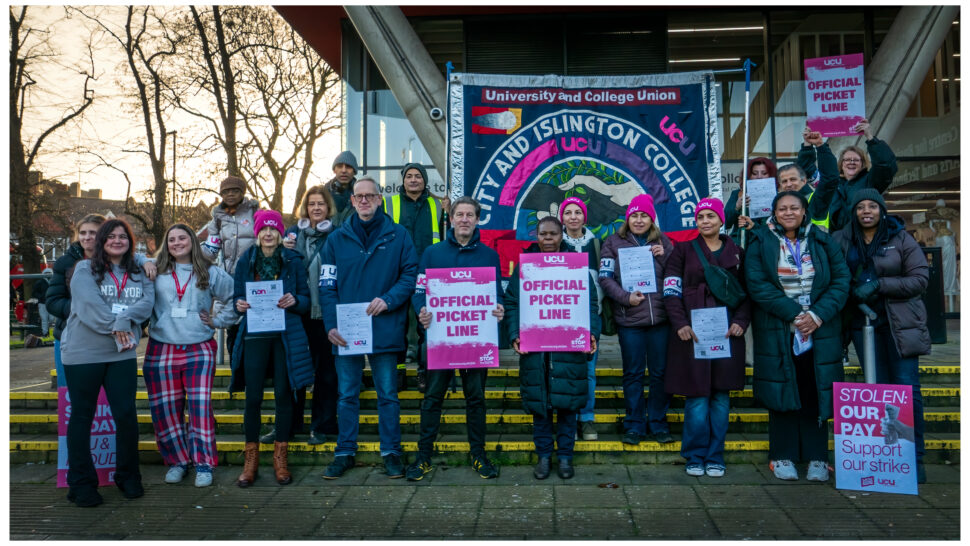
UCU and NEU members, who represent around 60 sixth form lecturers at CCC’s Angel campus – formerly known as City and Islington College, conducted a coordinated two-day strike across the group’s 11 sites in London.

NEU members have had 14 days of industrial action since October over CCC’s “intolerable” plans to freeze sixth-form teacher salaries for two to three years to bring them in line with FE lecturers.

“For the last 30-odd years, we’ve had these conditions despite being part of a bigger further education college,” said Nick Lawson, NEU rep at CCC.

“The college has unilaterally ripped those up, and we want to be returned to our national pay and conditions.

“We’re marching separately but striking together.”

Jeremy Corbyn also attended the picket line at the college group’s Finsbury Park campus, which is located in the MP’s Islington North constituency. Corbyn also lent his support to the UCU’s recent Parliamentary lobby efforts to seek a reversal of adult education funding cuts.

Meanwhile, UCU rep Mustafa Turus said the union’s branch had sought additional industrial action before the end of term.

Members rejected a pay offer of 4 per cent, a 4.5 per cent rise for those on a salary of £25,000 or less, and a one-off payment of £200-250 for those earning £34,000 or less.

Leaders also offered to set up a workload committee, which Turus said was not a tangible solution.

“We cannot wait months and months, if not years, for a workload committee to come to address our urgent concerns,” he said.

CCC declined to comment.

AoC quids in after £9m cash windfall

The Association of Colleges (AoC) has cashed in a £9 million windfall after ditching a pension fund that posed a “significant risk” to its financial stability.

The membership body’s newly published 2025 annual accounts reveal it agreed a settlement with the London Pension Fund Authority after taking the “difficult decision” to remove its employees from the defined-benefit scheme.

The scheme was in deficit for many years, reaching a peak of minus-£21 million in 2021 which meant the college body was technically insolvent.

But following improvements in market conditions, including an increase in interest rates, meant the AoC could exit with a £9.44 million surplus.

Chair Shaid Mahmood (pictured, right) said: “The AoC was technically insolvent for a significant number of years due to the LPFA pension liability.

“Once the LPFA moved to a surplus in 2024, the board discussed the option to withdraw in order to remove the risk and secure AoC’s financial security.

“We had long and detailed discussions across a number of board meetings, giving significant consideration to various options and taking into account the impact on those members of staff who were in the pension.”

The move required the agreement of about half the association’s 148 staff body who were signed up to the scheme.

Hughes enters the £200k club

The 2024-25 accounts also revealed that AoC chief executive David Hughes’ (pictured, left) basic salary grew 5 per cent to £205,905.

This places his salary in the same group as 12 college principals whose basic salary was £200,000 or more per year in the 2023-24 financial year.

Mahmood said: “The remuneration of our chief executive is determined by the remuneration committee which considers performance and impact as well as the market rate for senior, national roles like this one in the same way we set pay at all levels.”

‘Principal risk’

Annual accounts for the college body show its board viewed the pension liability as the only “principal risk” to its financial stability.

The AoC’s fund had suffered a high deficit due to financial reporting standard (FRS) rule 102, which governs how pension liabilities and assets must be accounted for by companies.

This included the association’s lack of security that could be “offset” against the pension deficit, said Mahmood.

The board had chosen to over-pay pension contributions for several years to reduce the liability.

According to its accounts for the year to March 2025, the AoC held £5.4 million in its profit and loss account, a 20 per cent increase on the previous year, and £9.4 million in its pension reserve, a 100 per cent increase.

The London Pension Fund Authority was set up in 1989, has about £8 billion in assets, nearly 100,000 members and 115 contributing employers.

Staff agreed voluntarily

Mahmood said AoC staff were offered two options: either a LPFA defined-benefit pension that required employee contributions based on their salary level, or a defined contribution scheme that did not require contributions.

Defined-benefit pensions offer a guaranteed income for life based on an employee’s salary at or near retirement, and how long they have been in a scheme.

They are generally viewed as more lucrative than defined contribution pensions, which provide an income based on how much the employee and employer invest, and how well those investments perform.

Staff in the LPFA scheme are understood to have “voluntarily” agreed to the change after the AoC offered an “alternative defined-contribution rate” as part of their agreement to exit.

About £1.9 million has been ring-fenced from the £9.4 million to fund this.

Mahmood added: “Our new pension offer for all staff was enhanced and is a good benefit which we are proud to offer.”

Following staff approval, it took LPFA 10 months to undertake the “complex process” to calculate the final settlement.

How will AoC spend the cash?

The AoC has set up a reserves and investment sub-committee to manage its “enhanced reserves” and will share further details “in the new year”.

Mahmood said: “As a board, we are clear the reserves should be utilised carefully to both secure the long-term future of the AoC so that it can continue its work to address current member priorities as well as the position of the sector with government and in wider society.”

The AoC currently represents 191 college members.

A spokesperson for LPFA said: “The LPFA reported a 128 per cent funding level at its last Valuation in 2022 and whilst the 2025 valuation is not yet complete, we expect to report a surplus once again.

“Our latest annual report, published last month, reports consistent year-on-year growth.

“It is not for the LPFA to comment on the benefits the Association of Colleges decides to provide for its employees, but we continue to support employers that provide benefits under the Local Government Pension Scheme.”

Eton gets go-ahead to develop 2 of 3 elite sixth forms

Two “elite” sixth forms proposed by Eton College and Star Academies have been approved, while the government blocked a third.

The trio of post-16 colleges – in Dudley, Oldham and Teesside – were submitted under the previous Conservative government and placed under review last year after Labour took office.

An updated pipeline list confirms that Eton Star Dudley and Eton Star Oldham were both marked to “continue in pre-opening”, meaning they will move forward to the next stage of development. However, Eton Star Teesside has been “minded to cancel”, effectively terminating that proposal though an appeal is possible.

The Department for Education said it chose to only approve new schools and sixth forms that provided a “unique offer for students who would otherwise not get it, without damaging the viability of existing local schools and colleges”.

Sir Hamid Patel, chief executive of Star Academies, said the trust was “delighted” two of its three Eton sixth forms had been confirmed.

“We understand the rationale for not progressing the other project and will look at alternative ways we can create opportunities for young people in those communities,” he added.

One UTC approved, another axed

The same dataset shows contrasting fortunes for two university technical college (UTC) bids.

Doncaster UTC – Health Sciences and Green Technologies, led by Brighter Futures Learning Partnership Trust, has been allowed to proceed. It will be Doncaster’s second UTC after one specialising in digital and science engineering was opened in 2020.

But UTC Southampton, sponsored by UTC Portsmouth, was canned.

Kate Ambrosi, CEO of the Baker Dearing Education Trust, the charity which represents UTCs, said she was “thrilled” that a second UTC in Doncaster would go ahead but was “naturally disappointed” by the Southampton decision.

“Like the new Doncaster UTC, this would have provided life-changing opportunities to young people in a very deprived area. It would have also helped meet an immense demand for places at UTC Portsmouth,” Ambrosi said, adding that the UTC’s backers would be appealing to the Department for Education for a review of this decision.

In total, 28 of the 44 mainstream free school proposals in the pipeline have been approved (see the full list here).

Eton College and Star Academies had previously argued their sixth form model would boost aspiration in areas with limited access to high-quality post-16 provision. Critics, however, warned about selective admissions and the risk of diverting resources from existing local colleges and schools.

Millions lost in fraud from Covid apprentice payments

Only a fifth of the £4.7 million in rogue Covid incentive payments given to employers to hire apprentices and trainees has been recovered.

An independent report by Covid counter-fraud commissioner Tom Hayhoe found the now-closed Education Skills Funding Agency (ESFA) had recouped £1 million of taxpayer money lost to fraud and error from its pandemic recovery schemes.

His report, which found a total of £10.8 billion of public money was lost to fraud, lambasted government departments’ unpreparedness for the crisis and “inadequate” measures to protect against criminality.

Hayhoe criticised some public bodies’ “inconsistent” approach to fraud risk assessments. Be he praised the Department for Education’s review of fraud dangers by “experienced” counter-fraud professionals.

Under the Conservative government, the DfE introduced employer cash incentives of £1,000 for each traineeship learner taken on in 2020, which could be claimed until the end of July 2022.

Then-chancellor Rishi Sunak concurrently unveiled a £2,000 bonus for employers who hired apprentices aged 16 to 24, and £1,500 for apprentices aged over 25 who were taken on for six months. The incentive for older apprentices was later doubled to £3,000.

The DfE spent £7.2 billion on Covid support, administered mostly by the ESFA, for emergency measures such as distributing laptops to vulnerable students, online classroom resources and employer incentives for traineeships and apprenticeships.

The department later conducted an assurance review of priority spending areas in the 2021-22 financial year.

Hayhoe’s report said the DfE found £9.7 million of detected fraud and error in total from its Covid spending, with £5.1 million recovered so far.

Alongside the ESFA’s £4.7 million lost to fraud and error for apprenticeship and trainee incentives, the report also detailed the recovery of £200,000 from “erroneous” payments made for exceptional costs to schools.

Hayhoe advised the DfE should continue to pursue bogus employer incentive payments, and said the department should use its extended legal powers to enforce recovery.

The public authorities (fraud, error and recovery) act received royal assent last week and creates new powers for government departments to tackle fraud, as well as adding an additional six years to the period during which actions against Covid-19 fraud can be taken.

“Where the pursuit of civil recovery has been unsuccessful, the department should consider utilising external enforcement resourcing given the extension of the statute of limitations granted by [the act],” Hayhoe recommended.

The DfE declined to comment.

Committee chair criticises DfE response to SEND report

The chair of Parliament’s education committee has criticised government for not directly addressing recommendations set out by its SEND report, calling on ministers to provide a “much more detailed response” in the new year.

The Department for Education has published a 14-page response to the education committee’s “solving the SEND crisis” report, which in September set out 95 recommendations for improving the system.

The report recommended ministers should create a ringfenced funding stream for special educational needs in FE. 

It also called on ministers to not remove statutory entitlements to education, health and care plans (EHCPs).

The government has also confirmed SEND tribunals will continue under its reforms, as new data published today showed a continued increase in the number of appeals against EHCP decisions.

Response ‘deliberately high level’

The DfE normally responds to each recommendation from the committee in full. Instead, the response published this week sets out only its principles of reform.

The government said its response “at this time is deliberately high-level and further detail on our plans for SEND reform will be set out in the schools white paper early in the new year following a further period of engagement with children and families”.

But committee chair Helen Hayes (pictured above) said while the committee “understands that the government isn’t in a position to answer our report’s recommendations in detail whilst it is still developing its SEND reforms”, the current response “will only suffice as an interim response”.

This is “because it does not directly address any of our report’s recommendations in the way that is expected of an official response to a select committee inquiry”.

“We expect the government to provide a much more detailed response to our recommendations early in the new year alongside the expected launch of the white paper.

“It is important that the extensive input from individuals and organisations, as well as the hard work committee, is respected and reflected in a detailed response from the government.”

Tribunals to remain

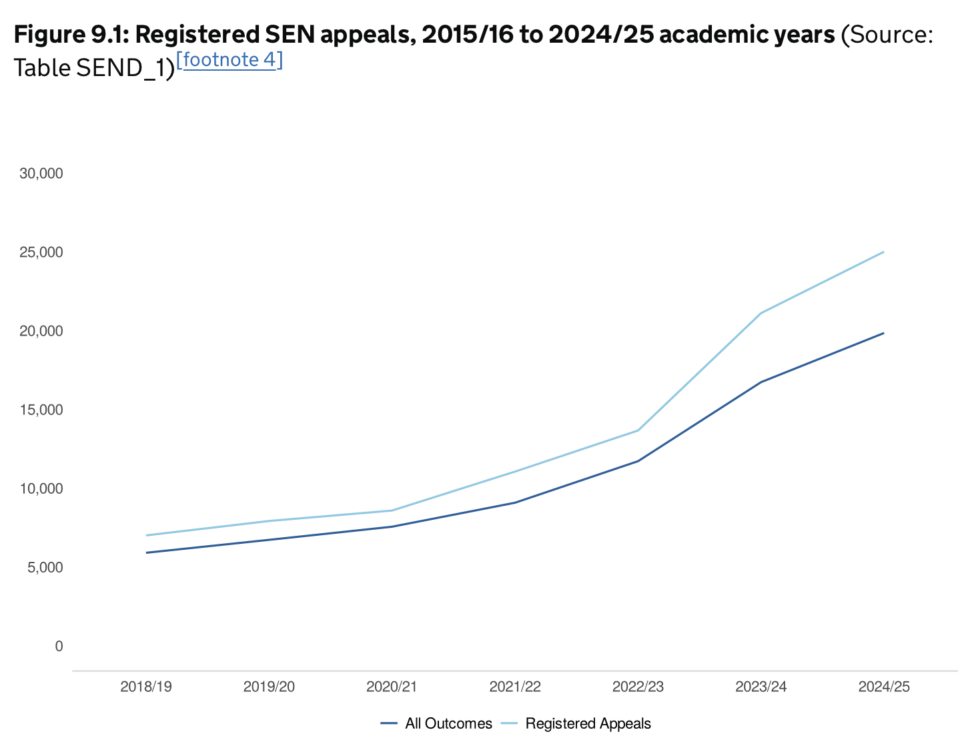
The government has also confirmed SEND tribunals – which rule on EHCP appeals – will continue, after new figures showed an 18 per cent increase in appeals in 2024-25 compared with the previous academic year.

There were 25,002 registered appeals last year, up from just 3,147 ten years ago. An age breakdown shows 7 per cent of appeals were for post-16 education.

Data published by the Ministry of Justice also shows that, as in previous years, the vast majority of cases – 99 per cent – that ended up at tribunal resulted in a finding in favour of parents. These are cases where the appellant wins the majority of the appeal. 

Last year, 14,009 appealed were decided on by judges. The decision was only upheld in 143 cases. 

Source Ministry of Justice

In its response to the committee, the DfE said it recognised “the need for clear, independent routes of redress, retaining the SEND tribunal as an important legal backstop for families who are unable to find resolution earlier in the process.

But it added that “all parties should work closely and collaboratively to develop solutions to their disagreements, so that children or young people get the support they need quicker without the need for a tribunal appeal”.

Schools minister Georgia Gould told an online consultation event this week the government was “really actively looking at” how to address needs without parents entering the “adversarial” tribunal process.

‘Barriers’ to resourced provision

Georgia Gould
Georgia Gould

Government is hosting nine face-to-face and five online events aimed at “putting families at the heart” of its plans.

But the “conversation” only runs until January 14 – and leaves little time ahead of the delayed white paper, expected to be published the same month.

Ministers have said they want to see more resourced provision for students with SEND.

Gould said government wanted to understand the “real barriers” to operating such provision.

Office for Students chief to leave at Easter

The chief executive of the higher education regulator will stand down earlier than planned.

Susan Lapworth is set to leave the Office for Students (OfS) at Easter, despite being appointed for a term that was due to end in August 2026. 

The announcement comes just weeks after the OfS published its new five-year strategy and follows the government’s post-16 education and skills white paper which bolstered the regulator’s role in overseeing struggling university finances, expanding higher technical education and cracking down on franchising fraud.

The OfS announcement did not include a reason for Lapworth’s departure. FE Week has approached the regulator for comment. 

In a letter to education secretary Bridget Phillipson, Lapworth said she was “hugely proud of everything we have achieved” since she joined, initially as director of regulation, in 2018. She became chief executive in May 2022. 

Lapworth said: “We have established a new regulator and a regulatory system focused on the interests of students in a sector that has never been regulated in this way before. And we have increasingly focused our regulation on the things that matter most. 

“We have acted where students, particularly those from disadvantaged backgrounds, are exposed to weak outcomes, poor academic experiences, or sexual misconduct. And we have robustly defended academic freedom and freedom of speech – the essential foundational values of all higher education.”

The move will mark the end of over a decade in higher education regulation for Lapworth, which began as registrar at the Higher Education Funding Council for England, the OfS’s predecessor, in 2014.

She was paid £175,000-£180,000 last year alongside a bonus of £15,000-£20,000.

Lapworth is the second senior OfS staff member to announce their departure from the organisation in as many months. John Blake announced last month he will not be renewing his term as director for fair access and participation. He was replaced on an interim basis by Professor Chris Millward, who first held the role when it was created in 2017.

Phillipson said: “I would like to thank Susan for her dedicated service to the Office for Students and to higher education. Her leadership has ensured that the OfS is now well placed to meet the challenges ahead and help the sector achieve the government’s vision. I wish Susan every success for the future.”

Aspiring successors only have until January 12, 2026, to apply for the role, which has been advertised with a four-year term of office and a salary of £145,000 per annum.

Ofqual: On-screen exams could be introduced by 2030

On-screen exams could be introduced for some GCSE and A Level subjects by 2030, the head of Ofqual has said, in a big step towards making exams digital.

Ofqual plans to allow exam boards to introduce up to two on-screen specifications for GCSEs and A Level qualifications with less than 100,000 entries per year.

Chief regulator Sir Ian Bauckham said it was “important to start small” and that Ofqual will “have a very close eye to fairness” when assessing proposals.

It comes after a three-year-long research project by the regulator and the Department for Education, published today, identified “potential benefits” but also “significant challenges” for on-screen exams.

Ofqual has launched a consultation on its proposals running until March 5. The regulator then plans to hold a technical consultation next year, and if plans proceed, exam boards can then submit proposals.

Boards have praised Ofqual’s “rigorous approach” despite plans limiting the scope of subjects eligible for on-screen assessments in the near future.

What subjects could have on-screen assessments?

Exam boards were developing plans for on-screen assessments – but announced they had been delayed in December 2024. All required Ofqual approval.

Pearson Edexcel wanted to give students the choice to take GCSE language and literature on-screen in summer 2025, and OCR had plans to launch a digitally assessed computer science GCSE.

AQA had published proposals for parts of GCSE Italian and Polish to be assessed digitally by 2026, with plans for bigger subjects to be partly on-screen assessed in 2030.

But Ofqual’s proposal means the majority of GCSE subjects would not be eligible for on-screen assessments.

Eligible subjects would include German, which had 32,430 entries last academic year, design and technology (77,770 entries), physical education (79,285 entries), food preparation and nutrition (55,035 entries) and drama (48,650 entries).

For A Level subjects, only maths (105,755 entries) would be disqualified for on-screen assessment, as all other subjects had below 100,000 entries.

Bauckham told FE Week’s sister publication Schools Week: “The first step here is the introduction of specific regulations, and that’s because at the moment, there is no regulation to manage the entry of on-screen qualifications into the market.”

He added it was “important to start small” by targeting GCSE subjects with lower uptakes, as it “would be lower stakes and easier for schools to deliver”.

On what subjects may be chosen by exam boards, Bauckham said: “We think it’s going to be a range. We’re not absolutely certain that all of them are going to submit specifications either.

“Developing a new specification does require resource that they will have to put in.”

On-screen and paper versions would be offered as completely separate qualifications, but it is not clear whether schools and colleges will be able to offer both qualifications with students choosing whether to take an on-screen or paper assessment.

‘A pragmatic way forward’

Exam boards have welcomed Ofqual’s proposals – despite the regulator limiting the subjects it could introduce on-screen assessments for. None shared details of which subjects they were considering.

AQA chief executive Colin Hughes said: “Not introducing digital exams would be a disservice to young people. In many cases, their future jobs will involve digital devices.

“We recognise there are concerns about issues such as fairness, sockets and space. That’s why we believe that digital exams should be introduced in a measured, paced way, beginning with subjects for which digital delivery offers a clear benefit, and where the shift is least disruptive”.

Myles McGinley, managing director of Cambridge OCR, said Ofqual’s “regulatory approach should be robust while allowing for innovation where it improves assessment experience”.

OCR said it will continue its work on a fully on-screen computer science GCSE and will consider other suitable subjects in the coming months.

Chief executive of WJEC Ian Morgan said the proposed cap of 100,000 maximum entries “offers reassurance to stakeholders, particularly schools and colleges, in managing the transition towards greater use of digital assessment and represents a pragmatic way forward”.

Morgan said there remains “substantial work” to be done to assess which subjects would be suitable for on-screen assessment.

Pepe Di’lasio, general secretary of the Association of College and School Leaders, said: “This would represent a significant change, with many practical issues, and a measured approach is the right way to proceed.”

‘Very close eye to fairness’

The exams regulator would also publish guidance on platforms and devices that would be suitable for use in on-screen exams. Students would not be able to use their own device.

Bauckham said when assessing proposals, Ofqual “will have a very close eye to fairness, and anything that is demonstrably going to increase unfairness will be pushed back, and they’ll be asked to think again before they can market it to schools and colleges”.

Schools and colleges will be given three years with an assessment specification before an exam takes place. Two of these will teaching years. 

This means the first-on screen assessment would likely be taken towards the end of the decade, Ofqual said.

Research carried out by Ofqual and the DfE found “potential benefits such as improved accessibility, particularly for students with special educational needs and disabilities (SEND), greater operational efficiency, and alignment with a digital society”.

But it continued there are “significant challenges” including “unequal access to digital technology, inconsistent IT infrastructure, technical risks and concerns about fairness, standards and delivery”.

Dame Ann Limb becomes a Baroness

Dame Ann Limb has become the first former further education college principal to be appointed to the House of Lords.

Downing Street announced this afternoon the life peerage has been approved by The King on the recommendation of the prime minister, Sir Keir Starmer.

Limb will sit on the Labour benches and will take the title Baroness Limb of Moss Side in the city of Manchester and the county of Lancashire.

Limb, who grew up in Moss Side and currently chairs The Manchester College, said: “Having worked in and championed FE colleges for half a century, the cosmos has conspired to put me in the right place at the right time. Improving skills levels of all young people and adults is critical to strengthening the nation’s economic, cultural and social fabric. I want to play a role in making this happen.”

She led Milton Keynes College for a decade from 1986 before moving to Cambridge Regional College from 1996 to 2001, and led Learndirect in its formative years until 2005. 

She is currently chair of The King’s Foundation, the City & Guilds Foundation, Lloyds Bank Foundation and the Lifelong Education Institute. Limb is also pro chancellor of the University of Surrey and founder and vice president of the Helena Kennedy Foundation, a charity that has supported thousands of students to access higher education. Limb made headlines as the first woman to chair The Scouts and City & Guilds.

Queen Elizabeth II made Limb a dame in her 2022 birthday honours for services to young people and philanthropy.

Limb said: “I have not spent my career believing I would ever be offered a life peerage. However, the opportunity to serve as a life peer in the House of Lords is an experience my parents and grandparents would have deemed both inconceivable and incomprehensible.

“My decision to accept this honour follows a period of personal reflection and discernment over the last two months. In this, I have been sustained by prayer and upheld by my life partner, Maggie Cook. As a Quaker, and as a peer, I shall be guided in all decisions I take by my faith, values, conscience, and independence of mind.”

An outspoken advocate for the sector and its students, Limb has championed inclusion, social justice and leadership. She recently spearheaded the historic sale of City & Guilds to PeopleCert, securing ongoing “significant investment” in the now independent City & Guilds Foundation.

Among Starmer’s other appointments for life peerages was Sir Michael Barber, who was a skills policy implementation adviser under the last government, and Russell Hobby, the former CEO of Teach First and former general secretary of the National Association of Head Teachers.