

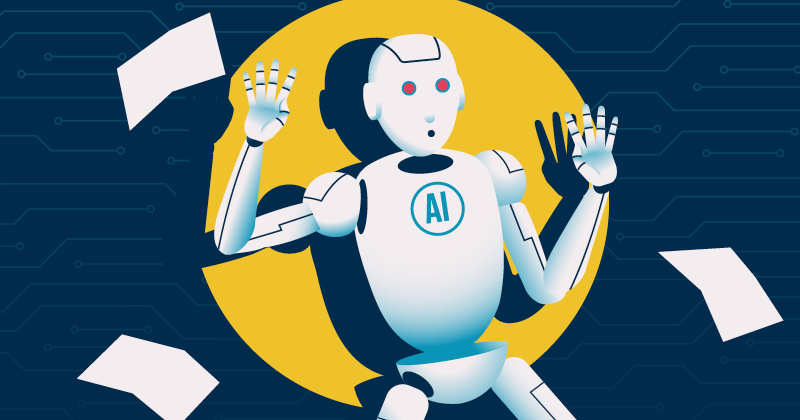
AI is transforming education faster than expected, and its impact is impossible to ignore. While 92 per cent of UK students report using generative AI tools, educators are struggling to adapt.
Confidence in spotting AI-written work has plummeted, with a survey by online training provider Coursera claiming just 26 per cent of teachers feel capable, down from 42 per cent in 2023.
And AI tools like ChatGPT are evolving fast; In November, a ChatGPT update enabled users to prevent its notorious overuse of the em dash (—), thereby making AI-generated content even harder for people to detect.
AI versus human writing
AI-generated work typically appears polished and technically correct, but lacks the depth, intent and personal perspective that only human writing can bring.
Human writers draw from lived experiences, vocational knowledge and individual reasoning to shape meaning and purpose, elements AI cannot replicate.
Human writing is intentional. It starts with an idea, and each word is chosen to shape a story, build flow and add meaning. From sentence structure to grammar, human writing shows purpose.
AI writing, by contrast, operates on probability, not perspective. Large language models do not think or understand; they rely on predictions and statistical patterns.
They imitate human language, but lack genuine comprehension and creativity, the subjectivity and insight that defines authentic writing.
These limitations show up in the text. AI-generated content often features repetitive phrases, uniform sentences, probabilistic word chains and overused clichés.
Over time, it reads more like a predictable pattern than something created with intent. While these traits can help identify AI writing, they’re not always obvious at first glance.
Advanced detection technology provides a more systematic way to surface these subtle patterns and give teachers confidence in their assessments.
Using AI detection tools
AI detection tools analyse the underlying structures of a written piece. Rather than relying on quirky punctuation, such as em dashes, for clues, they examine how sentences are formed, how often certain words appear, both independently and in phrases, and whether the text feels more mechanical than deliberate.
Detection tools typically break text down into sections and compare each sentence for the tell-tale signs, assigning probabilities rather than binary judgements to indicate whether it was likely written by a human or generated by AI.
Teachers need advanced tools to tackle the challenge of AI paraphrasing tools or “bypassers”, which allow students to rephrase AI-generated content to make it sound more human-like.
These tools allow the user to see the entire writing process and understand how the piece has evolved through the revision history.
This deeper layer of analysis provides granular insights, which are helpful when marking assignments for large groups or assessing extended written tasks.
It gives a clearer sense of when writing may have been shaped by AI, and provides context to support informed conversations with students about thoughtful and honest use of digital tools.
Responsible AI use
While detection software can help flag potential issues, it is only part of the solution.
What matters most is creating a culture where students feel confident talking about how they use AI and understand the importance of learning integrity.
When students understand that responsible use is about building skills for the workplace, like problem-solving and critical analysis rather than a false sense of competency, they are more likely to make considered choices.
Academic integrity is built on partnership, not just policing. AI detection is a valuable starting point, and teachers can use it as a bridge to an honest conversation, helping students navigate AI as a tool for the future, rather than a shortcut for the present.
By combining clear guardrails with professional insight, teachers can turn the challenge of AI into an opportunity for growth – preparing students for the modern workplace through meaningful dialogue rather than just detection.








AI detection tools have improved enormously but they will still only catch ‘naive’ users – more sophisticated users will use another AI to humanise their work or use smarter prompts to disrupt AI patterns. And for that 1-in-a-100 case where Turnitin incorrectly flags a child’s work as AI, the damage done to student-teacher trust (which we know is so crucial for learning), as well as trust in the system in general, by the resulting investigation can be irreparable.
While Turnitin is paywalled, GPTZero (generally evaluated as fairly accurate on shared objective benchmarks) rates this very article as 76% AI. Draw from that what you will.