

Ofsted inspectors have warned against high 16 to 18 dropout rates and weak GCSE resit progress among the first FE colleges to be inspected under the inspectorate’s renewed framework.
The watchdog handed multiple ‘needs attention’ judgments to one college and raised concerns at another, after publishing new-style inspection reports for three FE colleges this morning.
Inspectors urged college leaders to strengthen their use of in-year risk indicators to spot learners at risk of dropping out, “rapidly” improve GCSE English and maths teaching, and “sharply” focus on improving the progress learners make from their starting points.
St Helens College received one ‘strong standard’ and eight ‘expected standard’ ratings but also five ‘needs attention’ judgments across its 16 to 18 provision and adult learning programmes, alongside a further ‘needs attention’ rating for leadership and governance, following an inspection on December 9, 2025.
Sandwell College was awarded two ‘strong standard’ and 12 ‘expected standard’ ratings, but also a single ‘needs attention’ judgment in the achievement category of its 16 to 18 provision, while Gloucestershire College met the ‘expected standard’ in all 15 inspection areas.
Ofsted released the first batch of reports last month, which awarded one independent training provider (ITP) with the coveted ‘exceptional’ grade.
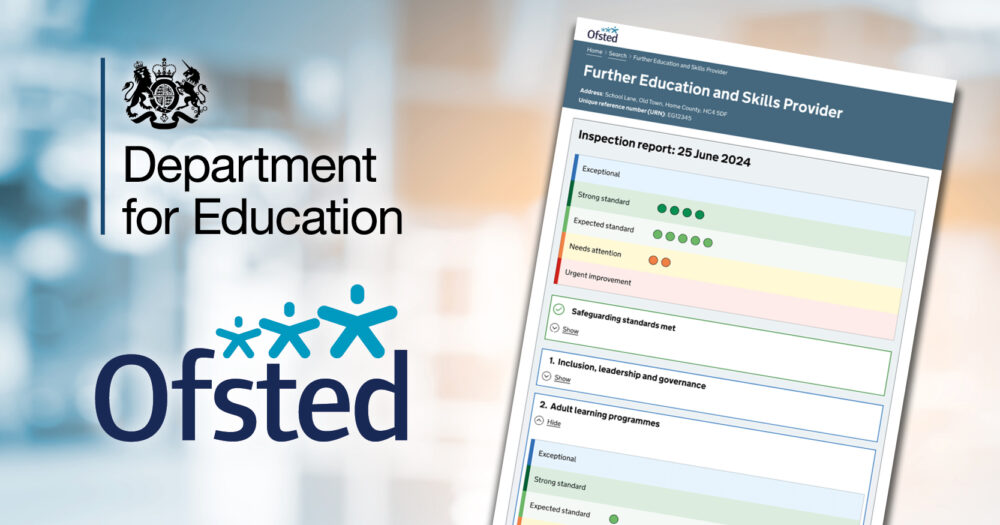
Following a consultation last year, Ofsted abandoned overall headline grades in favour of a five-point scale in 15 individual areas – including inclusion for the first time.
Education providers will now be graded from ‘exceptional’, ‘strong standard’ and ‘expected standard’ to ‘needs attention’ and ‘urgent improvement’.
Ofsted expects providers to achieve the ‘expected standard’ grade as a baseline. Anything below will be deemed ‘needs attention or ‘urgent improvement’, and above will get a ‘strong standard’ or ‘exceptional’ grade.
Drop-out risks not identified quickly enough
Achievement rate data is now visible on report card pages for individual colleges and providers.
Inspectors said leaders at Merseyside-based St Helens College, which enrols over 5,500 students and apprentices, do not identify “quickly enough” why students leave their courses early or do not achieve.
The finding triggered a ‘needs attention’ grade for leadership and governance.
The report said “appropriate” measures were taken to improve the quality of provision since the previous inspection in 2023, when it was graded ‘requires improvement’, but added that managers’ “oversight” of in-year risk indicators “lacks precision”.
This was after the inspection visit identified “too many” young and adult students leave their courses early or do not achieve on completion.
Inspectors criticised the varied achievement across St Helen College’s course provision and highlighted many students on GCSE English and maths courses do not make progress towards achieving a higher grade.
“[They] often achieve less well than they did at school,” the report card said.
All three inspection areas under the 16-18 programme category and two out of three inspection evaluation areas under adult programmes were deemed ‘needs attention’ by the watchdog.
Interventions to improve GCSE resit provision did not have the “desired impact” and the quality of teaching was found to be poor “in some cases”.
Inspectors urged GCSE resit teaching to be “rapidly” improved at St Helens College as well as interventions to increase retention and better in-year monitoring of indicators of risk “across all courses” to identify potential dropouts.
Inspectors pointed out in Gloucestershire College’s report that while its GCSE resit pass rates were low, most do make progress by “at least one grade” from their starting points.
At 7000-strong Sandwell College, the report found entry level, level 1 and level 2 learners often make “better than average” progress towards achieving the GCSE English qualification, with around a third receiving at least a grade 4 when they resit the exam.
But “too many” learners at level 3, who study A Levels or vocational qualifications, do not make enough progress from their starting points.
“Too many learners at level 3 do not continue to the second year of two-year courses,” inspectors added, leading to a ‘needs attention’ grade in the achievement inspection area.
The watchdog made a recommendation to “focus sharply” on improving the progress that learners on level 3 courses make from their starting points so they “achieve at least the grades of which they are capable”.
“We are always ambitious for our learners and our strategy ‘your future our focus’ is all about progression to their next stage,” said Sandwell College CEO and principal Lisa Capper.
“We continue to go from strength to strength with good achievement and progression, and a great ethos embracing learning, diversity and well-being.”
Sandwell College was also found to be delivering inclusion and meeting skills needs to a ‘strong standard’.
Attendance ‘persistently low’
Ofsted found two colleges struggling with attendance at GCSE resit lessons.
St Helens College learners’ attendance at GCSE English and maths, and “a few vocational lessons”, was “persistently low”.
They also criticised managers’ lack of support for adult students to attend, though it found that the college has improved “wraparound support” to vulnerable students on English for speakers of other languages (ESOL) courses so they are “fully supported” to attend and achieve.
At Gloucestershire College, attendance at GCSE English and mathematics sessions is “typically lower” than vocational and technical lessons.
Meanwhile, Sandwell College achieved ‘expected standard’ in the participation and development of 16-18 programmes.
Inspectors found staff put in “suitable” plans for learners when they are absent or their performance falls.
St Helens College declined to comment.










Your thoughts