

When I was asked to give a Black History Month workshop at a college, it caught me off guard.
I’ve been teaching in FE for more than 15 years, but I’d never seen myself as someone who teaches Black history. I always thought my presence as a Black lecturer opened the door to honest conversation. In practice, it’s different.
I started teaching in my late 20s in Ipswich, where around 3.5 per cent of the population identifies as Black.
Growing up, Black History Month felt forced. In school it was a lecture about struggle, not culture or pride. Maybe that’s why I avoided it in my teaching.
Yet, as a media lecturer, I realised that I already teach elements of Black history through the stories, people and visuals I bring into lessons.
Walking into a classroom as the only Black teacher some students have ever met, I am representation. I face questions like “Do you rap?” or “You’ve smoked weed before, right?”
Those moments show how narrow some young people’s exposure to Black culture is.
So my first job is always to challenge stereotypes and open minds. But that isn’t enough. To understand a people, you have to respect their history.
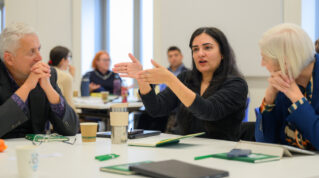
That’s what I tried to do in my workshop at West Suffolk College in Bury St Edmunds where the Black population is even lower, at around 1.6 per cent.
I wanted students to feel invited in, not lectured to. I spoke about figures like Spike Lee, Naomi Campbell and Ashley Walters, icons who show creativity, resilience and influence across industries.
My approach came from my other role as a BBC radio producer, where I curate a three-hour show celebrating Afro-Caribbean stories and voices across the East of England.
The goal is always the same: to connect people through real, lived experiences rather than guilt or politics.
What surprised me most was how many students had never heard of these names or their achievements, and how engaged they became once they did.
Maybe it was my delivery, or maybe they had just never been told these stories in this way before. Either way, their curiosity reminded me that representation is not only about visibility; it’s about storytelling.
For me, Black history was not a lesson. It was a lifestyle. My parents filled our home with African art, books, and films like Mario Van Peebles’ Posse. They showed me that Black history lives through creativity and pride. That foundation shaped how I teach today, with honesty and context.
One key point I made in my workshop was about awareness. None of the students were visibly of African heritage.
I asked them to think about their future workplaces. Would they stay in Suffolk or move elsewhere? Would they understand the cultures of their colleagues and communities? If not, they may be at a disadvantage.
I learned British, German, French, and American history at school. I can work comfortably in diverse spaces because of that. Can they say the same?
After four engaging sessions, I left feeling both proud and reflective. I had spent years teaching without formally including Black history, assuming it was covered elsewhere. Now I know it must be part of everything we teach – not just in October, not just in diversity week.
In most FE colleges, Black History Month still sits as a one-off event in October, often led by well-meaning white staff relying on the same slavery heavy curriculum I endured. It is time to change that.
According to the Ethnic Equity in Education FE Report 2024, just 7.2 per cent of FE leaders are Black, compared with 30 per cent of students. As the report notes, “At no point in the FE workforce is there a reflection of the UK’s Black population”.
FE colleges need to bring in Black leaders and educators to write, teach, and reshape the narrative. Let’s make Black history a natural part of the curriculum every month of the year.
But what do I know? I’m just a rapper.





Your thoughts