

The government will temporarily slash minimum off-the-job training (OTJ) hours for dozens of apprenticeship standards following concerns that the timing to implement new rules was too short.
Last month, the Department for Education agreed cuts to OTJ hours for 39 standards “of concern”.
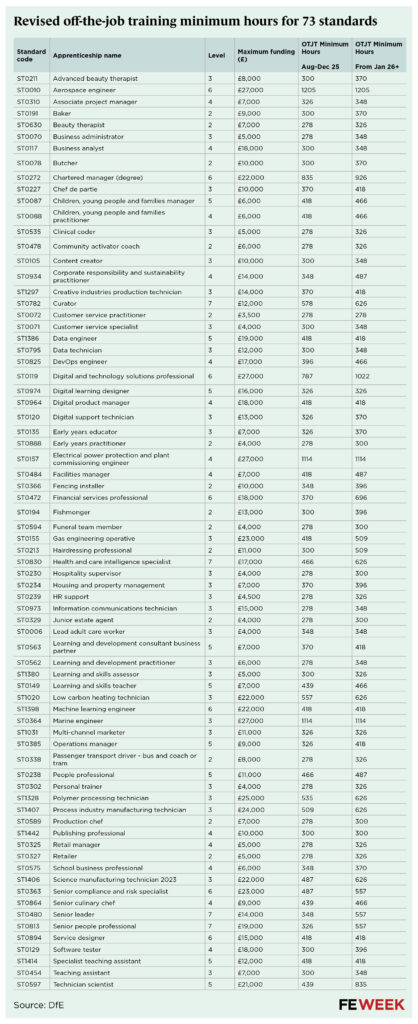
In version 2 of the 2025-26 apprenticeship funding rules published today, the DfE has added 34 more to the list of standards included in a “transitional period” for off-the-job training, bringing the total to 73 (see full list below).
However, only 60 of the 73 listed show more lenient OTJ hours during the transition period. It appears the other 13 standards have also been listed because the overall OTJ hour baseline has been reduced since the original version.
For example, the level 6 aerospace engineer had a minimum requirement of 1344 hours in May’s announcement but this figure has been lowered to 1205 hours from August onwards.
FE Week is seeking clarity from DfE but did not receive a response at the time of going to press.
In May, DfE said it would introduce minimum off-the-job training (OTJ) hours for each apprenticeship standard for the first time.
It means that training providers no longer have to calculate how much minimum OTJ training each apprentice requires depending on the length of their apprenticeship – which must be at least 20 per cent of their working hours.
But providers complained that there was not enough time to talk to employers on the change nor to tweak their specific delivery models and curriculum.
As a compromise, the minimum OTJ training hours for new starts between August and December this year have now been lowered for all providers wanting to deliver 73 apprenticeship standards.
The move aims to allow training providers “headroom” to engage with employers and change delivery models.
The changes are effective from August this year, in accordance with the 2025-26 funding rules.
Three standards published in last month’s list are no longer in the revised list due to no change in the set minimum hours. These are the level 3 funeral director, fundraiser and team leader standards.
DfE has reduced the minimum hours for new starts from January for fifteen standards in its version two of the rules.
For example, the level 3 early years educator standard, which has a temporary 326 OTJ hours set, will increase to 370 hours from January as opposed to the original 396 hours.
The rest will shift back to the original hours required from January.
Providers risk DfE clawback if they do not meet the minimum requirement of OTJ training.
Minimum hours for the first seven foundation apprenticeships have also been published today. They are all set at 187 hours each.
RPL changes
DfE also clarified its stance on recognition of prior learning policy (RPL).
Providers must use their own planned OTJ hours as a starting point for calculating RPL, “provided their planned hours are equal to or more than the published OTJT minimum requirement for the standard”.
“This figure can only be reduced if there is evidence of relevant prior learning,” the rules said.
The guidance added that no apprenticeship programme must fall below 187 hours of delivery or 8 months in duration.
Full list of 73 apprenticeships with OTJ ‘transition’ period
Click here for high-res version










Your thoughts