

I finished medical school and realised I couldn’t go straight into work. I was 24, burnt out and I needed to feel well again.
Burnout is widely discussed in medicine. National training data shows that a significant proportion of trainees are at high risk of burnout and find their work emotionally exhausting, so my experience isn’t rare.
That’s the bit people often miss when they hear I’m now on an adult construction course at Bradford College. They reach for a neat story about switching careers or rejecting medicine.
That isn’t what happened. I stepped sideways for a while, because I needed something physical and grounding.
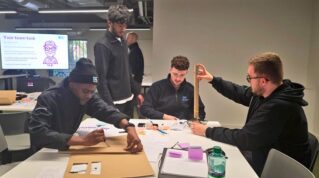
This is my ‘year out’, a construction skills course. I could’ve gone travelling but I needed to reconnect with my community and do something fulfilling.
At the end of a session, I can look at what I’ve done and know whether it’s good work or not. It’s been unexpectedly steadying.
When people talk about construction, they often talk about it as if it’s rough or basic. That hasn’t been my experience. The work is precise and physical at the same time.
Watching a hip replacement being done properly is like that too. It’s careful, methodical work. Someone is rebuilding part of a body.
On this building course, you’re measuring, fixing and working with materials, and if you get it wrong, it shows. There’s craft in it.
For me, these are skills for life. You stop thinking you can’t touch anything without breaking it, you trust yourself a bit more.
I’m the only woman on my course, and people have been respectful and supportive. But I’ve become more aware of how language shapes whether women feel they belong.
I remember being told that I’d be ‘the only girl on the course’. It wasn’t meant badly; it was meant as useful information. But, if I’d been younger, or less confident, I might have heard that and thought, ‘this course isn’t for me’.
Women are still underrepresented in construction, particularly in manual trades. They make up around 15 per cent of the workforce, and far fewer work in site-based roles.
These figures are often used to explain why things are difficult, and less often used to look at how everyday interactions either invite women in, or quietly signal that we’re out of place.
Further education sits right at that point of contact.
Belonging is built through small, ordinary signals. At Bradford College, there are basic practicalities that make a difference. You’re treated as a learner, not as a novelty. You’re not asked to perform gratitude for being allowed into the room.
Even at the construction centre, things like having sanitary products available in the toilets tell you that someone has thought about whether women will be here and decided that we should be.
I’m working class, and that shapes how I experience education. On this course, I haven’t felt like I have to perform or explain myself. It’s hard to learn new things if you’re wasting precious energy trying to fit in.
Since starting this course I’ve had so many women say, ‘I wish I could’ve done that when I was younger’. My mum has looked for similar courses. A friend’s mum has too.
There’s appetite here for practical skills among women of all ages, not just for work, but for independence and confidence in everyday life.
On International Women’s Day (on Sunday), there’s often a focus on exceptional stories. I don’t think my story is exceptional. I think it’s instructive.
If we are serious about routes into male-dominated trades for women, the work isn’t only about recruitment campaigns or telling us to be brave. It’s about designing learning environments that assume women belong, rather than treating us as anomalies who need special handling.
This construction course has been my year out, and it’s helped me to become well again. The college didn’t just give me skills. It gave me a place where I could learn without being reduced to what I’d done before.






Your thoughts