

Qualifications are rarely the whole story in how young people progress into industry or higher levels of learning. Increasingly, educators and employers point to gaps in confidence, communication, relationships, allyship and understanding of professional environments.
Without these skills that sit beneath employability, progression can feel out of reach, particularly for students already facing systemic barriers.
True equity is not simply about access to courses or qualifications. It is about ensuring that young people understand how to navigate spaces that were not designed with everyone in mind.
Do they understand how to build healthy professional relationships? Do they know what allyship looks like in practice? Are they confident communicating across difference, culture, and power? And crucially, do they see people like themselves reflected in positions of influence and leadership?
These questions sit at the heart of a growing shift in FE partnerships.
Preparing students to not only work but belong
Traditional industry partnerships often focus on exposure: a talk, a visit, a short placement. While valuable, these tick-box models can unintentionally assume that students already possess the confidence, cultural capital and emotional resilience needed to benefit fully from such opportunities.
A more holistic approach is emerging that recognises skills development as inseparable from wellbeing, identity and lived experience. Spaces designed with this understanding aim not just to prepare students for work, but to belong within it.
The Holistic Wellness Training Centre in Ipswich was created with this ethos in mind. Rather than functioning as a conventional placement site, it operates as a collaborative learning environment where education, sports, wellbeing, creativity and culture intersect. The focus is not only on what young people do, but how they feel, relate to others and understand their own potential.
Closing invisible gaps
Across FE, learners frequently arrive without the self-belief or opportunities to gain access to industry-led experiences in a meaningful way. For those from under-represented backgrounds, this gap can be compounded by limited access to networks, role models or environments where they feel safe to make mistakes and grow.
This is where holistic partnership models can make a tangible difference. By embedding wellbeing, reflective practice and cultural awareness into skills development, students are supported to build the foundations that enable learning to stick.
Through partnerships with local colleges that are part of Eastern Education Group, students have engaged in immersive experiences that combine creativity, communication and cultural learning.
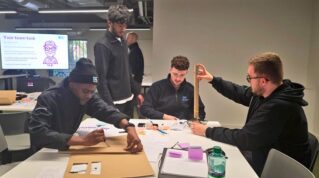
In one example, around 20 young people on a progression construction course created a Windrush-inspired podcast project – exploring heritage, storytelling and representation while developing presentation, teamwork and confidence. Importantly, this work did not happen in isolation.
On the same day students also worked alongside national media professionals, including the BBC, gaining insight into industry expectations and communication standards. The combination of creative expression, professional exposure and supportive facilitation allowed students to stretch themselves without feeling overwhelmed.
Role models make aspiration tangible
A defining feature of these experiences is the emphasis on relationships and representation. Students engage with diverse role models across sectors – individuals whose journeys challenge narrow ideas of success and leadership. These interactions matter.
When students see people who look like them or share similar lived experiences operating at high levels, aspiration becomes tangible. Young people not in employment, education or training (NEET) do not often get these opportunities for growth. Neither do those taking English for Speakers of Other Languages (ESOL) courses, who we are working closely with.
Alongside this, conversations around allyship, anti-racism, healthy relationships, and inclusive leadership are embedded naturally into learning. Rather than being abstract concepts, they are explored through discussion, collaboration and real-world context – skills increasingly essential for both education and employment.
Young people were able to interview the boxer Fabio Wardley and other celebrities as media presenters. When interviewing a world boxing champion is their first professional experience, there is no ceiling on what they can achieve.
Health and wellbeing are also part of the learning environment. Physical wellbeing activities have included working with national athletes and sports experts to create reflective spaces, and open dialogue around mental health to help students understand the link between confidence, communication and resilience.
Opportunity alone is not enough
The impact is already visible. Two students have secured an apprenticeship directly.
Holistic partnerships challenge us to rethink what education spaces can be. They ask whether we are truly creating equity, or simply offering opportunity without the support needed to access it.
When education, wellbeing, and culture come together, young people are not just prepared for their next step – they are equipped to thrive within it.



Your thoughts