The story of PiXL: how the pursuit of excellence found new meaning

On a mission to help school and college leaders solve shared problems together, Pixl chief Rachel Johnson talks to Jessica Hill about resilience, leadership and building on a legacy through tough times.

The dramatic moment when Rachel Johnson announced she was taking over as school and college leadership network Pixl’s new chief executive was one that still gives her shivers.

It was January 2020, and little did any of the 1,200 education leaders present at Pixl’s national conference realise that over in China, a new virus was taking hold which would change the world forever. Pixl then operated on a model mostly reliant on live events.

Johnson, a former English teacher who was then Pixl’s head of strategy, recalls her heart going “mad and fluttery” as she told the audience that Sir John Rowling, the charismatic chief executive who had personified Pixl for 15 years, had died four days earlier.

He’d kept his five-month battle with cancer a secret from everyone except close family. “I’m his daughter”, Johnson continued to a “massive gasp” from Pixl members, most of whom had had no idea the pair were related.

Then, she dropped her final bombshell: “I’m taking over” the organisation.

Sir John had not publicly advocated any particular line of succession. Johnson had left her husband to care for their children while she moved back in with her parents to nurse her father in his final weeks. But when she revealed to him her desire to succeed in his footsteps, he refused to voice his opinion on the matter.

He wanted his daughter to feel free to make her own choices. But Johnson was hurt by his lack of endorsement. “I couldn’t get my head around it because I wanted him to say, ‘go on, you’re going to be brilliant’. I was imagining that Lion King moment of him saying, ‘Here’s my legacy, you take it’.”

Now, she believes it was “the biggest gift” he could have given her because it meant she “wasn’t trying to fill his shoes”.

Johnson could then be free to lead Pixl her own way and shake off an image of the company that was then still tarnished by old accusations it had encouraged schools to game the system. But more on that later.

That was the last time she would be at a face-to-face conference for the next two years. During that time, Johnson had to find ways to keep her own organisation going while supporting her members through some of the toughest moments in leadership they would ever experience.

Rachel Johnson and her father Sir John Rowling

Learning from each other

Since that time, Johnson has grown the dedicated division for Pixl’s 300 college and sixth-form members.

Despite being siloed in different parts of the education system, Johnson believes leaders in schools and colleges have a lot to learn from each other.

One clear advantage of more cross-sector collaboration is on careers advice and guidance.

For years the post-16 sector has criticised schools for not giving pupils independent and impartial information about 16-19 options, like technical training and apprenticeships.

The FE sector nationally turned to the government to step in, and now there’s a more robust ‘Baker clause’ in law with tougher rules telling schools how many “meaningful interactions” schools should have with different post-16 providers.

“To help young people, post-16 leaders need to work across the key stages, and know what has been and what’s coming”.

That means talking to year 7 students and teachers, key stage 4 students and to employers and workplaces. 

“Ultimately, we know what is coming down the track in post-16 if we know how the cohort behaves in years 6 and eleven. We can prepare them better if teachers fully understand what the next stage looks like and prepare students for continuity, rather than seeing artificial breaks in education.”

Johnson

Out of the echo chamber

Johnson believes that too often people resort to “camps” in their thinking which are far removed from reality, because “nuance isn’t sexy”.

In the divisive education section of social media, she expresses distaste for the “sniping” that takes place between progressives and traditionalists.

It “saddens” her, because while that debate is “unnuanced”, leaders are “missing out on the really big debates we ought to be having over how we can be relentless about high standards, without losing compassion. I want somebody to talk about that.”

Leading through grief has made her “unquestionably more understanding and compassionate” to herself, “as well as to others”.

But in the period immediately following Sir John’s passing, Pixl entered a “state of flux” in readjusting to his absence, as he had always been its driving force.

Sir John started the network in 2006 after DfE pulled the funding for the London Challenge school improvement programme he was helping to lead. Its then-55 partner schools pledged to continue working together under a new network, with Sir John at the helm.

Meanwhile, Johnson had just started teaching English at a secondary school in Stockton-on-Tees. As a child growing up in a household where her mum was a teacher and her dad was a head, her dream had been to one day become a head herself.

Pixl stands for Partners in Excellence, which seems apt when Johnson – a self-confessed “book addict” – points at a stack of books and explains that three, titled Climbing towards Excellence, Changing towards Excellence, and Heading towards Excellence, were written by her father.

Sir John grew Pixl by “word of mouth” through its reputation for providing strategies for raising attainment. Meanwhile, Johnson became head of English at Cramlington Learning Village in Northumberland.

But she “didn’t really enjoy” being “in and out” of school on maternity leave after having the first of her three children, and began instead writing English resources for Pixl.

Sir John was adamant that if his daughter wanted to climb the career ladder at his company, she’d have to get there on her “own merits”. He therefore left others to make decisions over her appointments as head of strategy and director.

The network grew rapidly due to his ability to build “relationships with people personally”. There were therefore moments after his passing that Johnson questioned whether Pixl could continue without him.

Rachel Johnson after a serious car crash left her struggling to walk

Gaming the system allegations

However, his leadership hadn’t always been plain sailing. In 2012, he was forced to bat off accusations that Pixl had encouraged pupils to enter both English GCSE and the international GCSE to improve grades.

Johnson becomes agitated as she speaks out in defence of Pixl’s true intentions. Some schools had presented at a Pixl conference on how English iGCSEs were “much easier” for weaker pupils to “get their heads around” than standard English GCSEs, because the exam involved more “tangible” concepts. The qualification’s popularity gained momentum, which Johnson had no problem with – after all, “private schools still use it”.

Then followed “that whole hoo-ha about gaming”, as Johnson describes the media furore over Pixl’s motives.

Johnson claims Pixl was not telling heads “do this and get 20 per cent on your results”, but asking, “who are the young people who will leave with hardly anything because they’re struggling?”

Three years later, Pixl was engulfed in a similar controversy over the European Computer Driving License, an IT qualification then recognised in the government’s performance tables as equivalent to a GCSE, which it was claimed could be taught in three days.

Reports emerged that Pixl was urging schools to enter their entire cohort for it to massage Progress 8 scores.

But Johnson is adamant that was not the case.

At a Pixl conference, a school leader’s story of how they had boosted attainment by enrolling “some vulnerable” pupils in for the qualification, linked to their work experience, spiralled into some heads putting entire cohorts in for it.

“No one ever said ‘do it with 150 pupils’. And we don’t tell schools what to do. We say ‘here’s what people are doing … use your own knowledge of your school and your kids, to make that discernment.”

Amanda Spielman

‘Integrity, humility, pursuit of excellence’

Pixl kept a “dignified silence”, and the government withdrew its recognition of the ECDL. But the gaming controversy continued to haunt Pixl.

In 2018, Ofsted chief inspector Amanda Spielman described the aims of the watchdog’s new inspection framework, which focused more on curriculum rather than outcomes, as being to help “undo the ‘Pixlification’ of education”.

But “Pixl has evolved” since Johnson took over.

Although she and her father shared the same values, she has been “more relentless” in pursuit of “integrity, kindness, humility, pursuit of excellence and constant talk about how we all behave”.

Whereas Pixl started with no staff and a “fairly narrow focus”, now Johnson commands a team of nearly 50 with a broader remit.

While Pixl still wants to “provide practical things to leaders to help them improve life chances”, its focus is on “doing this across character and culture as well as academic outcomes”.

It has separate primary and alternative provision divisions, and its post-16 membership is rapidly growing. The network just held its biggest conference ever for post-16 leaders, with 350 delegates.

Johnson wants to “wear my own shoes and walk my own leadership walk” – so much so that she’s written a book on leadership. Time to Think: The things that stop us and how to deal with them, is out on October 13.

It’s an apt title, given thatJohnson believes one of the biggest challenges for leaders now is their lack of time to think, a phenomenon she calls “the whirlwind” that they “get caught up in”.

Rather than seeking endorsements from celebrities of the education world to market her book, Johnson requested accolades from her staff and “some very normal school leaders who no one will have heard of”.

She claims not to care what the “biggest names in education” think of the book, because “it’s not for them.  I’m not selling out for sales because it betrays what I stand for.”

She has dedicated it to her parents, who are “not here to see the reality, but always saw the potential” in her.

Multicultural Apprenticeship Awards honour diverse talent and inclusive employers

A young carer and the founder of the Young Black Professionals Network were among a host of learners recognised for their success at the 2023 Multicultural Apprenticeship Award awards.

The awards were established in 2016 to highlight diverse talent in apprenticeships, and include 30 awards in total across 16 categories. It recognised both firms and individuals for the work in apprenticeships at Birmingham award ceremony earlier this month. 

Among the winners was Aymen Belkacemi, a data technician degree apprentice at University College London and young carer. He was praised for his “tireless commitment to supporting others and letting nothing stand in his way”, and won the charity, voluntary and public services award. He is both co-chair of the carers’ truth youth advisory panel and an apprenticeship ambassador at Not Going To Uni and his employer, Multiverse, in his spare time.

Belkacemi was joined on the podium by Joseph Lennox, a civil service policy apprentice from HMRC, who took the apprentice of the year award. At HMRC he is a senior strategy advisor, which has included working on this year’s spring statement. He is also a regional lead for the HMRC apprenticeship network.

Tracy Fearon, an apprentice electrician at Nottingham City Council who studies at Nottingham College was recognised for her efforts in dispelling the myth that construction is a male-only industry”. She won the construction services award for her work as a Women in Construction ambassador, which involves holding monthly workshops at local schools.

Safaraz Ali, founder of the Multicultural Apprenticeship Awards and chief executive of Pathway Group, said seeing so much talent gathered at the awards was both “inspiring and exciting”.

“A warm thank you to everyone who has contributed to making this event an extraordinary success,” he added.

Pathway Group ran the event in partnership with Pearson, at a ceremony hosted by DJ and television presenter Tommy Sandhu.

It also included performances by bhangra dance group Vakhri Tahr, poet and rapper Raza Hussain and the Marshon Dance Company.

Abu Berete, a chartered management degree apprentice at the BT Group, won the award for best apprentice in the creative, media and marketing sector. Berete has led on large projects at work including a customer experience programme worth over £100 million, but also founded the Young Black Professionals network in his spare time.

The awards further recognised Tracy Tran, a degree apprentice at Ravensbourne University, in the digital and technology category. She is a BT Group apprentice in digital and technology solutions. She was described as a “role model for what can be achieved through hard work and determination”, after she grew up in one of the most income-deprived London boroughs, but went from having no IT experience to achieving a first-class honours degree.

Lloyds Banking Group also took the award for large employer of the year – after nearly 40 per cent of its most recent apprenticeship intake were from a multi-cultural background.

Graham Hasting-Evans, chief executive of NOCN Group scooped the award for the overall contribution to apprenticeships, while his company took the leader in diversity award.

Martyn Leader, vice president of Pearson TQ said the awards were a “chance to highlight the impact of apprenticeship programmes and acknowledge and celebrate the diverse range of learners entering the workforce and the employers who champion diversity and inclusion”.

“Each winner has demonstrated remarkable dedication and resilience, and has embraced the opportunity to learn, to adapt, and to excel in their chosen field,” he added.

Winners of the 2023 Multicultural Apprenticeship Awards

Award nameSponsorWinnerEmployer (Training Provider)
Apprentice of the Year 2023 PearsonJoseph LennoxHMRC (Capita Learning)
Accounting & Finance (Apprentice Award)Kaplan FinancialJoseph LennoxHMRC (Capita Learning)
Accounting & Finance (Employer Award)Kaplan FinancialNatWest Group
Management, Legal & Professional Services (Apprentice Award) Mindful Education Alisha KasobyaMBDA (University of Hertfordshire)
Management, Legal & Professional Services (Employer Award) Mindful EducationWTW
Charity, Voluntary & Public Services (Apprentice Award) NCFEAymen BelkacemiMultiverse (University College London )
Charity, Voluntary & Public Services (Employer Award)NCFEBolton at Home
Health, Medical & Social Care (Apprentice Award) Royal NavyChristina Dumitriu Jackson AstraZeneca (Manchester Metropolitan University)
Health, Medical & Social Care (Employer Award)Royal NavyLancashire and South Cumbria NHS Foundation Trust
Construction Services (Apprentice Award) Severn TrentTracy Fearon Nottingham City Council Housing Services (Nottingham College)
Construction Services (Employer Award)Severn TrentHS2 Ltd
Engineering & Manufacturing (Apprentice Award) JTL TrainingAlexia Williams  Rolls-Royce (Cranfield University)
Engineering & Manufacturing (Employer Award)JTL TrainingSevern Trent
Digital & Technology (Apprentice Award) BT GroupTracy Tran BT Group (Ravensbourne University)
Digital & Technology (Employer Award)BT GroupSalesforce
Creative, Media & Marketing (Apprentice Award) Occupational Awards LimitedAbu Berete  BT Group (QA)
Creative, Media & Marketing (Employer Award)Occupational Awards LimitedBBC
Retail, Hospitality & Tourism (Apprentice Award) Lifetime TrainingAkwasi Boateng  British Airways (Avado)
Retail, Hospitality & Tourism (Employer Award)Lifetime TrainingCompass Group UK & Ireland
Transport & Logistics (Apprentice Award) British ArmyMamadou Kone  Amazon (University of Exeter)
Transport & Logistics (Employer Award)British ArmyGo-Ahead Group
Intermediate Apprentice of the Year  Skills & Education GrouHoney Warner  Performance Through People (PTP Training)
Judges’ Choice  Lloyds Banking GroupJainna Bhalla  Leonardo (Coventry University)
Small, Medium Employer of the Year Amazing ApprenticeshipsHockley Mint
Large Employer of the Year  NOCN GroupLloyds Banking Group
Learning Provider of the Year (Small Learning Provider)Association of Employment and Learning ProvidersThe Development Manager (TDM)
Learning Provider of the Year (Large Learning Provider)Association of Employment and Learning ProvidersJTL Training
University of the Year UCASManchester Metropolitan University
Steve Lawrence Award for Commitment to Apprenticeships  Pathway GroupPaul Sobers,National Grid
Overall Contribution to Apprenticeships Multicultural Apprenticeship AllianceGraham Hasting-Evans, NOCN

‘Groundbreaking’ school and college partnership to deliver new sixth form

A college in West London has partnered with a neighbouring secondary school to launch a new sixth form, in what local leaders claim to be a sector first.

Richmond upon Thames College and neighbour Richmond upon Thames School will launch Sixth Form Plus next September, which aims to enrol 50 students who will experience a hybrid teaching model offering a mix of A-level and vocational courses.

Revealed at an event to mark this year’s Colleges Week, the aim of the “ambitious initiative” is to boost admissions into Richmond upon Thames School and provide a clear pathway to sixth form, and to add additional learners onto the college’s roster.

It is part of efforts to build collaboration instead of competition between schools and colleges.

Although the partnership will be funded the same as a 14 to 16 school links programme – a part-time vocational taster programme – leaders said they believe it is “the first partnership of its kind in the sector”.

“There are a lot of school link programmes, but these end at year 11 and 12 and there is no continuation of support or cross teaching,” said a spokesperson for Richmond upon Thames College.

“The partnership will enhance the local educational landscape by offering an unrivalled sixth form experience and support students’ prospects,” they added. 

Richmond upon Thames School headteacher Kelly Dooley added: “[It’s] almost like a commissioning arrangement with the school, where we the school provide particular aspects of the education so the pastoral care and the some of the structure of the school.”

How it works

Sixth Form Plus will offer students 21 A-level options and 27 vocational courses, taught by teachers from both the college and school.

Both the college and school will be responsible for the students and will merge safeguarding and pastoral care policies, but the college will have the additional students on its roll and will commission and cover the operating costs.

Gavin Hughes, principal of Richmond upon Thames College, said: “We’re already sharing facilities. We’re close to sharing staff already as well and if we do, I’ll pay that proportion of that staff’s timetable if they’re delivering there.”

Students will have access to the two neighbouring buildings and although the sixth form will be primarily located in the college, students will receive some elements of college learning at the school, such as morning registration.

The sixth form students will also access the school’s enrichment programme – a compulsory extracurricular programme for all school pupils.

“Students have a menu, and every single student must choose, and they change those three times a year. That applies to students in year seven through to year 10. What we see is our sixth form students participating in or even leading some of the opportunities,” Dooley explained.

“We’ve all got these resources, but it works going the other way because the opportunities that the school put on are through the roof,” Hughes added.

Richmond upon Thames School opened in 2017. A spokesperson said it will benefit from the college’s physical facilities and staff resources and parents will be “reassured” that they won’t have to look elsewhere when their children are in year 11.

“They are also able to offer a much larger range of Level 3 courses and careers guidance than a standalone sixth form would be able to,” a spokesperson added.

The sixth form will operate under a co-ownership model, overseen by an executive management board, co-chaired by Hughes and Dooley.

Both organisations’ trustee boards have signed a memorandum of understanding, which entails how the sixth form will monitor its progress and review its processes.

Richmond upon Thames College merged with Harrow and Uxbridge Colleges earlier this year.

MOVERS AND SHAKERS: EDITION 438

Judith Allen

Managing Director, Educationwise Academy

Start date: October 2023

Previous Job: Director of Training and Skills, Seetec

Interesting fact: Outside of education, Judith has a deep love for dogs. She envisions her retirement as an opportunity to fulfil her dream of opening a doggy day care centre


Georgina Barnard

Director of the Stoke-on-Trent and Staffordshire Institute of Technology, Newcastle and Stafford Colleges Group

Start date: September 2023

Previous Job: Managing Director, Black Country and Marches Institute of Technology

Interesting fact: Georgina has conquered most of the big mountain summits in North Wales and the Lake District


Workers face £40k financial penalty if they switch careers, research warns

Workers face a bill of around £40,000 if they want to retrain – a financial penalty that hits mostly younger people and those with lower-level qualifications, a new report has warned.

The Learning and Work Institute (L&W), which conducted the analysis shared exclusively with FE Week, is now calling for the incoming lifelong learning entitlement (LLE) to be expanded to help ease the financial burden on people wanting to switch career.

The government gave the greenlight to the LLE legislation last month, which will provide the equivalent of four years of tuition loans to students on courses between levels four and six when it launches in 2025. But the L&W said the LLE should cover courses at levels two and three as well. Under its plans, funding for those courses would not need to be paid back.

Analysis by the institute found that people switching sectors face an average pay cut of £3,731 (14 per cent) per year.

However, if training is needed to change careers, workers face a potential retraining bill of up to £40,000. L&W calculated that to take a one-year, full-time course, the average worker would lose £30,000 in lost wages plus course fees on top of the subsequent drop in their earnings.

L&W chief executive Stephen Evans told FE Week the £40,000 number is a “ballpark figure” which would vary by person, but pointed out that it was certain industries and demographics that would mostly be hit by the penalty.

His report, co-authored with Lovedeep Vaid, said that of the 7.4 million people who started a new job in 2022-23, 1.7 million switched sectors.

According to the research, job moves were one third higher in retail, and double in hospitality, compared to the UK average. In addition, people with lower qualifications were 30 per cent more likely to switch sectors than higher qualified people and young people were three times more likely to switch sectors than older people, meaning career change is “particularly significant among workers with lower earnings”.

‘A patchwork quilt of offers’

While Evans said the current LLE is a “good idea”, he argued the “real gap is for level two and three [qualifications]”.

“It should be free training, plus maintenance loans for living costs that you would have to pay back, unless you’re on universal credit.” Currently, support for level two and three courses resembles a “patchwork quilt of offers”, he said.

The level of support for level two and three courses depends on a learner’s age and course, but Evans argued widening that support would reduce the “big financial risks” associated with retraining.

“People have got families to support, or they’ve got rent costs, or mortgage costs, they’ve got financial commitments.

“They are struggling with their bills already. Are they going to take the risk of this big drop in income and the potential long-term pay penalty when they’re struggling to make ends meet already?”

L&W suggested grouping financial support for all courses from level two upwards under the LLE.

‘Reflect 21st century reality’

The report warned that without better support to manage longer working lives and changing skill demands, “people and businesses will find their opportunities limited and economic growth will be held back”.

“Policy and practice need to change to reflect 21st century reality,” it added.

The report also called on the government to expand the right to request time off to train scheme, which allows people to take up to 16 weeks off work to do that. Under the plan, workers would be able to stay employed while training for a year.

They would not be paid, but it would mean “they could return to their current employer after training either in a different role or if retraining does not work out for them.

“This helps to reduce the risk to people of retraining by ensuring they have a job and employer to return to.”

On top of that, L&W reiterated calls to widen access to skills bootcamps and apprenticeships. Government data shows that three-quarters of skills bootcamp starters already have a level three qualification, while nearly one in five have a postgraduate qualification.

“What about the 16 million working-age people not qualified to level 3 who want to or need to retrain?” the report asked.

A spokesperson for the Department for Education claimed that funding is already available to help career changes, including “for many level two and three courses through the adult education budget and advanced learner loans”.

They also said the opportunity is there for more people to upskill for free via skills bootcamps or the free courses for jobs scheme.

Training provider calls it quits after 50 years

A training provider that has been running services for the past 50 years has called in the liquidators.

Key Training Ltd locked its doors for good this week having offered adult education, apprenticeships and study programmes to young people since the 1970s.

FE Week understands the owners of the Ofsted ‘good’ rated provider were unable to renew borrowing facilities with its bank leaving it unable to pay its debts as they fall due.

It comes after the provider missed out on both devolved and non-devolved adult education budget contracts in recent procurements.

Around 70 staff will now lose their jobs.

Chair Andrew Dunsire told stakeholders he was lining up a new buyer but despite showing “strong initial interest and considerable due diligence”, the buyer withdrew.

Key Training has appointed Turpin Barker Armstrong as its liquidator following a review of the provider’s financial affairs. Its latest accounts go up to the year ending July 2022 and show the provider owed almost £1 million to creditors.

Liquidators expect to notify creditors of next steps in the next few weeks.

Dunsire assured stakeholders he has tried all avenues to trade on and not let any creditors down.

Key Training operated mostly in the northeast and has held adult education budget contracts annually with the North of Tyne Combined Authority worth over half a million pounds in recent years, but it was unsuccessful in re-securing its contract in the last tender round.

The provider also doesn’t hold a national AEB contract with the Education and Skills Funding Agency. It operated in the traineeships space, but that scheme has now been ended by the government.

Key Training held a near-£1.5 million contract to deliver study programmes for over 400 16- to 19-year-olds in 2021/22, and trained over 510 apprentices in the same year.

Its apprenticeships have, however, plummeted since the launch of the levy in 2017. In the year prior to levy launch, Key recorded 2,080 starts – which halved a year later. For the first three quarters of 2022/23 Key Training recorded just 260 apprenticeship starts.

Key is the latest in a spate of large and long-running training providers to go bust over the past year.

The Association of Employment and Learning Providers launched a campaign over the summer following the closure of Skills Training UK.

It is pleading with ministers to take urgent action to prevent the “total collapse” of the training system, which is being caused by a “perfect storm” of rising costs, reduced AEB contracts, the end of the traineeship programme last year, and real-terms cuts to apprenticeship funding bands.

Portable flexi-jobs apprenticeship pilot flops

Government attempts to recruit people onto “flexible” apprenticeships with multiple employers are falling flat after a pilot barely hit one per cent of its target.

An 18-month “portable flexi-job apprenticeship” trial was launched in April 2022 to help employers take on apprentices in sectors which typically employ people on short-term contracts, or where self-employment is common.

It was targeted at those industries that cannot offer a long enough placement with a single employer to meet the government’s minimum 12-month duration requirement for apprenticeships, like TV and film.

Ahead of the launch, the Department for Education said it was looking for 40 training providers to recruit up to 2,000 apprentices through the scheme.

However, data obtained by FE Week shows that just 16 providers signed up and only 18 apprentices have been started through the trial to date. The pilot is set to end in December, at which point DfE will evaluate its effectiveness.

Multiple providers involved blamed low take-up on a lack of employer appetite as well as confidentiality concerns.

This “portable” pilot, where apprentices find their own series of employers with the support of a single training provider, is one of two delivery models for flexi-job apprenticeships being tried by DfE.

The other involves new “flexi-job apprenticeship agencies” which act as the employer and arrange placements with host businesses for the apprentice.

The DfE said it is “continuing to work with employers including the creative sector who originally requested the flexibility to drive employer engagement and boost starts”.

‘Employers have to have buy in’

The portable pilot runs across 37 apprenticeship standards in the creative, digital, healthcare and construction sectors.

Employers commit to a minimum three-month apprenticeship contract. The apprentice then takes on sequential employment contracts with other businesses to meet the government’s 12-month minimum duration rule.

But a third of the 16 providers involved told FE Week they’re yet to start any apprentices through this flexi-job model.

Blue Lion Training Academy chief executive Harj Danjal said: “We have not taken on a single apprentice through the flexi-apprenticeship scheme, as the employer has requested the traditional route.”

London South East Colleges echoed this. “Employers are taking on learners full time rather than opting for the portable route,” a spokesperson said.

Some employers told providers in the pilot there were concerns over confidentiality if apprentices came to work for a short period of time.

Dimple Khagram, founder of Purple Beard Ltd, told FE Week privacy concerns were affecting her provider’s efforts in running flexi-job apprenticeships in the digital sector.

“We applied for the DevOps engineer [standard]. I think around GDPR and confidentiality, it gets complex. So if an apprentice is moving from employer to employer, obviously, people are worried,” she said.

“If you’re a software developer for example, or a DevOps engineer, you could be working for one IT company and then on to the next. It’s a bit concerning for them.”

Another provider, Chesterfield College Group, said it hadn’t advertised the scheme at all due to “delays” with an employer’s construction site.

“Our application was linked to a construction skills hub development in partnership with the Devonshire Group and University of Derby alongside the involvement of the site’s employers/suppliers,” a college spokesperson said.

“Unfortunately, due to delays with access to the site we’ve not actually advertised or ran any apprenticeships as part of the programme at all yet.”

The providers are still trying to drum up interest from employers ahead of the December end-date for the trial.

Khagram said: “From a training providers perspective, the employers have to have buy in. We are speaking to employers, but if you don’t have interest, we don’t have interest.”


Last flexi-job apprenticeship agencies signed up

Alongside the portable flexi-job apprenticeship pilot, the Department for Education has been rolling out flexi-job apprenticeship agencies since February 2022.

Organisations on this register recruit and employ apprentices and arrange placements with host businesses across a variety of sectors for the duration of an apprenticeship.

The multi-million-pound scheme initially aims to recruit up to 1,500 apprentices through this pathway.

However, since its launch, multiple agencies have pulled out of the scheme due to low employer demand, and also because it was too expensive to deliver.

There are now 45 agencies on the register, which closed this month with no plans to reopen.

The final flexi-job apprenticeship agencies to be added are:

  • Clink Events
  • Denbre Ltd T/A Joe Brennan Training (JBT)
  • FDM Group Ltd
  • Flex Legal Ltd
  • Manchester Athena Ltd
  • Manpower UK Ltd
  • NSAR Ltd
  • Randstad Solutions Ltd
  • Toolstation Ltd
  • Trendy Pooches (Heswall) Ltd
  • Twin Training International Ltd

Few agencies have been able to recruit more than a handful of apprentices to date.

There were 280 starts in the first three quarters of 2022/23 onto flexi-job apprenticeships, over half of which were delivered by training provider Let Me Play Limited (114 starts across 10 standards).

A DfE spokesperson said: “We are seeing continuing demand from a range of sectors and employers to join the flexi-job apprenticeship register. We are pleased with the progress of the pilot with starts now significantly higher and growing each month, with positive feedback from employers.”

The right decisions for FE will be better made locally than in Westminster

Labour’s conference this week showed that we are not just offering an alternative to the Conservatives, we’re already planning for the better future our country deserves. Over the last eight months Labour Leader Keir Starmer has set out the five missions Labour will take from opposition into government, and at conference he made plain our determination that a complete revolution in how we deliver skills in this country will be at the heart of our whole approach.

Last year we set out that the next Labour government will bring leadership and ambition to our skills system by creating a new national body – Skills England – to drive the change we need. He explained how we will devolve and combine power and budgets for skills and adult education to combined authorities, ensuring the right decisions and the right priorities are taken by the right people in the right places. And he pledged the reform of the failed apprenticeships levy into a wider growth and skills levy that genuinely drives learning in every workplace, large and small.

While the Conservatives have been content to drift and fail, Labour hasn’t sat still. As Labour’s new shadow skills minister I’ve been keen to hit the ground running. This week we have set out the next steps towards building a skills system that works for everyone, delivering opportunities for individuals to upskill, companies to grow, communities to thrive and for Britain to succeed.

The network of Technical Excellence Colleges that we’ll develop will be key to that. Under Labour’s plans, education providers will work hand-in-hand with local businesses and employers to align skills and training provision with local need and real job opportunities. And they will drive deepening cooperation and collaboration between higher and further education across our country, building on the work many successful institutions already deliver and bringing those opportunities to every corner of our country.

We want to see local and national government working as one, not at odds

We want to see local government and national government working as one, not at odds, to ensure local skills plans meet national strategic priorities to grow the economy and reskill people in the jobs of the future. We are determined that we will unlock opportunity for people right across our country.

The Britain Labour wants to build won’t just be rich in skilled jobs one distant day; it will require hundreds of thousands of them to get there. More skilled NHS staff. Higher standards of workers in adult social care and childcare. Construction skills to meet the demand for 1.5 million new homes and a new generation of new towns. And the engineering expertise to deliver the energy security and the net-zero future our world so urgently needs.

Labour is determined that in government we’ll not just bring a change of policy and a change of focus, but a whole new approach – governing for the long term, putting our country first, and seeing the difficulties we face as challenges to be tackled, not one to be exploited for political point-scoring. Our country has a proud history, and our young people deserve a bright future: a future that only Labour can deliver.

Teachers must see their fair share of extra FE funding

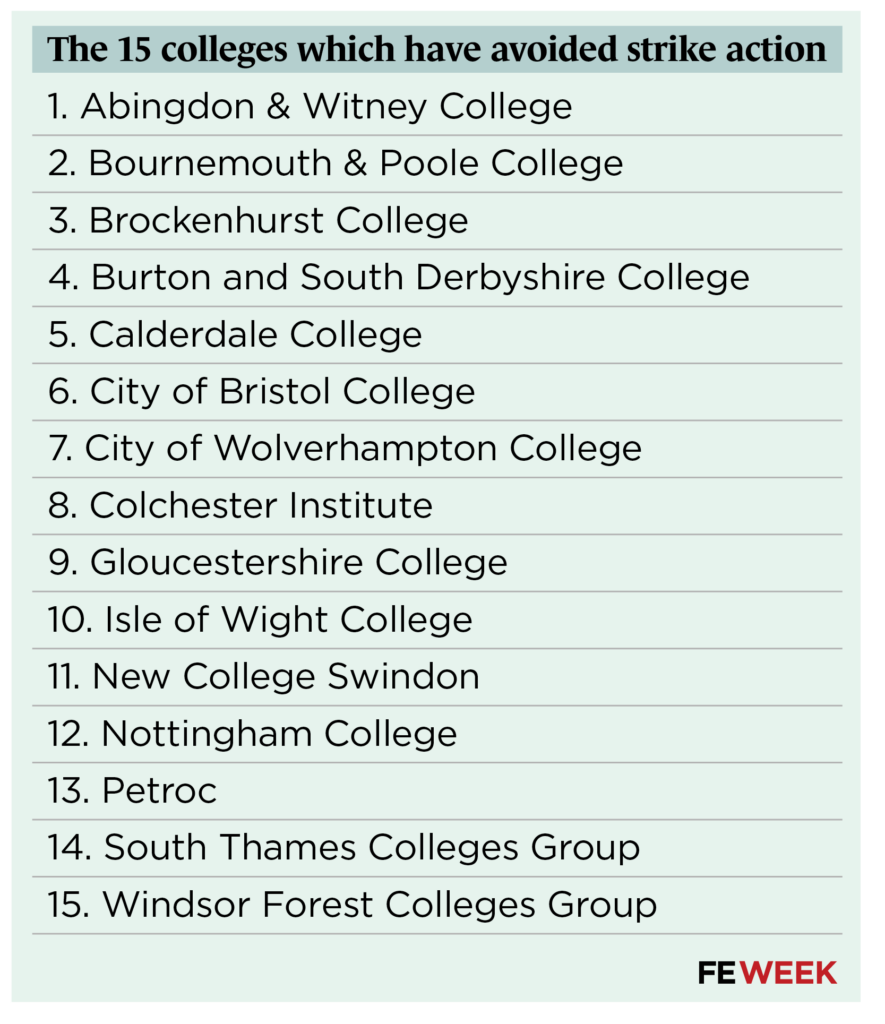
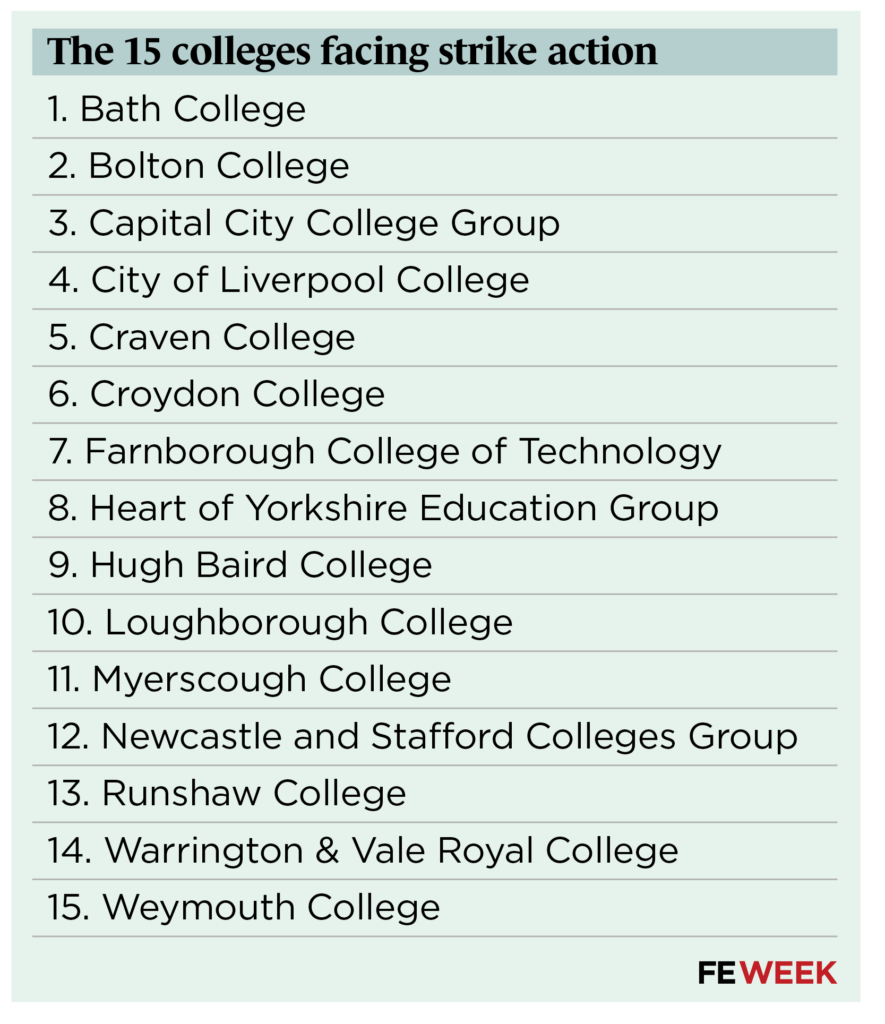
Our members have just voted ‘yes’ to strike action at 32 colleges in the fight for fair pay and conditions. Given the state of further education, this should come as no surprise. 

Pay has been held down so much that college teachers now earn £9,000 less than their counterparts in schools. Workloads are so high that staff say they are forced to work an average of two days extra each week, unpaid, just to keep up. 

After our ballot started, the college employer body the Association of Colleges (AoC) met with us and recommended a 6.5 per cent pay uplift. The recommendation confirms what we know: that after years of campaigning by UCU, further education is finally getting some of the funding it needs. 

Indeed, many employers can afford to offer much more than 6.5 per cent – and should do so.

Make no mistake, there is no chance the AoC would have put this offer on the table were it not for the pressure we are applying. However, there is one important difference between the 6.5 per cent pay offer accepted by teachers and the recommendation put forward by the AoC: colleges are under no obligation to implement the uplift. 

Each year we see many colleges failing to implement the recommended pay rises – even when these have been as little as one per cent. This is why, as well as a decent pay rise, we are demanding a new national bargaining framework for the sector with binding outcomes, so all staff get a pay rise.

So far, the AoC has failed to address workload concerns or make any concrete commitments to a new bargaining framework. Our members aren’t getting a fair deal, but college bosses have been splashing the cash elsewhere. 

From 2020-22 the amount spent on buildings and equipment jumped by 50 per cent, but money going to staff crept up by just one per cent. In 2022, college leaders increased their own salaries at quadruple the rate recommended to workers that year. One principal got a total package of over £360,000. 

The AoC accepts colleges face a staffing crisis, and far too many college staff are themselves in crisis. 

Our members aren’t getting a fair deal, but bosses are splashing the cash

They have told us that financial struggles are impacting their mental health, with many saying their pay cheque doesn’t even cover the bare essentials. We have reports of staff rationing their heating, skipping meals, and using food banks. This situation is completely unacceptable, and it‘s untenable. 

No worker should have to choose between eating and heating. Our members are entrusted to transform the lives of our young people and give adult learners a second chance at education, the very least they deserve is a salary that can pay the bills. 

Considering this situation, it is sadly no surprise that colleges have lost a fifth of their teaching staff since 2015. One member told us: “There is no hope, it’s a difficult job and even small treats like a meal with a friend are out of my reach. My debt keeps mounting and the only paths out of it seem to be further debt or starvation.”

Both Labour and the Conservatives have made clear in recent weeks that they want colleges to skill up the nation, but that can only be done if teachers’ pay and conditions are good enough to sustain their lives and stay in the sector.

It is also crucial that, in building a sustainable future, the sector is linked more explicitly with the green skills agenda. That’s why the formation of a transition commission for FE is a core bargaining demand in this year’s claim. This ballot result shows the strength of feeling amongst staff that urgent change is needed.

College bosses now need to meet with us, do the right thing and raise pay. Any that refuse to do so will be signing up to unprecedented industrial unrest. We hope they choose to work with us.