Skip to content
5 November 2026

Latest news from FE Week

Professional race teams visit Dearne Valley College to launch motorsports programme

Dearne Valley College (DVC) is launching a new motorsports programme.

The launch event, which took place on Thursday, welcomed a number of professional race teams and associations showcasing their vehicles such as; ‘Team Honeywell’ UK Uniroyal Fun Cup Winners, Max Lees Locost Championship Driver, the Motor Sport Association, Sheffield and Hallamshire Motor Club and Dukeries Rally.

New for September 2012, the Wath-based college is offering the new exciting programme that will look at the skills needed to compete in the world of motorsport.

Jon Barker, DVC programme area manager for engineering and technology, said: “This exciting new programme is ideal for any young person wanting to pursue a career in the motor industry.

“The practical skills gained will be put to good use with the sprint car project which is a first for the college.”

Pheasants meet their namesake at Sparsholt College Animal Management Centre

Sparsholt College Animal Management Centre has played host to a rather unusual re-union.

Amongst the college’s Pheasantry, the Himalayan Monal or Impeyan Monal Pheasants met Andrew Impey, the great, great, great, great grandson of Lady Mary Impey, who, in the 18th Century, the species was originally named after.

The big get together was the first time Andrew from Winchester had actually seen the bird which bears his family name.

The story dates back to the 18th Century, when Sir Elijah and Lady Impey, Andrew’s great, great, great, great grandparents moved to India following Sir Elijah’s appointment to chief justice of Fort William in Bengal.

At this time Lady Impey began keeping birds and wildlife in the garden of their mansion, commissioning drawings of her collection which actually include the earliest depictions of Indian species.

These drawings have been used by subsequent ornithologists to identify new species or new habitats for existing species.

Praise for Havering College designers

Up-and-coming artists from Havering College of Further and Higher Education received the ultimate accolade from one of the top interior designers in the world.

Martyn Lawrence-Bullard, a multiple award winning designer with A-list celebrity clients, has praised the talents of four students on the BA Fine Arts degree course. Los Angeles-based Bullard visited the college in Hornchurch, Essex, as part of a filming project.

He toured the college’s £6 million centre dedicated to the study of the creative arts and looked at the work of students on the BA Fine Arts degree course.

He said: “It is a joy to come to Havering College and see all this great creative talent.

“There is a fantastic style of work here. You can see that everyone has a great painterly essence. You can see they have studied the classics to move forwards.”

Painting and decorating students Sam Lucas (19), from Chigwell, Glenn Cooper (18), from South Ockendon and Brentwood resident Christian Davy (24), worked alongside a professional team to make Bullard’s creative vision for the apartment a reality.

Cornwall College Surf Science students recreate the last supper on Newquay beach

Cornwall College takes pride in having a classroom on the beach in Newquay but these students took the principle to the extreme when they literally picked up their desks and moved onto the sand, in the name of charity.

The Surf Science degree students decided to create a calendar as part of their Personal and Employability Skills Development module in aid of the Great British Junior surf team who are desperately trying to raise money to attend the International Surf Association (ISA) Junior World Championships in Panama next month.

And the star picture – a surfer’s take on Leonardo Da Vinci’s masterpiece The Last Supper.

Student Rachel Preston said: “We decided we wanted to create a calendar and we were looking at iconic surf images.

“We wanted something more recognisable so decided why not combine a surf shot with a picture everyone knows.”

Blackburn College hosts major collision

Students at a Blackburn College were given the opportunity to put the theory into practice during a mock-up of a major traffic collision.

FMG Support, the UK’s leading vehicle recovery resource, and the Highways Agency, hosted a Major Incident Day to provide the emergency services with a live practice of their emergency plans.

More than 40 Blackburn College students were invited to get involved as casualties and people trapped in the wreckage, complete with fake blood and injuries, as well as act as witnesses and members of the media.

Katie Rigby, Level 3 extended diploma in public services, said: “It was such an amazing experience.”

Darren Leen, from the Highways Agency and former Blackburn College Public Services tutor, added: “There is nothing of this scale and size in operation like this so it’s a unique exercise for the students and the spectators.”

On the move again to promote adult literacy?

How do we listen to people who have quiet voices?

As public funding of adult skills gets tighter and tighter there is a strong argument for making sure it gets spent both on the highest priorities and with positive impact. Rather than dictating what those priorities should be, the current policy is to make the ‘system’ respond to learner and employer demands. This is the driver for the UKCES employer ownership pilots which provide an opportunity for employers to have their needs met in the ways that help support them best.
It is also underpins the thinking behind many other developments, including the launch of the National Careers Service, FE Loans, freedoms and flexibilities for colleges and providers and the cutting of red tape. This Government has set out its stall: it wants empowered learners to drive the learning and skills which get delivered.

In a country (and a world) where power, resources and outcomes are all very unequal, we need to be wary that this vision for empowered learners does not simply result in those with the loudest voice scooping up the entire adult learning budget. It is not enough for learning to be funded which meets the needs of those already engaged and ignores those who could and need to benefit.

There are lots of scary statistics around; for instance, our Inquiry last year cited the Survey which found that 5.2 million adults of working age lack the literacy skills to enable them to function effectively in modern society (Work, Society and Lifelong Literacy, NIACE Inquiry Report, 2011). Only last week the BMJ published research that showed that poor literacy skills can mean you won’t live as long as you should.

Headlines like these can put more fear into people who are already anxious enough. So how do you reach people without scaring them? You don’t teach kids to read by frightening them.

The media has a significant role to play here.

On the Move, a television show made by the BBC in 1976, which I watched as a (very young) schoolboy, was aimed at adults with literacy problems. Written by Barry Took and staring Bob Hoskins (before he was famous) as a removal man, it had a massive impact, resulting in a surge in demand for adult education.

NIACE was involved then and has been again this last six months advising the BBC as it launches a new series of BBC Daytime dramas ‘Secrets and Words’ exploring adult literacy.

The five dramas start on Monday (26th March), running every day next week at 2.15 – 3.00pm on BBC1. To back this up, we have also been supporting a complete revamp of materials and resources on the Skillswise website to help teachers.

This is important work, reaching people who may not have the confidence, the information or the wherewithal to access the learning which could make such a difference to their lives. This partnership with the BBC and other work such as Adult Learners’ Week do make an impact, providing the impetus for some people to go to the local college, adult learning centre or library. Others will call the helpline which directs them to Next Step. Will they get the advice and support they need to progress? Will there be learning opportunities to meet their needs? Will the system meet their demands? Is the system fully prepared for empowered learners?

I sincerely hope that the system is ready for all learners and there is lots of evidence that people working in adult and further education want to deliver in ways which address equality issues.

But reaching out, designing learning which meets diverse needs and doing the extra work to support success is a tough call when resources are getting tighter. We all need to remain vigilant to make sure that even those people with the least powerful voices are listened to and their needs met. That would be real equality and empowerment.

David Hughes, chief executive of the
National Institute of Adult Continuing Education

Duke of York marches up to Newcastle-under-Lyme College for right royal visit

Newcastle-under-Lyme College (NULC) was given the Royal seal of approval when His Royal Highness the Duke of York paid a visit.

The Duke visited to help promote the work of colleges in providing apprenticeships, work-based learning and business skills development.

After meeting local dignitaries, His Royal Highness was given a tour of the college by NULC principal and chief executive Karen Dobson, accompanied by the Lord-Lieutenant of Staffordshire, Sir James Hawley.

He told students he hoped the college could help inspire them to “be more than you think you can be”. The Duke of York added: “I can assure all of you young people that you have a great deal more potential than you probably realise or understand.

“Over the last 10 years I’ve been doing a huge amount for British business and I will continue to do so, because I believe in it, and I also believe you young people are the future of it.”

Mrs Dobson said: “I’m very pleased that the Duke’s visit has shone a spotlight on the work that we are not necessarily well known for, in terms of our work for employers with apprenticeships and skills training.”

FE Week visits Poole for the launch of the Reed NCFE employability lab

L -R:  Lawrence Vincent, Bournemouth and Poole College , James Reed, from Reed and David Grailey, NCFE 

The unemployment crisis is a top priority for the coalition government.

With more than a million young people out of work, the focus is now increasingly shifting to the education sector, including FE, to help students successfully transition into the world of work.

A number of qualifications exist to try and help learners improve their employability skills, but very few actively engage with businesses and employers in the local area.

A new scheme by the awarding body NCFE, developed in partnership with Reed, was officially launched at Bournemouth & Poole College last week to show an alternative way of linking up students and jobs.

Lawrence Vincent, principal of Bournemouth & Poole College, introduced visitors to the new e-Lab facility, a series of classrooms designed to help learners search and apply for jobs.

“The e-Lab and our partnership with Reed NCFE is a radical new approach to employability,” Mr Vincent said.

“We have to face the fact that our sector is changing – these days we are being measured by how effective we are at placing our young people into employment.

“This is the measure by which we will be judged and expectations are high.”

The e-Lab has been open since January and registered more than 500 learners at the college.

We have to face the fact that our sector is changing – these days we are being measured by how effective we are at placing our young people into employment”

Students develop their CV and interview skills during the employability qualification, but can also speak to the Reed NCFE employment brokerage team about the type of work they’re ideally looking for.

The team, which consists of three full-time staff members, will then try and seek out job openings relevant to their qualification or area of interest, often by liaising with local employers.

The job brokerage service will also try and persuade the company to advertise the role exclusively through the college, before offering the position back to the learner.

Mr Vincent admitted in his opening speech that the college partnered with Reed and NCFE partly because his staff were ill-equipped to give advice on the current job market.

“We have about 1,000 dedicated staff here at Bournemouth & Poole College but about 90 per cent have been here for five years and 95 per cent have been here for ten or more years,” he said.

“As good as they are, they cannot, with the best will in the world, be in the best position to know what is required by employers of the students in the ever-changing world of work.

“It is an inconvenient truth that we do need help of the kind offered by partnerships with successful and experienced organisations such as Reed NCFE.”

Ryan Cooper, a student at the college studying electronics and engineering, was one of the first to register with the e-Lab.
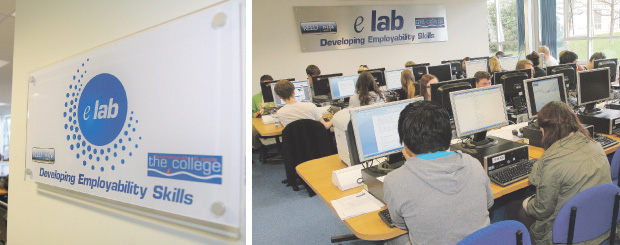
View on the way into the new brand new e lab facility |  Students working hard in the new e lab centre

He said: “Almost immediately after I registered and was introduced to my Reed NCFE advisor, the calls from potential employers started coming in.

“Within a few days I was actually offered a post which would give me work experience alongside my studies.”

He added: “The advisors are really supportive.

“This is a fantastic way to look for openings and It should be taken up by other FE colleges.”

Geoff Russell, chief executive of the Skills Funding Agency (SFA), was scheduled to give a speech on the morning of the launch.

However, Mr Russell was unable to attend due to illness, but gave the following comment: “This is an inspiring example of how FE is responding creatively, flexibly and dynamically to the demands of employers, learners and local communities.

“The REED NCFE Partnership and the college’s new e-Lab are clear evidence of how the FE sector is uniquely placed to help overcome the economic and social challenges we currently face.

“This initiative sends out strong signals to both employers and students that the right skills in the right place at the right time are the answer the economy needs.”

Steve Wentworth, a skills consultant at Bournemouth & Poole College, said that in the past local employers had been reluctant to take on British people.

The introduction of the scheme by Reed NCFE however, he said, was starting to change people’s perceptions of the college to one of being a reliable source of employment.

“If I’ve spoken to an employer in the hospitality sector about taking on a British person, I’ve had quite a negative response right away,” Mr Wentworth said.

The jobs tree brings colourful opportunity to the new e lab  |  L -R:  David Grailey, NCFE, James Reed, from Reed and Lawrence Vincent, Bournemouth and Poole College 

“But now we’ve got this, the Reed NCFE partnership with Bournemouth & Poole College, the interest has been incredible.”

He added: “if you look at the Reed brand with Bournemouth & Poole College, together that really does give some credibility to what we’re trying to do with the e-labs.

“That, along with the employability qualification, gives an added reassurance to employers which is just something they’ve never had.

“So I do think that overall we’re seeing a real shift in people’s perceptions.”

NCFE began working on the concept shortly before the Conservative party came into power, foreseeing youth unemployment and job outcomes as a high-level policy for both the Department for Business, Innovation and Skills (BIS) and the SFA.

The awarding body assigned Alistair Downes, director of business development at NCFE, to develop the model for six months before approaching Reed as a partner.

David Grailey, chief executive of NCFE, said: “If you look at the work Reed has done on Department for Work and Pensions (DWP) contracts, as well as for welfare-to-work, they’re one of the best performers.

“So we met with James Reed, as well one of his managing directors and we said to him, ‘we have this idea and we would like you to be our partners because you have not only the knowledge and experience of working in the education sector but also the recruitment expertise.’”

Mr Grailey said the scheme at Bournemouth & Poole College, which combines both an employability qualification and recruitment, is unique for the FE sector.

“The idea that you can take a learner and you can teach them to understand that if they have the right mind-set that can give them an advantage in the recruitment world and help them identify jobs which they want, as well as having the opportunity to track them while they’re in the job, that end to end solution, I’m not aware of any other on the market,” Mr Grailey said.

He added: “There are variations of the idea, but not many people are doing the specific qualifications around mind-set, which we think is critically important to making those learners competitive.”

James Reed, chairman of the Reed group of companies, said it was important the sector did more to prepare young people for work.

“The worst thing is that people leave college or school, go onto benefits and then we have to get them from welfare to work,” Mr Reed said.

“It’s far, far better that they go from college or school directly to employment, and that is what this is focused on doing.”


Learners get hands on with e lab facilities 

Learners enrolled on the BTEC Level 3 Extended Diploma in Applied Science, specialising in either medical science or forensic science, were using the e-lab facilities on the morning of the launch.

Bournemouth & Poole College has strong ties with the forensic science department at Bournemouth University, but also encourages students to think about their future job prospects.

Ellen Bryant, lead forensic science lecturer at Bournemouth & Poole College, (pictured above, centre) said: “I think they all thought they could leave here and all be qualified medics, so it’s been a real eye opener for them to strive for what they want and actually think ‘I really want to do this and this is what I need to do’.

“So it’s making the pathway for them much clearer.”

Students are told not only to look for traditional, highly specialised jobs in their field, but also ‘quirky’ openings which are still medical or forensic science related.

“They have also been writing their own job adverts, including the qualities they would look for in somebody they would want to employ,” Ellen added.

“I think that’s important for them so that they understand that when they go for an interview next year – even if it’s for University – they know the qualities and the first impression they would be required to show.”

Imogen Young, (pictured above, left) a student at the college studying BTEC Level 3 Extended Diploma in Applied Science (Medical Science), said: “I have looked at jobs in my own time but I think it’s good we get to do it in the college, because then we get more help with it.”

Tom Clarke, another student on the course added: “I can see how it will be useful for after we finish college and for people who haven’t already got a job, but I work part-time already, so in the short term it wouldn’t really help much.”

Forensic science and medical science are notoriously difficult industries to get into, and Mr Clarke says he does still appreciate the extra help from the college.

“There’s not a lot out there, so it could help a lot having this extra qualification,” he said.

“Having experience in knowing what’s going to happen will put us at an advantage to anyone else who hasn’t had the opportunity.”

Lawrence Vincent, principal, Bournemouth and Poole College

“I didn’t think I’d ever be a principal,” says Lawrence Vincent, who has been principal of Bournemouth and Poole College for the past four years, before adding: “I wasn’t a career academic.”

Although the sentiment is often banded around, with Vincent, a man who openly admits that he is happier away from of the spotlight, you get the impression he really means it.

But here we are, in the 51-year-old’s impeccably tidy – but modest – office where we find each other discussing his life’s work.

So how did it happen? How does a man who has the impressive and intriguing CV which includes a fleeting career in the music industry and work to help rehabilitate offenders in the USA become a principal?

It began for Vincent in Leeds, a city he is proud to say he is “born and bred” in, but one which he was keen to leave – and move away from quickly. “It was a hard city. I left Leeds as soon as I could,” he says.

Vincent attended Sherburne High School, but “didn’t enjoy” his time there, insisting that he “did okay and moved on” after his exams.

Despite disliking growing up in the city, Vincent still today holds a high affection for his beloved Leeds United.

Heading away from the city in the late 1970s, Vincent moved down to London where he studied humanities at Greenwich University.

“I enjoyed London a lot,” he says, adding: “I was pleased to be away from The North and doing something different.”

And it was while living in the capital that Vincent was able to develop one of his main passions in life; music.

We take public money and have fantastic resources so we should be more generous with our time, space and expertise”

Working at record store, HMV, he immersed himself in the New Wave movement and started promoting and managing young bands.

Although none went on to become huge stars, it was a time of his life that you sense he thoroughly enjoyed.

“It was interesting. I enjoy going to see bands play live. It’s a big part of my life,” he adds with a smile.

However, it was then that Vincent’s move into education began.

While working at a community radio station he became involved in “social issues and social problems” and shortly after he started as a youth worker in Thamesmead – an area which at the time suffered heavily in the recession.

“Through that, I started to get philosophical at people who weren’t achieving, rather than at those who were, and that defined my interest in teaching and in education,” he explains.

However, it was then that the opportunity came up to work in juvenile correction systems in Boston, Massachusetts

Although he knew it would be a challenge, he insists – as a man in his late 20s – it was something that he had to do.

“I was teaching English to kids who were mostly Hispanic. We had a lot of challenges. When people say the kids are difficult here, the benchmark I had was completely different,” he says.

Despite the many challenges, it was a part of his life which he talks about with great affection and thoughtful reflection.

He says: “America seemed like ‘the promised land’ so if you had the opportunity to go there, you would take it.

“Living there in your late 20s is a fantastic experience. It felt different to here. It felt a bit more exciting and rewarding.”

However, by the late 90s, he moved back to England after taking a job teaching at South Thames College.

“I didn’t find it easy to adapt in America; I missed London. I find London is full of good ideas for colleges,” he says.

As well as those ideas, Vincent brought back across the pond his own new ideas for how he could develop the sector.

“When I was in America, I was attached to a community college, so I brought back a real belief that colleges in the UK should become more involved in local communities and I’ve held that ever since.

“I fell in love with the college sector. They are fantastic, vibrant, interesting places,” he says.

However, ambition soon took over from the love affair with London in his heart when the opportunity came up to become the new head of department for social and community studies at Bournemouth and Poole College.

He would then swiftly become the college’s vice-principal and then – four years ago – he was named its principal.

“I was always feeling I could do the job of my line manager,” he says, before adding: “But this is enough for me; I have no great ambitions after this.”

Vincent then jokes about his desire to own a jazz club, but admits it is more of a pipedream then a realistic option.

And it is then that we move onto discussing his three children.

He tells me that eldest daughter Jordan is studying business management at nearby Bournemouth University, while his son Kit is studying music at his father’s college, before heading off to Sussex University next year, and his youngest daughter Mya is working hard towards her GCSEs next month.

Like-father-like-son, Kit is also in an up-and-coming band – he is the drummer for Kinnie the Explorer (Keen musician and FE Week head designer Dan Duke has played on the same bill as Kit’s band and gives them a top report). Vincent urges me to check them out as soon as I can when I get home.

But how does he balance the rigour of being a principal, with seeing his family, as well as finding time for his hobbies?

“The job of a principal is demanding and all engulfing, so you have to create an offer for this, and your time with your family, but you have to work at it,” he says, particularly when “there’s never been a harder time to run a college”.

He adds: “Expectations are increasing and changing.

“The way in which we have to be measured is changing and it will have a significant impact on us.”

He adds: “It’s a challenge to implement the recommendations of the Wolf Report, but I’m a devotee of Wolf.”

And what about the new college freedoms handed down from government? Vincent believes that it is the colleges who can “make sense” of them which will be the ones to “flourish” with them.

However, he does not think deregulation will lead to privatisation of colleges – as has been suggested in some quarters. “We need businesses to work with us, not control us,” he says.

Vincent is also delighted that his college is the first to sign up to the NCFE and Reed employability partnership.

“There’s a theme I’m developing here and that’s resilience.

“Colleges will have to be more resilient and we have to train students to become more resilient,” he adds.

But, what about the future for colleges?

Although he praises existing community work, including the ideas within the report released in November by Baroness Sharp, the chair of the Independent Commission on Colleges in their Communities, alongside NIACE and the 157 Group, Vincent says: “I think that we can go further.

“We take public money and have fantastic resources so we should be more generous with our time, space and expertise.

“We are developing enrolment, so local people use the facilities but don’t enrol on courses.

“So that’s like using our libraries and IT. We’ve even had elderly people who come in for hot meals. People say it’s not easy, but it is.”