Skip to content
30 September 2026

Latest news from FE Week

Commissioner visits first two local authority providers

The FE Commissioner has made his first two visits to inspect local authority provision, FE Week can reveal.

Dr David Collins visited Lancashire Adult Learning (LAL), run by Lancashire County Council, and Warrington Borough Council last month to review adult learning after grade four Ofsted inspection results.

The commissioner’s powers of intervention extend to FE corporations, designated institutions, and local authority-maintained FE institutions, but he had only previously inspected general FE colleges.

He visited LAL after the education watchdog’s report in December dropped the provider from good to inadequate.

Inspectors said: “Outcomes for learners have declined over the last three years from very high levels to around national averages.”

Following the Ofsted report, the principal of Lancashire’s outstanding-rated Nelson and Colne College, Amanda Melton, became principal and now splits her time equally between the providers.

Previous principal Joyce Dalton, who had been acting in the role, left at the end of August and the Ofsted report noted “the loss of senior management posts has not been managed efficiently”.

A LAL spokesperson confirmed the commissioner had visited and met with officials, but declined to comment further.

Warrington’s Ofsted report, also published in December and dropping the provider down from a good rating, found “key procedures for managing subcontractors’ work and improving the quality of teaching, learning and assessment are weak”.

Gareth Hopkins, assistant director for human resources at Warrington, said: “We have an action plan in place, which will be monitored by senior management to ensure that the necessary improvements are quickly made to get this service back on track. A number of identified issues have already been addressed.”

Meanwhile, Dr Collins has also made visits to several more colleges in recent weeks. City College Brighton and Hove was visited over financial concerns, as was New College Nottingham and Central College Sussex.

Greenwich Community College was visited after a grade four inspection result, which is the same reason he’s due this month at Barnfield College, which was visited by the FE Commissioner already last year over financial concerns.

comm


Niace and Inclusion merger casts jobs shadow

Staff at the National Institute of Adult Continuing Education (Niace) and the Centre for Economic and Social Inclusion (Inclusion) face an uncertain future with a possible merger on the horizon after the two organisations formed a “strategic alliance”.

Neither organisation said it could “rule out job losses or a name change” if the alliance, which entails shared resources and joint contract tenders, resulted in formal merger later in the year.

Niace chief executive David Hughes (pictured) told FE Week the move to form an alliance was part “exploring whether a more formal arrangement or even a merger is a sensible way forward”.

“It may or may not happen, but meanwhile we’re going to develop working relationships between our staff and that work starts today,” he said.

The alliance came into effect on February 2 and statements from both organisations said it would be “business as usual” over the coming months.

“In a world in which policy makers, Local Enterprise Partnerships and others increasingly talk about how to integrate employment and skills, we felt it made sense to bring the two organisations to work more closely together,” said Mr Hughes.

He said the shared “purpose, ethos and values” of 65-worker Niace, which is based in Leicester, and 20-worker Inclusion, based in London, meant the process of aligning the organisations’ work would be “simple”.

“Nobody else will be able to offer the same level of standing across the welfare, employment and learning and skills systems than we can combined, and that’s the driver behind this,” he said, adding that no decision on where a merged organisation might be based had been taken.

Inclusion and Niace have collaborated in previous years sharing research, but Inclusion chief executive Dave Simmonds said the alliance would mean they could achieve “a greater impact”. “Our strategic alliance will combine our expertise to offer more to our stakeholders,” he said.

“It will create exciting opportunities to deliver new services, more research and new ideas in the challenging times ahead.”

He added the partnership would be “focused on improving skills and employment support for everyone, but especially for those who need it most”.

The alliance will centre around five core areas — a united voice on employment, skills and lifelong learning, integrated, practical research and policy development, a new national events, campaigning and public affairs function, improving service and cost-effectiveness and developing the options for closer working.


Supporting part-time teachers

The Further Education Trust for Leadership (Fetl) has handed fellowship grants, worth up to £40,000-each, to four senior figures from the world of FE. Reporter Paul Offord spoke to Ann Creed for the fourth and final piece in a series of FE Week articles to focus on the chosen fellows.

Experienced project manager Ann Creed hopes her research for Fetl will help give part-time teachers more influence over how they are managed.

Improving the lot of teachers is an issue dear to her heart, as she has spent much of the last eight years working on projects geared toward boosting their professional development with organisations including the Learning and Skills Improvement Service, the National Institute of Adult Continuing Education and the Workers Educational Association.

Her research will focus on how different leadership styles affect the attitudes and wellbeing of part-time teachers who often have to work away from their employer’s main base.

She said: “What I don’t think has been addressed is whether there are more effective ways of leading those sort of people working in outreach locations.

Jill Westerman
Jill Westerman

“These part-time teachers may not have the same links to a particular provider as full-time staff and could, in fact, be working for two or three different providers within a locality on a part-time basis. They could be getting pulled in different directions by different employers.”

Ms Creed said her research would aim to identify what outreach teachers think about leadership and “see what ways of leading supports them best to deliver high quality teaching and learning”.

She added: “The whole purpose of my research will be to give teachers a much stronger voice in leadership, rather than focusing on management issues which is where thinking is usually confined.

“The majority of the FE teaching workforce is part-time and their activities with students and the outcomes achieved are the foundations of the sector’s success.”

Jill Westerman CBE, chair of Fetl, said: “The role of part time tutors often working across a number of organisations and a wide geographical area is a key leadership concern facing many organisations today. We feel Ann’s research will contribute greatly to the leadership of thinking in this area.”


Careers advice hotline brought under one roof

Careers advice hotline services for young people and adults are to be brought under one roof after Serco was awarded a £6m Skills Funding Agency (SFA) contract to deliver both.

Serco, which previously ran the National Careers Service (NCS) advice line for adults, will also take up the service for young people, previously delivered by BSS.

Serco’s existing contact centre in Newcastle will expand to take on the new work, with a total of 118 staff, with workers from the BSS sites in Leicester and Manchester having been offered posts.

Both BSS and Serco, which has an initial contract for three years with the option of a two-year extension, achieved grade two Ofsted ratings for their services.

A Serco spokesperson told FE Week: “All BSS employees were offered a TUPE transfer to Serco. A number of employees found new jobs elsewhere.

“The employees who transferred have decided not to take up the roles on offer due to location. We have offered them support in terms of finding alternative roles and they will also receive a financial package.”

Sean Hanson, managing director of Serco’s public sector outsourcing business, said: “I am delighted and excited to be extending our partnership with the SFA to provide careers advice and information for the NCS.”

The new centre is expected to be accessible seven days a week and 14 hours a-day on telephone and online.

Joe Billington, NCS director, said: “We’re delighted to be working with such an experienced service provider as Serco to ensure users receive the best possible service.”

An SFA spokesperson said the contract had been awarded following a “competitive procurement process”. She said: “This is part of an integrated approach to the delivery of careers information and advice to young people and adults in England.”

Jan Ellis, chief executive of the Careers Development Institute (CDI), the professional body for careers advisers, said: “Congratulations to Serco. We’re really delighted that it’s going to be delivering personalised support and inspirational career guidance.

“And the CDI would hope that people providing the service are qualified to do so and are members of the CDI.”

The CDI sits on the advisory board of the new careers and enterprise company, proposed by Nicky Morgan in December to provide links between schools and employers — but Ms Ellis said the two services would be “completely separate”.


Outstanding London provider achieves top marks across the board from Ofsted

East London Advanced Technology Training (ELATT) has scored top marks across the board to secure a grade one rating from Ofsted inspectors.

The ‘outstanding’ report on the provider, which has 260 learners, was published today (February 20).

ELATT, which received a grade two rating following its last inspection in April 2009, achieved top marks in all the main headline field this time around — for ‘outcomes for learners’, ‘quality of teaching, learning and assessment’ and ‘effectiveness of leadership and management’.

Anthony Harmer, chief executive of ELATT, said: “Our outstanding result reflects the

efforts and commitment of our staff and governors who work tirelessly to give people the

support, knowledge and ability to find new opportunities for establishing brighter futures.

“This is a fantastic achievement and we are delighted to be officially recognised as being an outstanding education provider.

“Our staff have a consistent dedication to the success of our learners and our programmes are tailored to meet the educational needs of people from all walks of life.

“Inspectors applauded our imaginative and effective programmes and initiatives.

“We will continue to sustain our inspirational teaching and strive for even higher standards by maximising our affiliations with employers, other charities and voluntary organisations. I am extremely proud of everyone that has contributed to this significant achievement.”

The Oftsed report praised impressive leadership at the provider, which runs courses for example covering web design, computer engineering, office skills, pathways to care, English and essential skills, and work skills and employability from entry to advanced level.

It said: “Outstanding leadership, with very good support from trustees and full commitment from a remarkably dedicated staff, ensures that ELATT’s aims of helping the disadvantaged are fulfilled.”

It added: “ELATT leaders provide innovative training and personal development programmes which are carefully aligned with local employment opportunities, more aspirational opportunities in the City of London and with meeting local community needs, such as a ‘welcome club’ which helps migrant women socialise, improve their English and be introduced to further learning.”

The report said that “excellent personal support from teachers, specialist staff and fellow learners all help to increase learners’ self-esteem, as well as instilling in them a desire to succeed in training and improve their personal circumstances”.

It said success rates were “outstanding” for information and communication technology courses and “very high” for all other courses and programmes.

“The pace of learning is particularly good and learners are successfully encouraged to work at higher levels than their previous qualifications and experience would suggest,” the report added.

“Lessons are not only extremely effective in improving learners’ knowledge and skills but are also filled with humour and laughter.”

Pic: ELATT staff celebrating after hearing about the outstanding Ofsted report

Ofsted halving number of FE reports per year

Ofsted has announced plans to halve the number of times it publishes official FE statistics to two a year in response to a month-long consultation.

The consultation, which opened on August 11 on the education watchdog’s website, received 22 responses — 73 per cent of which agreed with the proposal to reduce the number of releases to two a year.

In its response to the consultation, Ofsted said: “As a result of the responses, we will reduce the frequency of our FE official statistics.

“In conjunction with this, we will publish monthly management information that will provide a frequent and timely snapshot of inspection judgements throughout the academic year (September to August) to date.”

The last quarterly official statistics were published in December and the first bi-annual report will be released in June, with the next due in December.

The monthly management information will include provider-level data on judgements in areas such as apprenticeships and 16 to 19 provision, as well as a breakdown of subject area judgements as well as key findings on the sector as a whole.

However, the “snapshot” will not include learner information, performance data and success rates or examples of
good practice.


Unionlearn rejects Labour apprenticeship policy as AELP looks five years ahead

Labour proposals to abolish level two apprenticeships were rejected by Unionlearn at the Association of Employment and Learning Providers (AELP) 2020 Vision conference.

Tom Wilson, director of the education wing of the Trades Union Congress (TUC) told audience members in London’s Congress Centre that plans would be a “grave injustice”.

“We do not think that level two should be abolished,” he said on Thursday (February 19).

“I think that would frankly be a grave injustice to the thousands and thousands of apprentices who’ve currently got level two.

“Of course, everybody aspires to level three, we aspire to level three, wouldn’t it be great if level three become the norm?

“But the way to do that is not just to abolish at a stroke level two, it’s to work with employers, work with unions, work with the sector bodies and try and create that sense of progression.”

He described his comments as “a plea for a bit more nuancing and a bit more care in how these issues are expressed”.

Stewart Segal, AELP chief executive, also blasted the policy, saying Labour had “got it all wrong”.

“All this talk of higher apprenticeships is great,” he said.

Delegates listening to speakers

“But at the same time they’re talking about getting rid of level two and this has to be a ladder of opportunity and in my view it should start at level two.”

The role of apprenticeship providers in ongoing reform discussions was also hot topic as the conference — aimed at examining the future for learning providers over the next five years — opened.

Mr Segal outlined his key issues with the reforms, which have seen apprenticeship standards redesigned by trailblazer groups of employers, and proposals to route funding through employers rather than providers.

“I’m trying to separate the trailblazer and standard issues from the funding issues,” he said.

“We did need to refresh the frameworks — in fact we’ve been putting off doing it for the last few years because we knew something big was coming.”

He said AELP “absolutely” supported the principals of the 2012 Richard Review of Apprenticeships, which laid the groundwork for the reform proposals.

However, he said: “I want to see employers getting control of funding — but not getting the actual pound notes through their bank account, that’s where we have the issue.”

He went on to acknowledge that government was beginning to pay more attention to training providers’ concerns.

“We’ve made our views clear, we hope that if we can work together with all stake holders with all the sector experts we could find the model that will drive that growth that all the political parties have committed to,” he said.

He was followed by Skills Funding Agency (SFA) director of apprenticeships Sue Husband.

“The apprenticeship reforms are crucial in ensuring that apprenticeships are fit for purpose to support the skills system now and in the future,” she said.

Skills Funding Agency and Education Funding Agency chief executive Peter Lauener

“Key to these important changes are making sure that employers are in the driving seat and can shape the competencies required in a successful apprenticeship.”

She added: “The role of training providers is vital for apprenticeships both now and in the future.

“Training providers are expertly placed to step up and influence the future. Your involvement and your voice are crucial.”

The attention turned to Local Enterprise Partnerships in the afternoon with the conference coming just days after the SFA released a document detailing how it planned to increase their influence on skills budgets.

Mr Segal told FE Week this could have a particular impact on his members.

“There are issues for national providers who are delivering locally in multiple Leps. The processes for local links have to take into account that providers and employers often operate across many different Leps,” he said.

“Because of the way that independent training providers are funded by the SFA, ie funded on delivery in response to local employer demand, we are confident that their provision is meeting local economic needs.”

And in a panel discussion at the close of the conference, Mr Segal warned against an overemphasis on localism.

“There has to be a balance between national programmes and the benefits you get from that — being high profile, everybody knows where they stand, everybody has access to it — and then local influence on that national programme,” he said.

“When you’re looking at a core programme like apprenticeships, traineeships, work programmes, they should have some standardisation so everybody knows where they stand, and then if locally that group of organisation can enhance and improve that position then that’s great.

Delegates consider the views of what the next five years might look like

“If it doesn’t look like it’s going right, those national programmes should be challenged by those local organisations, but it’s not about having your own one — we’ve all come from a time when we were involved in Training Enterprise Councils and we had 74 different systems, I don’t think we want to go back to that.”

South East Midlands Lep (Semlep) chief executive Daniel Mouawad said: “We don’t want to be controlling the funds but we certainly want to ensure that we bring the right influence on where the funding goes to ensure that we close the skills gap that is clearly opening up in our labour market.”

Peter Lauener, chief executive of the SFA, sought to reassure providers about the document.

“The main mediation needs to happen between colleges, providers and Leps without SFA getting in the way,” he said.

“The document is about a direction of travel and trying to establish the importance of the Lep relationship, about trying to clarify rules and responsibilities.

“I don’t think people should read into it too much as a definitive fully mapped system, but the devolution agenda is important, its powerful, it’s not going to
go away.”

Main pic, from left: Unionlearn director Tom Wilson, AELP chair Martin Dunford, AELP chief executive Stewart Segal, Skills Funding Agency director of apprenticeships Sue Husband and Professor Bill Lucas, of the Centre for Real World Learning

Throughout the conference delegates had the chance to vote on the issues being discussed. Here’s how the voting went:

Question: How concerned are you about the trailblazer process?

Answers: very concerned — 33 per cent, a little concerned — 57 per cent, fine with it — 8 per cent, and not concerned at all (it will improve the apprenticeship programme) — 2 per cent.

Question: How do we increase the number of traineeships?

Answers: a greater commitment from local job centres to make referrals — 23 per cent, allow all providers access to the programme —18 per cent, improve careers advice offered to young people — 50 per cent, and simplify the contracting process — 9 per cent.

Question: What role should Leps perform?

Answers: improving labour market information — 58 per cent, co-ordinating delivery on the ground — 14 per cent, direct contracts with a Lep — 6 per cent, influencing and monitoring national contracting — 22 per cent.

————————————————————————————————————————————–

Conference-goers have their say


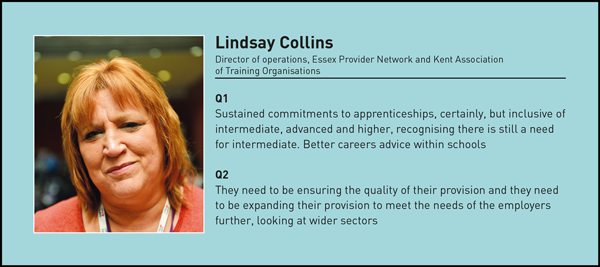
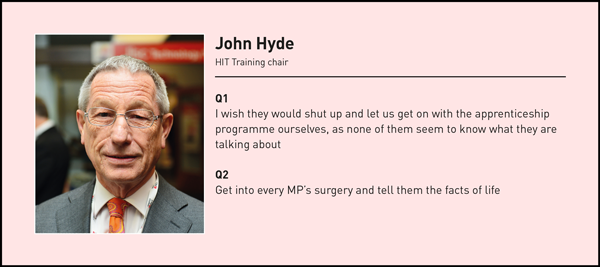
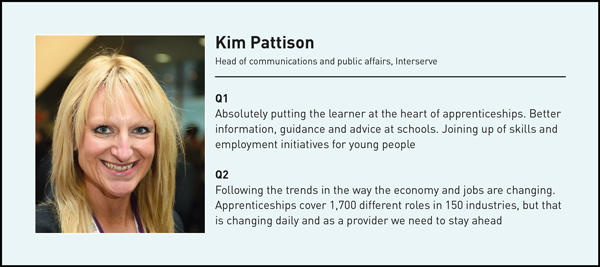
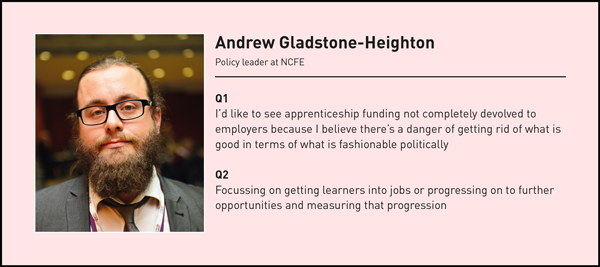
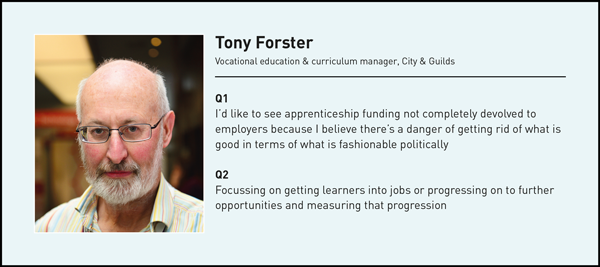
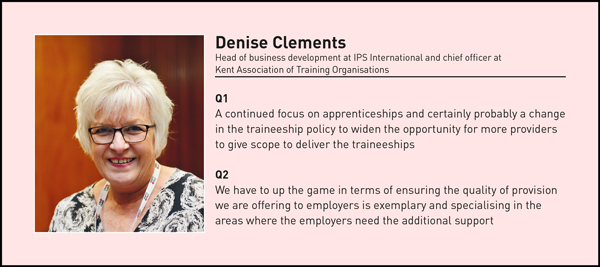
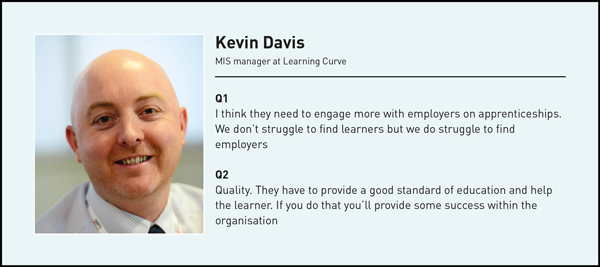
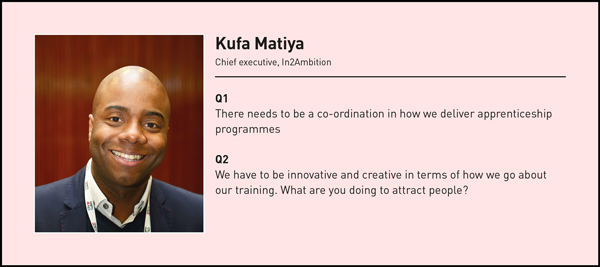
FE Week reporters Rebecca Cooney and Sophie Scott hit the AELP conference floor to meet delegates. They asked them (Q1.) what would you like to see all political parties include in their manifestos for the general election? They also asked (Q2.) what is it important for providers to be doing to ensure their survival to 2020 and beyond?
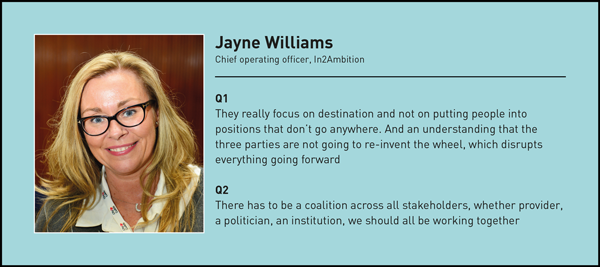
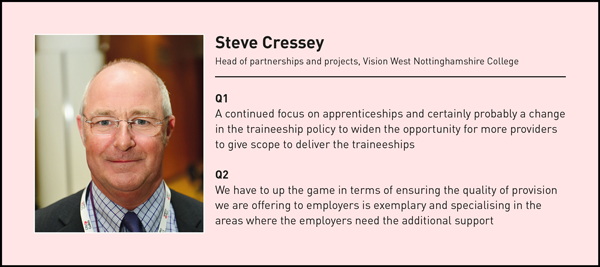


Voxpops-1

Voxpops-2

Voxpops-3

Voxpops-8

Voxpops-5

Voxpops-6

Voxpops-9

Voxpops-4

Voxpops-7

Voxpops-10

Untitled-3


Report calls for apprenticeships to be ‘re-made’ to meet new outcomes

Apprenticeships should be “re-made” to give learners expertise, resourcefulness, craftsmanship, business-like attitudes and wider skills for growth, according to a report by the City & Guilds Alliance.

The Alliance has released its report Remaking Apprenticeships (pictured inset above), written by Professor Bill Lucas and Ellen Spencer of the Centre for Real-World Learning at the University of Winchester, which sets out five key recommendations (see below) for government, employers and providers so apprentices can reach six “outcomes”.

The report calls for a shift in focus to improve teaching and a debate about the pedagogy of apprenticeships, along with accessible guidance for employers and providers on teaching and a push to ensure government documents include references to pedagogy.

Kirstie Donnelly, UK managing director of City & Guilds (pictured above), said: “We firmly believe now is the time to remake apprenticeships and that, if we take the right approach and embed learning and assessment at the heart of an apprenticeship, as well as ensure they are designed to meet employers’ needs, we can ensure the UK’s apprenticeship system can compete with the very best on the world stage.”

“This timely report is launched in the run up to a general election where both Labour and Conservatives have promised a huge increase in the number of apprenticeships.

Stewart Segal
Stewart Segal

“It proposes a series of practical tools to enable government and the vocational educational sector to work together to rebuild apprenticeships to ensure they become a top choice for both learners and employers in the future, equal to other learning routes in a status.”

The City & Guilds Alliance also includes the 157 Group, the Association of Employment and Learning Providers (AELP) and the Centre for Real World Learning.

Stewart Segal (right), AELP chief executive, said: “Apprenticeships are now at the centre of skills development in the UK and therefore this report reinforces the message that high quality work-based learning is the most effective way forward.

“The report makes clear that both on-the-job and off-the-job learning should form a core dimension of an apprenticeship because the combination can help produce the desired job expertise, functional literacies and business-like attitudes required in a modern economy.

“We hope that the new standards being developed under the apprenticeship trailblazers will incorporate the report’s key recommendations.”

Colleges ‘not meeting employer needs’ on digital skills, Lords warn

Further education colleges are failing to meet employer needs when it comes to digital skills, an influential group of Peers has warned.

In its latest report, Make or Break: The UK’s digital future (pictured below right), the House of Lords digital skills committee claimed that although the FE sector was “best placed” to respond to England’s digital skills gap, colleges needed to “move up a gear”.

In its report out today, the committee said FE colleges were already “well-placed to link local people with training and jobs”, but that evidence showed that there were “pockets of excellence in the FE system, but provision is patchy, unresponsive and not meeting employer needs”.

Committee chair Lady Morgan (pictured), a Labour peer and former chair of Ofsted, described the report as a “wake-up call for whoever forms the next government”.

The report said: “There is an urgent requirement for comprehensive industry input into the FE system. The government should encourage strong partnerships between industry and colleges. Training delivery must be revamped.

“FE colleges need to move up a gear and provide industry-designed and endorsed short courses that are going to lead to a job.”

The report is based on months of evidence-gathering, and includes testimony from business leaders including Siemens skills partner Martin Hottass and City & Guilds chief executive Chris Jones, along with Skills Funding Agency apprenticeships boss Sue Husband, Skills Minister Nick Boles and FE sector leaders, academics and others.

It said skills cash, controlled by the Skills Funding Agency, was “not presently targeted sufficiently to improve the capacity of the UK’s workforce and grow its economy”.

It called for a greater focus on “short, more flexible courses”, and for money to be diverted to making them happen, but it did not go into further detail about how much funding should be re-allocated.

It added: “Provision is cumbersome and slow to adapt. There is a clear opportunity for the government here, to join-up industry, FE and funding.

“The government’s proposals to improve FE will not have the desired effects without an overhaul of the funding system.”

The report said apprenticeships could help “plug the short and medium-term skills gap”, adding: “We believe 16 to 19-year-olds must be targeted by employers, teachers, and careers guidance professionals to enable them to choose and take up good apprenticeships. There is also a need to tackle negative perceptions of vocational education among schools, teachers, head teachers and parents.

“Including a digital element in all apprenticeship schemes, as well as offering more digital apprenticeships for specific technology occupations and sectors (taking into account the predicted changes to the labour market), could improve general digital skills.”

It said: “There is widespread support for the expansion of apprenticeship programmes, but the UK’s interests and ambitions need increased scale. There are not enough apprenticeships in digital subjects or apprenticeship schemes with digital featuring as an important element of content. Apprenticeships need to be seen as a viable alternative to higher education and the more traditional education routes.”

Lady Morgan said: “This report is a wake-up call to whoever forms the next government in May. Digital is everywhere, with digital skills now seen as vital life skills. It’s obvious, however, that we’re not learning the right skills to meet our future needs.

“Our overwhelming recommendation is that the incoming government creates a digital agenda, with the goal of securing the UK’s place as a leading digital economy within the next five years.

“Digital skills can no longer be dealt with by individual departments – this must all join up. We urge the new government to create a cabinet minister post to steer this digital agenda through.”