Skip to content
29 September 2026

Latest news from FE Week

Barnfield looks for ‘new partners’ after academies split rubber-stamped

Barnfield College is “looking to forge new relationships” with partners in the education sector after Whitehall rubber-stamped its split from a chain of academies and studio school.

Skills Minister Nick Boles officially approved the break-up of the Barnfield Federation, which means the Barnfield Academy Trust and Barnfield College, its original sponsor, are now separate entities.

The decision brings to an end more than seven months of uncertainty since the proposed split was announced last June, and a particularly troubled period for the college, which became the first FE provider to expect a second full visit from FE Commissioner Dr David Collins after Ofsted described it as “inadequate” in January.

It comes more than a year after the Skills Funding Agency and Education Funding Agency both published critical findings of their investigations into the federation and after Dr Collins called for at least half the governors to be replaced and for “significant changes” to the federation’s leadership after his first visit last January, triggered by financial concerns.

Tim Eyton-Jones, the new principal of Barnfield College, said the college was looking for new partners, but did not say whether he meant other colleges, schools or other providers.

He said: “We are looking to forge new relationships with all partners in the education, learning and skill sector so that collectively we can meet the needs of local learners, communities and employers.

“We have implemented a series of strategies at the college focused on reclaiming the excellence in teaching, learning, outcomes and destinations Barnfield College was once renowned for.”

Barnfield Academies Trust, which is made up of Barnfield South school, Barnfield West school, Moorlands Free School, Barnfield Vale school and the Barnfield Studio School, has also spoken of its efforts to move on from the federation.

Trust chief executive Andrew Cooper said: “Today’s announcement is the news we’ve all been waiting for.

“There have been issues and challenges in recent times, but from today it’s a brand new start for us. This is fantastic news for teachers, parents and most importantly the children and students we teach in our two primary schools, two secondary schools and studio school.

“The ministerial permission to go it alone demonstrates a huge vote of confidence in the great work already being done in our five schools. We share that confidence — we are all incredibly excited about this fantastic opportunity.”

Mr Cooper said the trust would change its name in the future.


Numeracy and literacy not just learner issues

The FE sector has to face up to low levels of literacy and numeracy among staff if it wants to improve learners’ maths and English, an Ofsted official has warned.

Marina Gaze, Ofsted’s deputy director for skills and FE made the comments at the BKSB Skills Conference focussing on English and maths.

Ms Gaze’s comments found support from the other members of the panel gathered at Leicester City Football Club on Tuesday (March 3).

Naomi Nicholson and Stewart Segal

In August, it became a condition of funding for all learners who had not yet achieved A* to C GCSE English and maths by the age of 16 to continue to study these subjects as part of their 16 to 19 education.

Ms Gaze argued one of the best ways to teach good literacy and numeracy was to embed it into other subjects, as well as offering English and maths classes.

However, she said, this created problems when staff had their own issues with literacy.

“I often see absolutely brilliant vocational tutors who can do the most amazing things, have the most fantastic skills, but their use of English is weak,” she said.

“So because if staff don’t have skills themselves, they can’t help learners improve their own skills.

“So I think we have to be honest as a sector about the staffing issues we face.”

Ms Gaze added the solution to issues with literacy and numeracy for both staff and learners often came from leadership.

“At Ofsted, when we see maths and English working well there is always somebody senior with responsibility for it,” she said. “It has to be led from the top.”

However, many panel members and delegates pointed to issues with recruiting and retaining staff to teach English and maths.
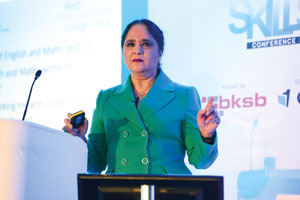
Asha Khemka
Asha Khemka

Dame Asha Khemka, principal of West Nottinghamshire College, said: “Recruiting the right people to teach English and maths and upskill is still an effort, but we need to do more of that.”

She added that the college had recruited more English and maths graduates recently as a result of the ‘golden hello’ bursaries offered by the Education and Training Foundation (ETF).

But, she said: “Retention is an issue. Do you know what? There’s no correlation between how much you pay people and how you retain people. It’s about motivating those people, and nurturing them and recognising them.

“It is a problem, you have to work at it, you need to skill and reskill people constantly so people are being supported to do a better job.”

Association of Employment and Learning Providers chief executive Stewart Segal said constantly changing government policy didn’t help with staff retention.

“It’s about making sure that what you’re teaching is respected so that your teachers get respect,” he said.

“Every minister says, we’ve got to improve — I know we have but what it suggests is that what we’ve been doing so far is not good enough.

“They’ve got to listen to what people are struggling with and build on what’s good and we might have a chance of convincing people that what they’re doing is recognised.”

One audience member, who provided training in the Royal Air Force (RAF), explained all their apprentices were required to take Functional Skills as many had not come straight from school.

Delegates in  the Ideas Exchange question and answer session
Delegates in
the Ideas Exchange question and answer session

This meant, she said, many learners were forced to take level two Function Skills qualifications, despite operating at level three.

Naomi Nicholson, director of strategic relationships for vocational qualifications at Ofqual, said level three Functional Skills had thus far not been developed because “the idea was that level two was the functional level”.

However, she pointed to the ETF review of English and maths qualifications currently underway. and due to report at the end of March, and said: “It would be interesting to see whether they might have any views on that or if other people say there’s a need for it.”

A Department for Business, Innovation and Skills spokesperson told FE Week: “We are not intending to introduce a new Functional Skills qualification at level three at this time.

“We have commissioned the ETF to carry out a review of English and maths qualifications outside of GCSE, and whether these suit employer and learner needs. We will consider any recommendations it makes.”

From left: Beej Kaczmarczyk, director, Learning Curve Group, Asha Khemka, Vic Goddard, principal, Passmores Academy, which featured in Channel 4 TV show Educating Essex, Naomi Nicholson and Stewart Segal


Fraudster poses as principal ordering urgent payment

A fraudster posing as a London college principal has been foiled in the latest in a string of attempted scams to hit the sector.

Finance staff at Westminster Kingsway College received an email, purporting to be from principal Andy Wilson (pictured), instructing them to make an urgent payment.

However, despite the email appearing to be genuine, staff noticed the reply email didn’t match the principal’s email address and checked with Mr Wilson himself.

A spokesperson for Westminster Kingsway College told FE Week: “The college can confirm that it received a fraudulent email asking for a payment which was flagged immediately.

“The college has rigorous procedures and checks in place, which prevented any scam from happening and the college was not put at risk.

“This issue has been reported to the Action Fraud helpline and we are cooperating with any further investigations.”

The incident follows a series of similar attempted cons across the FE sector since the beginning of the year.

In January, at least eight colleges, including the College of Haringey, Enfield and North East London and City of Southampton College were targeted by a conman, calling himself Brian Hall, who phoned claiming to be a bailiff on the way to the college to collect £7,000 which he said was owed to a fictional company.

He then attempted to con money out of the college, saying he could get a temporary suspension order — if the college hand over nearly £4,000.

FE Week understands no college handed over any money and the case is currently being investigated by Greater Manchester Police.

Con artists tried their luck again last month when the Colchester Institute received a letter purporting to be from ISG, the building contractors constructing the college’s new £5.8m buildings.

The letter said the contractors had changed their bank account details — but when the college checked with the company, the letter was found to be bogus. Colchester institute financial controller Tanya Ellingham, who was part of the team that outwitted the fraudsters said they would have got away with “big money” if the con had not been noticed.

FE Week understands the Colchester Institute case has been handed over to Kent Police for investigation.


FE college UTC heads out of special measures

A University Technical College (UTC) which had to be rescued by its local FE college after a damning Ofsted report could be on its way out of special measures, inspectors have said.

A monitoring visit report on Central Bedfordshire UTC came out on March 2, revealing it had made “reasonable progress” since an inspection in March last year resulted in an inadequate rating and special measures.

The revisit was the third since the full inspection, which found learning was “not secure” because teachers “do not always check students’ understanding or how well they have developed skills in lessons”.

Following the initial Ofsted report, published in June, then-Education Secretary Michael Gove asked nearby Bedford College to step in as sponsor for the 150-learner UTC.

The latest monitoring report said: “The quality of teaching is steadily improving. Teachers’ subject knowledge has strengthened. Whereas previously not all teachers were teaching their specialist subject, this is no longer the case. Students have more confidence in their teachers.”

It added: “Students typically display positive attitudes towards their learning because teachers have become more skilled at meeting their needs when planning for learning.”

It also praised the support Bedford College had offered the UTC, saying it had been “successful” in strengthening the quality of teaching.

Central Bedfordshire UTC head teacher Lesley Glover (pictured) said: “Improvements are being made since Bedford College became involved with the UTC.”

The news comes as the Baker Dearing Trust, which oversees UTCs, announced it would be establishing a new UTC in Newcastle.

Northern Futures UTC will specialise in IT and healthcare science and is so far is the only UTC due to open in September 2017.

There are 30 UTCs currently open, and 13 more are due to open in September, with a further 14 in September 2016.

Baker Dearing Trust Chair Lord Baker said he was “delighted” by the announcement.

He said: “Our challenge now is to ensure that young people and their parents have access to the information and advice they need to take advantage of this exciting and important technical provision.”

For groups wanting to apply to open a UTC, there is expected to be an application round later this year, closing in October.


Back to the drawing board on merger as financial rescue plan rejected

A Hampshire sixth form college has had to go back to the drawing board in its search for a partner with Sixth Form College Commissioner Peter Mucklow having warned it could not function alone financially.

Totton College principal Mike Gaston (pictured below, left) announced in December that his college would be seeking a partnership and Eastleigh College had emerged as a favourite.

But Eastleigh rejected the move this month following a governors’ board meeting.

A Totton spokesperson told FE Week: “Eastleigh College has been in discussion with the Education Funding Agency [EFA] regarding merger with Totton College.

“They have now had the opportunity to model the impact of a closer relationship and following their recent corporation board meeting have decided not to proceed.”

Mr Mucklow visited the 3,000-learner Totton College, which was deemed by Ofsted to require improvement a year ago and has an EFA allocation of £5.4m, in October after concerns were raised about a lack of improvement since it was issued with a financial notice to improve.

He warned the college, which also runs adult provision with a £2m Skills Funding (SFA) allocation and through subcontracting, faced an “immediate” crisis with the SFA seeking to claw back funding allocated for 24+ apprenticeships never delivered.

In response, Totton had been in talks over a potential merger with 14,000-learner and grade one Ofsted-rated Eastleigh College, also in Hampshire, which has a current SFA adult skills budget allocation of £16m.

The Totton spokesperson said, having missed out on the Eastleigh merger option, it was working the EFA “to agree a solution that is considered to be in the best interests of its students and our community”.

“We have been advised by the EFA to continue recruiting for September 2015 intake. It’s important to highlight that meeting students’ needs will be at the heart of any decisions. We are still looking for a partner to realise the college’s ambitions for future stability and growth,” she said.

A spokesperson for Eastleigh College said: “In any merger situation we would want to deliver the same outstanding level of provision for learners at all the sites while achieving the necessary economies of scale.

“We were unable to see how this would be possible in this instance. Therefore we have now withdrawn from the Totton College process.”

A DfE spokesperson said: “We are aware that Totton College’s preferred partner has withdrawn. The EFA is now working with the college to agree a solution that is in the best interests of its students and the community.

“Discussions are still ongoing and it would be inappropriate to comment further at this stage.”

David Igoe (pictured below, right), chief executive of the Sixth Form Colleges’ Association, said: “It’s sad to see another sixth form college get into financial difficulties and not table to find a suitable partner to aid its recovery.”

He added: “This college’s plight highlights the general problem which we have been at pains to point out to Government, that the funding settlement for 16 to 19 is insufficient for many colleges to continue to offer the kind of education that young people need.

“We need a fundamental review of the way all state education is funded to ensure that young people at every stage and age gets the educational opportunities
they deserve.”


Skills Minister admits ‘no plans to promote new SFCs’

Skills Minister Nick Boles told the House of Commons the government has no intention of “promoting the establishment” of new sixth form colleges (SFCs).

Labour MP Kelvin Hopkins, chair of the all-party parliamentary group for SFCs and vice-chair of governors at Luton Sixth Form College, asked Mr Boles if he supported opening more SFCs during education questions on Monday (March 2).

Mr Boles replied that while the government had backed the creation of new sixth form schools, “we do not currently plan to promote the establishment of more sixth form colleges”.

He said SFCs were “generally fantastic institutions producing great results, but I disagree… on this obsession with particular forms and structures”.

James Kewin, deputy chief executive of the Sixth Form Colleges’ Association, told FE Week: “It is this obsession [with structures] that has seen the inexorable rise of more expensive and less effective free school and academy sixth forms, while the number of sixth form colleges has continued to decline.”

He added the government could afford to stop charging SFCs VAT, while schools and academies get a 20 per cent refund, if it stopped “lavishing money” on school sixth forms.


Apprenticeship week keenness at Milton Keynes

Staff at Milton Keynes College were among thousands of sector workers up and down the country to have set up events for National Apprenticeship Week (NAW), which launches today (March 9)

They created a specialist apprenticeship zone at college that will give learners an opportunity to explore a variety of industries available at all levels during an open event tomorrow.

And in the run up to the week, NAW has been boosted by a pledgeometer.

A total of 221 firms placed pledges to take on apprentices at the time of going to press.

Throughout the week, ministers and senior government officials will be out and about taking part in events, visiting businesses, and talking to apprentices.

To learn more about NAW events be sure to read the FE Week supplement free with this edition.


Main pic: from left, Business services administrator for apprenticeships Harmony Wood and 21-year-old apprentice marketing administrator Alixandra Fisher


Lords celebration for foundation learners

The success of nearly 90 learners helped by the Helena Kennedy Foundation to overcome a variety of obstacles was celebrated at the House of Lords.

Each Learner selected by the foundation — which is supported by FE Week — received a bursary of £1,500 to help cover the costs of going from FE college study to higher education, as well as on-going guidance and training from the foundation.

Lady Kennedy said: “It is an honour to support such inspirational and deserving people in their rise to success. Presenting these students with one of our awards in acknowledgment of their achievements at university marks a crucial milestone in their lives and future careers.”

The event took place on Monday, March 2.

Lady Kennedy (front, second from right) with learners helped by her foundation


Develop ‘world class apprenticeships’ to tackle global productivity shortfall, report urges

World class apprenticeships should be developed to solve a “productivity shortfall”, the International Skills Standards Organisation (INSSO) has claimed.

In a report based on research in the UK and overseas, INSSO chief executive Tom Bewick calls for a “real debate about whether continued university expansion is the best policy choice for the 21st century”.

He says: “A lot of blind faith has been applied to the notion that expanding the flow as well as the total stock of graduates in society would act like some kind of elixir, a magic formula capable of translating human capital potential into stellar economic performances across the board.

“Yet nowhere is such a hypothesis supported by the evidence.”

The report analyses data which shows that the number of graduates in work 3.5 years after graduating has steadily declined since 2003, while the unemployment rate for those with a skilled apprenticeship is less than 5 per cent

It also shows that almost 40 per cent of global employers cite a lack of skills as the main reason for entry-level vacancies and that countries with lower university participation rates and better quality vocational training systems, like Germany and Switzerland, report lower observed levels of youth unemployment.

Mr Bewick adds: “University education is becoming more expensive across the developed world, student indebtedness is growing, and graduate–level jobs are not necessarily resulting in gainful employment for every former student.

“Meanwhile, the learning-and-earning approach associated with formal apprenticeship models reveals positive data that generally shows higher completion rates, more limited indebtedness for young people, and financial gains to companies.”

The report has been welcomed by Association of Employment and Learning Providers (AELP) chief executive Stewart Segal, who said: “We need to improve comparisons between different countries’ apprenticeship programmes and any progress on generating effective comparisons would be really helpful.

“AELP doesn’t believe though in the wholesale adoption of another country’s system and it’s better that we build here on our own successful programme.”

Read a special 16-page report based on FE Week senior reporter Freddie Whittaker’s trip to America and Canada last year with INSSO here.