National Apprenticeship Week is about banging the drum for apprenticeships.
It is about showcasing the excellent work that has been taking place across the country and it is about shouting from the rooftop — an apprenticeship can take you anywhere.
Apprenticeships embody one simple idea — opportunity.
They are an opportunity for young people to gain hands on experience in the workplace while getting a top class qualification.
We have been putting employers in the driving seat in designing apprenticeships.
Businesses now have a say on how apprenticeships run and what they have to offer.
This new apprenticeship known as a Trailblazer is already being supported by over 1,300 employers who have designed and published 205 new apprenticeship standards.
It’s great to see businesses getting stuck in and grabbing the opportunity to take on apprentices knowing they will help their businesses grow.
It’s great to see businesses getting stuck in and grabbing the opportunity to take on apprentices knowing they will help their businesses grow.
I hope National Apprenticeship Week will inspire and motivate a whole new cohort of businesses to get on-board and start designing apprenticeships.
We have got together some of the big names in business from Fujitsu to Barclays to get out into the business community and shine the light on apprenticeships through the Apprenticeship Delivery Board.
Over the past 20 years we have seen investment and training in skills decline, which is why we are introducing an apprenticeship levy to ensure a highly skilled workforce for the future.
Coming into force in April 2017, the levy will only be paid by employers with a pay bill of £3m or more,
that’s less than 2 per cent of employers.
The funding will be in the hands of employers through the Digital Apprenticeship Service which will give them genuine control of the training they buy.
Over the last parliament, we had 2.4m apprenticeship starts and we know for the vast majority this means a long and lasting job.
I want to continue along this road and create 3m more apprenticeships by 2020.
The opportunities don’t stop there.
If you don’t think you’re ready for an apprenticeship how about a traineeship?
Click here to read Shadow Skills Minister Gordon Marsden’s exclusive expert piece on National Apprenticeship Week 2016.
Local authorities have recorded a nationwide increase in the proportion of young people in education or training across England.
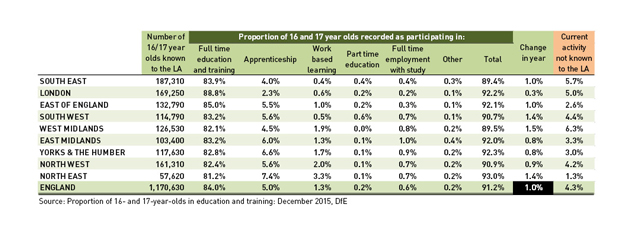
Data to be published on Wednesday shows that 91.2 per cent of 1,170,630 16 and 17-year-olds known to local authorities across the country were in some form of education or training at the end of 2015.
It represents a 1 per cent increase from the end of 2014.
All of the English regions experienced an increase, with the largest being 1.5 per cent for the West Midlands and the lowest 0.3 per cent for London.
The figures were welcomed by Catherine Sezen (pictured), senior policy manager for 14 to 19 and curriculum at the Association of Colleges.
She told FE Week: “Raising the age of compulsory participation in education and training has enabled colleges to offer high-quality technical and professional pathways to more young people.
“These figures are extremely encouraging and they emphasise the value young people place on post-16 education and training, when they are enrolled on the right courses in the right environment.
“Colleges are pleased to play a part in creating a positive experience for young people to encourage them to continue into further study or training.”
While the overall percentage increase was the lowest for London, where 169,250 16 to 17-year-olds were recorded in total, it had the highest proportion in full-time education and training at 88.8 per cent.
The capital, however, had the lowest proportion on apprenticeships at 2.3 per cent.
That was in contrast to the north east, where there were 57,620 young people from the same age group.
It had the lowest proportion in full-time education and training at 81.2 per cent, but the highest on apprenticeships at 7.4 per cent.
Skills Minister Nick Boles said: “The [overall] rise in 16-and 17-year-olds participating in education or training is very welcome, and we will work with councils to ensure this positive trend continues.”
A former employee who defrauded Leeds City College of almost £500,000 has been jailed.
Julia Hogg (pictured) pleaded guilty to two counts of fraudulent activity against the college, between August 2011 and September last year, before she was jailed for three years and eight months.
Leeds Crown Court heard she had been in charge of giving out childcare financial assistance to students, but diverted large payments of money to her own bank account instead.
West Yorkshire Police confirmed the total amount stolen from the college was £479,000.
A Leeds City College spokesperson told FE Week on March 10: “We are shocked and disappointed at the behaviour of this former employee.
“As ever, our students remain our highest priority and we make every effort to ensure that they are supported at all times.”
Hogg, aged 43, of Field Lane, Thorpe Willoughby, near Selby, Yorkshire, began working at the college in 2009 and on a salary of £14,800.
Hogg’s role involved overseeing payments to childcare providers that were supposed to help students with parental responsibilities to attend lessons.
It was reported that she stole £141,000 in a single year at the height of her offending.
Hogg was sacked in October last year after the college realised what she had been doing.
The spokesperson said: “The learner support fund is administered by the college for those who require financial assistance to study and does not form part of the college budget.
“Once identified, we took immediate action to prevent further fraud and to ensure that students were not affected. Student welfare is always our main priority.”
The judgment came as the college, one of biggest in the country, dropped from a grade two to three Ofsted rating. The report, giving the college a ‘requires improvement’-overall rating, was published on March 9.
The college had previously been rated ‘good’-overall in May 2012.
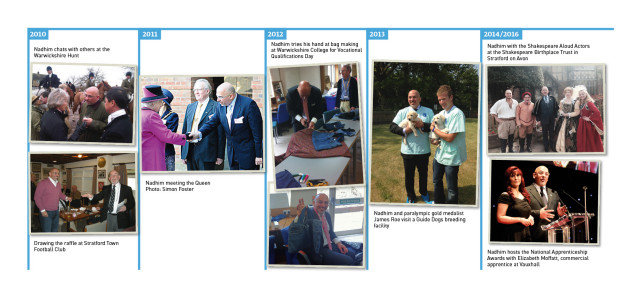
The Prime Minister’s apprenticeship advisor Nadhim Zahawi can hardly believe how far he has come, from fleeing Iraq as a child and being so quiet at his first English school that teachers thought he had learning difficulties.
Zahawi and his Kurdish family fled from Iraq in 1978, when he was just 11, to escape a brutal ethnic cleansing programme.
He described the transition from Baghdad to the UK as harrowing.
“When you’re that young, you don’t realise why your parents have made such a big move, you’re leaving all your friends,” he says. “It’s really difficult.”
Zahawi’s first school in the UK was Holland Park Comprehensive, London.
“I was the quietest boy in the class — the teachers thought I had learning difficulties because I was so quiet,” he recalls.
Within six months he had learned to speak English and was adapting to his new home, but it was still “a really tough time”.
“I think the first week I was at school, a bunch of kids thought it would be a good idea just to see whether I could swim in Holland Park pond,” he says. “I knew what it was like to run for your life.”
But these early challenges have not diminished the gratitude he feels towards the UK, and the sense of wonder at how his life has developed here.
He says: “Every morning I wake up and I have to pinch myself when I stand in front of the mirror.
“When I look at what’s happening in Syria, or even in Iraq itself, I identify with so many of those people. That could have been me, so easily.”
I knew what it was like to run for your life
After his early difficulties in the state school system, Zahawi’s parents decided to move him into private education.
“They scraped enough money together to put me into Ibstock Place School first, and then Kings College School [an independent boys’ school in Wimbledon].”
Kings gave Zahawi “real coincidence” and after doing well in his A-levels, he went on to study chemical engineering at University College London.
When asked why he chose the course, he says: “Being the son of immigrants, mum and dad either wanted me to be a doctor or an engineer — you’ve got no choice. It’s like you’d break their hearts [if you did anything else].”
Zahawi enjoyed his degree, but admitted he never really wanted to practice as a chemical engineer, despite the best wishes of his parents.
He would have preferred to ride horses for a living and says: “I was a pretty good jockey. My ambition was to become an international showjumper at some stage, but that didn’t happen.”
Zahawi set up a small business after leaving university with a friend, focusing on property, but they ran into difficulties when the market crashed in the late 1980s.
It led to a change of focus, with the launch of another business that sold colour-changing T-shirts all over the UK.
He recalls: “They were a huge hit for about 18 months. I think we sold over 3m T-shirts and they did brilliantly.”
Zahawi later worked as a European marketing director for Smith and Brooks, while also pursuing his interest in politics through getting elected onto Wandsworth Council.
It was at this time that he met Stephan Shakespeare, with whom he went on to found the highly successful market research company, YouGov, in 2005.
He is still really proud of the company and described its launch as “my big successful moment”.
But after five years as chief executive of YouGov, Zahawi saw a new opportunity that he couldn’t pass up.
He explained to his business partner in 2010 that the upcoming election was going to be huge, and it was time to “try and come into politics and hopefully offer an alternative”.
He was elected as Conservative candidate for Stratford-on-Avon — which he describes as “the greatest seat in the country” — and now splits his time between London and Tysoe in the south of Stratford, with his wife and children doing the same.
He met Lana, the sister of one of his best friends, when he was a teenager and is still clearly smitten.
“It was love at first sight,” he says. “It was a real love story, and I still love her. I first met her when I was 16 or 17, but we didn’t get married until much later.”
As well as looking after the family, Lana is a co-director of the pair’s business consultancy company Zahawi & Zahawi.
She also shares his interest in horse riding and they run a yard at home.
“I love it. It’s the one time I can sort of just switch off completely, when you’re out on a horse,” he says.
They used to have a full house, with 19-year-old twin boys and a three-year-old girl, but the boys have now moved to the US to study at Princeton University.
Zahawi is clearly proud of and enjoys spending time with his daughter.
He took the trouble to show me a hand-painted green mug, in his office, that she made for him and recalled a recent trip with her to London to see the musical adaption of the classic Roald Dahl story, Matilda.
“I think she was the youngest person in the audience but she sat through the whole thing,” he says.
Looking to the future, Zahawi is excited about his work as the PM’s apprenticeship adviser — a role he was given in November last year.
“I think I’ve got the best job in this place [Parliament], I relish the challenge,” he says.
He has high aspirations for the future of apprenticeships and the impact of the government reforms.
“I want to get to a place where, when the envelope lands on the carpet with an offer from Oxbridge or an apprenticeship, you as a parent are just as excited and as happy for your son or daughter to go down the apprenticeship route.”
Zahawi feels that apprentices themselves are doing a good job of championing this path into employment.
“I see it now all the time, where apprentices are saying ‘Look at me — I’ve got a great career’,” he says.
But he adds: “I want to get to a place where, when I’m long gone from here, when we’re all long gone, the system just works — where I don’t meet young people who say to me, ‘Oh, I fell upon it by accident’.
“The options are there for young people. It’s not just the traditional route of going to university — there is another route here which is aspirational, and can lead to a great career.”
IT’S A PERSONAL THING
What’s your favourite book?
Perfume by Patrick Suskind, it’s just a beautifully written book, and I thoroughly recommend it to anyone.
What do you do to switch off from work?
The best way for me to be able to switch off from work is playing with my three-year-old daughter. Being an MP is a very full-on job, and I often work long hours late nights, so when I have the opportunity to spend some time with her I take it.
What’s your pet hate?
People in businesses, national or local government who make my constituents’ lives more difficult by just mindlessly following the rules — even if it’s against all common sense.
If you could invite anyone to a dinner party, living or dead, who would it be?
As the Member of Parliament for Stratford-on-Avon, it has to be Shakespeare – especially as we commemorate the 400th anniversary of his death in April. Yet another reason to visit beautiful Stratford this year, if you needed one.
What did you want to be when you were growing up?
I wanted to be an international show jumper, but I’ve been very happy to be an entrepreneur and then an MP.
CURRICULUM VITAE
Born:
1967: Born in Baghdad
1976: Immigrated to the UK
Education & Career:
1985: Started a degree in chemical engineering at UCL
2005: Founded YouGov
2010: Elected as Conservative MP for Stratford on Avon
2011: Co-authored Masters of Nothing, a book that examined the financial crisis through behavioural economics, with fellow MP Matt Hancock
2015: Appointed as PM’s apprenticeship adviser
2018: Parliamentary Under-Secretary of State for Children and Families
2019: Parliamentary Under-Secretary of State for Business and Industry
2020: Parliamentary Under-Secretary of State for COVID-19 Vaccine Deployment
Sir Michael Wilshaw “didn’t really mean” what he said about the FE sector at last week’s Education Select Committee, Skills Minister Nick Boles has said.
Mr Boles opened his speech at the Education and Training Foundation (ETF) Leadership Summit, held at Westminster Kingsway College on March 9 by disagreeing with Sir Michael’s comment, which provoked widespread anger in the FE sector, that all 16 to 19-year-olds should be educated in schools.
“You will all be aware that Sir Michael Wilshaw, the chief inspector of Ofsted, made some comments last week that I’m sure he didn’t really mean. I certainly hope he didn’t really mean them,” Mr Boles said.
“And I just wanted to say, not only do I disagree with him, not only does David Cameron disagree with him, I actually think Michael disagrees with himself,” he continued.
The Ofsted chief inspector attacked the FE sector during an evidence session for the Education Select Committee on March 2, describing it as “in a mess — that’s why the government is reviewing it”.
“My view is that 16 to 19 should be done in school,” he told the committee, chaired by Neil Carmichael MP.
Mr Boles said that Sir Michael had complained “over the last few months and years” about the small number of 16 to 18-year-olds doing apprenticeships.
“It is simply inconceivable to have every 16 to 18-year-old in a school sixth form, and also have more of them doing apprenticeships, because there aren’t very many school sixth forms that I’m aware of who are going to start engaging with employers and providing training that supports apprenticeships,” Mr Boles said.
The Skills Minister told ETF delegates that Sir Michael believed that provision for 16 to 18-year-olds who “are not going to pursue the standard academic route” had “historically been inadequate, not high quality, not a source of pride and focus, not an investment in the same way as the A-level and the full-time university course route has been”.
“So I can only assume that he was perhaps — as we all do, as I’ve often done — slightly misrepresenting his own considered views,” Mr Boles added.
FE Week’s news story about the chief inspector’s comments provoked an unprecedented and unanimous backlash, with more than 40 comments posted on the FE Week website in just 24 hours many of which criticised him for airing his personal opinions in a public capacity.
Martin Doel, chief executive of the Association of Colleges, wrote to Sir Michael, challenging him to justify his opinions about the sector.
He called on Sir Michael to provide “as a matter of urgency a clear rationale for your conclusions”.
“It would be all the better if those conclusions corresponded with the judgment of the inspectors in your organisation; I fail to see how this could be so given that 82 per cent of colleges who provide 16 to 18 education have been judged good or outstanding in recent Ofsted inspections,” he continued.
FE Week contacted Ofsted to ask for Sir Michael’s response to Mr Boles’s comments, but a spokesperson said they had nothing more to add.
A spokesperson for the education watchdog had previously said that Sir Michael’s comments were clearly his personal opinion.
Government budgets are of course finite — but our front page exposes questionable priorities over how it is being handed out.
How can it be right that apprenticeship providers could be short-changed, while the well-documented UTC fiasco is going to be propped up by even more handouts?
Lord Baker’s UTC project is in trouble and ministers are wrong to throw more money at it.
It also worries me that colleges are being encouraged to climb on the consultancy gravy train over area reviews.
Isn’t the FE Commissioner and his team supposed to provide the expert guidance over where mergers are needed and how to maximise benefit for everyone involved?
If highly paid college management teams can’t then implement the recommendations themselves, they probably aren’t fit for purpose.
Ministers keep telling everyone who will listen that apprenticeships are the overriding priority for FE, and providers across the country must play their part in boosting the number of starts.
If there really is more to this then bluster and rhetoric, they should send out a clear message by investing in them properly.
National Apprenticeship Week rightly celebrates tens of thousands of individual successes from young beginners to older workers acquiring new skills — and of the trainers and employers who inspire them.
I’m proud the last Labour government set up the National Apprenticeship Service (NAS) and introduced National Apprenticeship Week in 2008, alongside pushing the programme from 65,000 apprenticeships in 1996/7 to 279,700 by 2009/10.
Infrastructure projects begun by Labour such as Crossrail have been a crucial conduit for apprenticeship expansion.
The young apprentices who stood round the Queen as she opened the Elizabeth Line are its legacy.
Now ministers have set themselves the ambitious target of 3m apprenticeship starts by 2020 with a proposed apprenticeship levy, delivery board, and Institute for Apprenticeships as levers. I and the
Labour Party applaud the principle of expansion — but we need to take stock of potential devils in the detail.
To meet those targets with quality apprenticeships, we need to scale up traditional areas in manufacturing and industry, but also grasp the potential for high-quality apprenticeships in the service sector — to meet growing demands in social care, leisure and visitor services — as well as digital and creative industries.
That expansion could fuel some of the cohorts needed to fill the gaps in technical and professional staff, so long bemoaned by Lord Sainsbury and others.
We must also keep a wary eye on apprenticeship completions — down from 76.4 per cent in 2010/11 to 68.9 per cent in 2013/14 — so expansion is not undermined by unacceptable drop-out rates. Apprenticeships for high-tech companies are crucial.
I have argued we need to encourage such employers to ‘overtrain’ their apprenticeship numbers with the surplus available to energise their supply chains and other small and medium sized businesses.
I have argued we need to encourage such employers to ‘overtrain’ their apprenticeship numbers with the surplus available to energise their supply chains and other small and medium sized businesses.
Government utilises traineeships to get far more young people competitive for high quality apprenticeships.
The mechanisms for doing this are shrivelling because of cuts in funding to FE colleges and providers, and in their own capacity to drive initiatives forward.
With staffing levels at the Skills Funding Agency down nearly 50 per cent since 2011 and similar levels of reduction in the NAS, and ministers cutting off UKCES funding, they will struggle to deliver their grand designs.
It makes sense to look to the opportunities from devolution to both LEPS and combined authorities for apprenticeship expansion.
In the pamphlet for the Smith Institute, we demonstrated how local authorities were already taking on apprentices and backing local initiatives. If more power was devolved, this could be done on a far larger scale.
The Government also needs to mobilise public sector apprenticeships, using contract procurements to lever more and match the programme we proposed in the last parliament.
These roadmaps for apprenticeships are ones that everyone needs to feel included.
But across business there are already concerns how the proposed levy will operate.
Will the money raised be additional or a substitute for existing Government funding?
Will a ‘big bang’ approach and a hasty introduction jeopardise its credibility?
The Apprenticeship Delivery Board charged with meeting the 3m target is narrowly drawn, with only one woman among the six members.
That’s why I have argued forcefully the Board of the Institute for Apprenticeships intended to be a long-term standing body should include not only employers, who are central to the process but also further education providers and colleges , relevant trade union expertise, university and local authority expertise.
Matching Apprenticeships to the flexibility and economic demands of 21st century Britain demands that inclusive approach.
The government “can’t make any guarantees” it will be able to fund all apprenticeship growth requests, Skills Minister Nick Boles (pictured above) has said.
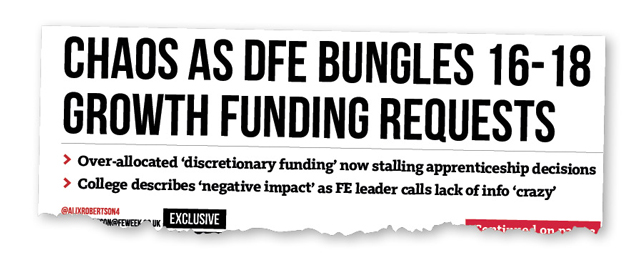
His remarks, at the Education and Training Foundation Leadership Summit on at Westminster Kingsway College on March 9, came a month after many training providers were left short-changed following the Skills Funding Agency’s (SFA) overdue announcement in February of extra cash for delivering 16 to 18 apprenticeships.
“You will understand that we’ve had the position where we’ve been agreeing every growth bid, more or less, every quarter, and there is a limit to how much we can carry on doing that given that we do have a fixed budget,” Mr Boles said.
He continued: “We will do our absolute level best to meet any growth bid that we possibly can, but I can’t make any guarantees, because the budget does have to be limited.”
On February 5 the SFA announced £25m of additional funding to deliver 16 to 18 apprenticeships.
The extra cash, which should have been announced on January 8, was in response to growth requests submitted by colleges and training providers to help fund apprenticeships and traineeships in 2015/16.
However, many providers received much less than they had asked for, and no requests for traineeship growth had been funded — a situation that led to fury from providers.
As exclusively revealed by FE Week on January 29, the delay in announcing the funding was due to the Department for Education (DfE) over-allocating its discretionary fund for 2015/16.
Mr Boles acknowledged the pressure on 16 to 18 apprenticeships in his remarks to ETF delegates.
“And in 16 to 18 the budget was more constrained than the adult budget,” he said.
“And I was a bit puzzled as to why also, it seemed to me, we were getting more growth bids at 16 to 18 than we were for adults in the last 12 months in a way that hadn’t been the case in the previous 12 months, which I don’t quite understand,” he continued.
“I understand the frustration because you want to be able to recruit people, and indeed some of you go ahead and recruit them anyway, and find your budget bid isn’t approved and in effect you’ve had to subsidise them,” Mr Boles said.
The introduction of the apprenticeship levy would mean that “by the end of the parliament it’s going to be completely different”, the Skills Minister said.
“All of the money, all £2.5bn, will be in digital accounts, either by companies who pay the levy or by other companies who don’t pay the levy but who want to have apprenticeships,” he said.
“So by the end of the parliament, everybody – every employer of an apprentice – will be controlling the money and then deciding which training provider they want to work with.”
University Technical Colleges (UTCs) have been told they will get a new source of financial support, as another of their number is forced to close due to recruitment problems.
Skills Minister Nick Boles wrote to the chairs and principals of UTCs on March 3, to inform them of the “new centrally funded package of educational and financial support”, which will be accessible to UTCs in their early years.
It will be available to those that have not yet been judged good or better by Ofsted, but not to those that are subject to intervention. The letter was delivered only a week before Central Bedfordshire UTC announced that it would have to close in August this year — just four years after it first opened its doors.
Leaders at the struggling 14 to 19 vocational institution admitted it has not been able to attract sufficient pupils to provide a “financially viable experience” after this year.
It is the third UTC to close since the programme began, with Black Country and Hackney UTCs shutting last summer following problems with recruitment and viability.
The Skills Minister’s intervention in the UTC programme comes after FE Week found that 40 per cent of UTCs opened between 2010 and 2013 saw student numbers fall for the current academic year.
Exclusive research by FE Week through Freedom of Information requests found that six of the 15 UTCs opened between 2010 and 2013 saw their learner numbers decrease for 2015/16.
Central Bedfordshire UTC had only 101 students for 2015/16. This was an increase of nine on the previous year, but still meant that the UTC was only 16.8 per cent full.
Meanwhile, the new funding stream and educational support for UTCs will be delivered through a range of different channels, to help them to bed in during their preliminary years.
These include sources of advice such as an experienced mentor for the principal; support for UTCs’ trust boards through a National Leader of Governance (or equivalent); and enhanced education advisor visits in term two for all new UTCs.
The letter also describes “increasing educational and financial capability with up to two years intensive support from a Teaching School, organised via the National College of School Leadership, under similar terms as the current school to school support fund”.
The Department for Education was unable to confirm to FE Week how much this new funding would be worth per UTC or per year in total.
The Government’s focus on offering support for UTCs has been manifold. Alongside further financial provision, Mr Boles told the House of Commons last week that UTCs should function as part of multi-academy trusts (MATs) to make them stronger.
This point is also addressed in his letter, which says that “all future UTCs should be established as part of a strong MAT or within a partnership of similar depth, strength and permanence”.
It refers to “crucial educational, financial and pupil recruitment benefits” from these partnerships, and says this will be helpful in overcoming the “current hostility which some UTCs face from other local education institutions” which “makes working as a single stand-alone institution more difficult”.
For UTCs already approved for pre-opening and planning to open from 2017 onwards, the letter says “the Secretary of State will not agree to enter into a funding agreement” unless the UTC is part of a MAT or has arranged other partnership arrangements.
In response to this recommendation, Alice Barnard, chief executive of the Edge Foundation, a charity dedicated to technical, practical and vocational learning, commented: “There’s no evidence that being in a multi-academy trust guarantees better performance, but it does provide the opportunity to share resources and expertise.
“However, a lot of stand-alone academies perform very well and there are many ways to collaborate less formally with other schools, colleges and academies.”
Charles Parker, chief executive officer of the Baker Dearing Trust, which supports and promotes UTCs, said: “UTCs exist because they are needed locally and they are controlled by the employers and the university that have backed them from the very beginning.
“UTCs are always looking for robust local partnerships with supportive educational providers. These come in many forms and depend on local circumstances. One size does not fit all.”
He added: “The key factors which lead to successful UTCs are profound employer engagement and really good leadership.”