


Leadership and management apprenticeships are on the chopping block under plans to find savings and tilt the apprenticeship system towards young people, Jacqui Smith has confirmed.
The skills minister told FE Week the popular programmes, along with other unnamed “higher level” standards, are “not only not what people would traditionally think of as apprenticeships, but also things that people traditionally have thought of as employers funding [themselves]”.
“So yes, that will be one of the areas,” she confirmed when asked whether leadership and management apprenticeships were up for defunding consideration.
Smith added the government would have “more to say about which of those apprenticeship standards we think aren’t appropriate for public funding” but did not commit to a timeframe or scale of impact.
Leaders have warned that removing public funding from leadership and management apprenticeships would be a “disorientating shock” for many employers who have “never been told that levy funding is not theirs to use as they see fit”.
Value for money
Employer anxiety has grown over potential cuts to management courses and industry progression routes amid mounting apprenticeship budget pressure in recent months.
A “streamlining” review was signalled by chancellor Rachel Reeves in November’s budget, when she reiterated that the government would refocus apprenticeships on young people and simplify the system to ensure better value for money.
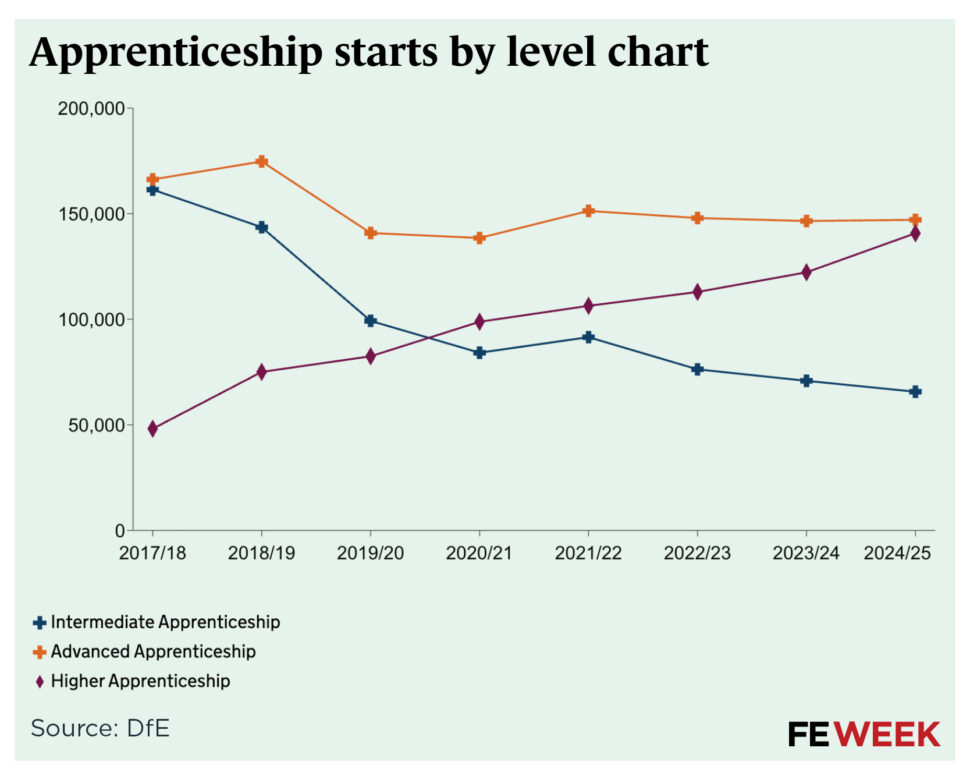
Ministers are concerned about spiralling numbers of expensive higher-level apprenticeships being taken up by older workers, while starts at lower levels and among young people have crashed.
Apprenticeship starts at level 2 have plummeted almost 60 per cent from 161,390 in 2017-18, the year the apprenticeship levy was introduced, to 65,680 in 2024-25, while starts at level 3 shrunk 12 per cent from 166,220 to 147,090 over the same period.
Meanwhile, starts at level 4 and above, which are more costly to deliver, rocketed 192 per cent from 48,150 to 140,730.
FE Week understands that officials are scrutinising apprenticeships that resemble continuing professional development instead of discrete occupations, and are mostly taken by older workers.
Management standards are the most popular in terms of starts across most apprenticeship levels.
FE Week analysis of the government’s latest full-year data shows that at level 5, the operations manager apprenticeship recorded the most enrolments in each of the past three years, hitting triple the number of starts as the next most popular (leader in adult care) in 2024-25.
The chartered manager degree apprenticeship was the most popular at level 6, the senior leader programme was the most prolific at level 7, and at level 3 the team leader standard was consistently the second most popular.
Most starts on these standards are from people aged 25 and older.
The total number of people aged 24 or younger starting an apprenticeship fell by 22 per cent, from 220,280 in 2017-18 to 172,240 in 2024-25.
Starts for people aged 25 and older have shot up by 17 per cent from 155,480 to 181,270 over the same period.
During an interview with The Times last month, former Labour cabinet minister Alan Milburn, who is leading a review into the rise in young people who are not in education, employment or training (NEET), said it was a “crazy” fact that a significant number of them go to people over the age of 40.
“Ask any member of the public what they think an apprenticeship is,” Milburn said. “It’s an entry opportunity for young people, not in-work training for older people.
“So we’ve got to look at all of these things and we’ve got to look at where we’re spending public money.”
Traditionally speaking
The government has already moved level 7 apprenticeships out of public funding for people aged 22 and older.
FE Week asked skills minister Jacqui Smith what else was in the firing line in terms of the government’s streamlining efforts during an interview for National Apprenticeship Week at a site visit to Kier Group (pictured above) this week.
She said officials were looking “very carefully at areas that don’t have many starts” before confirming that management apprenticeships were under real threat of defunding.
“We’re working with employers, and we’ll have more to say about which of those apprenticeship standards we think aren’t appropriate for, essentially, public funding,” she said.
Asked directly whether she was referring to management apprenticeships, the minister replied: “I think there are elements in some of the higher-level apprenticeships, some of the areas of leadership and management, where not only are these not what people would traditionally think of as apprenticeships, but there are also things that people traditionally have thought of as employers funding [themselves]. So yes, that will be one of the areas.”
While the government is engaged in a streamlining effort, officials are also set to bring on board new short courses to be funded through the levy from April. Smith told FE Week, however, that the initial offer would be “tight” (click here to read full story).
That’s Asda price
Defunding of popular management apprenticeships is expected to cause outrage among employers.
The Chartered Management Institute (CMI) launched a petition last month to show the removal of management apprenticeships would undermine productivity in industrial strategy sectors, as well as other critical areas such as retail and hospitality.
It has around 5,000 signatures so far, including testimonies from big-name employers such as Amazon, BAE Systems, Heathrow, Barnardo’s, John Lewis, Kier Group, Lloyds Bank and Marie Curie.
James Goodman, supermarket giant Asda’s chief people officer, said: “Reports that the government plan to defund leadership apprenticeships would clearly be a further backward step, that would cut off proven progression routes and weaken the sector’s ability to develop future leaders.”
Matthew Percival, future of work and skills director at the CBI, said businesses were “deeply disappointed that ‘how can we unlock business investment in skills’ has been replaced with ‘where is the least damaging place to cut’”.
“With each new announcement, the levy looks more like a tax and less like a ‘use it or lose it’ incentive to invest in training,” he added.
Every little helps
The levy is generating more cash contributions than expected and is estimated to raise £4.4 billion this financial year.
England’s apprenticeship budget for 2025-26 has received an in-year top-up worth £43.2 million, bringing it up to a record £3.118 billion. Deducting the £500 million paid to the devolved nations, it means the top slice the Treasury takes between how much the levy generates and how much is dished out for apprenticeship spending hits around £780 million.
Percival said: “It [the levy] takes more money out of employers’ training budgets than it adds to government-directed programmes, reducing total investment in training. Turning this around starts with transparency about where levy receipts go, not only how the skills budget for England is spent.”
Ben Rowland, chief executive of the Association of Employment and Learning Providers, added: “Removing public funding from leadership and management apprenticeships would be a disorientating shock for many employers who have never been told that levy funding is not theirs to use as they see fit.
“Not only are these skills vital for productivity and growth, they are vital if these employers are going to be in a position to take on NEETs into their workforces. Government has to pause and rethink these proposals from a whole system perspective.”
Sources told FE Week that government officials could link the streamlining efforts to new apprenticeship units, in some cases turning full apprenticeships into fundable shorter courses.
The British Chambers of Commerce (BCC) said the threat of restrictions to management apprenticeships was “damaging business confidence and would be counterproductive to growth”.
“It is vital that apprenticeship units deliver the promised flexibility and help to address the training gaps created by the removal of level 7 provision or defunding of management and leadership training at any level,” a BCC spokesperson said.












So this is all about terminology then? If it had been called a ‘UK Skills Levy’ or similar (like it should have been) management apprenticeships probably wouldn’t have been in the firing line? Or is it all about finding some £ down the back of the sofa? Just some dinosaurs tied to the word apprenticeship and what it means?
Labour’s approach to apprenticeships reflects an outdated perspective, mistakenly believing that cutting funding for advanced apprenticeships will lead to more employers hiring younger apprentices at levels 2 and 3. However, this assumption is incorrect, in many sectors those roles do not exist and the drive for growth and productivity relies on a more highly skilled work force. Apprenticeships a re a skills programme not a welfare support mechanism, those programme need to be specialized to address with multiple needs of young people before they enter the workforce. Employers are not social workers and most do not have the skills to deal with employees with multiple workforce developmental needs. The policy wonks in government need to look at historical data shows that the proportion of under-19 apprentices has consistently remained around 24–28%, even under the old framework. While current standards are more rigorous and longer, the percentage of younger apprentices has not changed significantly. Additionally, business administration frameworks historically had the highest number of apprenticeship starts.
Don’t agree with much of what the skills minister says but finally she says that apprenticeships were designed for young people and that was what the levy was for- read the papers in 2015
The drift since has been alarming
Get back to basics – always said it but taken them 10 years to understand
The damage to the brand since has been enormous
Want management and professional quals- pay for them or get the employer to pay as they will
It’s the same failed argument with uni loans – ‘ I pay for my degree’ – you don’t because the vast majority pay nothing back and now we hear £5bn a year given to foreign student in the way of uni loans that are never paid back
Labour inherited the baggage and consequences of the Levy.
The levy was an accounting device. Introduce a new tax on larger business under the auspices of it being hypothecated (to be spent on what it was raised for). That instantly shifted a few numbers around on the UK plc balance sheet. Hey presto, you now have a revenue stream coming in, alongside the expenditure. At the same time, the set up of the system was designed to guarantee an underspend by limiting the budget below levy receipts, expiry dates, having a system that SMEs couldn’t navigate easily and vanilla funding band methodology to shoehorn in ‘efficiencies’. All resulting in a hefty surplus for Treasury (in the £bn’s over the years).
Businesses reacted as business does, control the costs, maximise the profits and an obvious solution was rebadging existing training to draw on levy allocation instead of shelling out twice.
The problem now is that there has been a massive skew towards higher levels (the levitating ladder of opportunity), lower SME engagement and a dearth of ‘newly’ employed apprentices. The age profile hasn’t changed massively – but the current demographic bulge in young people and the dawning legacy of a mounting student loans debt pile (over £250bn) mean the dynamics have changed, so age is relevant.
It’s also worth pointing out that in the pre-levy world, it wasn’t all rainbows and unicorns. Accusations of apprentices being on a carousel and repeating the same low level were commonplace (L2 on the deli counter, progressing to L2 on the fish counter, inflating starts statistics one ‘stuck’ employee at a time and deftly side stepping the minimum wage).
What the ‘old’ pre levy system and the new post levy world teaches us is that one size fits all policies don’t work, they guarantee outliers, but mostly through ignorance not choice. What one sector or occupation needs is not the same as what others need.
The irony is that we exist in a time where there has never been so much information and data available, with greater processing power and now AI to guide us through the semantic quagmire of what apprenticeship means and what we use them for.
Cutting apprenticeships for older workers makes no sense, as we are always been told that we will need to work longer, people will need new employment and training opportunities. Also apprenticeships must be attached to employment , not just used as another form of ‘course work training’ with nothing at the end of it.
As a management coach with predominantly apprentices aged 30 to 60, I have seen that the level 3 and 5 management standards make a significant difference to 99% of those completing the apprenticeship. They gain confidence in their ability to lead and manage staff, have a better insight into business continuity and are more empathetic and inspirational than those without training. It definitely helps with building a high performing team and empowering individuals to be the leaders of the future.
Yes, invest in NEETS but also invest in those that can lead the next generation into being future leaders and not just being able to do basic skills roles that AI can do quicker and more effectively!