


Funding for 16 to 18 education will need to rise by a further £150 million by 2028-29 simply to maintain spending per student in real terms, according to the Institute for Fiscal Studies.
The warning comes in the IFS’s annual report on education spending in England, which highlights growing demographic pressure across further education and skills that is “absorbing” recent funding commitments.
Economists at the think tank urged for further real-terms increases “beyond” those already announced to account for growth in 16- to 18-year-olds of around 70,000 (3 per cent) students by 2028.
The report, supported by the Nuffield Foundation, also highlighted concerns of a “narrower” apprenticeship flexibility under the new growth and skills levy, modular Lifelong Learning Entitlement take up and deficit pressures on colleges.
‘Limited detail’ on funding boosts and allocations
The report’s authors cast doubt on the commitments made in the Spending Review last June that indicated that the overall FE and skills budget would rise by just over £300 million in real terms between 2025-26 and 2028-29.
Altogether the skills budget, made up of 16 to 19 education, adult skills and apprenticeships, accounts for £14 billion of public spending in 2025-26.
Chancellor Rachel Reeves pledged an additional £1.2 billion per year in day-to-day funding for FE by 2028-29, in cash terms.
But the Treasury did not publish a detailed breakdown of how the increased funding would be doled out across the different parts of the further education and skills system, which the IFS said leaves “scope for it to be distributed in different ways”.
The Department for Education’s post-16 white paper published in October confirmed a real-terms boost of £450 million to the 16 to 19 budget between this academic year and 2026–27, which the authors said will reverse some of the real-terms funding decline seen since the 2010s.
“This would lead to a 2.5 per cent real-terms increase in spending per student aged 16-19 over this period. This would return funding per student in colleges to around its 2012-13 level and funding in school sixth forms to levels last seen in the mid 2010s,” the report said.
It added that after the increase, per student funding in FE would remain 6 per cent below 2010-11 levels.
“Although the white paper set out a broad range of policies, there was limited detail on how different strands are intended to fit together or how key trade-offs within the skills system would be addressed,” economists added.
More cash needed to meet demographic surge
The post-16 white paper indicated a desire to at least hold spending per student constant in real terms.
IFS’ economists said that between 2018 and 2025, the number of 16- to 18-year- olds in England grew by around 300,000, or 16 per cent. Population projections suggest a further increase of around 70,000 (3 per cent) by 2028, when the number of 16- to 18-year-olds is expected to peak.
The authors concluded that based on these population projections, maintaining spending per student at its 2026-27 level in real terms would require total funding to increase by a further £150 million (in today’s prices) by 2028-29.
SEND white paper will be ‘pivotal’ to addressing pressures
The most “acute” financial pressure is in special educational needs and disabilities (SEND), with the IFS warning that the government’s upcoming white paper on SEND reform will be “pivotal” to addressing soaring council deficits and provision demand.
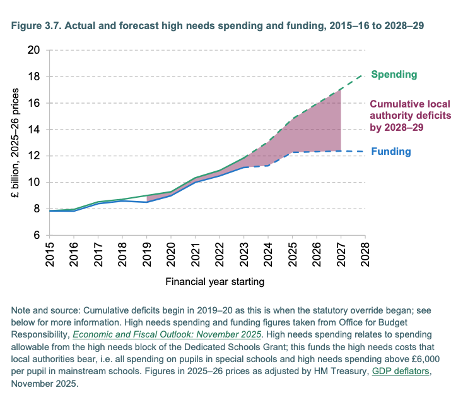
The Office for Budget Responsibility has forecasted a £6 billion gap between expected spending and funding SEND provision by 2028-29.
The IFS expects SEND spending to more than double in real terms between 2015 and 2028. Over the last decade the think tank said SEND has accounted for over half the increase in total school funding over the period.
But local councils have been forced to spend more, causing them to build up deficits of up to £14 billion by 2027-28.
Additionally, SEND transport spending almost doubled to £2 billion between 2018-19 and 2024-25, though a breakdown on post-16 transport was not provided.
Luke Sibieta, IFS research fellow and author said: “The current system is increasingly costly and failing to deliver for everyone. Whether the government can both put the system on a stronger long-term footing, and manage to generate shorter-term savings, will be a crucial test for the forthcoming schools white paper.”
Nearly 3 in 10 colleges in deficit
The report also found almost three in 10 colleges are in deficit, according to analysis of the latest 2023-24 figures.
In 2010-11, just 16 per cent of colleges (weighted by income) were operating in deficit. This more than tripled to 54 per cent by 2015-16 and almost one in five colleges reported deficits exceeding 5 per cent of their income.
While financial performance has improved since its peak in 2017, by 2023-24, 28 per cent of colleges were in deficit. Additionally, 16 per cent of those colleges had been in deficit for at least three consecutive years.
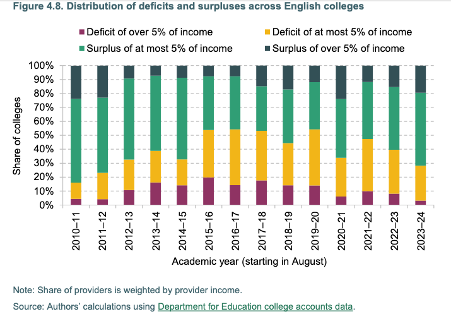
The think tank’s authors said the “persistent” deficits frame the cost pressures colleges are likely to come up against in the next several years.
“Colleges have limited scope to absorb these pressures through adjustments to their largest area of spending, staff costs.”
Staff costs account for around 70 per cent of spending in English colleges in England but staff pay has seen substantial real terms pay cuts since 2010.
“With recruitment and retention challenges evident, colleges are likely to have limited scope to reduce staff costs further without risking additional strain on staffing capacity and provision,” the report added.
It added that the 2022 reclassification of colleges as public sector bodies has limited colleges’ ability to manage pressures through commercial borrowing or short-term financial adjustments.
Apprenticeships units could be ‘narrower’ model than promised
The report criticised the opacity of how new short, flexible courses will be delivered under the evolved growth and skills and levy.
DfE’s post-16 white paper last year indicated that employers will be able to use the levy on “apprenticeship” units but gave no “significant detail” about how apprenticeship units will be defined, approved or delivered.
Economists said this was “concerning” given that they are planned to be rolled out in April 2026.
The units that will be only available in a set of “designated critical skills areas”, which the report said would restricts eligibility to courses needed in areas of labour market need and limit the extent to which the levy supports wider workforce development.
“The government appears to be moving towards a narrower model than the broader flexibility proposed prior to the election,” the report said.
“The challenge for the government will be to balance flexibility, cost control and the targeting of public funds towards training with demonstrable economic value.”
Uncertainty around Lifelong Learning Entitlement modular take up
The report’s authors also said they will be examining the take up of Lifelong Learning Entitlement (LLE) funded short courses in the coming year.
The first LLE-funded courses are expected to open for applications in September 2026. Applicants will also be able to take out loans for individual modules or short courses rather than full qualifications, initially only for subject areas outlined in the government’s industrial strategy.
The IFS cast doubts on the value of short courses, plus a possible reluctance from learners to take on debt for modular provision, and “uncertain” incentives facing providers.




Your thoughts