


Employers and training providers have been urged “not to step back” from foundation apprenticeships after rollout figures revealed the flagship policy suffered a “sluggish” start.
Just 36 young people began one of the government’s new foundation apprenticeships in the first three months after their launch last summer.
The figures, published today and covering August to October, sparked concern about employer awareness. It is also feared the initial set of seven foundation apprenticeships are too focused on industrial strategy sectors rather than labour market need.
Leaders of training providers involved in the early delivery of the programme insist the figures should be a reason for the foundation apprenticeship offer to be “strengthened”.
Foundation apprenticeships are level 2 programmes for people aged 16 to 21, or up to 24 if the person has an education, health and care plan, is a care leaver or has been in prison. The programmes are paid jobs lasting eight months and are designed to be a stepping stone to a full apprenticeships and work in industry.
The seven foundation apprenticeships launched in August included three for the construction sector, two for digital, one for engineering and manufacturing and one for health and social care.
Incentive payments of up to £2,000 per foundation apprentice are on offer to employers, in addition to the existing £1,000 payment businesses receive for 16 to 18-year-old apprentices.
The most popular was the onsite trades foundation apprenticeship with 17 starts, FE Week analysis of the data found.
Next was building services engineering with eight recruits, followed by engineering and manufacturing with five, health and social care with four, and then hardware, network and infrastructure with two.
Two foundation apprenticeships – in software and data and finishing trades – are yet to get off the ground as nobody started on them in the period.
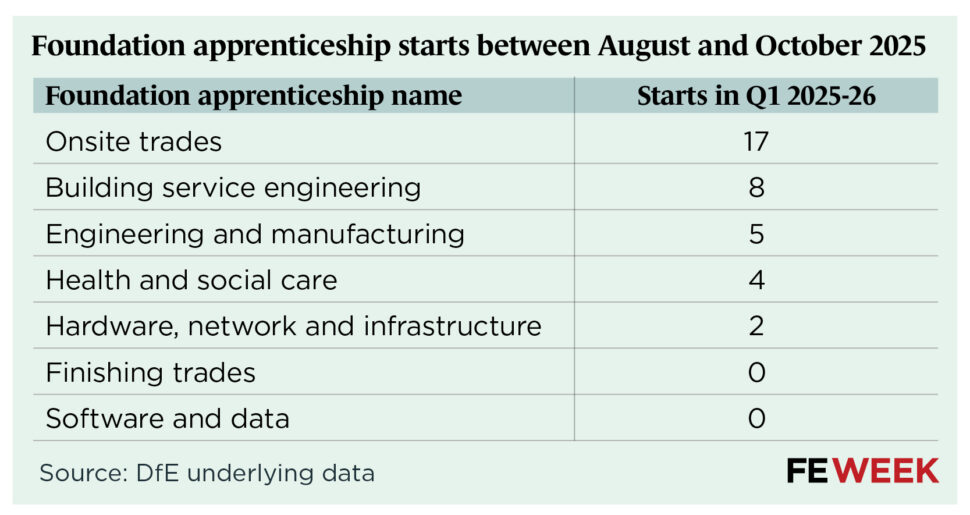
The government’s dataset described foundation apprenticeships as a “new programme which will be building over time”.
Exeter College was the biggest provider, having recorded 16 starts on the onsite trades programme during the first quarter of 2025-26.
Mike Blakeley, Exeter College’s group executive director of partnerships and apprenticeships, said foundation apprenticeships had “opened up a valuable new route into industry” and were “positively received by both employers and learners”.
He told FE Week his college is “sharing our experience of foundation apprenticeships with other colleges and key employers, and we expect momentum to continue to build over time”.
Association of Employment and Learning Providers chief executive Ben Rowland warned in November that the initial delivery of foundation apprenticeships had been “a damp squib” because the government “began by taking them to industrial strategy sectors who didn’t ask for them, need them or want them”.
The government has announced plans to introduce foundation apprenticeships in hospitality and retail, but officials are yet to publicly commit to a timeline for their rollout.
FE Week understands the government hopes to have them up and running by April.
Simon Ashworth, AELP’s deputy CEO and director of policy, said: “There is an underlying danger that an over-fixation with industrial strategy sectors becomes a distraction. This shows why a broader, more inclusive approach should be taken to help create jobs, address skills gaps and tackle the NEET crisis.”
He told FE Week that if the government is serious about foundation apprenticeships helping tackle NEET numbers, it should “speed up development in sectors like retail and hospitality” as these areas have “strong entry-level opportunities and employer demand”.
“That would give the programme the boost it needs after a sluggish start,” Ashworth added, and urged ministers to announce next steps for more foundation apprenticeships during next month’s National Apprenticeship Week.
Apprenticeship giant Lifetime Training started four foundation apprentices on the health and social care programme between August and October and has since enrolled more.
They are all employed by Manchester-based social enterprise PossAbilities.
Lifetime Training CEO Charlotte Bosworth said this week’s starts figures “are not a reason to step back from foundation apprenticeships; they are a reason for government to strengthen them”.
She called for officials to give the courses “greater clarity of purpose” because employers lack a “concrete understanding of how foundation apprenticeships differ from level 2, what they are designed to achieve, and how progression works”.
“Without a clear and consistent message, the model will continue to struggle to gain traction,” Bosworth warned.
She told FE Week that tighter alignment to real labour market need was also “vital”, with clearer frameworks to prevent foundation apprenticeships becoming “simply a level 2 substitute”.
“The first 36 starters show the model is still bedding in, but with clearer policy, employer-led design and better communication across the system, foundation apprenticeships can become a powerful tool for widening opportunity and tackling skills shortages,” Bosworth said.
A government spokesperson said: “We’re investing £1.5 billion to get hundreds of thousands of young people earning or learning – including through an expansion of apprenticeships and training.
“As part of our plans, £725 million is going towards reforming the apprenticeship system, helping 50,000 more young people into work and driving economic growth.
“It’s fantastic to see the first cohort of learners successfully entering employment in critical sectors. We’re determined to go further to support young people to succeed.”













Engineering starts are incorrect. Check the website out https://assessors.apprenticeships.education.gov.uk/find-an-assessment-opportunity/ShowApprovedStandardDetails?standardReference=FA0006
Official data released this morning shows five starts in quarter one (August to October) 2025 – four were at Cheshire College South and West and one was at Cornwall Marine Network Limited
Embarrassing figures.
The DfE can’t successfully distort an employer demand led system to tackle neets in this way. Ben Rowlands is correct – no one apart from DWP want this.
Well done to Exeter College on scraping together a cohort that is just about viable (until withdrawals kicks in).