


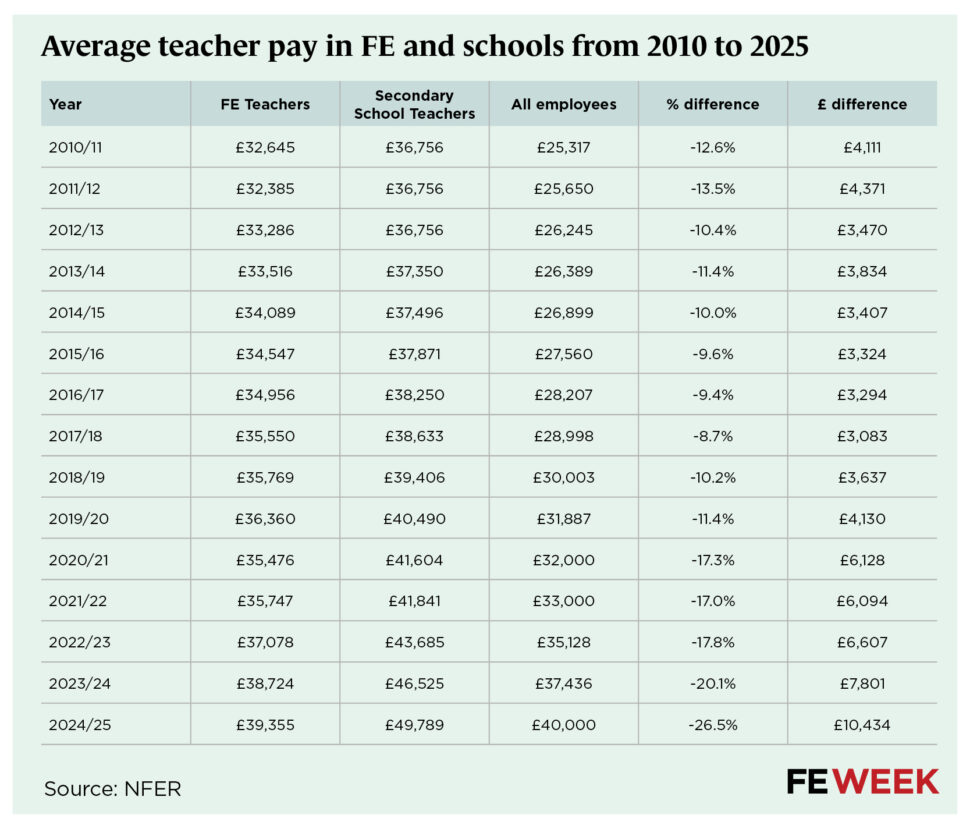
Further education teachers now earn nearly £10,500 less than school teachers – the widest pay gap in at least 15 years, new research has found.
New findings from the National Foundation for Educational Research (NFER) today reveal teaching staff in FE providers earn on average 27 per cent less than their peers in secondary schools.
The disparity has widened sharply in recent years, with researchers warning that sustained funding increases will be needed if colleges are to close the gap and recruit enough teachers.
While average UK earnings have grown by 4 per cent since 2010, FE teacher pay has dropped 18 per cent in real terms over the same period.
In 2010, the median FE teacher salary was £32,645, compared with £36,756 for secondary school teachers — a gap of about 12.6 per cent.
The difference narrowed slightly during the 2010s but began widening again from 2020-21.
By 2024-25, the median FE teacher salary stood at £39,355, compared with £49,789 for secondary school teachers, leaving a pay gap of almost £10,500.
The report said: “School teachers’ pay has also dropped in relative terms, but the drop for FE teachers has been far larger. This data reinforces the impression that FE teacher pay is now far less competitive than it was in the recent past.”
Funding pressures
Recent analysis from the Institute for Fiscal Studies revealed per student funding for 16 to 18-year-olds, the main income source for many colleges, has declined by 8 per cent in real terms over the last 15 years.
NFER researchers said this reinforces its conclusion that the 27 per cent gap in FE teacher pay is largely driven by colleges and other providers’ inability to afford higher pay.
The Department for Education further stung leaders this week after it announced a 0.5 per cent rise to the 16 to 19 funding base rate this week despite promising real-terms increases in the recent skills white paper, prompting warnings that this measly cash boost to college finances will leave “very little” for staff pay rises.
NFER called for a “sustained” effort over several years to sufficiently fund colleges to pay teachers more.
School teacher salaries are nationally binding and set through a recommendation by the School Teachers’ Review Body, which is then approved by the secretary of state.
In contrast, colleges are responsible for setting staff pay themselves.
‘Totally unacceptable’
David Hughes, chief executive of the Association of Colleges, said college leaders’ hands are tied without a headline pay increase for FE staff.
“The increasing pay gap between school and FE teachers is totally unacceptable,” he said.
“It is also grossly unfair to thousands of college staff who are not being paid what they deserve. It is no wonder that the unions are able to secure wins in ballots for industrial action, with pay below where it should be.”
UCU general secretary Jo Grady said the pay gap between school and college teachers is a “scandal that has blighted the sector for years”.
She added: “Our members took strike action at colleges across England earlier this year in defence of their pay and working conditions and college employers must do more to ensure staff are paid properly.
“If the government is as committed to improving the skills of the nation as it says, then it must put its money where its mouth is, increase funding for further education and ensure staff pay is prioritised.”
Boosting teacher numbers
The analysis, funded by the Nuffield Foundation, also found the number of teachers in general FE colleges and sixth form colleges has stabilised in the last three years, following a decade of decline.
Latest data from 2023-24 showed there were around 80,000 FE teachers working in England
The report also cited 3,000 vacant FE teaching posts in 2023-24, with very high vacancy rates in key subject areas like the construction and engineering sectors, which reached one in 10 unfilled posts in some regions.
NFER education workforce lead Jack Worth said: “We know that FE teachers in these subjects are set to play a critical role in supporting the government to meet its economic growth ambitions.”
Hughes added: “The disparity between school, and indeed industry salaries, has serious consequences for recruitment and retention, particularly in high-priority areas like construction, engineering, and health, which then means key courses can’t run.”
The demographic bulge of an estimated 20,000 more 16 to 18-year-old students in colleges this academic year further exacerbates the FE teacher shortage.
NFER pointed out that the number of 16- to 18-year-olds in England is projected to increase by 7 per cent between 2023 and 2027.
Researchers said that FE providers will “almost certainly” have to recruit significantly more teachers and to continue doing so for the next few years, adding that a 7 per cent increase in the teaching workforce equates to 2,700 more teachers – nearly half of the government’s 6,500 teacher recruitment target.
Workload and morale
The study also looked at working conditions for FE teachers.
Full-time FE teachers worked an average of 39 hours per week, compared to 41 hours among similar workers in 2024-25.
However, FE teachers were more likely to report working overtime, often without additional pay.
Combined with relatively low salaries, researchers said this could contribute to dissatisfaction and retention problems.
The report also found FE teachers reported less influence over workplace decisions than comparable workers and were associated with lower levels of happiness at work.
NFER suggested colleges could help improve retention by meaningfully involving staff in organisational decision-making.
The report also recommended ministers continue targeting financial incentives in shortage subjects, pointing to evidence from school teacher bursaries and retention payments showing they can be cost-effective.













Your thoughts