


The chair of Parliament’s education committee has criticised government for not directly addressing recommendations set out by its SEND report, calling on ministers to provide a “much more detailed response” in the new year.
The Department for Education has published a 14-page response to the education committee’s “solving the SEND crisis” report, which in September set out 95 recommendations for improving the system.
The report recommended ministers should create a ringfenced funding stream for special educational needs in FE.
It also called on ministers to not remove statutory entitlements to education, health and care plans (EHCPs).
The government has also confirmed SEND tribunals will continue under its reforms, as new data published today showed a continued increase in the number of appeals against EHCP decisions.
Response ‘deliberately high level’
The DfE normally responds to each recommendation from the committee in full. Instead, the response published this week sets out only its principles of reform.
The government said its response “at this time is deliberately high-level and further detail on our plans for SEND reform will be set out in the schools white paper early in the new year following a further period of engagement with children and families”.
But committee chair Helen Hayes (pictured above) said while the committee “understands that the government isn’t in a position to answer our report’s recommendations in detail whilst it is still developing its SEND reforms”, the current response “will only suffice as an interim response”.
This is “because it does not directly address any of our report’s recommendations in the way that is expected of an official response to a select committee inquiry”.
“We expect the government to provide a much more detailed response to our recommendations early in the new year alongside the expected launch of the white paper.
“It is important that the extensive input from individuals and organisations, as well as the hard work committee, is respected and reflected in a detailed response from the government.”
Tribunals to remain
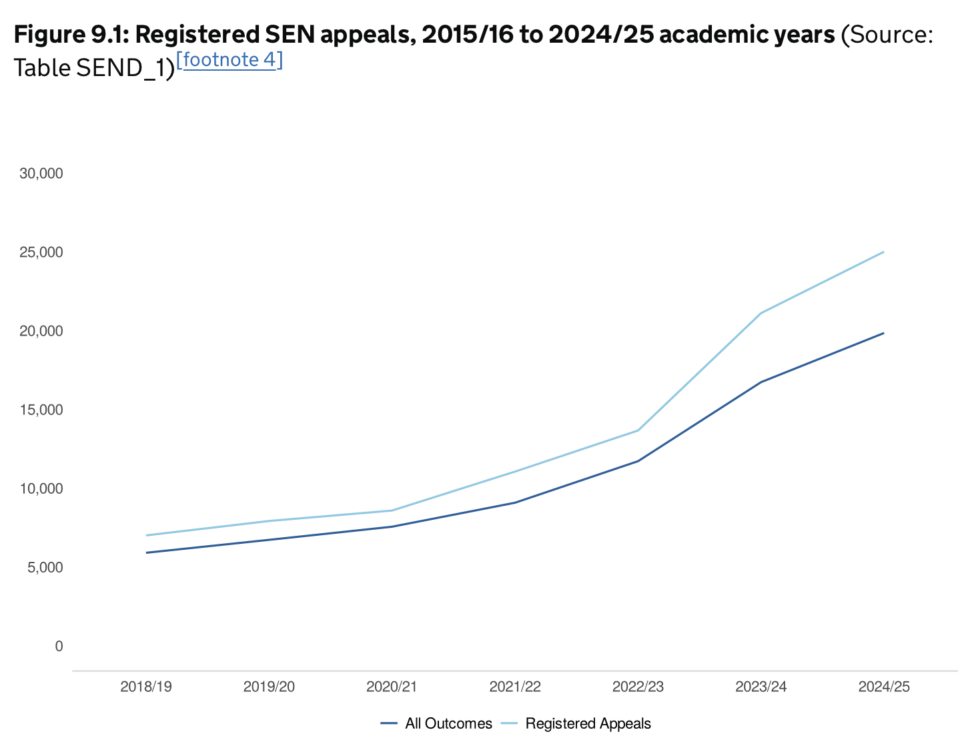
The government has also confirmed SEND tribunals – which rule on EHCP appeals – will continue, after new figures showed an 18 per cent increase in appeals in 2024-25 compared with the previous academic year.
There were 25,002 registered appeals last year, up from just 3,147 ten years ago. An age breakdown shows 7 per cent of appeals were for post-16 education.
Data published by the Ministry of Justice also shows that, as in previous years, the vast majority of cases – 99 per cent – that ended up at tribunal resulted in a finding in favour of parents. These are cases where the appellant wins the majority of the appeal.
Last year, 14,009 appealed were decided on by judges. The decision was only upheld in 143 cases.
In its response to the committee, the DfE said it recognised “the need for clear, independent routes of redress, retaining the SEND tribunal as an important legal backstop for families who are unable to find resolution earlier in the process.
But it added that “all parties should work closely and collaboratively to develop solutions to their disagreements, so that children or young people get the support they need quicker without the need for a tribunal appeal”.
Schools minister Georgia Gould told an online consultation event this week the government was “really actively looking at” how to address needs without parents entering the “adversarial” tribunal process.
‘Barriers’ to resourced provision

Government is hosting nine face-to-face and five online events aimed at “putting families at the heart” of its plans.
But the “conversation” only runs until January 14 – and leaves little time ahead of the delayed white paper, expected to be published the same month.
Ministers have said they want to see more resourced provision for students with SEND.
Gould said government wanted to understand the “real barriers” to operating such provision.










Your thoughts