

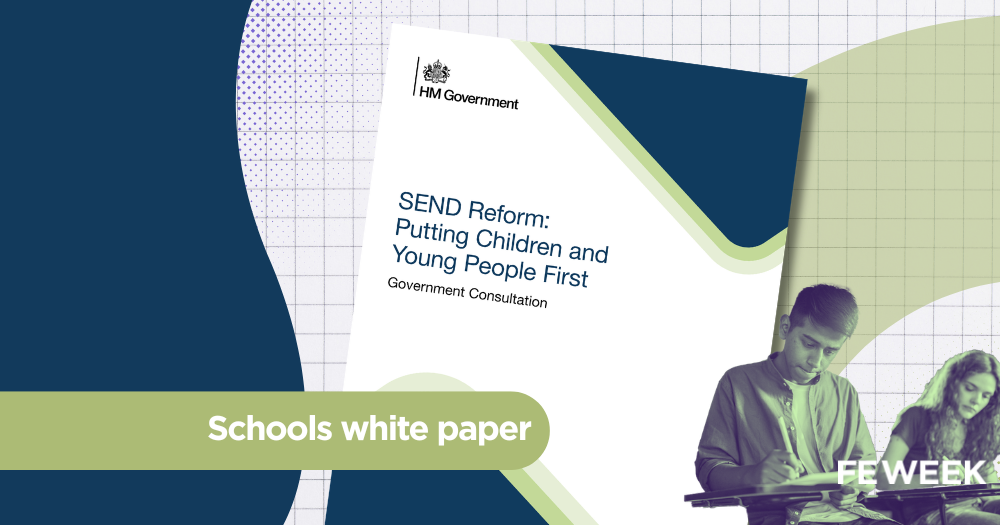
Colleges will face fresh legal duties to produce new support plans for learners with SEND under proposed reforms that set out to reduce the number of young people receiving education, health and care plans.
A Department for Education consultation, launched today, contains proposals to reserve education, health and care plans (EHCPs) for learners with the most complex SEND needs and provide learners with less complex needs with new individual support plans (ISPs).
The overhaul aims for one in eight students with EHCPs to be moved to the new ISPs by 2035, with new statutory duties placed on schools and colleges to develop and deliver the plans.
Colleges, as well as schools, will have access to inclusion funding of £1.6 billion over three years, £1.8 billion to improve access to external support and £200 million for staff training.
Officials are consulting on whether colleges should be required to demonstrate how they use inclusion funding in their accountability agreements.
The consultation is open until May 18.
Inclusion accountability
The DfE said it will work with colleges to develop an “appropriate and proportionate” approach for inclusion support in FE.
Targeted support will give children and young people access to ISPs – interactive and annually reviewed plans developed with parents.
The government is consulting on whether to make it statutory for colleges to produce an ISP for young people with SEND. FE providers would develop them with parents to identify barriers to learning, their provision, any reasonable adjustments and the intended outcome.
Ministers argue that while fewer learners will require EHCPs, more will receive multi-agency support through the new “targeted” and “targeted-plus” layers.
Meanwhile, the specialist support layer will bring out new “specialist provision packages” designed by experts and tested with parents to detail provision based on evidence. In future, they will form the basis of ECHPs.
It follows Ofsted’s renewed framework from November, which shifted more focus on inclusion in colleges for the first time.
Post-16 transition planning to start earlier
DfE vowed to work with colleges and local authorities to design a “clear” approach to support transition from school to college to reduce the risk of SEND learners becoming NEET.
Schools, councils and post-16 providers will be asked to plan for transition needs to begin at least 12 months in advance to allow time to create bespoke learning packages.
“In doing so, they will ensure young people can choose a suitable study programme and are supported from day one through to further education,” DfE said.
From September 2029, subject to legislation, children and young people with an EHCP will have their needs assessed by local authorities at transition points, such as the end of primary school, secondary school and post-16, and either move onto a specialist provision package or ISPs.
Young people with EHCPs in mainstream settings at the point the legislation comes into force would retain them until the end of their current education phase. This in specialist settings will not be required to move to a mainstream setting unless they choose to.
Staff training
The consultation said colleges could be subject to new statutory duties to deliver a national inclusion training programme to all workers in the 0 to 25 system, not just specialist SEND staff.
This will be done through an amendment of the SEND code of practice. A separate public consultation on the proposed changes to the code will be launched after the government responds to this consultation.
Backed by £200 million over three years starting this September, FE staff will be trained on building on “best practice” to ensure learning is accessible.
DfE will also review the equivalents of the special educational needs coordinator (SENCO) in colleges to examine how they can use their expertise “more strategically”.
Experts at hand
The reforms also revealed a £1.8 billion ‘experts at hand’ programme over the next three years, embedding educational psychologists, speech and language therapists, and occupational therapists into schools and colleges.
The investment, most of which will be pumped into local authorities and integrated care boards, will be expected to improve access to the experts for general FE colleges and specialist post-16 colleges.
This programme will be available to learners who need the “targeted plus” level of support.
DfE acknowledged that each sector may need to “tailor” its approach.
“An alternative model may be more appropriate for colleges and localised post-16 providers given that their size and therefore commissioning capability is varied and often spread across multiple local authorities,” DfE said.
Inclusion bases
The consultation also detailed £3.7 billion capital investment by 2030 to create tens of thousands of new places for SEND learners in so-called “inclusion bases”.
These bases replace SEN units in schools and are meant to provide tailored learning environments and equipment for learners’ needs.
Colleges are included in the programme and will be able to access the funding to make their buildings more accessible.
Specialist settings cap
The government is also examining the prices that councils pay for SEND places in specialist settings after finding school places were “unreasonably” high compared to state special schools – £62,000 vs £24,000 in respectively in 2024-25.
Ministers will for the first time cap the fees independent special schools can charge councils for provision, with the education secretary vowing to “crack down on providers who put profit before children”.
DfE said it will legislate to require new reporting duties on financial transparency and give new powers to ministers to refuse opening new independent special schools.
Officials added they are considering what changes would be required to ensure special post-16 institutions are “treated in a similar way”.











Your thoughts