
GCSE failure as Wilshaw sounds alarm bells

Ofsted boss Sir Michael Wilshaw has told of his shock at GCSE English and maths attainment levels and teaching quality — and just days later figures for 2012/13 revealed nearly half of 16 to 18-year-olds without at least grade C in GCSE English or maths failed to repeat or even study alternative qualifications at the same or lower levels.

The chief inspector warned that “alarm bells” should be ringing over 16 to 19 study programmes, which were launched last year — after the period of the Department for Education figures — and requiring learners without grade C in GCSE English or maths to keep working towards the achievement.

The figures for 2012/13 further showed that of the total number of key stage four learners that did not achieve A* to C GCSE in English (188,365) and maths (211,171) only around 18 per cent were re-entered for either. And in total, just 6.5 per cent then achieved at least C in English and 7 per cent in maths.

Schools Minister David Laws said: “These figures show that prior to our reforms too many young people were allowed to give up these subjects without achieving the levels required by employers.”

But Sir Michael, speaking ahead of a lecture by the education watchdog’s FE and skills director Lorna Fitzjohn, expressed fears that young people were not “well served” by study programmes.

“Too few students make sufficient progress in improving their skills in English and mathematics, because the teaching they receive is simply not good enough,” he said.

He said: “The gap between the good intentions of government policy in relation to this age group and the reality of what is happening on the ground is worryingly wide… our recent surveys of the 16 to 19 study programmes and youth participation, should ring alarm bells for policy-makers and also practitioners.

“The simple truth of what’s happening at the moment is that too many young people, particularly those from disadvantaged backgrounds, and those who want to find vocational pathways, are not yet being well served by these programmes… as chief inspector, I am very concerned.”

Sir Michael also used his speech to talk about the potential impact of not preparing young people for the world of work, claiming that a “sloppy attitude to punctuality” and a “lackadaisical” attitude could stem from poor employability skills teaching.

He said: “Our most recent report on careers guidance, published this time last year, is one of the most damning documents that Ofsted has ever produced.”

He added: “Again, it’s quite shocking that 84 per cent of youngsters who don’t get their GCSE at grade C in English and maths at 16 fail to achieve these grades at 19.

“Above all, I am particularly concerned that education and training is not preparing young people well enough for work. Many employers complain that far too many young people looking for work have not been taught the skills, attitudes and behaviours they need to be successful in the world of work.

“And what does this actually mean on the ground? It means they have a sloppy attitude to punctuality. It means they are far too relaxed in terms of meeting deadlines to produce work. It means that far too many young people are lackadaisical in the way they present themselves for work. If they dress inappropriately, speak inappropriately, and have poor social skills, they are not going to get a job.

“Youth unemployment in our country is far too high, and it is in everyone’s interest to ensure that young people receive the very best education and training to improve this situation.

“And the consequences, if we don’t get this right, are too serious to ignore.”


Editorial

In October last year, we reported how new DfE figures showed the majority of students achieving a GCSE grade D in English and maths were not then being re-entered for the qualification at sixth form or college.

In his editorial at the time, my predecessor Nick Linford was rightly critical of colleges for offering alternative qualifications, such as functional skills, to these learners where achieving the grade A* to C GCSE would have overcome a barrier to employment.

We now know nearly half of all those not achieving the grade C, not just those with a grade D, were neither entered for GCSEs nor functional skills in 2012/13.

In fact, they didn’t even study an alternative entry or level one English or maths qualifications.

The government has acted, as English and maths lessons for those 16 to 18-year-olds without a grade C or above at GCSE became a funding requirement as part of a study programme from this year.

And from 2015/16 a learner leaving school with a grade D GCSE in English or maths will have to retake it.

Yet these new government requirements are worth nothing if the teaching and success rates are poor.

The Ofsted’s verdict on study programmes last year is not good.

So the whole school sixth form and FE sector needs to step up to the challenge.

What must be avoided as a response is the shirking of responsibility and, like many employers, the raising of entry criteria and thus refusing to take on 16 to 18-year-old learners without GCSE Cs and above.

The government needs to be alert to that risk, as it would be an unintended tragedy.

Chris Henwood, editor


College rips up ‘not fit for purpose’ UTC action plan

An improvement plan aimed at turning around the fortunes of an inadequate-rated university technical college (UTC) has been ripped up and rewritten by its new general FE college sponsorship team.

Ofsted inspectors revisited Central Bedfordshire UTC to see how it was getting on after the grade four result, but branded its improvement plan “not fit for purpose”.

However, Bedford College, having been asked by former Education Secretary Michael Gove to step in and take over, became the UTC main sponsor after the revisit — and principal Ian Pryce said a new plan had been drawn up and was now in place.

Mr Pryce, who is also the newly-appointed UTC chair of governors, told FE Week: “Bedford College has a separate plan, which Ofsted said it would consider at its next visit.”

He added: “Since Bedford College became sponsors of the UTC over the summer, we have appointed a new head, new senior team, strengthened the teaching team, revised the curriculum and invested in new facilities including the library.

“The Ofsted visit also took place before the summer exam results came out and these included excellent pass rates in engineering courses and improved A-level results.”

Ofsted’s inadequate rating came in June, with inspectors critical of the quality of leadership, governance, teaching and curriculum.

They also said learning at the 150-learner UTC, which specialises in engineering and design, was “not secure” because teachers “do not always check students’ understanding or how well they have developed skills in lessons”.

The inspectors’ report on the revisit, which took place mid-July, also revealed how “due to too few applications, the college is not expecting to admit any students into year 10 in the academic year 2014/15.

Nevertheless, with the UTC in new hands, Mr Pryce said he was “confident the UTC has a very bright future”.

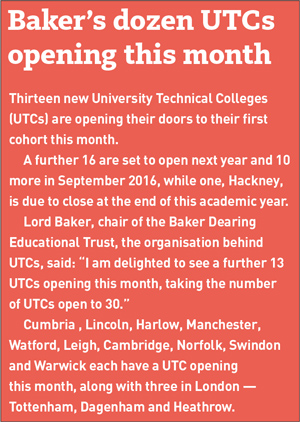
Of the three other UTCs inspected so far, Black Country and Hackney UTCs got grade three results while the JCB Academy in Staffordshire received a good rating.bakers-dozen-web

However, the issue of low enrolment figures has hit a number of UTCs, including the one in Hackney, which is to close after this academic year having failed to recruit enough students.

Despite this, Shadow Education Secretary Tristram Hunt told
FE Week sister publication Academies Week on Tuesday (September 9) that he wanted “considerable growth” in their numbers.

However, he stopped short of the recommendation in June’s review for the Labour Party by Lord Adonis, called Mending the fractured economy: Smarter state, better jobs, in which the Labour peer proposed 100 more UTCs by 2020.

Mr Hunt told Academies Week at the CBI Education Conference: “There should be considerable growth in UTCs but I won’t put a figure on it.”

Main pic: Ian Pryce

Scotland vote uncertainty for UKCES

The future of the UK Commission for Employment and Skills (UKCES) could be just as much on the line as the United Kingdom, FE Week can reveal.

With voters in Scotland due to go to the polls this week over whether they want independence, it has emerged that the Department for Business, Innovation and Skills has not planned for the UKCES in the event of a split.

A BIS spokesperson conceded the future of the UK-wide research and policy body was not planned for if Scotland was to break away after Thursday’s referendum.

She said: “We will not be making or commenting on plans for the possibility of an independent Scotland before the referendum.”

The organisation, which had a budget of £66.9m for 2013-14 and employs around 100 staff, produces an annual employer skills survey for each of the four UK nations, as well as an overall survey — but much of its work focuses on the UK as a whole.

The Scottish government directly contributes £500,000 a-year to the UKCES to support the development of National Occupational Standards. And the Scottish government claims to have made an “active contribution” to the development of the UKCES.

The Scottish government website says: “Scottish Ministers influenced and agreed the organisation’s remit and year one objectives, ensuring that UKCES focussed appropriately on Scottish issues from the outset.”

A spokesperson for the UKCES, which was created in April 2008, said she was unable to comment on plans for the future of the organisation.

But Sir Charlie Mayfield (pictured front), UKCES chair, speaking in his role as chair of the John Lewis and Waitrose partnership, appeared to express misgivings about the prospect of Scottish independence, warning there would be “economic consequences to a Yes vote”.

And Colin Borland, head of external affairs at the Federation of Small Businesses Scotland warned the future of many projects such the UKCES could be at risk.

“There are many cross-UK institutions who are wondering what’s going to happen to them,” he told FE Week.

“Whether or not a lot of the good work could continue in the event of a Yes vote or a more devolved situation, we don’t know but it’s going to have to be sorted out.”

The BIS spokesperson said: “The UKCES has a commissioner appointed from each of the home nations by their respective governments. Each year, the four nations have the opportunity to influence the work of UKCES through their grant-in-aid letter.”

However, she declined to comment further on the grounds that the government was observing Purdah — an electoral convention where all parties agree not to publish material that could sway the vote just before an election.

But both the Yes and No campaigns have accused the other of breaking Purdah following a host of new policy announcements affecting Scotland.

Principal who stood down amid allegations returns as deputy

A former principal who stood down from the top job at London’s Newham College amid a series of damaging allegations has been given a deputy’s role at another college.

Densie Brown
Densie Brown

Denise Brown (formerly Brown-Sackey) left Newham in January, two months after it was claimed the college had failed to take action over a recording posted on YouTube of former head of drama Dr Mark Walcott seeming to make homophobic comments about gay teachers.

The 20,000-learner college also faced allegations that passes had been awarded to students who did not attend any lectures, or had attendance rates of 40 per cent or less.

Ms Brown was confirmed as permanent vice principal for curriculum and quality at South Essex College, which has around 19,000 learners, this month — six months after taking up the post on an interim basis.

Angela O’Donoghue, principal of South Essex College, said: “Ms Brown was appointed as vice principal for curriculum and quality, on an interim basis, on March 25, before being made permanent earlier this month.

“She went through a rigorous interview and selection process and was considered the most appropriate person to meet the needs of the college by our governors and senior staff.

“She is highly experienced with more than 30 years’ experience in FE, working her way up from being a lecturer to senior manager, vice principal and principal. It is right that we utilise those skills to help take our college forward.”

Ms Brown had served at Newham for almost 25 years, starting as a lecturer in 1988 and working her way up to principal, with a brief stint as deputy principal at Havering College between 1999 and 2002.

Her move to a deputy role is thought to be at least the second time in recent years that a principal has gone from the top job to a lesser role at another college.

Martin Penny quit as principal of Stratford-Upon-Avon College, which has around 6,000 learners, in October.

It was given a grade three Ofsted inspection result the following month, before its financial health was branded inadequate by the Skills Funding Agency, in turn prompting a visit from FE Commissioner Dr David Collins

Mr Penny has since become interim director of finance and corporate services at Devon’s Bicton College.

A spokesperson for Newham said its investigation into the grade massaging allegations was ongoing. It is understood that Mr Walcott no longer works for the college.

Ms Brown declined to comment on her appointment.

Free schools sector poised for more FE college sponsors

Two FE colleges and one sixth form college are expected to bid to open their own free schools when the next round of Department for Education (DfE) bidding opens, FE Week can reveal.

Croydon College and New College Swindon want to open free schools with sixth form provision, while New College Pontefract — a sixth form college — is hoping to open a free school for 16 to 19-year-olds.

Croydon College’s planned New Croydon Academy would be situated on its own campus, taking on 180 students a-year, starting with just the year seven cohort in 2016.

New College Swindon is looking at a free school and sixth form on a separate site, and New College Pontefract wants to open a free school sixth form college for 1,200 learners in Doncaster.

The colleges are expected to hand their free school proposals into the DfE when the bidding window opens, on September 29 — closing on October 10.

If the bids were successful, all three free schools would open in September 2016, adding to the FE sector’s existing free school offer with South Staffordshire College and Hadlow College already running one each. Richmond upon Thames College won permission earlier this year and plans to open a free school in 2017.

Free schools are state-funded schools which are not required to follow the national curriculum, operate outside of local authority control, and answer directly to the Secretary of State for Education.

Frances Wadsworth, principal at Ofsted grade two-rated Croydon College, said: “This is an exciting opportunity for Croydon. Together, we can provide resources, expertise and world-class facilities to benefit the pupils, the community and the future prosperity of the borough and beyond.”

A vision statement on the proposed new free school’s website said it planned to deliver “teaching and learning through the use of digital literacy and science”.

Amanda Walton, head of marketing and customer services at the grade two-rated New College Swindon, told FE Week: “We were approached by the MP for Swindon North Justin Tomlinson and the council and asked if we wanted to put together a bid.

“We felt that having run an FE college we were in a good position to do it and we wanted to help and support learners.”

The new school, which would have capacity for 1,500 students, will have a focus on business and enterprise, but would follow the national curriculum, she said.

New College Pontefract principal Pauline Hagen told FE Week: “We had a few areas in mind, but we chose Doncaster because in many ways it’s very similar to Pontefract — it’s a former mining community where
the manufacturing base has disappeared, leading to worklessness and low expectations.

“We’ve had experience of dealing with that in Pontefract, of raising aspirations of parents and students, and we thought we had a lot to bring to Doncaster, where most existing providers are grade three or four.”

The college, rated outstanding by Ofsted, had been motivated to get involved with the free schools project, she said, because sixth form colleges were in danger of being overlooked.

“Sixth form colleges are not part of the government’s thinking at the moment — we were a 1970s creation, but we are still top-performing providers,” she said.

“We want the secretary of state to notice what we do and appreciate what we do and so we are embracing the government’s agenda.”

DfE passes NCS funding buck to BIS

The National Careers Service (NCS) figures in many of the hopes for improved information, advice and guidance (IAG). However, its source of funding recently underwent a key change, as Freddie Whittaker reports.

Department for Education (DfE) responsibility for NCS funding was shifted to the Department for Business, Innovation and Skills (BIS) just months before the service plays a bigger role in schools.

The NCS currently provides phone and web services to anyone aged 13 and over. Only those aged 19-plus can access its face-to-face service. But new statutory guidance for schools, issued in April, says the NCS will “expand its offer to schools and colleges” from next month.

However, while the DfE dished out £4.7m last year to the NCS — it gave nothing this year. The DfE said it previously paid for the helpline and webchat service for young people and “this formed in effect a ring-fenced budget within the NCS”. Shifting the budget to BIS, it said, “provides some flexibility in the way NCS is able to develop online and telephone advice for young people”.

However, with BIS picking up a £94m bill for the NCS this year, up £10m on last year, a DfE spokesperson was unable to identify any of its funds that had been transferred to BIS along with the added responsibility. And a spokesperson for BIS was also unable to confirm if it had received any additional funding — from DfE or elsewhere — to cover any of its extra £10m for NCS. The Ministry of Justice (MoJ) pays £14m and the Department for Work and Pensions (DWP) £1.5m of the NCS £109m budget for 2014/15. Last year’s budget of £106m was made up of £84.4m from BIS, £14m from MoJ, £1.5m from DWP, and DfE’s contribution.

The funding of NCS has previously proved a bone of contention with National Careers Council (NCC) members Professor Tony Watts and Heather Jackson resigning from the body last year. They walked out in a row over the way an NCC report covered NCS funding, arguing it “ducked the issue” of BIS paying for youngsters’ careers guidance, allowing DfE to “escape its responsibilities”.

Funding for the NCS was also one of the main points in the Association of Colleges’ (AoC) Careers Guidance: Guaranteed campaign with chief executive Martin Doel, writing in FE Week last year: “Let’s be frank about this, the DfE contribution to the NCS has been extremely disappointing.” And in light of the funding shift, Joy Mercer, AoC education policy director, said: “We feel the DfE should contribute equally [with BIS] both in terms of money and engagement.”

Former Skills Minister Matthew Hancock was also grilled about the issue last year by the education select committee, including chair Graham Stuart. At the time, Mr Stuart said: “Will the minister reassure us that the DfE is committed tosupporting the work of the NCS properly? Will the DfE realise the opportunity that the NCS provides to ensure that we have an all-ages, competent, re-professionalised careers service?”

FE Week contacted Mr Stuart’s office, but was told he had no comment on the latest development.

ETF passes £20m contracts milestone

The Education and Training Foundation (ETF) has broken through the milestone of £20m in sector contracts.

It gave out a total of £23,364,323 to 77 different organisations, from charities and unions to universities and private training providers, since its official launch around August last year and the beginning of last month.

The three biggest-earning contractors, Tribal Education Ltd, the Association of Colleges (AoC) and the Association of Employment and Learning Providers (AELP), were awarded contracts worth almost £9m between them for various services.

The biggest single contract, with Tribal, was £2,930,000 for the maths teacher recruitment incentive scheme.

David Russell, ETF chief executive, told FE Week: “All of our contracts are designed to generate high value outputs and impact. Quite rightly we are held up to account on this by our sector owners, our board, expert panels and the Department for Business, Innovation and Skills (BIS) — as our funding body.

“An English enhancement programme is about to start which will enable 1,400 teachers to teach at GCSE level. This will impact thousands more learners. This stands out as it provides practical support to a sector under pressure to respond to the new GCSE requirements. Regional leads across the country will put organisations in touch with the support available to them.

“Also topical this month is the contract we issued for workforce data collection which has resulted in the most comprehensive set of characteristics we have ever had about the FE workforce.”

Last November, the ETF, which is owned by the AoC, AELP and the Association of Adult Education and Training Organisations (also referred to as Holex), said it was handing back £7m of its £18m budget to BIS due to an underspend.

Nevertheless, the ETF got an £18m budget for 2014-15 and is set to get a reduced figure of £10m next year.

‘We’ve been struggling with adult literacy and numeracy for decades’

An MPs’ committee has been investigating whether England has been failing adults who struggle with numeracy and literacy. Paul Stanistreet looks at the committee’s findings.

The House of Commons Business, Innovation and Skills Select Committee report on adult literacy and numeracy paints a troubling picture of a society in which those who have been failed by the education system continue to miss out on opportunities to learn.

The report is critical of the current government’s approach and of its predecessors’ failure to develop a coherent strategy for adult literacy and numeracy. It calls for a national campaign to boost adult literacy and numeracy and urges government to develop a more coherent, cross-departmental approach to dealing with the UK’s dreadfully poor performance in literacy and numeracy, with better screening, and support for more flexible provision.

The report mentions the ‘inevitable impact’ of low adult skills on economic performance. This is true and important, but the impact goes deeper.

Poor skills don’t just affect people’s ability to do a job well. They hold you back at every stage and in every area of life, with consequences for your health, political participation, relationships with others and, of course, your children’s life chances.

Many of those who leave compulsory education without the basic skills necessary to function in society are reluctant to re-engage with education. And those who do often struggle to find the right kind of opportunity. For many this will not be in a traditional classroom.

Some of the government’s interventions are making a bad situation worse

The report makes sensible suggestions for dealing with these problems. There is recognition of the need for flexibility, in terms of types of programme and provider, and a call for the reversal of the recent funding reduction to unionlearn, imposed in spite of its success in engaging exactly this type of learner.

The committee also calls for more investment and promotion of family learning schemes and a move away from the ‘traditional, linear approach to achieving qualifications’, typified by the government’s obsession with the GCSE ‘gold standard’.

Some of the government’s interventions are making a bad situation worse. The cut to funding for unionlearn is an example of the short-termism of many of the policies implemented under the banner of austerity. The 35 per cent drop in the adult skills budget over the past five years is closing rather than opening up opportunities for adults to learn and making it more difficult for providers to target the hardest to reach.

The community learning budget, though maintained in cash terms, has also been reduced in real terms. At the same time, reductions in voluntary sector support make it harder to replicate on the ground the kind of cooperation the committee would like to see between government departments.

We have struggled with this issue for decades. Despite that, it is still not the case that every child leaves compulsory education with the resources they need for a decent life. Those who fared the worst in compulsory education continue to be those least likely to take up educational opportunity as adults. Many of those who are most in need of support are bearing the brunt of austerity politics, working longer hours for less pay as they struggle to provide for their families. When your day-to-day life is all about survival it is hard to get your head up and think about the future (even if, by some chance, you have heard that the government guarantees to fund adult students up to level two in maths and English).

Cuts in FE funding have made the situation worse with providers given little incentive to invest time and resources in engaging the hardest-to-reach adults rather than focusing on those more likely to complete their courses and progress. As the report notes, funding continues to be ‘driven by the need for qualifications’. Some of the committee’s recommendations, if implemented, will help — and it is difficult to argue against the need for a national campaign or for greater cross-departmental cooperation.

But it is hard to escape the feeling that some more fundamental change — involving the way we do politics and how we address wider social and economic inequalities — will be necessary too.