
Twelve months of change for Skills Minister and FE Week — a review of 2014
The past year was a dramatic one for FE Week which saw a change of editor and a major re-design with publication of our 100th edition. Reporter Paul Offord looks back at the highlights of 2014, the 16 FE Week supplements and 35 newspapers published.
Click here to view the spread
JCP traineeship ‘target’ after ‘concerns scheme extends benefit claims’
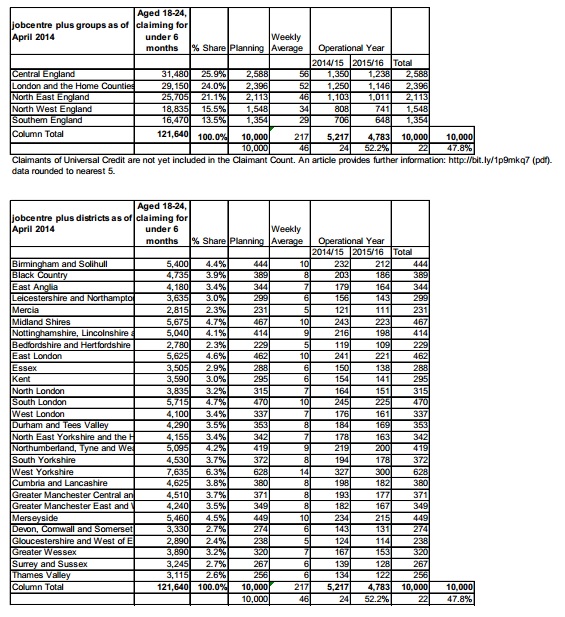
Job Centre Plus (JCP) staff have been set a “target” of 10,000 traineeship referrals amid concerns the youth unemployment programme had not been promoted to benefit claimants because it extended their time out of work, FE Week can reveal.
The figure, to be achieved within 12 months from August this year, was disclosed in documents released following a Freedom of Information request.
It is split into “planning assumptions” [see below] for England’s 28 JCP districts, but a Department for Work and Pensions (DWP) spokesperson said they did not represent targets despite, according to the documents, telling JCP staff to “ensure steps in place to achieve allocations.
There had been concerns that JCP staff were not putting benefit claimants on the programme because it affected their search for paid employment in the meantime.
Association of Employment and Learning Providers chief executive Stewart Segal said: “We have heard of many examples of where JCPs have not referred clients because they are concerned that traineeships are too long and will delay people getting off benefits.
“Providers are creating flexible programmes that ensure young people get the skills they need to sustain employment in the long term and JCP must support this process. It is good that JCP will set targets for referrals, but this should not become a numbers game.”
The Statistical First Release published on November 26 showed there had been 10,400 traineeship starts during 2013/14 — the programme’s first year.
Dr Fiona Aldridge, assistant director for development and research at the National Institute of Adult Continuing Education, said: “We have found that referrals to traineeships, by JCP staff, have been relatively low.”
She added: “We are in the process of capturing the good practice that exists between JCP and traineeship providers and will use this to develop support materials to help work coaches identify suitable participants. This will be invaluable in improving levels of awareness and understanding among JCP staff. It will improve partnership working between local JCPs and providers.”
Teresa Frith, senior skills policy manager for the Association of Colleges (AoC), said: “We are discussing with DWP how colleges can support JCPs in achieving these targets.
“We’re pleased to see the Department for Business, Innovation and Skills [BIS] and DWP working more closely as this allows for a more holistic approach in supporting people who are unemployed.”
A DWP spokesperson said: “There are no targets, but we want to help as many young people as possible to improve their skills and move into work. Traineeships are key to this, so as the programme grows we will be referring more young claimants to it.”
He declined to comment on claims about JCPs not referring clients to traineeships. A BIS spokesperson declined to comment.
Editor’s comment
A job for now or job skills for life?
Just under a year ago FE Week reported how Job Centre Plus (JCP) staff were turning 18 and 19-year-olds away from traineeships because enrolment would put their benefits at risk.
So it’s an odd situation to now hear of JCP staff having apparently turned potential enrolments away from the programme because it might actually extend their time claiming benefits.
This would have presumably taken place because chasing a job, any job, might appear more attractive to JCP staff than claimants developing lifelong employability skills while remaining in receipt of benefits.
But, in the week Ofsted revealed its view of traineeships as being one in which “the numbers involved are extremely low,” we learn the Department for Work and Pensions (DWP) now appears on board to push the programme.
Its target (let’s not kid ourselves it’s anything else) of 10,000 referrals will come as welcome news to the providers putting their time and effort into a programme that should always have had the full backing of those in charge of JCP staff.
These are the very staff who regularly deal with those for whom the traineeship programme was developed — young people with little or no job experience and employability skills.
It’s wrong to deny these people the chance to develop the essential skills to win and hold down a job.
Chris Henwood
chris.henwood@feweek.co.uk
Former Exeter College learner Jo Pavey beaten to BBC Sports Personality title by Formula 1 champion Lewis Hamilton
Hopes of an ex-FE and skills learner claiming glory in the Sports Personality of Year awards last night were dashed as Formula 1 champion Lewis Hamilton took the BBC crown.
Former Exeter College learner Jo Pavey, who won the 10,000m title at the European Championships Zurich in August 10 days after winning bronze in the 5,000m at the Commonwealth Games, had been in contention but ended third behind golfer Rory McIlroy.

The 41-year-old, who did her A-levels at the Devon college between 1990 and 1992, got 99,913 (16 per cent) of the 620,932 votes cast, while 25-year-old Mr McIlroy received 123,745 votes (20 per cent) and 29-year-old Mr Hamilton registered 209,920 votes (34 per cent).
Exeter College principal Richard Atkins told FE Week: “Jo studied with us before progressing to university.
“She has kept in touch with us and has, from time to time, come in and spoken to our sports therapy students.We see quite a lot of Jo locally, at community sports awards, chamber of commerce dinner etc and she remembers her time at college fondly in part because she and her (now) husband and coach, Gavin, spent a lot of time in the college refectory.”
He added: “As principal of Exeter College I am immensely proud of Jo’s achievements. She is a brilliant role model for our female students, and an exceptional example of how perseverance can triumph.
“She is very modest and it was amazing to see her standing alongside Lewis Hamilton and Rory McIlroy last night.
“As chair of AoC Sport, our sector’s sports organisation, I realise that we need role models such as Jo to help us to encourage more females to participate regularly in physical exercise and sport.”
Earlier today, Ms Pavey tweeted: “Thanks so much to everyone who voted for me. I feel very overwhelmed. I really can’t believe I made top 3. Thank you #BBCSPOTY.”
But there was BBC Sports personality disappointment for FE & skills among Commonwealth Games medallists who had been in the running for the Young Sports Personality of the Year award.
Loughborough College learner and sprinter Sophie Thorhill, Notre Dame Catholic Sixth Form College learner and diver Alicia Blagg, and former Prior Pursglove College learner and wheelchair athlete Jade Jones, all 18, were all shortlisted, but missed out to gymnast Claudia Fragapane. The 17-year-old became the first British woman in more than 80 years to win four gold medals at one Commonwealth Games.
New SFA chief Peter Lauener reveals college finance concerns in exclusive interview first with FE Week
New Skills Funding Agency (SFA) chief executive Peter Lauener (pictured) has told of his concern for the future of a “growing number of colleges” running into financial difficulties, in an exclusive interview with FE Week editor Chris Henwood.
Mr Lauener, appointed around the start of last month, outlined how “financial strategies” were key in the face of ongoing austerity measures.
In a wide-ranging interview, the first he has given since adding the SFA post to his existing chief executive role at the Education Funding Agency (EFA), he reflected on the scale of college inspections carried out by FE Commissioner Dr David Collins with concerns over bank balances.
He said: “All providers are certainly facing challenges, and we do have concerns about a number of colleges, and the growing number of colleges, and equally I could say in the schools sector there are a number of schools facing financial challenges, and some do have problems, but it is equally the case, coming back to the college sector, there are a number in strong financial health.
“Colleges need to look hard at their financial strategy; they need to look hard at their curriculum resourcing plan and make sure they’ve got a plan that they can afford, and they need to look hard as well at their governance and make sure that the corporation of an FE college, or a sixth form college for that matter, are getting the right regular reports about financial difficulties.”
The vast majority of Dr Collins’ 13 inspections, for which official reports have been published, were triggered by SFA financial concerns and where an Ofsted inspection result triggered his visit, finances were also later identified by the FE Commissioner as an issue.
“It’s not surprising that there would be more colleges in financial difficulty, given the reduction in budgets, in adult skills budgets, given the fact that the 16 to 19 budget has not been protected in the way that the pre-16 budget has been protected, so it has been, very clearly, a challenging financial position,” said Mr Lauener.
He added: “Our analysis indicates a worsening position for colleges in the FE sector and sixth form colleges, and that’s not surprising, given what we’ve talked about, and the workload of the FE Commissioner as a result is significant, as indeed is the workload of the Sixth Form College Commissioner [Peter Mucklow], who is one of my staff in the EFA.
“So there is definitely going to be an important agenda here over the next few years. In fact, I don’t see this being a ‘we’ll work hard and sort it over the next year’ situation — this needs to be a long-term issue.
“But the prime responsibility rests at corporation level, and I would much rather that these problems were sorted at corporation level. In my view, when there is intervention from the funding agencies, that’s because all the checks and balances in the system have not worked.”
And with further FE and skills cuts widely expected, Mr Lauener had words of budgetary caution. He said: “It would be foolish of any of us to expect that there will be a sudden loosening of the financial belt after the election — I would take quite the opposite from the broad statements made by the Chancellor [George Osborne] and the Chief Secretary [Danny Alexander] with the Autumn Statement.
“There is a public sector budget deficit that needs to be cut, and politicians from all parties are making it clear that they expect to cut that, to reduce that and eliminate that public sector financial deficit, and it will be very surprising if the post-16 sector was immune from that — I’m certainly not expecting that and I don’t think colleges should plan on that optimistic scenario.”
Peter Lauener in the FE Week spotlight

Chris Henwood: You’ve been at the SFA for around six weeks now. How are you finding the workload with your existing role at the EFA?
Peter Lauener: I’m certainly finding time is under a lot of pressure. Having said that, I’ve got two teams of very strong directors, and I wouldn’t have been able to take on this role without very strong people working for me, so that allows me to focus my time on what I think is most important.
What are your thoughts on the recent National Audit Office report that spoke of streamlining education and training funding systems?
If I look at the SFA and the EFA, they have done similar things in the territory of improving the IT systems, the platform on which we operate, so we both developed online account systems for the organisations that we fund. One question is could we bring these together? I think putting it a little bit more widely, and not just about the IT systems but about the systems that we use to fund. I think one of the questions I would certainly want to look at is whether there is cope for simplification in the SFA systems.
We’ve done quite a lot in recent years, partly because of the Alison Wolf agenda, to simplify some of the post-16 education funding agency systems, they’re massively simpler than they used to be, and that’s allowed us to streamline the data requirements of the sector from the EFA. I would certainly like to have a look at the scope for doing that in the SFA as well.
You mentioned IT systems, but this will send shivers down the spine of MIS officers up and down the country based on their experiences with Fis, Lars and the Hub. How can you assure them that they’re not in for more problems?
Things definitely went wrong in the last year. I’ve just had, in the last few days, a report on RO4 this year, because I asked to be kept up to date with my SFA and EFA hat on, and the reports are pretty encouraging, that the returns have worked to a good quality and consistent standard. So I think those problems are behind us, but I will certainly continue to look with my colleagues very closely at that, and there’s been a lot of work over the last year on the systems implementation, and I think we’re in a good position, a much better position than a year ago. But this will remain high on my radar for two reasons. One is a basic credibility thing — people expect a funding agency to be able to manage its data well. And people expect a funding agency to get the money out, but these are basic core licence to practice things. So before we do anything fancy we need to make sure we’re doing the basics now.
Are there any plans for a single funding system?
This is not about a merger of the organisations. I’ve not taken the job because of that, nor is there a plan to merge the organisations. Many of the organisations that the EFA and the SFA fund are the same; colleges, charitable and commercial providers, many of the partners and stakeholders are the same, so there is definitely scope for doing things simpler, better, better together, more effectively in the future, and I am obviously very keen to explore that.
We recently reported how providers were not complying with SFA rules on declaring subcontractor arrangements and, where they had, fees of up to 40 per cent were being charged. What are your thoughts on this?
I can’t say what we were doing in any particular case, but I do believe in transparency on these matters. Actually, there are many cases where you get a prime contractor/sub-contractor relationship which is entirely beneficial and allows organisations to play a part who haven’t got the capacity, or indeed the capability, and possibly not even the inclination to put in place all the QA arrangements and management information returns, they just want to do a particular thing.
A prime contractor can agree a wider range of functions with sub-contractors, and I don’t believe we should be laying down a very precise template and charging regime. Having said that, it would find it quite hard to see a set of arrangements that would justify a 40 per cent management fee, because it’s kind of obvious that what is taken as a management fee is not going to frontline education or training.
Exclusive feweek.co.uk additional Q&A content
Where the FE Commissioner has intervened, a vast majority have been because of financial problems, not Ofsted grades. Was that a surprise for you?
No, it wasn’t a surprise, and I don’t think it should have been a surprise in the sector. These financial problems have been brewing for the last couple of years, and Dr Collins’ letters to the sector have been very punchy and to the point.
I think it’s great having him in that role; every principal knows he’s been there, done that, got the t-shirt, in fact got one or two t-shirts, so his assessment is frank, it’s credible, but it only generally provides the basis for the next stages. It’s not the case that Dr Collins goes in, does a report, and the issue is sorted — it’s then often back to how do we now put these in place, what funding support might be needed, what is the action plan to bring this college back into a satisfactory financial state?
And that has to be led at the corporation level. Sometimes, there have obviously been cases, and no doubt there will be one or two, where it goes beyond the capacity of an individual corporation to do that, we will then need to look at the scope for mergers, if that’s a sensible way forward, and we can’t, we wouldn’t, rule anything out in that situation.
What we have to do is have confidence that the plans that emerge will provide a satisfactory way forward. There’s no point going from the frying pan into the fire and creating a situation that there is no confidence that it would be viable in the long-term. So that will need a long, sustained focus from corporations, and from the funding agency/agencies.
What kind of projections has the SFA got for the number of colleges we can expect to see being visited by Dr Collins?
I’m not going to give numbers of colleges, because this is not an area where you can turn the handle on a model and you get out a specific number.
This is something that we need to keep under very intensive review, and every time we get a new point of information, recalibrate and say, have we got concerns about that college, are things getting better or worse. So the important thing I would say here is that we’re very clear about the way we use data. And this is certainly one area that I am keen to look at the relative experience of the EFA and the SFA.
In the EFA, we’ve got quite a lot of experience of manipulating large amounts of financial data, because we’re funding now 4,500 academies. So 4,500 academies is a long way past the position where you can have a deep personal knowledge about what happens in each institution, so what we rely more and more on is data — putting data to an analytical model.
I was asked about this at the last public accounts committee I went to with my EFA hat on, and it’s a kind of data analytics approach that any organisation working in the financial sector will now use. So we’ve developed in the education funding a risk assessment tool, I know there have been similar approaches in the SFA, but I’d like to say, well, can we pool our experience on this? And are there different ways of using the data that will get us to a sharper understanding of the risk that is being run here? The second thing that I think is very important is absolute transparency. So one of the things that bothers me when I hear corporations that say, “Well, we didn’t know about this…” No, that’s obviously a set of arrangements that are not working well, and in many cases there are outstanding corporations with outstanding leadership teams, and there’s everything you would want to see. But I do think that funding agencies have got a role in making as much data transparent. So making data about the sector as transparent as possible, and I think there’s scope to go further with financial data on that, certainly making it transparent to corporations.
What was the thinking behind the change to a new system of loans from BIS [covered by FE Week in edition 121] as opposed to the former system of SFA advances?
That is just a matter of departmental accounting practice. This is not a matter of policy, but it is a matter of accounting practice, and the delegations, and where authority to make loans, as opposed to advances, is held. There’s nothing complex about that. As the chief executive of the SFA, I have authority to make advances of funding, but not authorities to make loans — and it’s as simple as that.
The final decision is a matter for ministers in cases of loans, but the recommendations and assessment are made by the SFA in a similar way as previously, so I don’t regard this as a big change in practice, or something odd or unusual, or something limiting the SFA.
Does this change to loans have any benefit?
Well, I’m not convinced it either has benefits or disbenefits. Again, we’re also in ‘last resort’ territory, because I never start from the proposition when a college is in financial problems that we should step in and bail it out, and I don’t think any college starts from that expectation. The first thing is, can the college reschedule its affairs? Can it make savings, can it realise assets, can it change what it does that will earn a surplus? And of course colleges are able to secure loans from the banking sector, and most colleges have got loans of one sort or another, or overdraft facilities, and that will resort to be the first point. I would always regard it as a sign that something was wrong if any college came in, and obviously a number do, seeking financial support in the form of an advance or a loan.
What are your thoughts on the future of the SFA in light of the movement towards city devolution and devolution of the skills budget?
It was already there with local enterprise partnerships (Leps) and skills pilots and all these things, and I think the wider question is, “What isn’t right to specify nationally?” or, “What isn’t right to specify locally?” or, “What isn’t right that employers should dictate?”
I view the devolution issue as part of that. And sometimes, there’s a mistaken belief that in the SFA we specify from on high what colleges should be doing — well, we don’t at all. That has always been a matter decided locally. The question comes from the localism/devolution debate is what the sum of colleges are providing in a particular area? Does it add up to what the local community needs or to employers’ needs? And some local partners are saying no.
If I was a college principal in that situation, I would be wanting to work very closely with other colleges, or in a college where you’ve got a large college covering a city, like Sheffield College, where I come from, I would take a particular responsibility for saying, “What evidence have I got that I am meeting community needs, young people’s needs, adult needs and employer needs?” And I would want to be on the front foot in that debate with local government, with the Lep, and I would be. I would see them as important stakeholders to satisfy. I don’t think that debate is going to go away, and I think it’s very important that the sector responds with national leadership and local leadership.
It’s our job at the SFA to make those arrangements work, however they emerge from the ministerial discussions and decisions — it’s not our job to say it should be this or it should be that. It’s our job to make the system work in the best possible way, the most efficient way, the most effective way, the way that consumes least resource from the system so everyone else can get on, provide the skills, provide the opportunities, get employers working more effectively.
So you don’t see the role of the SFA as being challenged by city devolution?
Not necessarily, and indeed we’re doing a lot of work to support Leps in their role. Now, clearly you could construct scenarios that said that the funding should be done, managed in a completely different way, and I’m neutral on that question, because the SFA doesn’t have a policy of responsibility or a planning responsibility. Our job is to make the system work as effectively as possible to meet the objectives set by ministers, and to advise on the best way. Is there a policy idea, say, to advise on the feasibility of implementation? Now, if there was a decision to manage some budgets in completely different ways, that’s probably a decision for ministers, and if that affects some of the rules that we do, then that’s something we will need to adjust.
But at the moment, ministers have asked us to work very closely supporting both Leps and supporting the new deals that are emerging for cities, and we will be doing that. I was talking with one of my senior team about discussions in Manchester, about the Manchester deal, and I’m sure we’ll play an important part in both providing data about what’s happening, and in developing the possible ways that local aspirations can be met.
Apprenticeships among the 16 to 18 age group are on the up again, but now the issue is for the 19+ age group and 25+. We have even heard that growth requests are being turned down for 25+. How can you increase 25+ apprentice numbers? Do you want to?
We want to meet whatever targets the government give us — as we speak on the day that the two millionth apprentice was announced. The adult apprenticeships budget is a single unringfenced budget so there are no separate limits for 19 to 24s and 25+ but of course we pay different amounts. We’re certainly targeting growth in 16-19 and 19 to 24.
Association of Employment and Learning Providers chief executive Stuart Segal recently said there needed to be greater flexibility when it comes to funding apprenticeships. What are your thoughts around that?
Providers always call for greater flexibility. I’ve already said I think there is a case to look at for other areas where we can simplify the funding system, but I have two absolute requisites in any systems we are operating. Number one, I have to manage the budget. A funding agency that busts the budget will not be long for this world, and we can probably all think of one or two examples where that has happened. I don’t think Stuart was saying this, so if providers are saying: “We need a fast-track way to increase our budget,” then that is only possible up to a point because we have to operate within a national budget, and that will never change — and nor should it change. We have to manage within the national budgets.
Then the second thing that’s a requisite for me in that kind of situation is all part of the national targets, and if there is a priority to a particular target, then to achieve that target you will have to maintain funding on that line and not move it into another line.
So I’m kind of sympathetic, subject to my two requisites and from managing the budget to meeting our targets. We are keen to expand higher apprenticeships, and I think that’s really important for the future of the whole programme, so we need to prioritise that. This may relate back to your 25+ point, but government is all about priorities, and if you decide to spend the money here rather than there, then that knocks back into the funding system. What we need to do in the SFA is not to erect our own rigidities that were never intended by ministers in setting the policy objectives and the targets for the organisation of the system.
Apprenticeship funding reforms have been in the pipeline for a while now. Do you have any concerns about making employers pay a third?
Well, we need to wait, clearly, to see what funding policy proposals emerge, so it’s our job to make a system work once a policy is decided. At the heart of it, it’s not a debate about funding — that’s a mechanism for making the policy happen. At the heart of it is getting employers engaged in the delivery of apprenticeships.
Why? Because that’s good, it’s right for the apprentice, it’s good for the employer and it’s good for UK Plc — and that’s at the core of it.
What have you learnt about the SFA since you have been at its chief executive?
It’s not exactly something I learned, but I’ve had a very warm welcome. So I’ve made a point of visiting all the SFAs major sites, so there are six major sites and I’ve visited all six in the last few weeks, and conducted staff meetings on those sites. I’ve also visited a seventh, as it happens, one of the smaller sites, and I’ve enjoyed talking to staff about the organisations they have previously worked in. So there is a lot of experience, a wealth of knowledge in the SFA, and that’s great — and that’s something I’ve had confirmed rather than something I have learned. The second thing I would say is that I’ve been looking at areas where there might be scope for the EFA and the SFA to work jointly and more effectively in the future together in a way that might enable us both to do a better job and to make savings, and there are a few areas that I’ve developed where I would want to look further at that in months to come.
What words of advice can you give to college principals in terms of the austerity ahead and the difficulties we are facing?
I would say there are some great colleges who are delivering for employers, delivering for their communities and delivering for their students, whether they are young people or adults, and they are running their organisation, getting excellent inspection results from Ofsted and with strong finances. So there are great examples in the sector for others to learn from. So make sure you made your own assessments of your college, and are aware of where there are colleges that are maybe doing things that you should learn from.
‘Outstanding’ indie hosts lavish Lords awards event
Above, pictured from left: Professional cricketer Tom Poynton, Castus apprentice Laura Martin, aged 23, cricketer Wayne Madsen, Baroness Kennedy, Castus apprentice Alex Bellis, 21, Gary Hides, Castus senior manager, professional footballer Shaun Barker, and 3aaa owners Peter Marples and Di McEvoy-Robinson
An independent learning provider rated as outstanding by Oftsed impressed high achieving apprentices and employers by holding its annual awards ceremony in grand surroundings at Westminster.

Aspire, Achieve, Advance (3aaa), given its grade one rating across all headline fields last month, held its annual awards ceremony in the Cholmondeley Room at The House Of Lords on Thursday (December 4).
Company owners Peter Marples and Di McEvoy-Robinson hosted the event and awards were handed out by Baroness Kennedy, chair of the Helena Kennedy Foundation, Shaun Barker, club captain of Derby County Football Club, and Wayne Madsen and Tom Poynton, first team players from Derbyshire County Cricket Club.

The provider’s eight top apprentices (see below) and a number of firms that employ 3aaa apprentices, including London-based IT infrastructure services firm Computacentre, Derbyshire-based Darley Dale Medical Centre, Sheffield-based website design company Castus.
Ms McEvoy-Robinson told guests at the ceremony: “We are very proud today to be celebrating success today. One of the key reasons for our outstanding [Ofsted] grade is our fantastic employers and apprentices. We have more than 2,000 apprentices and couldn’t bring them all along today, but are proud to recognise our top achievers.”
3aaa winners
Mariam Suleman, aged 18
Employer: Bay Accountancy
Training centre: Birmingham Academy
Apprenticeship: Level three accountancy
Paige Nolan, 18
Employer: B & M Stores
Training centre: Liverpool Academy
Apprenticeship: Level three accountancy
Lisa Jarvis, 20
Employer: CSC
Training centre: Manchester Academy
Apprenticeship: Level three IT
Luke Sanders, 19
Employer: Aldi Stores
Training centre: Tamworth Academy
Apprenticeship: Level three IT
Richard Morris, 18
Employer: ASD Solutions
Training centre: Derby Academy
Apprenticeship: Level three IT
Ryan Scales, 21
Employer: Ocado
Training centre: Watford Academy
Apprenticeship: Level three IT
Melissa Smith, 20
Employer: Darley Dale Medical Centre
Training centre: Nottingham Academy
Apprenticeship: Level three digital marketing & social media
Amy Allsobrook, 21
Employer: 3aaa
Training centre: Derby Academy
Apprenticeship: Level three digital marketing & social media
‘Relentless’ drive to improve standards
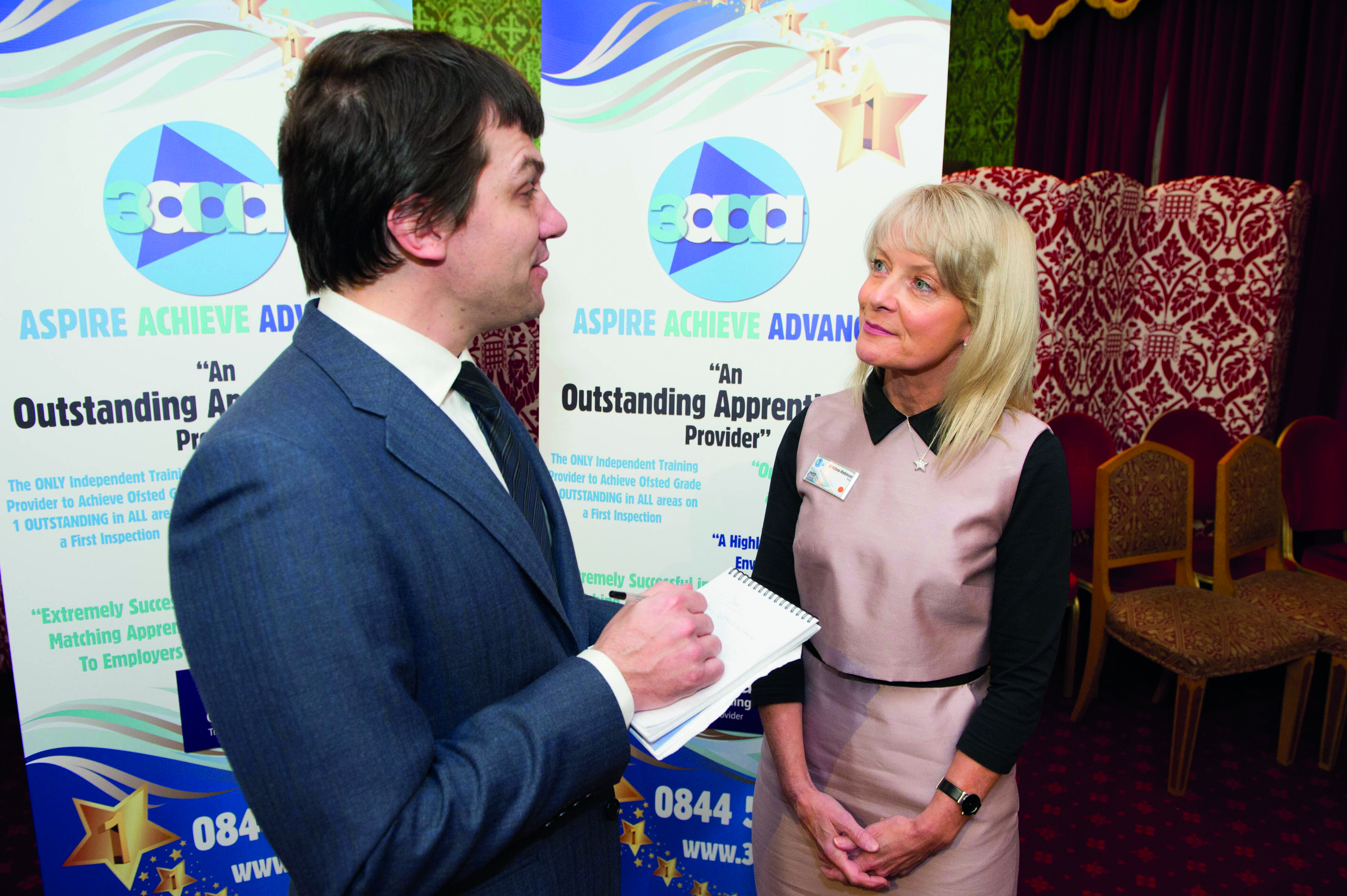
Co-owner of 3aaa Di McEvoy-Robinson speaks to FE Week reporter Paul Offord about the grade one achievement and other FE and skills issues
How did 3aaa prepare for the Ofsted inspection?
We didn’t know the inspection was coming, as you only get two days’ notice. But we knew one was due, so made sure all the checks and balances were in place to maintain our high standards.
We have a formal board. I lead a subgroup of that board for quality and standards which I chair every month and the key people in the business have to be accountable for improvements. We are relentless.
We also track the performance and support needed by our apprentices closely and have always observed our trainers and assessors and given immediate feedback.
If they are observed by our internal quality team and they achieve a grade one rating for the learning they provide, they are rewarded with a £300 payment.
We also celebrate that with a little story about them in our weekly newsletter. In addition to that, we bring in external inspectors to check what we are doing. We don’t just assume our internal processes are good enough.
What grade did you get in self-assessment before the Ofsted visit?
We [recently] self-graded a level one in all of the key areas. However, only a year ago, we had self-assessed at a level two and everybody in the organisation had a little part to play in thinking about how we could improve.
How can you improve further?
I think to improve further we need to look down the track and say what is going to be important in teaching, learning and assessment? How, for example, is social media and technology going to have an impact?
One of the key things is bringing in young people — so that’s, for example, 18 to 19-year-olds coming in and delivering technology training. It is so exciting what is happening with technology and they understand it best.
Would the result have been the same if your subcontracted work had been taken into account in Ofsted grading?
We don’t subcontract our own training, but we work as a subcontractor to other colleges where we run training academies and the standards are exactly the same as for the rest of the business. We, for example, work with Bedford College which funds our Milton Keynes Academy and was inspected by Ofsted as part of the overall grade one inspection.
What management fees does 3aaa charge?
As I said, we don’t subcontract ourselves, but no-one who we do subcontracting work for charges us more than 15 per cent. A 40 per cent management fee would be extortionate.
What are your views on the government’s planned apprentice funding reforms and potentially routing funding through employers?
The voice of small and medium-sized enterprises who deliver more than 65 per cent of new apprenticeship starts appears to have been lost in the debate and they certainly do not want the additional bureaucracy involved in the planned reforms.
We believe that employer contributions should be increased through a measured and incremental increase in apprenticeship wages.
Should Ofsted take greater account of providers’ financial situation when it inspects?
Ofsted should undoubtedly take account of the financial state of organisations it inspects. The FE Commissioner’s recent report highlighted key issues that need to be in place to provide all-round assurance to the funding bodies and more importantly to the tax payer, that Ofsted grades reflect strong and sustainable organisations.
‘Dear Santa…’ the sector’s Christmas wish list
With a general election, tightening funding and the ongoing apprenticeship reforms, next year looks set to be a turbulent one for the FE and skills sector, as well as the country at large.
But with the festive season of goodwill approaching, we asked familiar faces from across the sector what they’d like see under the FE Christmas tree for next year.
And whatever 2015 does bring, the team here at FE Week would like to wish everyone in the sector a very merry Christmas and a happy New Year.

Payment link to new outcome measures rejected
Skills Minister Nick Boles (pictured) has announced a second consultation on outcome-based success measures having all but ruled out their use in a “payment by results system”.
The Department for Business, Innovation and Skills (BIS) launched a three-month consultation in August on plans to add post-19 learner outcomes to qualification achievement as measures of success from 2016/17.
It proposed that the data should include whether learners get a job, details of subsequent salaries, and whether they continue learning.
The consultation further looked at proposed definitions for the measures, what additional information would be helpful, the uses to which the data could be put and how it should be presented and published. It also put forward using the new success measures to help set minimum standards that could trigger further investigation and ultimately intervention.
However, a document published by BIS on Wednesday (December 10) outlining the results of the consultation and the government’s own response, highlighted concerns about the possible new minimum standards framework.
It also said the government “expected that the outcome measures would not be used as part of a payment by results system; such a system must be able to track individual learners and matched data cannot be used in that way.”
Mr Boles, in the document, said: “We intend to proceed with the new measures as proposed in the consultation paper, but we want to make sure they are as useful as they can be.
“There are a number of issues we need to explore further and we will consult on the detail of, and timetable for, using and publishing the measures as part of a new accountability framework.”
Joy Mercer, Association of Colleges senior policy manager for quality assurance, said: “BIS has listened to concerns from a number of organisations about using this information to hold colleges to account.
“We welcome further work on the detail, including destinations into self-employment and contextual information.”
Association of Employment and Learning Providers (AELP) chief executive Stewart Segal’s response: “These are complex issues and AELP fully understands why the government is seeking to consult further.
“The government is right to strongly believe in the value and importance of outcome measures and since its founding, the AELP has pressed for a basket of measures which properly reflects the needs of employers and learners as well as recognising the positive outcomes of work-based learning providers.
“We are pleased therefore that the new learner destinations will cover the securing of employment.”
Dr Lynne Sedgmore CBE, executive director of the 157 Group, said, “We are pleased that the government seems to have listened to our view — and that of many in the skills system — that while developing these measures will give a fuller picture of the real impact of further education, we must take time before deciding how they should be used in any future accountability systems.
“History teaches us that allying such systems to underdeveloped data too swiftly leads to unintended consequences and, sometimes, game-playing. We would much rather see the development of a ‘basket of measures’ that – apart from giving an indication of institutional performance – enables colleges, other providers and employers to gain a better understanding of what we are doing.
“We look forward to informing next year’s more detailed consultation on these issues.”
A BIS spokesperson said the additional consultation would get under way within a year.
Meanwhile, the Department for Education’s response to a consultation on publishing performance measures on school and college websites came out on Thursday (December 11).
The month-long consultation, which ran from June 6, asked for views on whether colleges should have headlines performance measures, including learner progress, attainment, English and maths progress, retention and destinations, displaying on their website to allow parents and potential students to compare institutions.
The response added: “In light of the comments received we plan to continue to explore how we can present the headline measures in a way that best meets the needs of parents.”
Ms Mercer said: “The response reveals that the DfE needs to do some further research into the presentation of performance tables on college websites.
“We would encourage them to continue to involve colleges and schools in their next steps as it is important that parents and young people are not misled by something that looks attractive but does not put the information in context.”
The government will conduct “further user research” to find out the best way to do this and will inform colleges next autumn of the final requirements for 2016.
Cable concession on ‘two million’ apprentice claims
Government claims to have overseen the two millionth apprentice start have been met with caution after Business Secretary Vince Cable conceded around one-in-four learners may not stay the course.
Dr Cable announced the milestone figure, achieved during the course of this parliament, while on a visit to Oxford on Monday (December 8) to meet Paige McConville.
She started the two millionth apprenticeship, in advanced engineering manufacturing with employers FMB and provider Abingdon and Witney College, in August.
But in an interview with FE Week, Dr Cable conceded that not all the vaunted starts would lead to completions, and he accepted the figure included multiple starts per learner and frameworks of less than 12 months’ duration that were outlawed early on in the Parliament.
He said: “We can’t be absolutely confident because of course not all are completed. The completion rate for apprenticeships generally, and I’m going across all levels, is about 73 per cent. It has been up and down around that level for the past five years. Some people start them and do not complete them.
“The basic numerical narrative is we have started the two millionth apprentice and that is the number of starts over the last parliament.
“So far we will have completed over one million apprenticeships, but you won’t see the full effects of the starts for a few years.”
Statistical First Release (SFR) figures indicate that there have been around 1.99m apprentice starts during current parliament, which started around the fourth quarter of 2009/10. But the two million figure is expected to be listed in the next SFR, due late next month.
It comes against the backdrop of a second consecutive annual fall in the number of apprentice starts with 2013/14 down nearly 70,000 on the previous year.
All-age apprenticeship starts were at 440,400 last academic year, having been at 510,200 the previous year, and 520,600 in 2011/12.
Nevertheless, Mick Fletcher, a founder member of the Policy Consortium, said the two million figure was impressive, but he warned against “headline-chasing statistics”.
“The figures are for starts when what matters is successful completion, ideally with progression into sustainable employment,” he said.
“According to the latest figures fewer than three quarters of apprentices successfully completed their programme and of those who completed only around two thirds were kept on by their employer.
“The figure of 2m starts is still impressive, but only achieved by including programmes that are no longer recognised as apprenticeships — those lasting less than six months for example. This explains why despite meeting the target the trend in numbers is downwards.
“Moreover many members of the public would be surprised to learn that nearly half of the total are not young people starting their working life as ministers imply but adults, mainly over the age of 25 and in many cases already employed.
“Political leaders of all colours deserve credit for their consistent support for the apprenticeship programme but their enthusiasm for headline-chasing statistics risks devaluing their real achievements.”