The ‘painful’ path from inadequate to good

After a visit from FE Commissioner Dr David Collins in 2014, Weymouth College went from an Ofsted rating of inadequate to good in just 11 months last year. Nigel Evans explains how the feat was achieved.

Then FE Week asked me to write something on the turnaround at Weymouth College, it would be true to say that I was very flattered. However, I appreciate that we have been on a somewhat unique journey over the past year.

One of the key features of our ability to address the (critical) issues at Weymouth College has been leadership and management, and that doesn’t mean it is all about me. Quite the reverse.

I read the Barnfield College article in FE Week and was interested by the comments: ‘We’ve achieved a lot in 10 months. We now have a fantastic staff team, as over one third of the staff have changed, mostly managers.’ This may have been true at Barnfield — it certainly isn’t at Weymouth. We significantly reduced our staff ratio percentage but lost very few staff during our journey, and I think that single factor has probably contributed most to our success. The Weymouth College staff know this isn’t just about continuous institutional review, restructuring, retracting and redundancy.

I also read with interest, the FE Commissioner Dr David Collins’ words: ‘‘Dr Collins said that he had also identified issues with the background knowledge of some principals, however he said that this ‘doesn’t matter if you have got a very strong team around you’ but warned if the management team as a whole was weak the college ‘was at risk of getting into difficulties’’.

This is what I wanted to dwell upon. Dr Collins has provided real clarity for us at Weymouth. What he has said is true, we didn’t have it right and what was worse, we didn’t know what was wrong. So last year we had some painful reshuffles at senior level where we did lose a small number of senior staff where we didn’t have sufficient expertise, particularly at financial level. As a consequence we engaged Andrew Tyley (ex-finance director and principal and now part of the commissioner’s team) to help lead us out of our financial mire. Crucial here was also the ability of our new senior leadership team to provide accurate management information. The college culture was always going to be another key factor that brought Weymouth College out of difficulty.

We have rapid and effective decision-making and with the notable lack of egos

The current corporation and senior leadership team are the best that I have ever worked with and all staff contributed to our current position as we continue our journey to outstanding. The lessons from us are — teamwork, trust, openness and transparency, everyone working together for the benefit of the college’s future. We are now very lean (and mean) and it is a really good place to be, we have rapid and effective decision-making and with the notable lack of egos this creates a great formula for being a responsive and effective College.

And anyway, if you want my personal view, I think we all need to remember that, at principal level, we are only custodians of our colleges. It simply isn’t our role to lead our colleges as a reflection of ourselves — but it is about us ensuring that our colleges are fit for purpose, financially viable and serve our communities to the upmost.

It isn’t about us — and that, for me, is a potential danger facing the sector as we sit in the middle of a very ambitious and all-encompassing Area Review process following a government steer towards ‘larger and more resilient Colleges’. Even if a college is ‘larger and supposedly more resilient’ — whatever the size and makeup, you only need one errant principal and unreliable financial management information to bring it to its knees.

We need to be aware that what can come with ‘larger’/federated colleges can be, multi-layered hierarchies, where decision-making is constipated and sometimes impossible. The problems we had at Weymouth were nothing to do with being a small college and the fact we are back on the right track so quickly shows how much can be achieved without mergers, shared services or federations.


EDITORIAL: Boles bottles it

Editor’s comment

Boles Web boost

‘I don’t know, or if I did I wouldn’t tell you’ — it’s quite a statement for Skills Minister Nick Boles to make to FE Week readers.

And to be clear, our presence at this exclusive round-table had been cleared with him.

So it’s disappointing to hear his refusal to give straight answers to simple questions about apprenticeship quality.

As a holder of public office, he cannot simply bluster away such questioning and nor should he want to considering the question asked could well be key to paving the way for standards. Employers and providers are understandably anxious about the shift from frameworks — and here’s just more evidence of this.

So if the Apprenticeship Delivery Board serves just one purpose then it would be most helpful if that purpose were to get Boles to be more forthcoming.

David Hughes is quite right to air concerns about giving employers the job of policing employers. We’ll just have to wait and see if it’s a view heard by Boles.

And while the minister may well not want to share his views with the public, the sector would like to share its views with him on this with a consultation — it might just be the only hope of slowing down the mad dash to launch the Institute for Apprenticeships.

Chris Henwood

chris.henwood@feweek.co.uk

Steve McCabe, Labour MP for Birmingham

As both a former FE learner and lecturer, Labour MP for Birmingham and Selly Oak Steve McCabe knows the sector intimately.

Born in Thornhill maternity hospital on the West coast of Scotland in 1955, McCabe was the middle child between two sisters, Sandra and Susan.

His mother was a housewife who later worked as a dinner lady in a local school, while his father’s jobs included working at a Rootes car factory.

Steve-and-childrenweb
Steve spending some quality time in North Wales with his children Rhianna and Kieron when they were young

McCabe’s first experience of education came at Boglestone Primary School in Port Glasgow, which he remembers fondly for its expansive playing fields. He and his sisters then went to the same local secondary school, Port Glasgow High School.

“Boys were primarily prepared for jobs in the shipyard. Clever boys went to work in the drawing office, and then you worked your way down the trades,” he explains.

“Girls were primarily trained for childcare, domestic science or factory work.”

Taking the Scottish Higher exams — the equivalent of A-levels — in his fifth year opened the door for McCabe to attend Moray House College in Edinburgh, where he studied social care.

I think in order to be able to accommodate a changing employment market, we probably do need to rationalise and specialise

The college, which is now part of Edinburgh University, specialised in teacher training, PE teaching and social and community work skills.

In hindsight, he says that 18 or 19 years old was quite young to train in the social care profession.

“We had a broad range of subjects that we were taught, we did a number of practical placements and in theory I acquired some skills – but if I’m really truthful I was pretty clueless!” he says.

His first full time job took him to Wolverhampton to join a social work area team. His mentor at the time was his boss, Doreen van Hiley, who he says was a very positive influence, and helped him to survive the first 18 months.

Steve-doing-Snowdon-to-London-charity-walkweb
Steve on a week long walk from the top of Mount Snowdon to the centre of Birmingham with volunteers from Kings Heath Cricket Club, to raise money for the Anthony Nolan Trust and other charities

As the work went on he found himself engaging with the world of FE again, working with students from local colleges in both Wolverhampton and Newbury in Berkshire.

“In those days it was quite common to take students sometimes for placements, experience and opportunities … I worked for a spell with young offenders and I had contact with FE colleges through helping students to get through their training courses.”

He found working with colleges a “patchy” process.

“Although there have been dramatic changes in the FE sector over the years, some of it doesn’t strike me as that different,” explains McCabe.

“There were always arguments about funding, there were always arguments about people who want to offer courses in a particular way, and there were always customers who were seeking something that didn’t quite fit the model that the college was trying to sell — the challenge is how you make those things responsive to real demand.”

Steve-pancake-raceweb
Steve shows off his pancake flipping skills in a House of Commons Charity pancake race

McCabe had a chance to experience this challenge head on when in 1985, after a decade in social work, he completed a Master’s degree in the subject at the University of Bradford. It made him think more about the way social work education was being offered in colleges, and he took a position as a lecturer at North East Worcestershire College in Bromsgrove.

He taught mostly older students over three years, and says it was a great experience.

“They were fascinating people, usually people who were a bit frightened by education, because their earlier experiences hadn’t been so great. But they were really clever, interesting folk to work with,” says McCabe.

“I did teach a class of young people who were doing a primary social care course, which was quite entertaining and amusing, and I also taught one class for adult returners — people who had no formal academic qualifications at all.”

McCabe then moved to do two years of part time child care work with the Family Protection Team, combined with a part time research job for the British Association of Social Workers, looking at childcare for young offenders.

Now in his 30s, he did five years working for the Central Council for Education and Training in Social Work (CETS), as a regional adviser responsible for advising on changes in curriculum and inspecting and setting up social work training programmes, including the launch of the health and social care NVQs.

macmil-(2)web
Steve takes part in a sponsored walk for MacMillan nurses

“It was an exciting and interesting time when issues like gender, equality and racism were surfacing where social work training had almost been devoid of content in those areas for years before,” he says.

Alongside working for CETS, McCabe was also selected as a local councillor in Birmingham in 1990, and later became a father to Rhianna and then Keiron, who are now 22 and 19 years old. Rhianna is completing an information and administration apprenticeship with the local authority and Keiron is in his first year of a law degree at the University of Bristol.

In 1997, McCabe won the seat of Birmingham Hall Green, holding it until 2010 when the boundaries were changed, making him the MP for Birmingham Selly Oak.

He has worked with the colleges in his constituency in a variety of ways, particularly South and City College which was created through the amalgamation of South Birmingham College & City College Birmingham in 2012.

It’s an experience that has helped him form a view of today’s sector and the issues it faces.

Steve-and-son-Aston-Villaweb
Steve and Kieron at the Aston Villa vs Arsenal FA cup final last season

“I think in order to be able to accommodate a changing employment market, we probably do need to rationalise and specialise a bit. But with anything like that there will be good historical and territorial arguments which will make that very difficult for people,” he adds.

During his political career McCabe has taken a special focus on education, working as Charles Clarke’s Parliamentary Private Secretary when he was Secretary of State for Education and then taking up the position of Shadow Children and Families Minister under Ed Miliband’s leadership of the Labour Party.

He still follows developments in the education sector, including the government’s post-16 education and training area review process. McCabe, who is divorced, now lives in King’s Heath with his partner of 10 years, Fiona Gordon, and his local area and constituency fell under the first wave of area reviews.

“I’m a bit sceptical about [area reviews] because I think maybe this is the government just simply thinking about money, and the danger is it may become a cash recovery exercise,” he says.

“But the idea that we have a review that seeks to develop a greater knowledge of the demands of the market and sectors, and tries to come up with a rational plan with a significant degree of specialism where it’s appropriate quite appeals to me.”

Looking to the future for FE, McCabe says he would like to see more coherence across the education sector as a whole.

“We waste a phenomenal amount of resource, and we fail to capitalise on the best practice,” he explains.

“We need to create a facility for lifelong learning. People are going to have to train, update, and retrain throughout their lives now — that is part of living in a flexible economy with changing demand.”

————————————————————————————————————————-

It’s a personal thing

What’s your favourite book?

It’s probably The Ragged-Trousered Philanthropist, because it had such a big impact on me when I was at a young age, and it made me think a lot about politics

What do you do to switch off from work?

I read, I cook and I watch Aston Villa getting beat

What’s your pet hate?

People on the bus with headphones on that they’re sharing with me

If you could invite anyone to a dinner party, living or dead, who would it be?

I’d definitely invite Jose Mourinho [former Chelsea football team manager] and his banker, and I would ask his banker to buy Aston Villa and Mourinho to manage them

What did you want to be when you were growing up?

A policeman or a train driver


Leaders rush to defend FE from Sir Michael

Key FE figures have spoken out in defence of the sector following a scathing attack by Ofsted boss Sir Michael Wilshaw.

Sir Michael Wilshaw, Chief Inspector of Education, Children’s Services and Skills.

During a speech on Monday (January 19) for thinktank CentreForum, the education watchdog’s chief inspector accused the sector of being “inadequate at best” and criticised the sector for offering “uniformly weak” careers advice.

“It is a real pity that Sir Michael chooses to use such outdated and incorrect language to describe the education and training provided by FE colleges,” said Martin Doel, chief executive of the Association of Colleges.

Far from being the “large, impersonal and amorphous” institutions failing to deliver “high-quality vocational education” that Sir Michael referred to in his speech, Mr Doel said that FE colleges “provide excellent pastoral support, work hard to ensure that all students are supported to help them succeed and advance their valuable employability skills and develop their career opportunities”.

Martin Doel
Martin Doel
Sue-Pember
Dr Sue Pember

Dr Sue Pember, director of policy and external relations at Holex and FE Week agony aunt, said that, while Sir Michael was “right to draw attention to vocational education” the sector should not be held responsible when government changes to the education system fail.

“Colleges and providers have been the pawns in these policy changes and really can’t be blamed if the systems that governments have advocated don’t actually succeed,” she said.

“What vocational education and training in England needs is policy stability and sustainable funding.”

In response to Sir Michael’s comment that 16 to 19 study programmes have “yet to make an impact” on maths and English GCSE pass rates, Dr Pember said it was “unrealistic to think that any college can turn round 6 to 10 years of poor schooling”.

“We need to put the emphasis on getting it right in secondary school,” she said.

Malcolm Trobe
Malcolm Trobe
Sally Hunt
Sally Hunt

Malcolm Trobe, deputy general secretary of the Association of School and College Leaders (ASCL), said that FE colleges should be “celebrated” for the “enormous contribution” they make to meeting the needs of learners and employers.

“They are doing extremely good work under circumstances in which they have received horrendous budget cuts,” he said.

Sally Hunt, general secretary of the University and College Union (UCU), agreed with Sir Michael’s call for better careers advice for college students, but warned that providing it “will require proper investment”.

She added: “Sir Michael is wrong to dismiss further education colleges as simply having failed the pupils that struggled academically at his schools.

“All young people deserve access to the best education that most suits their needs.”

During his speech Sir Michael also outlined his vision for what he called “federations” of schools, which would include university technical colleges “that would admit youngsters across the ability range to focus on apprenticeships at levels four, three and two”.

“It would not be a dumping ground for the disaffected and cater just for the lower-ability youngsters,” he said.

Phil-Hatton-Web-boost


Staff consulted over potential job losses at troubled Totton College

A struggling sixth form college is consulting on a restructuring plan that it is thought could lead to dozens of job losses.

Totton College, which was branded as inadequate by Ofsted in June last year, announced on Thursday (January 21) that it had begun consulting with staff in a process that it said will “determine the future path of the college”.

The move comes after the college merged with social justice charity Nacro, which uses skills and training to reduce crime and re-offending in English and Welsh communities, on December 1.

In a statement, the college said that 39 members of staff were “potentially affected”.

The college did not say how many jobs were at risk, but it did say that some of those affected would only see a reduction in hours.

A number of new posts – equating to 14 full time equivalent (FTE) – are likely to be created, it said.

Mark Sellis, interim principal at Totton College, said: “We have to make sure the college is ready to meet the challenges of the future.

“Change is therefore inevitable – difficult as that is for all of us here – and we now await the outcome of the consultation to see how far-reaching that change will be.”

“The future of Totton College depends on the decisions we make now,” said Josh Coleman, education principal at Nacro.

“These proposals would safeguard the college’s financial future,” he added.

Caryn Symons, regional official for the Association of Teachers and Lecturers (ATL), which represents some staff at the college, said that Totton’s future had been “uncertain” for a long time.

“Staff morale is already low due to the stress from a huge amount of change and uncertainty about the college’s future,” she said.

“It is sad that staff who have already been through such a turbulent time are now facing more stress as they fear for the future of their jobs.”

The proposed restructure comes after a troubled couple of years for the 3,600-learner college.

A financial notice to improve from the Education Funding Agency (EFA) in spring 2014 was followed by a visit from the Sixth Form Commissioner, Peter Mucklow, in October 2014, after concerns were raised about a lack of improvement in the college’s finances.

In December 2014, Mike Gaston, then Totton principal, announced the college would be seeking a merger after Mr Mucklow warned in his report on the college that it could no longer function alone.

The merger with Nacro was announced in June last year, after governors at Totton’s first choice partner Eastleigh College rejected the proposal.

At the same time, the government paid a “one-off settlement” to write off Totton’s pension liabilities, FE Week exclusively revealed.

The National Union of Teachers (NUT), which also represents staff at the college, was unavailable for comment.

The Education Funding Agency declined to comment.

Sector set to step up for Muslim women’s £20m English funding

The services of colleges and independent learning providers (ILPs) could be called upon to deliver English language lessons to Muslim women from a £20m fund announced by the Prime Minister.

David Cameron said on Monday (January 18) that the government needed to be “more clear about the expectations we place on those who come to live here” and the new fund would help Muslim women from areas with “segregation” issues to integrate more smoothly into British society.

A government spokesperson told FE Week two days later that it planned to launch “a bid process on who will deliver these classes to encourage a wide range of approaches and providers that meet the specific needs of women in the most isolated communities”.

She added the plan was to make “the fund open to all providers”, so FE colleges and ILPs could bid to run the classes in the women’s homes, local schools and community facilities, with travel and childcare costs provided for learners.

She added the £20m would be allocated “on top of existing Esol [English for speakers of other languages] schemes — which have seen more than £800m of government investment since 2010 and supported over 800,000 learners.

“In addition, we have invested £8m for community-based English tuition, which will have helped 33,500 isolated people by March 2016.”

When asked about colleges lodging bids for a slice of the new fund, an Association of Colleges spokesperson told FE Week they “will work with national and local government to support all communities to access English language courses at FE colleges, as a means of helping them to integrate in society”.

But AoC chief executive Martin Doel said the new fund would “not make up for” previous cuts to English language provision.

He added the government had made a 50 per cent (£160m) reduction in the funds available for Esol courses from 2008 to 2015.

Meanwhile, the Association for Employment and Learning Providers’ chief executive Stewart Segal said: “We’re not sure why this had to be part of a stand-alone fund, when it could have been part of mainstream funding which would allow providers to integrate provision with other programmes.”

The government declined to response to Mr Segal’s comment.


Cameron’s 3m target boost — but no standard take-off

Reformed apprenticeships have shown little sign of taking off in latest government statistics that indicate the programme could be on target for Prime Minister David Cameron’s 3m target.

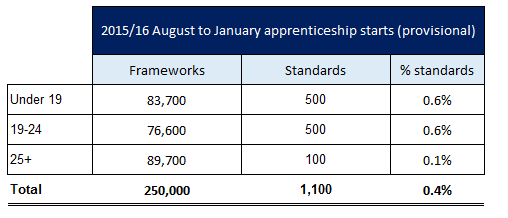
Just 700 starts across all ages and all levels were listed for the new standards in the statistical first release, published on Thursday (January 21). There were 400 confirmed for the whole of 2014/15.

The figure, which relates to the first quarter of 2015/16, is a stark contrast to the 153,100 starts on apprenticeship frameworks, which are being phased out for standards. It compares to 147,500 starts for the same period last year.

All the figures are provisional, but it paints a picture in which starts across the framework board were up 4 per cent on the same figures last year.

And to hit the Mr Cameron’s 3m target in the next five years there needs to be an average of 600,000 apprenticeship starts per year, or 150,000 per quarter.

However, the final figures could yet call this success into question. Last year’s final figures showed the first quarter to carry the most new starts at 163,600 — subsequent quarters brought lower figures, resulting in total new starts of 499,900 for the year.

Association of Employment and Learning Providers chief executive Stewart Segal said: “Adjustment of the provisional data for 2015/16 may lead later to better figures, but we are concerned that the programme is not growing at a pace we would like and in particular for 19-24 year olds.

He added: “Not all 19+ growth requests during this year have been approved and we are still waiting on the 16-18 responses as well which is a real concern when we are already half way through the year.”

But the provisional figures also showed an increase in the number of new traineeship starts, with 7,600 starts recorded in the first quarter of 2015/16, compared to only 5,000 for the previous year. And the growth could well continue with news, reported by FE Week on January 20, that restrictions limiting who can deliver traineeships were to be lifted next month rather than from August.

Skills Minister Nick Boles said: “Apprenticeships and traineeships are creating the highly skilled and productive workforce that is supporting our country’s economic growth. We are on the right track to delivering 3m apprenticeships by 2020.”


Deadline missed on apprenticeship consultation

The government has missed the first key deadline from its own timeline for apprenticeship reform implementation over the next five years, following delays to the launch of a consultation on the “public sector target”.

It published a document on December 7, called English Apprenticeships: Our 2020 vision document, setting out a number of imminent dates.

The first was that the government was supposed to consult “on the [apprenticeship] target for the public sector” before the turn of the year.

It explained that “through the Enterprise Bill, we [the government] intend to introduce new statutory targets for public sector bodies to employ their fair share of apprentices to contribute to our goal of achieving 3m apprenticeship starts”.

“The proposal is that the targets will apply to public bodies with 250 or more people working for them in England,” it said in the document.

“In December 2015, we will publish a consultation which will give the rationale behind a minimum target of 2.3 per cent and list the bodies proposed to be in scope.

“Following this and subject to Parliamentary approval, we will put these targets in place in 2016. Public bodies will then be required to report annually on progress.”

However, a Department for Business, Innovation and Skills (BIS) spokesperson admitted to FE Week on Thursday (January 21) that the “consultation has not yet been launched”, although he said “this will change in the next few days”.

The Skills Funding Agency (SFA) and BIS were also unable to comment ahead of publication on how the government was progressing with four other developments the 2020 document set for the first month of this year.

It said that a “National Careers Service digital platform will determine the potential suitability of a young person for apprenticeships, traineeships or the JCP work experience programme” from January.

“Data on apprenticeship wage returns by sector subject area” was also set to be published in the same month.

It added that “an integrated communications campaign to promote apprenticeships, traineeships and work experience opportunities” would also be created in January, and “guidance on funding both frameworks and standards for the 2016/2017 academic year” would be issued at the end of the month.

Shadow Skills Minister Gordon Marsden (pictured above) said: “It is the government that has set itself all these targets.

“Therefore, it doesn’t look good when it starts not being able to meet them. It raises questions over whether they have sufficient [staff] resources to do all these things.”

It comes as members of the Apprenticeship Delivery Board (ADB), which it is thought will be tasked helping ensure that the government doesn’t miss any more reform programme deadlines, were unveiled on Monday (January 18), five months after its creation was first announced.

But an SFA spokesperson told FE Week two days later that it was still “in the process of setting up the first meeting of the full ADB”.

Both BIS and the SFA declined to respond to Mr Marsden’s comments.


Online learning ‘not cheap option’

A Skills Funding Agency (SFA) decision not to introduce a reduced funding rate for online learning has been welcomed by the sector.

The SFA had been looking into online learning following the publication of the Further Education Learning Technology Action Group (Feltag) report in March 2014.

But speaking as a member of the audience during a talk at the Bett education technology show in London on January 20, Stephen Nichols, policy implementation manager at the SFA, said that online learning was not “the cheap option”.

“We’ve taken a lot of feedback on online funding rates,” said Mr Nichols.

“The Skills Funding Agency isn’t going to implement a cheap rate for online learning. I think we all appreciate that it’s not the cheap option,” he added.

Paul Rolfe, director of technology and innovation at Highbury College, Portsmouth, was part of the Feltag group. He said Mr Nichols’ announcement was “very much welcomed”.

He said: “Developing high quality online courses with interactive and engaging resources is incredibly time consuming and therefore expensive.”

The SFA’s acknowledgement of this “will enable innovative providers such as Highbury College to continue to invest in new delivery models which will respond to the changing needs of learners and employers,” he said.

A spokesperson for the Association of Colleges said the SFA was “right” that “developing and delivering high-quality online courses is not cheaper” than face-to-face learning.

“Colleges, and other providers, which choose to provide both types of course should receive funding that is accurate and commensurate with the type of content and means of delivery for specific courses,” she said.

Feltag also recommended that all publicly-funded learning programmes should have a minimum of 10 per cent online content from 2015/16.

In its Feltag progress report in February last year, the government said it had reviewed this recommendation “in the light of concerns raised about setting a target without first testing the impact”.

As a result, it said, the SFA would be undertaking “information gathering” to “baseline current activity”, as well as running a number of pilots and asking the sector to complete a “temperature check” survey.

Another Feltag member, learning technology adviser Bob Harrison, said: “What’s really encouraging, from an FE point of view, is that they are now actively looking to remove the barriers in the funding mechanism, which will allow teachers and FE providers to use technology in an innovative way.”

A spokesperson for the SFA said that the evidence they had seen showed that “there are a wide range of variables involved” in setting an online funding rate.

“Final recommendations on an online funding rate will be made when our online learning report is published in due course,” she said.

Maren-Deepwell-Web-boost2