

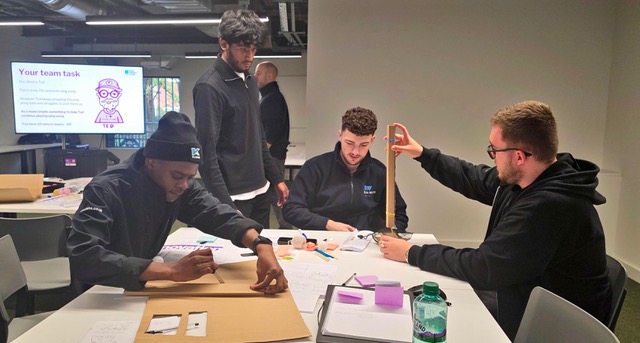
In Greater Manchester, a quiet revolution has been taking place in Further Education to address these challenges. It hasn’t come from new qualifications, or from policy announcements, but from a bold, new, practical idea, that innovation can be taught, learned and embedded through people.
The Innovation Literacy Launchpad drew on evidence from the GM Further Education Innovation Programme (GMFEIP), funded by Innovate UK, which demonstrated how FE-led approaches can widen participation, build capability and support diffusion in innovation.
The Innovation Literacy Launchpad was developed in response to a well-evidenced gap between technical skills and the real-world capabilities needed for innovation, the programme has, in just a short pilot phase, demonstrated something powerful, that when apprentices are given the tools, confidence and space to think differently, they don’t just learn, they transform how work gets done.
A Practical Response to a System Wide Challenge
Across the UK, organisations like Innovate UK and global bodies such as the World Economic Forum have consistently highlighted the same issue. While industries invest heavily in technical training, the skills that truly drive innovation such as creative thinking, problem-solving, collaboration and experimentation remain largely underdeveloped.
This gap is particularly visible in workplaces where processes go unquestioned, ideas remain unspoken and employees lack the confidence to challenge the way things have always been done.
The Innovation Literacy Programme was designed to tackle this head-on. Rather than treating innovation as abstract or reserved for specialists, it reframes it as something practical that everyone can do, every day. Delivered over eight immersive sessions, the programme takes apprentices on a journey from identifying problems to generating ideas, testing solutions and communicating change.
A Bold Pilot with National Reach
Between October 2025 and March 2026, the Innovation Literacy Launchpad pilot shared this innovate course with 13 colleges across England, Wales and Scotland. In that time, 30 staff were trained as facilitators through a “Train the Trainer” model, enabling them to deliver the programme directly to apprentices in their own setting, with 290 forecast for delivery in the upcoming months.
Facilitator satisfaction reached a Net Promoter Score (NPS) of +64, an exceptional level of endorsement, while through GMFEIP, over 300 apprentices completed the course and reported a positive experience with an NPS average of +25. But beyond the numbers lies something more meaningful, a shift in mindset and behaviour.
Trainers described learners arriving hesitant, unsure, even disengaged, “rabbit in headlights” and leaving as confident contributors, presenting ideas, challenging assumptions and actively seeking improvements in their workplaces. One apprentice summed it up simply: “Now, if I see something that doesn’t make sense, I ask why… and if nobody knows, I get rid of it.”
The shift from passive participation to active problem-solving is at the heart of the programme’s impact.

Apprentices as Agents of Change
A recurring theme throughout the pilot has been the idea of apprentices as “Trojan horses for innovation.” In organisations that may lack formal innovation capacity, apprentices are uniquely positioned as learners and employees, empowered to bring fresh perspectives into established environments.
During the Launchpad, apprentices reported increased confidence in speaking up, greater willingness to share ideas and a more constructive approach to teamwork and problem solving.
Apprentices began identifying inefficiencies, questioning processes and proposing improvements, often for the first time in their real world setting. The programme’s strength lies in its direct connection to real work contexts, where apprentices apply what they learn immediately, bridging the gap between education and impact.
The Power of Pedagogy
What sets the Innovation Literacy Launchpad apart is not just what it teaches, but how it teaches it.
This is not a traditional classroom based course. It is built around facilitation, discussion, reflection and hands-on activity. Apprentices are not passive recipients of knowledge, they are active learners engaging with innovation, which is critical for embedding in the workplace.
Where facilitators fully embraced the approach, sessions were more engaging, participation was higher and outcomes were stronger. Trainers themselves described returning from training “buzzing with enthusiasm,” with that energy spreading across their teams and colleges.
One senior leader captured the emotional impact, “I honestly had a tear in my eye at the end of the session. The excitement of the trainers to go ahead and deliver it is just palpable.”
The sense of possibility, confidence and shared purpose is difficult to quantify, but central to the programme’s success.
Scaling What Works
The pilot has shown that innovation capability can be developed effectively across Further Education institutions and that across the sector there is strong demand nationally. The Train the Trainer model offered a scalable route, enabling colleges to build internal capacity and extend reach.
A recent evaluation report noted that maintaining the integrity of the programme as it scales requires ongoing support, coaching, observation, feedback and communities of practice. During the pilot, a central team played a key role in quality assurance, working alongside facilitators to embed the intended approach which has been deemed essential for future success of the programme.
The evidence is clear that when delivered well, the programme works across a range of sectors, levels and learner groups, from Level 2 to Level 6, and across a wide range of disciplines.

Beyond Apprenticeships
While the pilot focused on apprentices, the potential reach of the Innovation Literacy Launchpad extends far beyond. Colleges and stakeholders have already expressed interest in applying the model to T Levels, Higher Education, staff development and direct employer engagement.
There is also growing appetite for commercial delivery, reflecting the programme’s relevance to workforce development more broadly. At its core, the Launchpad offers a solution to something that many organisations are searching for, a practical, proven way to build innovation capability from the ground up.
Further Education a Catalyst for Change
Perhaps the most significant legacy of the programme is what it reveals about the role of Further Education. Too often the sector is positioned as a provider of technical skills alone, but FE has the potential to be a driver of innovation within local and national economies.
The Launchpad demonstrates this potential in action, by equipping learners with the mindset and skills to innovate and by embedding those capabilities within workplaces, the FE sector becomes a catalyst for change.
As one university leader involved in the programme noted, the approach “demystifies innovation and makes it accessible.” It shows that innovation is not about costly expertise or high tech solutions, it is about people doing things better, every day.
Looking Forward
While the Innovation Literacy Launchpad is still in its early stages, its impact is already clear. The programme has engaged colleges, energised staff, empowered learners and begun to shift how innovation is understood and practiced within Further Education.
Looking ahead to further scale the programme, it will require investment, coordination and a commitment to maintain quality. It will also require a stronger long-term evidence base, tracking how learning translates into workplace impact over time.
In a system searching for ways to boost productivity, close skills gaps and drive inclusive growth, the Launchpad offers a model that is both practical and transformative.
The idea is simple, to teach people how to think differently and make small changes everyday.
To learn more about the Innovation Literacy Programme or to download the evaluation summary, visit https://innovationliteracy.co.uk/











Your thoughts